By JOCELYN GECKER, Associated Press
MANSFIELD, Ohio (AP) — The topic of a new course at Mansfield Senior High School is one that teenagers across the country are having trouble with: How to Get to Sleep.
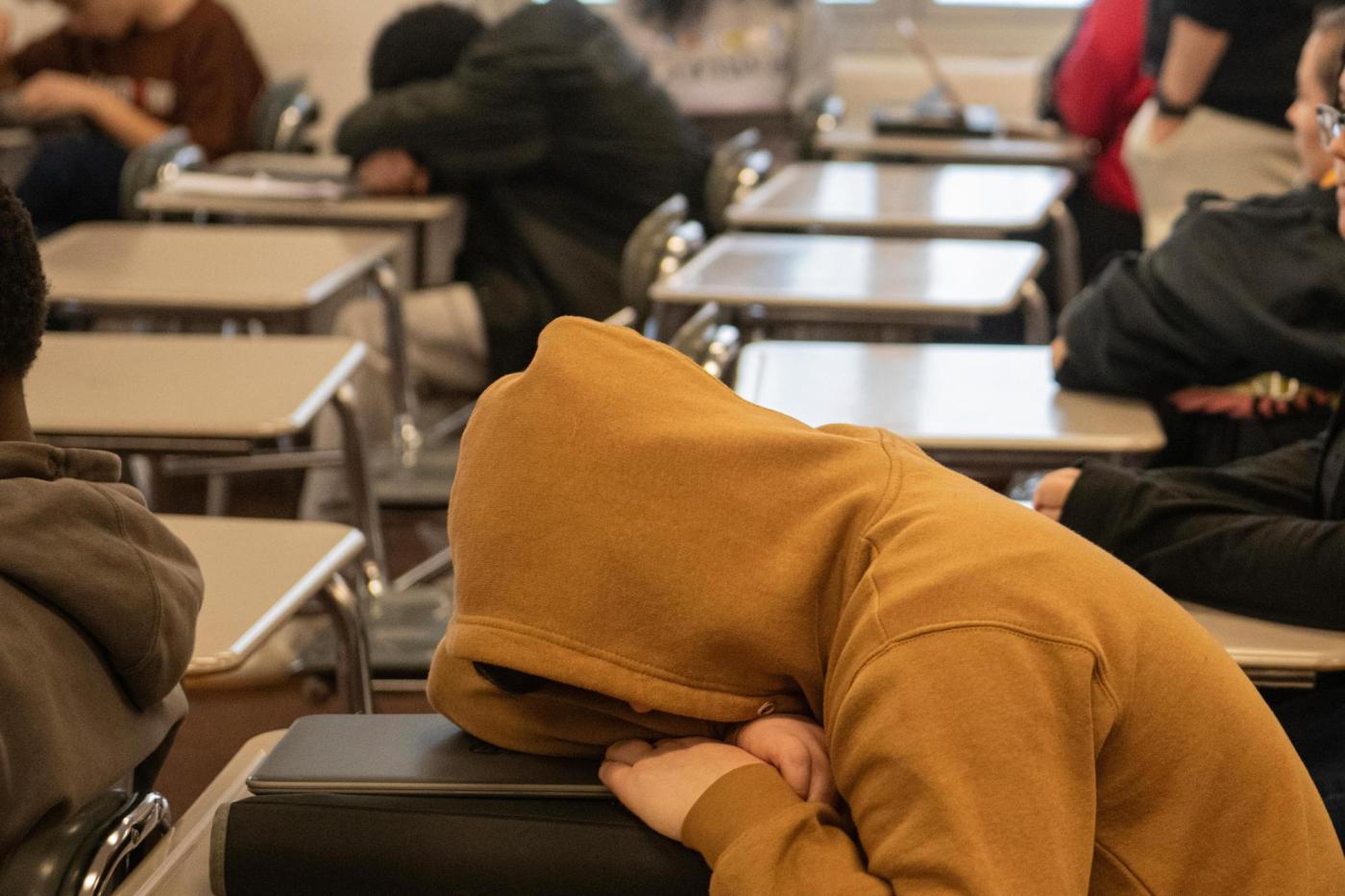
One ninth grader in the class says his method is to scroll through TikTok until he nods off. Another teen says she often falls asleep while on a late-night group chat with friends. Not everyone takes part in class discussions on a recent Friday; some students are slumped over their desks napping.
Sleep training is no longer just for newborns. Some schools are taking it upon themselves to teach teenagers how to get a good night’s sleep.
“It might sound odd to say that kids in high school have to learn the skills to sleep,” says Mansfield health teacher Tony Davis, who has incorporated a newly released sleep curriculum into a state-required high school health class. “But you’d be shocked how many just don’t know how to sleep.”
Mansfield Senior High School teacher Tony Davis talks to his health class about the topic of sleep Friday, Dec. 6, 2024, in Mansfield, Ohio. (AP Photo/Phil Long)
Adolescents burning the midnight oil is nothing new; teens are biologically programmed to stay up later as their circadian rhythms shift with puberty. But studies show teenagers are more sleep deprived than ever, and experts believe it could be playing a role in the youth mental health crisis and other problems plaguing schools, including behavioral and attendance issues.
“Walk into any high school in America and you will see kids asleep. Whether it’s on a desk, outside on the ground or on a bench, or on a couch the school has allotted for naps — because they are exhausted,” says Denise Pope, a senior lecturer at Stanford Graduate School of Education. Pope has surveyed high school students for more than a decade and leads parent sessions for schools around California on the importance of teen sleep. “Sleep is directly connected with mental health. There is not going to be anyone who argues with that.”
Mansfield Senior High School senior Talitha Cameron, 18, listens during her health class on sleep, in Mansfield, Ohio, Friday, Dec. 6, 2024. (AP Photo/Phil Long)
How much sleep do teens need?
Adolescents need between eight and 10 hours of sleep each night for their developing brains and bodies. But nearly 80% of teens get less than that, according to the U.S. Centers for Disease Control and Prevention, which has tracked a steady decline in teen sleep since 2007. Today, most teens average 6 hours of sleep.
Research increasingly shows how tightly sleep is linked to mood, mental health and self-harm. Depression, anxiety and suicidal thoughts and behavior go up as sleep goes down. Multiple studies also show links between insufficient sleep and sports injuries and athletic performance, teen driving accidents, and risky sexual behavior and substance use, due in part to impaired judgment when the brain is sleepy.
Mansfield Senior High School teacher Tony Davis hands out work sheets to his health class about the topic of sleep Friday, Dec. 6, 2024, in Mansfield, Ohio. (AP Photo/Phil Long)
For years, sleep experts have sounded an alarm about an adolescent sleep crisis, joined by the American Medical Association, the American Academy of Pediatrics, the CDC and others. As a result, some school districts have shifted to later start times. Two states — California and Florida — have passed laws that require high schools to start no earlier than 8:30 a.m. But simply telling a teenager to get to bed earlier doesn’t always work, as any parent can attest: They need to be convinced.
That’s why Mansfield City Schools, a district of 3,000 students in north-central Ohio, is staging what it calls “a sleep intervention.”
‘Sleep to Be a Better You’
The district’s high school is piloting the new curriculum, “Sleep to Be a Better You,” hoping to improve academic success and reduce chronic absences, when a student misses more than 10% of the school year. The rate of students missing that much class has decreased from 44% in 2021 but is still high at 32%, says Kari Cawrse, the district’s attendance coordinator. Surveys of parents and students highlighted widespread problems with sleep, and an intractable cycle of kids going to bed late, oversleeping, missing the school bus and staying home.
Mansfield Senior High School attendance coordinator Kari Cawrse stands with the school cafeteria in the background in Mansfield, Ohio, Friday, Dec. 6, 2024. (AP Photo/Phil Long)
The students in Davis’ classroom shared insights into why it’s hard to get a good night’s sleep. An in-class survey of the 90 students across Davis’ five classes found over 60% use their phone as an alarm clock. Over 50% go to sleep while looking at their phones. Experts have urged parents for years to get phones out of the bedroom at night, but national surveys show most teens keep their mobile phones within reach — and many fall asleep holding their devices.
During the six-part course, students are asked to keep daily sleep logs for six weeks and rate their mood and energy levels.
Freshman Nathan Baker assumed he knew how to sleep, but realizes he had it all wrong. Bedtime meant settling into bed with his phone, watching videos on YouTube or Snapchat Spotlight and often staying up past midnight. On a good night, he got five hours of sleep. He’d feel so drained by midday that he’d get home and sleep for hours, not realizing it was disrupting his nighttime sleep.
“Bad habits definitely start around middle school, with all the stress and drama,” Baker says. He has taken the tips he learned in sleep class and been amazed at the results. He now has a sleep routine that starts around 7 or 8 p.m.: He puts away his phone for the night and avoids evening snacks, which can disrupt the body’s circadian rhythm. He tries for a regular bedtime of 10 p.m., making sure to close his curtains and turn off the TV. He likes listening to music to fall asleep but has switched from his previous playlist of rousing hip hop to calmer R&B or jazz, on a stereo instead of his phone.
FILE – Mansfield Senior High School freshman Nathan Baker, 14, speaks during his health class on sleep, in Mansfield, Ohio, Dec. 6, 2024. (AP Photo/Phil Long, File)
“I feel a lot better. I’m coming to school with a smile on my face,” says Baker, who is now averaging seven hours’ sleep each night. “Life is so much more simple.”
There are scientific reasons for that. Studies with MRI scans show the brain is under stress when sleep-deprived and functions differently. There is less activity in the pre-frontal cortex, which regulates emotions, decision making, focus and impulse control and more activity in the emotional center of the brain, the amygdala, which processes fear, anger and anxiety.
Parents and teens themselves often aren’t aware of the signs of sleep deprivation, and attribute it to typical teen behavior: Being irritable, grumpy, emotionally fragile, unmotivated, impulsive or generally negative.
Mansfield Senior High School health teacher Tony Davis explains a graph of student responses to questions from his sleep class, in Mansfield, Ohio, Friday, Dec. 6, 2024. (AP Photo/Phil Long)
Think of toddlers who throw temper tantrums when they miss their naps.
“Teenagers have meltdowns, too, because they’re tired. But they do it in more age-appropriate ways,” says Kyla Wahlstrom, an adolescent sleep expert at the University of Minnesota, who has studied the benefits of delayed school start times on teen sleep for decades. Wahlstrom developed the free sleep curriculum being used by Mansfield and several Minnesota schools.
Social media isn’t only to blame
Social media has been blamed for fueling the teen mental health crisis, but many experts say the national conversation has ignored the critical role of sleep.
“The evidence linking sleep and mental health is a lot tighter, more causal, than the evidence for social media and mental health,” says Andrew Fuligni, a professor of psychiatry at the University of California, Los Angeles, and co-director at UCLA’s Center for the Developing Adolescent.
Mansfield Senior High School sophomore Regan Coley, 15, asks a question during her health class on sleep, in Mansfield, Ohio, Friday, Dec. 6, 2024. (AP Photo/Phil Long)
Nearly 70% of Davis’ Mansfield students said they regularly feel sleepy or exhausted during the school day. But technology is hardly the only reason. Today’s students are overscheduled, overworked and stressed out, especially as they get closer to senior year and college applications.
Chase Cole, a senior at Mansfield who is taking three advanced placement and honors classes, is striving for an athletic scholarship to play soccer in college. He plays on three different soccer leagues and typically has practice until 7 p.m., when he gets home and needs a nap. Cole wakes up for dinner, then dives into homework for at least three hours. He allows for five-minute phone breaks between assignments and winds down before bed with video games or TV until about 1 a.m.
“I definitely need to get more sleep at night,” says Cole, 17. “But it’s hard with all my honors classes and college stuff going on. It’s exhausting.”
Related Articles
A Scandia pastor overcame addiction. Now he confronts the stigma in a podcast aimed at faith communities.
States push Medicaid work rules, but few programs help enrollees find jobs
Taking a mental health leave from work is an option most people don’t know about
After diagnosis, RFK Jr. comments, local entrepreneur to host Happy Hour for Adults with Autism
HealthPartners clerical workers ready to strike as negotiations stall
There aren’t enough hours in the day to sleep, says sophomore Amelia Raphael, 15. A self-described overachiever, Raphael is taking physics, honors chemistry, algebra and trigonometry and is enrolled in online college classes. Her goal is to finish her associate degree by the time she graduates high school.
“I don’t want to have to pay for college. It’s a lot of money,” says Raphael, who plays three sports and is in student council and other clubs.
She knows she’s overscheduled. “But if you don’t do that, you’re kind of setting yourself up for failure. There is a lot of pressure on doing everything,” said Raphael, who gets to bed between midnight and 2 a.m. “I am giving up sleep for that.”
The Associated Press’ education coverage receives financial support from multiple private foundations. AP is solely responsible for all content. Find AP’s standards for working with philanthropies, a list of supporters and funded coverage areas at AP.org.