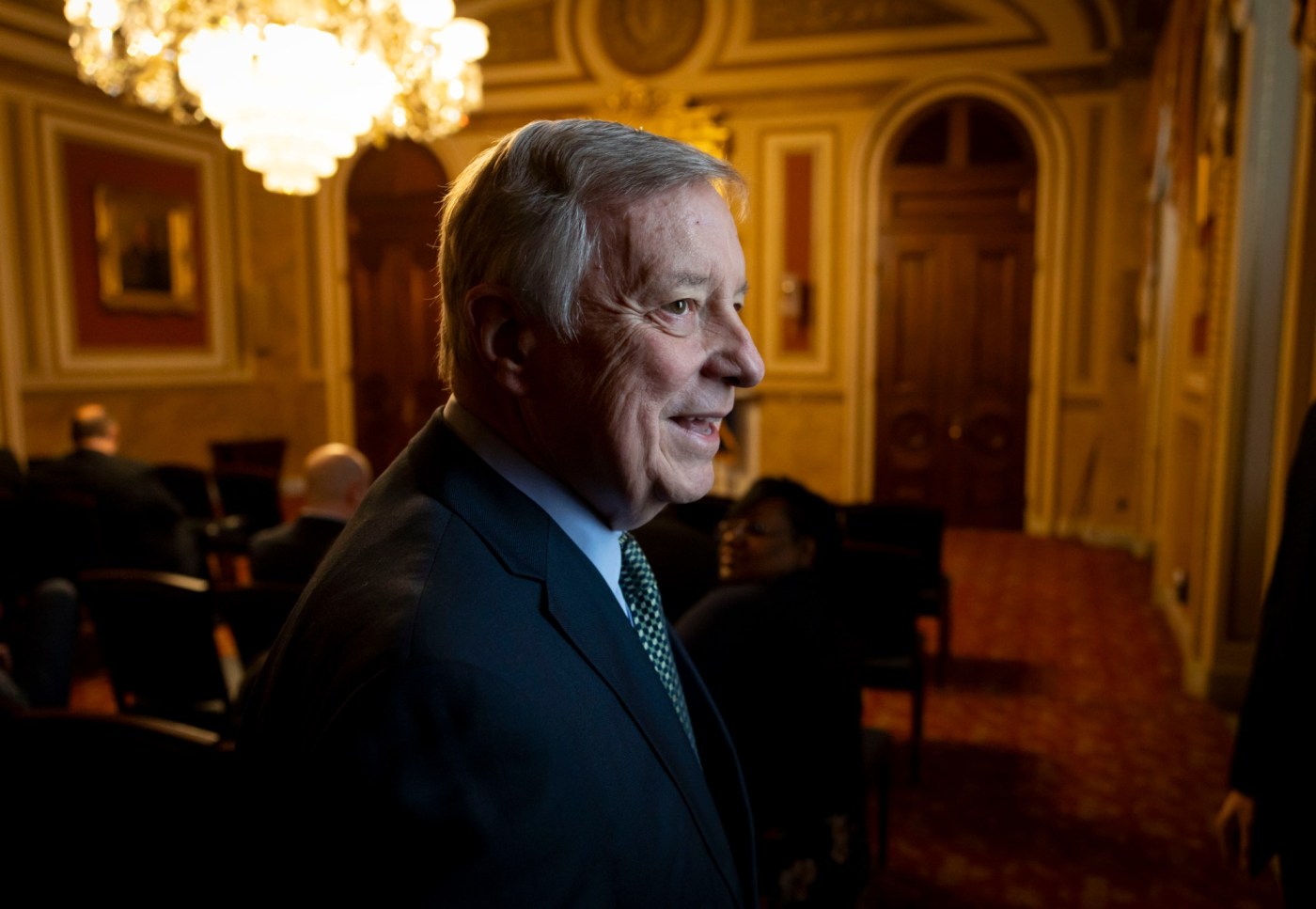
Dick Durbin, whose tenure as one of Illinois’ longest serving U.S. senators has also been a testament to the power of seniority in the chamber, announced Wednesday he would not seek a sixth term next year, setting up a scramble among potential successors vying for a politically coveted six-year term.
“The decision of whether to run for re-election has not been easy. I truly love the job of being a United States Senator. But in my heart, I know it’s time to pass the torch. So, I am announcing today that I will not be seeking re-election at the end of my term,” Durbin said in a video.
“Right now, the challenges facing our country are historic and unprecedented,” Durbin said. “The threats to our democracy and way of life are very real, and I can assure you that I will do everything in my power to fight for Illinois and the future of our country every day of my remaining time in the Senate.”
Related Articles
Trump administration is still resisting the judge’s orders in Abrego Garcia deportation case
IRS turmoil: Leadership churn, worker exodus and threats to groups’ tax-exempt status roil agency
Law firms fighting Trump to ask judges to permanently block executive orders
Cory Bowman, Vice President JD Vance’s half brother, runs for Cincinnati mayor
London talks on ending Russia-Ukraine war pared down as Vance says it’s decision time on peace deal
Democratic Gov. JB Pritzker, who had at times an uneasy relationship with Durbin over the control of power within the Democratic Party, said Durbin deserved the “utmost gratitude for representing the people of Illinois with integrity and honor.”
“His legacy is defined not just by the legislation he passed, but by the undeniable positive impact his character and moral leadership has had on the nation,” Pritzker said, adding Durbin “remains a clear voice for truth, equality, and justice.”
With Durbin’s announcement setting off a potential domino effect among Illinois Democratic members of congress and others angling to run for his Senate seat, he did not offer an endorsement of a potential successor. Instead, Durbin said the state was “fortunate to have a strong Democratic bench ready to serve. We need them now more than ever.”
Durbin, who turned 80 in November, had indicated that the Democrats’ loss of Senate control in last year’s general election would be a factor in deciding on whether to seek reelection in 2026. The party’s November loss also meant Durbin had to give up the chair of the powerful Senate Judiciary Committee, becoming instead its ranking minority member.
He retained his role as Democratic whip, the No. 2 ranking party post in the chamber. First elected to the position in 2005 and alternating between majority and minority whip depending upon control of the chamber, Durbin is the longest serving party whip in Senate history.
First elected to the U.S. House in 1982 and to the Senate in 1996, Durbin is the state’s senior senator and dean of the Illinois congressional delegation. At the end of his current term, Durbin’s 30-year Senate tenure will tie him for the longest in state history with Shelby Cullom, a Republican from Springfield, who resigned as governor to serve from 1883 to 1913 as U.S. senator.
Before announcing his 2014 reelection bid, Durbin acknowledged that weighing whether to commit to another six-year term required “a little more thought.”
Since that time he has faced some health issues. In August 2014 he was treated for a nonmalignant stomach tumor. In May of 2017 he had an outpatient procedure to correct an abnormal heart rhythm and in June 2024 he underwent a hip replacement.
Durbin’s departure will leave Illinois with a gaping loss of clout in Washington. The state’s junior senator, Tammy Duckworth, served two House terms before entering the Senate in 2017. She was recruited by Durbin into politics after she suffered injuries as a helicopter pilot in the Iraq War.
Familiar with the appropriations process from his time in the House, Durbin has helped shepherd tens of billions of federal dollars to a state that lacks such things as major military or federal installations. Most recently, he helped secure for Illinois $13 billion in the post-pandemic 2021 stimulus bill and $17 billion in the Infrastructure and Jobs Act, including $4.1 billion for transit projects such as the $1.9 billion CTA Red Line extension project to 130th Street.
“Seniority looks better and better the longer I’m in the Senate, and there are advantages,” Durbin said in an April 2014 interview, citing the ability to gain significant transportation funding for the state from both Republican and Democratic administrations, including millions of dollars over the decades for improvement and expansion of O’Hare International Airport.
Along the way were the $240 million reconstruction of Wacker Drive, hundreds of millions of dollars to Amtrak and Chicago’s Union Station as well as $157 million announced last fall for Springfield’s rail relocation project, including a new transit hub, to facilitate higher-speed rail between Chicago and St. Louis. There also were millions of dollars awarded on the lock and dam system for the Mississippi River.
Politically, Durbin went through an evolution before becoming a party stalwart and champion of progressive causes and issues. It was a reflection of the differences in representing a more conservative central Illinois congressional district to serving as a statewide politician in an ever-deepening blue state.
An ardent opponent of tobacco, he was the author of legislation that banned cigarette smoking on airplanes. An avid supporter of immigration reform, he has been the chief backer of seeking a path to citizenship for “Dreamers,” children of undocumented immigrants raised in the U.S. He also was a leader in advancing the First Step Act, which reformed criminal justice sentencing and increased job training to curb recidivism.
Durbin was one of fewer than two dozen senators to vote against the original authorization to go to war in Iraq, saying he believed the Bush administration had failed to make the case for it.
He fought against for-profit higher education institutions that profited from student loans while offering unaccredited courses.As judiciary committee chair, he led the nominations of 235 federal judgeships under President Joe Biden as well as the confirmation of Ketanji Brown Jackson as the first Black woman on the U.S. Supreme Court.
Born and raised in East St. Louis, Durbin earned his bachelor degree and subsequent law degree from Georgetown University and served as an intern to liberal Illinois Sen. Paul Douglas as well as working on Douglas’ unsuccessful 1966 reelection campaign against Republican Charles Percy.
After college, Durbin moved to Springfield where he started a law business and became legal counsel to Lt. Gov. Paul Simon and later to the state Senate Judiciary Committee as well as Senate parliamentarian. In 1976, he lost a general election bid for the state Senate. Two years later he was the lieutenant governor candidate of Democrat Michael Bakalis in an unsuccessful challenge to the team of Republican Gov. Jim Thompson and Dave O’Neal.
Sen. Ted Kennedy, right, with Dick Durbin, from left, Mayor Michael Bilandic and Michael Bakalis at the Continental Plaza on Oct. 24, 1978. Kennedy was in town to stump for Bakalis’ candidacy for governor. Durbin was the lieutenant governor candidate. (William Yates/Chicago Tribune)
In 1982, Durbin challenged and defeated 11-term Republican Rep. Paul Findley and went on to win reelection to the House six times. In his first term in the House, Durbin was an opponent of abortion, but later became a major abortion rights advocate.
In 1996, he defeated Pat Quinn to win the Democratic nomination to the U.S. Senate seat that his friend, Paul Simon, was retiring from and went on to easily defeat Republican Al Salvi in the general election. He never faced a strenuous GOP challenge in his subsequent bids for reelection.
Then-U.S. Rep. and Senate hopeful Dick Durbin, left, appears with President Bill Clinton at Homewood-Flossmoor Community High School on Sept. 17, 1996, in Flossmoor. (José M. Osorio/Chicago Tribune)
On Jan. 16, he honored Simon in a Senate floor speech commemorating the 10 year anniversary of the passage of his Paul Simon Water for the World Act, which improved access to clean water and sanitation around the world.
“Simon was ahead of his time on so many issues, including the importance of clean drinking water and sanitation for the poorest people in the world,” Durbin said. “Paul Simon realized that focusing on providing clean drinking water in some of the poorest places in the world can be transformative.”
In 2000, Durbin was under consideration by Democratic presidential nominee Al Gore to be named as his vice presidential candidate, which eventually went to Sen. Joe Lieberman. The Democratic ticket lost in controversy to Republican George W. Bush.
Arriving at his new office in Springfield, U.S. Sen. Barack Obama, left, laughs with U.S. Rep. Ray LaHood, center, and fellow U.S. Sen. Dick Durbin, on Jan. 10, 2005. (Pete Souza/Chicago Tribune)
“I’m not sure why people run for vice president, unless they think ultimately they’ll be president,” Durbin said seven years later. “The office itself is a little hard to explain. You spend four years standing two steps behind and looking at the back of the president’s head. It doesn’t strike me as being as interesting as this.”
In November 2006, Durbin played a major and influential early role in persuading the state’s then junior senator, Barack Obama, to run for president in 2008. Durbin was the first Democratic senator to endorse Obama, even before he officially announced, and was largely alone among his colleagues for more than a year until Obama demonstrated success by winning the Iowa Caucus.
With the November election of President Donald Trump, Durbin spent the early part of the year as a leading judiciary committee critic of some Trump nominees, including Pam Bondi for attorney general.
At Bondi’s January confirmation hearing, Durbin noted that, in reference to the Jan. 6 U.S. Capitol insurrection, she had ‘said there was a peaceful transition of power.’ Let me repeat that. ‘A peaceful transition of power.’
“[Have you] seen the videotapes? What happened here on January 6?” he asked her.
Sen. Dick Durbin, the ranking member, delivers opening remarks during a Senate Judiciary Committee nomination hearing, Feb. 12, 2025, at the Dirksen Senate Office Building in Washington. Chairman Sen. Chuck Grassley (R-Iowa) listens at left. The committee considered Todd Blanche for deputy attorney general and Abigail Slater for an assistant attorney general. (Brian Cassella/Chicago Tribune)
“January 6 resulted in the deaths of five of our law enforcement officers: Officer Brian Sicknick, Officer Howard Liebengood, Officer Jeffrey Smith, Officer Gunther Hashida, and Officer Kyle DeFreytag—and the injuries to approximately 140 other law enforcement officers. Despite Ms. Bondi’s claims of a “peaceful transition of power,” January 6 tells a different story,” he said.
Less than a decade into Congress, Durbin was asked what issues attract his attention. What he said then was consistent with his career.
“I have a tendency to be fairly eclectic when it comes to issues,” he told Illinois Issues magazine. “I grab issues, and sometimes I ruffle feathers a little bit with the so-called leadership team.”