BANGKOK (AP) — China on Thursday denied U.S. President Donald Trump’s assertion that the two sides were involved in active negotiations over tariffs, saying that any suggestion of progress in this matter was as groundless as “trying to catch the wind.”
China’s comments come after Trump said Tuesday that the final tariff rate on China’s exports would come down “substantially” from the current 145%.
“China’s position is consistent and we are open to consultations and dialogues, but any form of consultations and negotiations must be conducted on the basis of mutual respect and in an equal manner,” said Ministry of Commerce spokesman He Yadong. “Any claims about the progress of China-U.S. trade negotiations are groundless as trying to catch the wind and have no factual basis.”
Trump had told reporters earlier in the week that “everything’s active” when asked if he was engaging with China, although his Treasury Secretary had said there were no formal negotiations.
Trump had put 145% tariffs on imports from China, while China hit back with 125% tariffs on U.S. products. While Trump has given other countries a 90-day pause on the tariffs, as their leaders pledged to negotiate with the U.S., China remained the exception. Instead, Beijing raised its own tariffs and deployed other economic measures in response while vowing to “fight to the end.” For example, China restricted exports of rare earth minerals and raised multiple cases against the U.S. at the World Trade Organization.
China also made it clear that talks should involve the cancellation of all tariffs it currently faces.
“The unilateral tariff increase measures were initiated by the United States. If the United States really wants to solve the problem, it should face up to the rational voices of the international community and all parties at home, completely cancel all unilateral tariff measures against China, and find ways to resolve differences through equal dialogue,” said He, the spokesman.
Despite the economic measures leveled against China, Trump said Tuesday that he would be “very nice” and not play hardball with Chinese President Xi Jinping.
“We’re going to live together very happily and ideally work together,” Trump said.
By VASILISA STEPANENKO and SAMYA KULLAB, Associated Press
KYIV, Ukraine (AP) — Russia attacked Kyiv with an hourslong barrage of missiles and drones, killing at least nine people and injuring more than 70 in its deadliest assault on the Ukrainian capital since last July and just as peace efforts are coming to a head.
Ukraine President Volodymyr Zelenskyy said after the attack he is cutting short his official trip to South Africa and returning home as the city reeled from the bombardment that kept residents on edge for about 11 hours. It appeared to be Russia’s biggest attack on Kyiv in nine months, and Zelenskyy branded it as “one of (Russia’s) most outrageous.”
Kyiv Mayor Vitalii Klitschko announced that Friday would be an official day of mourning day in the capital.
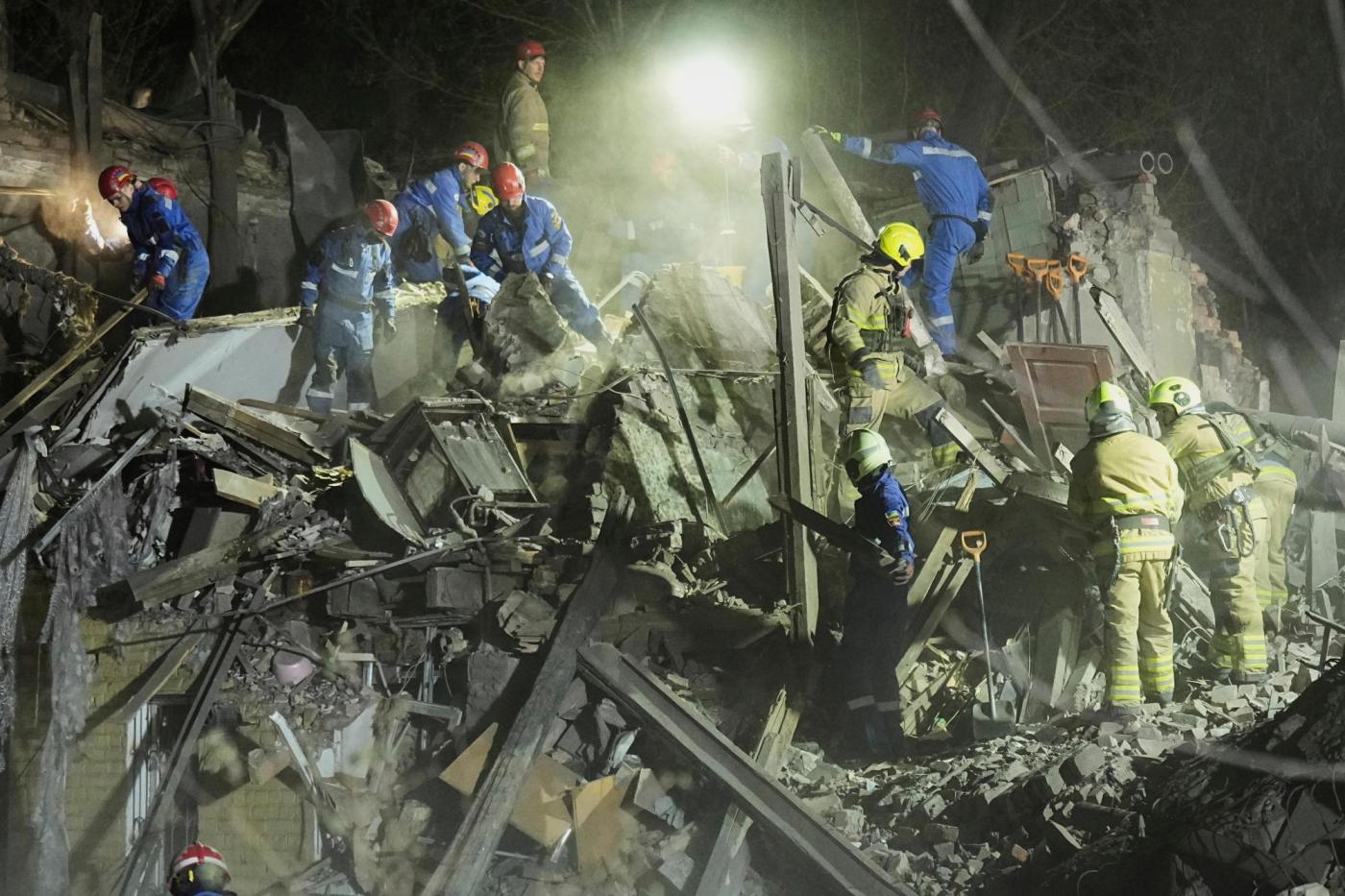
Rescue workers clear the rubble after a Russian strike in a residential neighborhood in Kyiv, Ukraine, Thursday, April 24, 2025. (AP Photo/Alex Babenko)
The Ukrainian air force said Russia fired 66 ballistic and cruise missiles, four plane-launched air-to-surface missiles, and 145 Shahed and decoy drones at Kyiv and four other regions of Ukraine. Rescue workers with flashlights scoured the charred rubble of partly collapsed homes as the blue lights of emergency vehicles lit up the dark city streets.
The attack came as weeks of peace negotiations appeared to be culminating without an agreement in sight and hours after U.S. President Donald Trump lashed out at Zelenskyy, accusing him of prolonging the “killing field” by refusing to surrender the Russia-occupied Crimea Peninsula as part of a possible deal.
Zelenskyy says future of negotiations depends on Moscow
Zelenskyy has repeated many times during the more than three-year war that recognizing occupied territory as Russian is a red line for his country. He noted Thursday that Ukraine had agreed to a U.S. ceasefire proposal 44 days ago, as a first step to a negotiated peace, but that Russia’s attacks had continued.
He said in South Africa that the latest attack meant the future of negotiations “depends on Russia’s intention because it is in Moscow where they have to make a decision.”
South Africa’s President Cyril Ramaphosa greets Ukrainian President Volodymyr Zelenskyy, at the Union Buildings in Pretoria, South Africa, Thursday, April 24, 2025. (AP Photo/Themba Hadebe)
While talks have been going on in recent weeks, Russia has hit the city of Sumy, killing more than 30 civilians gathered to celebrate Palm Sunday, battered Odesa with drones and blasted Zaporizhzhia with powerful glide bombs.
The European Union’s foreign policy chief, Kaja Kallas, said the attack underscored that the main obstacle to ending the war is Russia.
“While claiming to seek peace, Russia launched a deadly airstrike on Kyiv,” she wrote on social media. “This isn’t a pursuit of peace, it’s a mockery of it.”
Senior U.S. officials have warned that the Trump administration could soon give up its efforts to stop the war if the two sides don’t compromise.
Ukrainian Foreign Minister Andrii Sybiha said the attack showed Russian President Vladimir Putin is determined to press his bigger army’s advantage on the roughly 620-mile front line, where it currently holds the momentum.
“Putin demonstrates through his actions, not words, that he does not respect any peace efforts and only wants to continue the war,” Sybiha said on X. “Weakness and concessions will not stop his terror and aggression. Only strength and pressure will.”
Ukrainian Prime Minister Denys Shmyhal noted that since Russia’s February 2022 full-scale invasion of its neighbor, Russian attacks haves killed some 13,000 civilians, including 618 children.
Kyiv residents spent the night in shelters
At least 42 people were hospitalized following the attack on residential suburbs of Kyiv, Ukraine’s State Emergency Service said.
At a Kyiv residential building that was almost entirely destroyed, emergency workers removed rubble with their hands, rescuing a trapped woman who emerged from the wreckage covered in white dust and moaning in pain.
A woman sits in a school basement being used as a shelter after a Russian airstrike on a residential neighborhood in Kyiv, Ukraine, on Thursday, April 24, 2025. (AP Photo/Evgeniy Maloletka)
An injured woman sits near her house, which was damaged by a Russian airstrike, in a residential neighbourhood in Kyiv, Ukraine, on Thursday, April 24, 2025. (AP Photo/Evgeniy Maloletka)
Rescue workers evacuate an injured woman from the rubble of a house destroyed by a Russian airstrike in a residential neighborhood in Kyiv, Ukraine, on Thursday, April 24, 2025. (AP Photo/Evgeniy Maloletka)
Police officers guide an injured woman out of her house, which was damaged by a Russian airstrike, in a residential neighbourhood in Kyiv, Ukraine, on Thursday, April 24, 2025. (AP Photo/Evgeniy Maloletka)
Rescue workers clear the rubble at a house damaged by a Russian airstrike in a residential neighborhood in Kyiv, Ukraine, on Thursday, April 24, 2025. (AP Photo/Evgeniy Maloletka)
Ukrainian searchers clear the rubble after a Russian ballistic missile attack in Kyiv, Ukraine, early Thursday, April 24, 2025. (AP Photo/Efrem Lukatsky)
A mother comforts her son in a school basement being used as a shelter after a Russian airstrike on a residential neighborhood in Kyiv, Ukraine, on Thursday, April 24, 2025. (AP Photo/Evgeniy Maloletka)
Damaged cars lie in a yard with other debris after a Russian ballistic missile attack in Kyiv, Ukraine, Thursday, April 24, 2025. (AP Photo/Efrem Lukatsky)
A rescue worker passes the body of a victim after a Russian strike in a residential neighborhood in Kyiv, Ukraine, Thursday, April 24, 2025. (AP Photo/Alex Babenko)
Medics treat an injured woman in a school basement being used as a shelter after a Russian airstrike on a residential neighborhood in Kyiv, Ukraine, on Thursday, April 24, 2025. (AP Photo/Evgeniy Maloletka)
An injured woman sits near her house, which was damaged by a Russian airstrike, in a residential neighbourhood in Kyiv, Ukraine, on Thursday, April 24, 2025. (AP Photo/Evgeniy Maloletka)
Rescue workers carry an injured victim on a stretcher in front of a house that was destroyed by a Russian strike in a residential neighbourhood in Kyiv, Ukraine, on Thursday, April 24, 2025. (AP Photo/Evgeniy Maloletka)
Rescue workers clear the rubble of a house destroyed by a Russian airstrike in a residential neighborhood in Kyiv, Ukraine, on Thursday, April 24, 2025. (AP Photo/Evgeniy Maloletka)
People rest in a metro station, being used as a bomb shelter, during a Russian missile attack in Kyiv, Ukraine, early Thursday, April 24, 2025. (AP Photo/Efrem Lukatsky)
Rescue workers clear the rubble of a house destroyed by a Russian strike on a residential neighbourhood in Kyiv, Ukraine, on Thursday, April 24, 2025. (AP Photo/Evgeniy Maloletka)
Rescue workers clear the rubble of a house destroyed by a Russian strike on a residential neighbourhood in Kyiv, Ukraine, on Thursday, April 24, 2025. (AP Photo/Evgeniy Maloletka)
Rescue workers carry the body of a victim found under the rubble after a Russian strike in a residential neighborhood in Kyiv, Ukraine, Thursday, April 24, 2025. (AP Photo/Alex Babenko)
A rescue psychotherapist hugs a woman who lost a loved one, in front of the bodies of victims after a Russian strike in a residential neighborhood in Kyiv, Ukraine, Thursday, April 24, 2025. (AP Photo/Alex Babenko)
Rescue workers clear the rubble after a Russian strike in a residential neighborhood in Kyiv, Ukraine, Thursday, April 24, 2025. (AP Photo/Alex Babenko)
A woman helps an injured victim after a Russian strike in a residential neighborhood in Kyiv, Ukraine, Thursday, April 24, 2025. (AP Photo/Alex Babenko)
Rescue workers clear the rubble after a Russian strike in a residential neighborhood in Kyiv, Ukraine, Thursday, April 24, 2025. (AP Photo/Alex Babenko)
Injured victims stand and smoke after a Russian airstrike in a residential neighborhood in Kyiv, Ukraine, Thursday, April 24, 2025. (AP Photo/Alex Babenko)
Rescue workers clear the rubble from a house heavily damaged after a Russian strike in a residential neighborhood in Kyiv, Ukraine, Thursday, April 24, 2025. (AP Photo/Alex Babenko)
1 of 23
A woman sits in a school basement being used as a shelter after a Russian airstrike on a residential neighborhood in Kyiv, Ukraine, on Thursday, April 24, 2025. (AP Photo/Evgeniy Maloletka)
An elderly woman sat against a brick wall, face smeared with blood, her eyes fixed to the ground in shock as medics tended to her wounds.
Fires were reported in several residential buildings said Tymur Tkachenko, the head of the city military administration.
The attack, which began around 1 a.m., hit at least five neighborhoods in Kyiv.
Oksana Bilozir, a student, suffered a head injury in the attack. With blood seeping from her bandaged head, she said that she heard a loud explosion after the air alarm blared and began to grab her things to flee to a shelter when another blast caused her home’s walls to crumble and the lights to go off.
“I honestly don’t even know how this will all end, it’s very scary,” said Bilozir, referring to the war against Russia’s invasion. “I only believe that if we can stop them on the battlefield, then that’s it. No diplomacy works here.”
The attack kept many people awake all night long as multiple loud explosions reverberated around the city and flashes of light punctuated the sky. Families gathered in public air raid shelters, some of them bringing their pet cat and dog.
Zelenskyy returning from South Africa
Zelenskyy said in a Telegram post that he would fly back to Kyiv after meeting with South African President Cyril Ramaphosa.
The Ukrainian leader had hoped to recruit further South African support in efforts to end his country’s war with Russia, now in its fourth year.
The U.N. Office for the Coordination of Humanitarian Affairs said the Kyiv attack was “yet another appalling violation of international humanitarian law.”
“Civilians must never be targets. This senseless use of force must stop,” it said in a statement.
Anastasiia Zhuravlova, 33, a mother of two, was sheltering in a basement after multiple blasts damaged her home. Her family was sleeping when the first explosion shattered their windows and sent kitchen appliances flying in the air. Shards of glass rained down on them as they rushed to take cover in the corridor.
“After that we came to the shelter because it was scary and dangerous at home,” she said.
In Kyiv’s Sviatoshynskyi district, the attack flattened a two-story residential building and heavily damaged nearby multi-story buildings. Rescue work continued through the morning.
At a nearby school-turned-relief center, children helped parents cover blown-out windows with plastic while others queued for government compensation. Many stood in blood-stained clothes, still shaken.
Associated Press journalist Michelle Gumede in Pretoria, South Africa contributed to this report.
Today is Thursday, April 24, the 114th day of 2025. There are 251 days left in the year.
Today in history:
On April 24, 1916, Irish republicans launched the Easter Rising, a rebellion against British rule in Ireland. Though the rebels surrendered to British forces six days later, the uprising set the stage for republican victories in the Irish general election of 1918 and the establishment of the Irish Free State via the Anglo-Irish Treaty in 1922.
Also on this date:
In 1915, in what is considered the start of the Armenian genocide, the Ottoman Empire began rounding up Armenian political and cultural leaders in Constantinople.
Related Articles
Black churches back embattled Smithsonian African American history museum after Trump’s order
Today in History: April 23, Vietnam veterans stage protest at U.S. Capitol
Colorado’s first-in-the-nation sperm donor rules just took effect. Now lawmakers may roll some back
Today in History: April 22, the Oklahoma Land Rush of 1889
Today in History: April 21, Prince dead at age 57
In 1960, rioting erupted in Biloxi, Mississippi, after Black protesters staging a “wade-in” at a whites-only beach were attacked by a crowd of hostile white people.
In 1967, Soviet cosmonaut Vladimir Komarov was killed when his Soyuz 1 spacecraft smashed into the Earth after his parachutes failed to deploy properly during reentry. He was the first human spaceflight fatality.
In 1980, the United States launched Operation Eagle Claw, an unsuccessful attempt to free 53 American hostages in Iran that resulted in the deaths of eight U.S. service members.
In 1990, Space Shuttle Discovery blasted off from Cape Canaveral, Florida, carrying the $1.5 billion Hubble Space Telescope.
In 1995, the final bomb linked to the Unabomber exploded inside the Sacramento, California, offices of the California Forestry Association, killing chief lobbyist Gilbert B. Murray. (Theodore Kaczynski was later sentenced to four lifetimes in prison for a series of bombings that killed three people and injured 23 others.)
In 2013, in Bangladesh, a shoddily constructed eight-story commercial building housing garment factories collapsed, killing more than 1,100 people.
In 2018, former police officer Joseph DeAngelo was arrested at his home near Sacramento after DNA linked him to crimes attributed to the Golden State Killer; authorities believed he committed 13 murders and more than 50 rapes in the 1970s and 1980s. (DeAngelo would plead guilty in 2020 to 13 counts of murder and be sentenced to life in prison without parole.)
Today’s Birthdays:
Actor Shirley MacLaine is 91.
Actor-singer-filmmaker Barbra Streisand is 83.
Fashion designer Jean Paul Gaultier is 73.
Actor Eric Bogosian is 72.
Actor Michael O’Keefe is 70.
Actor-comedian Cedric the Entertainer is 61.
Actor Djimon Hounsou (JEYE’-mihn OHN’-soo) is 61.
Actor Aidan Gillen is 57.
Actor Rory McCann is 56.
Latin pop singer Alejandro Fernandez is 54.
Baseball Hall of Famer Chipper Jones is 53.
Actor Derek Luke is 51.
Singer-TV personality Kelly Clarkson is 43.
Country singer Carly Pearce is 35.
Actor-musician Joe Keery is 33.
Actor Jack Quaid is 33.
Actor Jordan Fisher is 31.
Golfer Lydia Ko is 28.
Two Minnesota Twins greats are recovering from strokes suffered days apart, the team confirmed Wednesday.
Former right fielder and designated hitter Tony Oliva had what the team called “a series of mini strokes” over the past month but is expected to make a full recovery. Former first baseman Kent Hrbek also suffered a minor stroke following knee surgery in early April and is recovering at home.
The 86-year-old Oliva spent his entire 15-year career with the Twins. He was the American League Rookie of the Year in 1964 and won the batting title three times. He was inducted into the Baseball Hall of Fame in 2022 by the Golden Days Era Committee.
Hrbek, 64, who grew up in the area in Bloomington and played his entire 14-year career with his hometown team. He was an integral part of the Twins teams that won the World Series in 1987 and 1991.
Both Oliva and Hrbek have remained around the team and have been regular fixtures at Target Field since the stadium opened in 2010. Their numbers have been retired by the Twins — Oliva’s No. 6 and Hrbek’s No. 14 — and the former players are represented by bronze statues outside the venue.
The team hopes to see both of them back at the ballpark soon.
Related Articles
Twins miss opportunities early, capitalize late in win against White Sox
Twins rookie Luke Keaschall making strong early impression
Byron Buxton’s game-saving catch helps Twins beat White Sox
Twins starter Pablo López nearing return
Byron Buxton homers again, but Twins swept out of Atlanta