Ahead of Valentine’s Day, Brenda Drehmel logged onto Bachmans.com to search for a bouquet of flowers to send to Nora Gulyas, her friend and neighbor.
After Brenda chose the “Tulip Town” bouquet, her order joined a growing list of thousands of fresh floral arrangements, including about 40,000 stems of roses and 85,000 stems of tulips, that would be created in time for Valentine’s Day in the floral design center of the Minneapolis headquarters of Bachman’s on Lyndale Avenue as well as by designers working in other locations.
The Lyndale location is unofficially known as “Valentine’s Day Central.”
In celebration of this holiday of love and friendship, the Pioneer Press followed the “Tulip Town” bouquet from its creation in Minneapolis on Wednesday to its delivery in Mendota Heights on Thursday.
The timing of Valentine’s Day (and Galentine’s Day)
With Valentine’s Day on a Saturday this year, the holiday is drawn out for florists, as some people prefer to send flowers to a loved one’s workplace on the weekday versus to their home on the weekend.
Susan Bachman West at Bachman’s in Minneapolis. (John Autey / Pioneer Press)
“So typically, when it’s on a weekend, it gets spread out between Friday and Saturday,” says Susan Bachman West, CEO of Bachman’s, a family-owned business that includes six Floral, Home & Garden Centers throughout the Twin Cities as well as 29 floral departments within Lunds & Byerlys grocery stores.
In total, based on last year’s numbers, Bachman’s estimates 40 delivery vehicles will deliver more than 4,000 packages (with more than 1,000 on Feb. 14). This includes everything from blooming plants that have been locally grown at Bachman’s greenhouses in Farmington to five semi loads of cut flowers from South America via Miami.
In addition to all those flowers and plants for Valentine’s Day, “Galentine’s Day” has also been a thing since 2010, when the concept was introduced in an episode of “Parks and Recreation” as a way for women to celebrate their friendships on Feb. 13, the eve of Valentine’s Day. Bachman’s recognizes this day of friendship with “Conversation Hearts,” featuring a pair of bud vases filled with flowers like roses, gerbera daisy and sprays of aster.
Galentine’s Day is definitely a day to celebrate for Brenda and Nora, friends and neighbors from Mendota Heights.
‘We’re trying to find ways to connect’
If geography is destiny, that’s true for this friendship born across two backyards in this Dakota County suburb.
“I’ve known her for about 17 years, when she moved into the neighborhood,” Brenda says of Nora. “I think because we share backyards we have gotten to know each other pretty quickly, but where we started spending the most time together is during COVID: She was working at home and I was working at home and we started going out for walks in the evening and during the summer we went for a lot of bike rides together so we definitely connected more after March of 2020.”
Years later, they’re still connected.
“We’re going to Lucky’s tonight to play purse Bingo,” Brenda said on Thursday.
While Brenda typically spends Valentine’s Day at home with her husband, Craig, making a special meal and perhaps enjoying chocolates they bought at Regina’s Candies, this is not the first time she’s sent flowers to friends for special occasions.
Get the love part right: It’s about knowing each other, sacrifice and sticking around on bad days
Tame Impala books August stop at Target Center
Celebrate Black History Month with these St. Paul events
After an eight year break, the eclectic Eaux Claires festival will return
Pop-up poster show, at Can Can Wonderland through Feb. 19, highlights anti-ICE protest art
“I just turned 50 and I have other friends who are turning 50,” she says. “I want to find a way to celebrate them and make sure that they know that I’m thinking of them on particular days. So it’s always been my plan to send flowers to other friends when they are sending flowers.”
Or, during sensitive times, too: Especially now, under the tension of Immigration and Customs Enforcement’s Operation Metro Surge in the Twin Cities, it was worth it to Brenda to send a goodwill gesture of $89.99 (plus tax and delivery for about $119 total).
“I think it’s just a boost right now,” Brenda said. “We live in Minnesota and it’s obviously challenging at times … so we’re trying to find ways to stay connected and get together, but this is just kind of another opportunity to celebrate our friendship.”
‘Why do you buy flowers?’
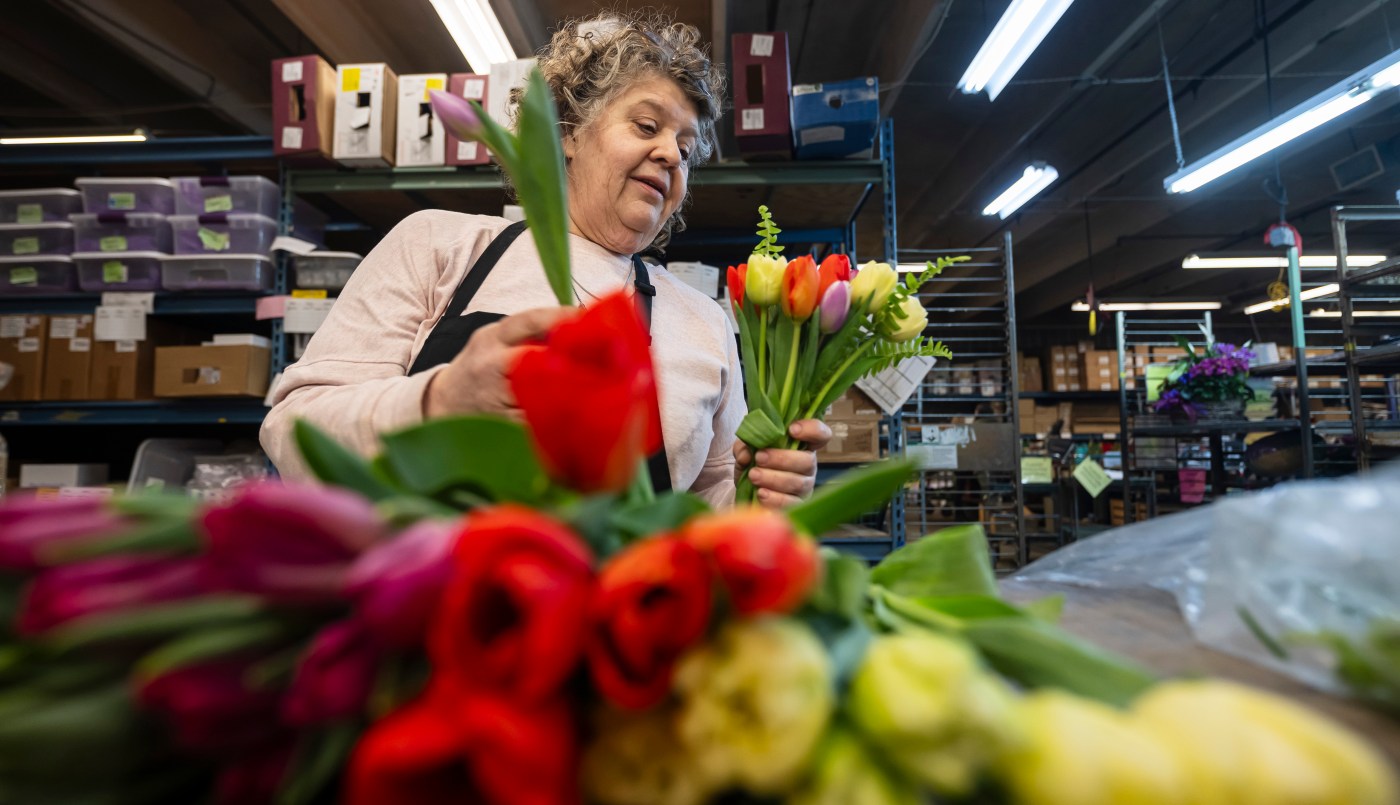
Workers, many of them from other departments, create bouquets for the busy Valentine’s Day week at Bachman’s Minneapolis Garden Center on Wednesday. (John Autey / Pioneer Press)
About nine miles away from Mendota Heights, at Bachman’s on Lyndale Avenue in Minneapolis, Jamie McLaughlin, lead designer, was dressed in pink for Valentine’s Day as she created Nora’s bouquet with multiple colors of tulips spread out on a large wooden table inside Bachman’s floral design room.
It was one of several arrangements in Bachman’s Valentine’s Day collection that she personally designed.
While it was winter outside, with snow on the ground and a chill in the air, in this large room it smelled like earth and flowers on Wednesday as staff worked on Valentine’s Day orders. In another room, more designers were focused solely on rose bouquets. In total, it takes about 250 employees for Bachman’s to bring Valentine’s Day to bloom.
Artfully, McLaughlin quickly arranged 22 tulips and six stems of swordferns in a six-inch glass vase, accessorized with swordferns.
“The tulips are nice,” she says. “It’s a good girlfriend gift.”
How does she make arranging flowers look so effortless?
“Practice, my dear,” McLaughlin says with a laugh. “It’s called 30 years of practice.”
McLaughlin, an artist who also paints flowers in her spare time, found her way into this career after doing the flowers for her own wedding and realizing she enjoyed it: “All I ever wanted to do for a job was to make pretty things,” she said.
Perhaps it’s about more than prettiness, though, as she considered what she hoped this bouquet of tulips might mean to the recipient.
“Joy,” she said. “Joy and love.
“You know, this probably doesn’t pertain to this, but on Friday, I waited on a customer who’s doing a celebration of life for her husband who passed away and she said, ‘All my friends are giving me grief about ordering flowers because they just die,’” McLaughlin said. “And I said, ‘That’s the point.’ I mean, flowers are a reminder that our time here is incredibly limited and our lifespan is short, just as the lifespan of flowers is short, and to celebrate the joy of every day, the brightness that’s in front of you, and to appreciate that. So that’s my, ‘Why do you buy flowers?’ speech.”
Waiting for joy
Pascual Briones, Bachman Farm shift leader, switches duty during the busy Valentine’s Day week and helps get bouquets ready for delivery in the shipping department at Bachman’s Minneapolis Garden Center on Wednesday. (John Autey / Pioneer Press)
After McLaughlin finished preparing the bouquet, the tulips were handed off to Karen Bachman Thull, director of community and business development, who, dressed in a heart sweater and wearing a smile, walked it over to an area near the delivery bay.
(Note: The family roots run deep here; the CEO is Bachman Thull’s cousin and Brenda, the sender of the flowers, is her sister-in-law.)
After Bachman Thull dropped off the tulips, Pascual Briones took over. Normally, he is the ship leader at Bachman’s Farmington greenhouses. But now, like all employees at Bachman’s, he was pitching in where it’s most needed for the Valentine’s Day crush.
Assembling and taping a cardboard box printed with Bachman’s signature lavender, he filled it with a protective cushion of paper and a swoosh of lavender tissue paper, settling the bouquet in the nest and covering it in a gossamer layer of protective plastic wrap and tying it up with a lavender ribbon. After that, it was time to place the tulips in a cooler until Thursday’s delivery.
The way the staff rallies for Valentine’s Day is meaningful for Bachman’s CEO.
“The reason it’s one of my favorite holidays is because everyone comes together, whether you work in IT or accounting, to accomplish the holiday,” says Bachman West, who was also dressed in a heart sweater.
Happy Galentine’s Day
The sun was shining and the birds were chirping, heralding the promise of spring on Thursday as a lavender Bachman’s truck pulled onto Nora’s street.
Out popped Bachman Thull, dressed in a lavender Bachman’s jacket, carrying the box with the bouquet of tulips, glimpses of color peeking through the plastic wrap.
“The way I see it, everyone deserves flowers,” she said, “something beautiful in their life.”
Walking up to the rambler, she rang the doorbell and waited with the something beautiful.
With a nervous smile, Nora opened her door.
“Happy Valentine’s Day!” Karen proclaimed, handing her the box of tulips that came with a card addressed to Nora and her children:
“To Nora, Izzi & Juli — best neighbors and friends! Love, the Drehmels.”
“Thank you!” Nora said, tears in her eyes.
Nora Gulyas, right, receives a Valentine’s Day bouquet, gifted to her by a neighbor, from Karen Bachman Thull at her Mendota Heights home on Thursday. (John Autey / Pioneer Press)
“Oh, I love it,” she said. “I’m very emotional … It is emotional when you get flowers. And I’m a single mom, so I don’t get flowers too often!”
After they said goodbye, Karen was moved as she absorbed Nora’s reaction to this gift.
“I didn’t expect it to take this turn,” she says of the emotional response. “But this is why we do what we do.”
As she walked back to her lavender van, she spotted another Bachman’s van on the street. The driver pulled up to say hi, saying he had just delivered flowers to someone else in the neighborhood.
“We’re buddies!” Karen said with a laugh. “We’re delivery buddies.”
They couldn’t chat long, though. they both had to get back to “Valentine’s Day Central.”
“There will be hundreds of orders coming in today,” Karen said with cheer.
Valentine’s Day at Bachman’s
Bachman’s is extending its hours for Valentine’s Day, with stores open from 10 a.m. to 8 p.m. on Friday and 8 a.m. to 7 p.m. on Saturday. Bachman’s flowers are also sold at Lunds and Byerlys. In addition, the chain will once again offer Cupid’s Quick Lane for drive-up options featuring a menu of Valentine’s Day flowers, chocolate and more.
Info on Valentine’s Day flowers and more at Bachmans.com.
Tame Impala books August stop at Target Center
Celebrate Black History Month with these St. Paul events
After an eight year break, the eclectic Eaux Claires festival will return
Enter the 2026 Pioneer Press Peeps Diorama Contest
Theater review: Latte Da shifts to classic drama for an involving ‘Glass Menagerie’