Kody Clemens sends Twins to walk-off win in suspended game

posted in: All news | 0

The Twins have so often been on the other end of it over the past few years, watching the Guardians raucously celebrate a walk-off win as victory slipped away from their hands.

Wednesday, they returned the favor.

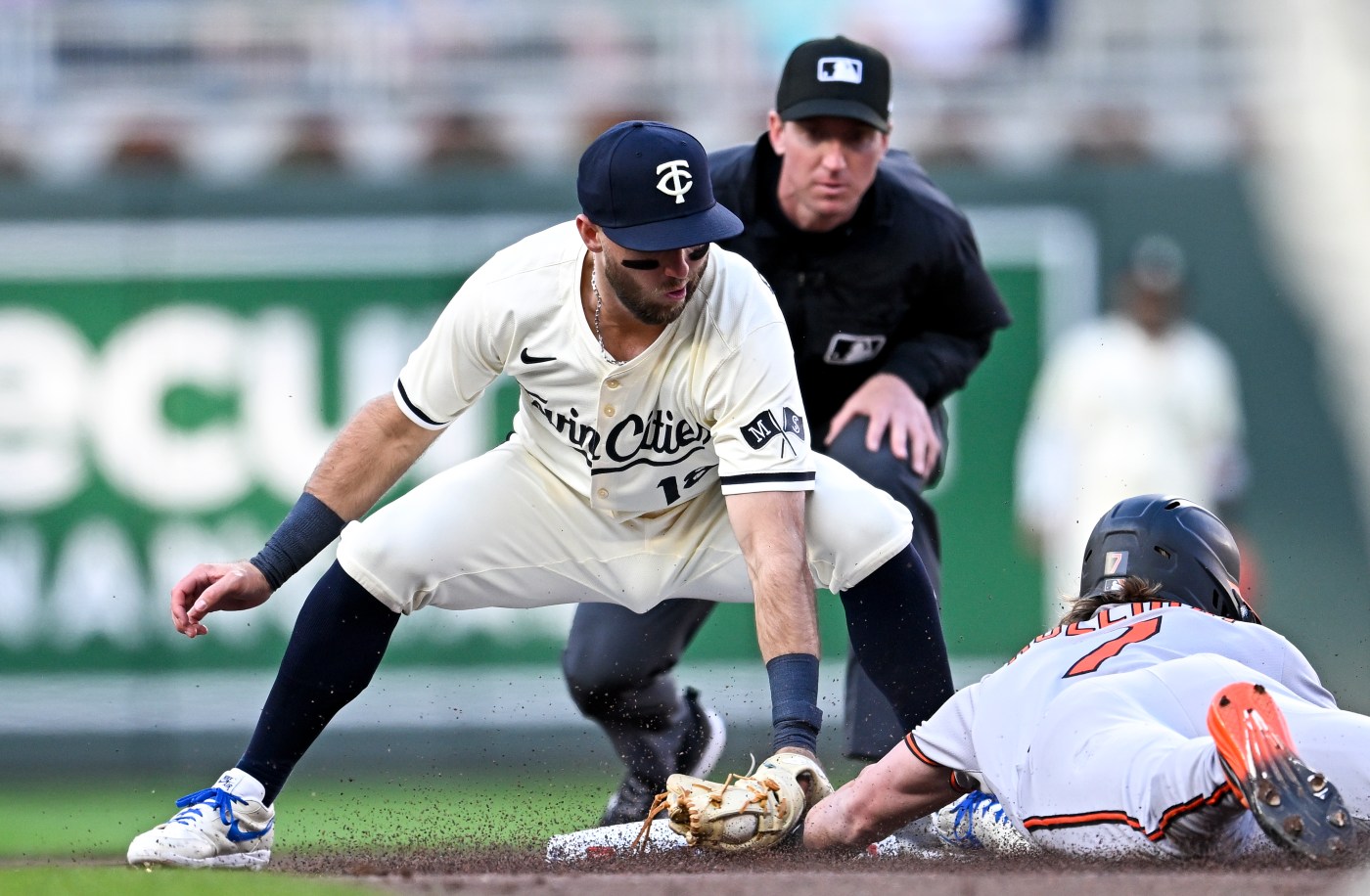
It took nearly two full days to do it, but the Twins and Guardians finally finished Monday night’s game, playing through chilly temperatures and misty rain on Wednesday afternoon in downtown Minneapolis. After two rain delays Monday and a postponement on Tuesday, the two teams picked up in the fourth inning on Wednesday, with the Twins, who were leading 2-1 at the time the game resumed, eventually coming out on top in a 6-5 walk-off win.

Kody Clemens’ ninth-inning double came after the Guardians had scored three runs in the top of the ninth inning to tie the game.

“I got some consistent playing time and finally got on time with my swing,” Clemens said. “It’s been a blessing.”

The Twins were one strike away victory earlier in the inning when Bo Naylor smacked a double off the wall in right field off Jhoan Duran, bringing home a pair of runs. The inning had started with Joe Ryan, who was on the mound when the game resumed, allowing a double and a walk before making way for Duran.

Duran couldn’t extract the Twins from the jam.

“Wish we could’ve just closed it out cleanly, but it’s kind of fun to go out there and do your thing,” Ryan said. “Maybe it’s a good thing, burned their reliever there, too. Can look at a positive from that.”

While the Guardians (25-22) decided on a bullpen day for the resumption of the game, the Twins (27-21) rode starter Joe Ryan into the ninth inning. Ryan gave up a home run to former teammate Carlos Santana, who initially showed bunt in his fourth-inning at-bat before blasting Ryan’s sixth pitch of the at-bat pitch out to right. That home run tied the game 2-2 at the time.

“It was tough,” Ryan said of his day. “I’ve been grinding through some stuff for a while now. I think the antibiotics that I’m on right now — I didn’t even wake up for a while so it was kind of hard to get going. … But defense did great, offense was awesome, so, great to get another win.”

The Twins had retaken the lead in the fourth inning after Santana’s home run and they held it until the top of the ninth.

Outfielder Trevor Larnach led off the inning with a single and ended up scoring when Clemens, pinch hitting, hit a ball toward center that outfielder Nolan Jones dove for, despite having seemingly no chance at catching the ball. Larnach scored on the play, and Clemens wound up on third. He scored immediately after on Harrison Bader’s sacrifice fly. Bader would drive in another run in the eighth inning, bringing home pinch-runner DaShawn Keirsey Jr.

The Twins’ earlier two runs came on RBI knocks from the Ty France in the first inning and Willi Castro in the second off Cleveland starter Logan Allen on Monday. Bailey Ober, who started the game initially, gave up a run in the first inning. He pitched three innings in between rain delays before the game was suspended.

Related Articles


Twins, Guardians washed out again; will attempt to play (almost) two Wednesday


Twins, Guardians game suspended; to be resumed on Tuesday, weather permitting


Kody Clemens makes most of opportunity with Twins


Walks haunt Twins early as Brewers stop Minnesota’s win streak at 13


Carson McCusker is a good-sized Twins roster addition

Texas Set to Create State Bitcoin Reserve that Would Accept Private Donations

posted in: All news | 0

The State of Texas is set to get into the cryptocurrency investment game as the Texas House passed a Senate bill on Wednesday to create a “Strategic Bitcoin Reserve” that could use millions of taxpayer dollars to purchase cryptocurrency. 

Senate Bill 21 will—assuming Senate concurrence and the governor’s sign-off—establish a new government investment fund through which the state comptroller and a team of appointed advisors have broad discretion to invest in cryptocurrencies like Bitcoin. The bill allows the state to appropriate funds from its coffers to finance those purchases.  

The House version also restored a controversial provision that had been stripped in the upper chamber to allow private donations to the fund. 

The House approved the measure with overwhelming bipartisan support on a 101-42 vote, with no debate over the wisdom of getting the state into the business of investing in highly speculative virtual coins. Opponents included 21 Republicans and 21 Democrats.

The bill’s lead champion, GOP Senator Charles Schwertner, has said the state needs to create this crypto fund not only as an official show of support for the powerful digital currency industry but as a fiscal hedge against the strength of the U.S. dollar amid growing federal debt and global tumult. 

“Senate Bill 21 is about recognizing digital assets not as a trend but as a strategic opportunity,” Representative Giovanni Capriglione, who carried the bill in the House, said on the floor Tuesday. “With strong oversight, clear boundaries, and smart financial planning, Texas can take a leadership role in the evolving digital economy.” 

Top Republican leaders in Texas, including Governor Greg Abbott, have gone out of their way to make the Lone Star State an epicenter of the crypto industry—including of power-hungry bitcoin mines that have set up near rural towns and proven to be major nuisances for local residents.

SB 21 was a top priority in the Senate and was one of the first bills passed by the upper chamber back in early March. It was drafted in coordination with the Texas Blockchain Council, an industry group representing many of the largest crypto companies. 

Schwertner’s original bill, however, faced some opposition from members on his Business & Commerce Committee, particularly over a provision that would allow the state to accept donations of cryptocurrency from private citizens and corporations to the state reserve, which critics said posed a risk for market manipulation and undue influence. 

“If someone decides to give $10 billion [worth of crypto] to the state, they’re creating a market for themselves [and could effectively] manipulate the market using the imprimatur of the state,” Senator Nathan Johnson, a Dallas Democrat, said during the February hearing. “I don’t want the state to be a tool of an investor. I would want this to be limited to just state allocations. I don’t want billionaire tech bros owning a branch of the state government.” 

Schwertner amended the bill to remove that private donation component before it was then passed by the committee. 

That provision was added back into the House version by Capriglione, though it limits potential donors only to individuals who are “domiciled” in Texas. 

Schwertner indicated support for the House version in a social media post: “SB 21 has officially passed both chambers, and Texas is now on the verge of establishing the Texas Strategic Bitcoin Reserve!” 

Schwertner’s office did not immediately response to a request for comment. Johnson’s office said that the Dallas senator would vote against concurrence with the private donation clause. 

To show precedent for such a state reserve, Capriglione has pointed to the passage of his bill back in 2015 to create a state-run gold depository to allow the state to invest in the precious metal. “Bitcoin and gold are quite the same; both have a limited supply, and its value is based on multiple world economies making it stable to economic distress or devaluing a currency across all countries,” he said in a committee hearing on the bill in April. 

However, as Comptroller Glenn Hegar told the Senate committee earlier this year, the state never did become an investor in gold commodities and holds no gold in its treasuries. 

But Bitcoin boosters are apparently intent on ensuring that the state does have the means to invest in crypto—on the taxpayer’s dime, of course. In the committee hearing, Caprligione said that the Senate has included a budget rider, contingent on passage of SB 21, that would provide $21 million to “kick start” the bitcoin reserve. 

Crypto watchdogs have warned against state governments using the power of their purse to get into Bitcoin—and even some crypto enthusiasts have warned that it’s antithetical to the original purpose of digital currency: getting out from under the boot of government fiat currency. “There is simply nothing behind Bitcoin. It has no strategic use,” Hillary Allen, an American University law professor who studies cryptocurrencies, previously told the Texas Observer, saying they are effectively a “Ponzi–like asset.”

Still, since President Donald Trump issued an executive order calling for the creation of a federal crypto stockpile, several red states have taken up legislation to create similar state reserves. Lawmakers in most of those states, including Florida, have rejected the idea. So far New Hampshire is the only one to pass the idea into law. Arizona’s GOP legislature passed a Bitcoin reserve bill, but the Democratic governor vetoed it. 

Governor Abbott expressed apparent interest in the bill, via double-eyes emoji, from the session’s early days.

The post Texas Set to Create State Bitcoin Reserve that Would Accept Private Donations appeared first on The Texas Observer.

Majority of US states now have laws banning or regulating cellphones in schools, with more to follow

posted in: All news | 0

By JEFF AMY

ATLANTA (AP) — Florida was the first state to pass a law regulating the use of cellphones in schools in 2023. Just two years later, more than half of all states have laws in place, with more likely to act soon.

Related Articles


Over boos, Columbia University president notes Mahmoud Khalil’s absence at graduation


Most AAPI adults oppose college funding cuts and student deportations, a new poll finds


After crossing the border for better schools, some parents are pulling their kids and leaving the US


UMN names Gretchen Ritter executive vice president, provost


Hüsker Dü’s Bob Mould receives honorary degree and delivers Macalester College keynote

Bills have sprinted through legislatures this year in states as varied as New York and Oklahoma, reflecting a broad consensus that phones are bad for kids.

Connecticut state Rep. Jennifer Leeper, a Democrat and co-chair of the General Assembly’s Education Committee, on May 13 called phones “a cancer on our kids” that are “driving isolation, loneliness, decreasing attention and having major impacts both on social-emotional well-being but also learning.”

Republicans express similar sentiments.

“This is a not just an academic bill,” Republican Rep. Scott Hilton said after Georgia’s bill, which only bans phones in grades K-8, passed in March. “This is a mental health bill. It’s a public safety bill.”

So far, 26 states have passed laws, with eight other states and the District of Columbia implementing rules or making recommendations to local districts. Of the states, 17 have acted this year. Just Tuesday, Nebraska Republican Gov. Jim Pillen signed a law banning phones throughout the school day. Earlier Tuesday, Alaska lawmakers required schools to regulate cellphones when they overrode an education package Republican Gov. Mike Dunleavy had vetoed for unrelated reasons.

More action is coming as bills await a governor’s signature or veto in Florida, Missouri, Nebraska and New Hampshire.

Increasing focus on banning phones throughout the school day

When Florida first acted, lawmakers ordered schools to ban phones during instructional time while allowing them between classes or at lunch. But now there’s another bill awaiting Gov. Ron DeSantis’ action that goes further. It would ban phones for the entire school day for elementary and middle schools.

Ten states and the District of Columbia have enacted school day bans, most for students in grades K-12, and they now outnumber the seven states with instructional time bans.

North Dakota Republican Gov. Kelly Armstrong called the ban throughout the school day that he signed into law “a huge win.”

Students react as North Dakota Republican Gov. Kelly Armstrong hands a pen to a girl after he signed a bill for a “bell-to-bell” cellphone ban for public school K-12 students on Friday, April 25, 2025, at Centennial Elementary School in Bismarck, N.D. To the right of the governor is first lady Kjersti Armstrong. Republican Sen. Michelle Axtman is at left. Republican Rep. Jim Jonas is at right. (AP Photo/Jack Dura)

“Teachers wanted it. Parents wanted it. Principals wanted it. School boards wanted it,” Armstrong said.

Armstrong recently visited a grade school with such a ban in place. He said he saw kids engaging with each other and laughing at tables during lunch.

The “bell-to-bell” bans have been promoted in part by ExcelinEd, the education think tank founded by former Florida Gov. Jeb Bush. The group’s political affiliate has been active in lobbying for bans.

Nathan Hoffman, ExcelinEd’s senior director of state policy and advocacy, said barring phones throughout the day heads off problems outside of class, like when students set up or record fights in halls.

“That’s often when you get some of your biggest behavioral issues, whether they go viral or not,” Hoffman said.

Other states want school districts to set their own rules

But other states, particularly where there are strong traditions of local school control, are mandating only that school districts adopt some kind of cellphone policy, believing districts will take the hint and sharply restrict phone access. In Maine, where some lawmakers originally proposed a school day ban, lawmakers are now considering a rewritten bill that would only require a policy.

And there have been a few states where lawmakers failed to act at all. Maybe the most dramatic was in Wyoming, where senators voted down a bill in January, with some opponents saying teachers or parents should set the rules.

Where policymakers have moved ahead, there’s a growing consensus around exceptions. Most states are letting students use electronic devices to monitor medical needs and meet the terms of their special education plans. Some are allowing exceptions for translation devices if English isn’t a student’s first language or when a teacher wants students to use devices for classwork.

There are some unusual exceptions, too. South Carolina’s original policy allowed an exception for students who are volunteer firefighters. West Virginia’s new law allows smartwatches as long as they are not being used for communication.

Some parents and students oppose the rules

But by far the most high-profile exception has been allowing cellphone use in case of emergencies. One of the most common parent objections to a ban is that they would not be able to contact their child in a crisis like a school shooting.

“It was only through text messages that parents knew what was happening,” said Tinya Brown, whose daughter is a freshman at Apalachee High School, northeast of Atlanta, where a shooting killed two students and two teachers in September. She spoke against Georgia’s law at a news conference in March.

Some laws call for schools to find other ways for parents to communicate with their children at schools, but most lawmakers say they support giving students access to their cellphones, at least after the immediate danger has passed, during an emergency.

In some states, students have testified in favor of regulations, but it’s also clear that many students, especially in high schools, are chafing under the rules. Kaytlin Villescas, a sophomore at Prairieville High School, in the suburbs of Baton Rouge, Louisiana, is one student who took up the fight against bans, starting a petition and telling WBRZ-TV in August that Louisiana’s law requiring a school day ban is misguided. She argued that schools should instead teach responsible use.

“It is our proposition that rather than banning cellphone use entirely, schools should impart guidelines on responsible use, thereby building a culture of respect and self-regulation,” Villescas wrote in an online petition.

Most states provide no funding to carry out laws

A few states have provided money for districts to buy lockable phone storage pouches or other storage solutions. New York, for example, plans to spend $13.5 million. But states have typically provided no cash. New Hampshire lawmakers stripped a proposed $1 million from their bill.

“Providing some specific money for this would kind of ease some of those implementation challenges,” Hoffman said. ”That said, most states have not.”

Associated Press writers Becky Bohrer in Juneau, Alaska; Susan Haigh in Hartford, Connecticut; Jack Dura in Bismarck, North Dakota; and Kate Payne in Tallahassee, Florida; contributed to this report.

Climate action group schedules first Ward 4 candidate forum for Tuesday

posted in: All news | 0

Voters in St. Paul’s Ward 4 neighborhoods will choose a new city council member in a special election this August, and the first candidate forum of the campaign season will be held from 7 p.m. to 8 p.m. on Tuesday at Hamline Methodist Church.

The forum, organized by the St. Paul chapter of Unidos Minnesota, a climate action and economic and social justice organization, has invited the three declared candidates to participate. They are nonprofit founder Molly Coleman, former Hamline-Midway Coalition president Cole Hanson and school board member Chauntyll Allen.

Candidates will be given the opportunity to respond to five questions, prepared in advance, on “climate resilience.”

“This year the city council will make big decisions about funding for home upgrades that lower energy bills, negotiating a new contract with our utility company and revising St. Paul’s Climate Action and Resilience Plan,” reads a statement from Unidos St. Paul, which raises concern about “rising energy costs, unaffordable homeowner’s insurance and unhealthy air quality.”

Hamline Methodist Church is located at 1514 Englewood Ave. in St. Paul. Attendees are asked to RSVP in advance at tinyurl.com/UnidosForum2025.

Ward 4 has five neighborhoods — Hamline-Midway, Merriam Park, St. Anthony Park and parts of Macalester-Groveland and Como. Former Ward 4 Council Member Mitra Jalali stepped down from office in February, citing health concerns, and interim Council Member Matt Privratsky was recently appointed by the mayor’s office to fill her role until voters elect a new member to complete the four-year term, which ends in 2028.

The Ward 4 filing period opened Tuesday and runs through June 2. The special election, which will be decided by ranked choice, is Aug. 12.

Related Articles


Bruce Vento Nature Sanctuary likely to be renamed Wakan Tipi


Letters: Preventing landlords from screening tenants is a one-sided view of our housing problem


Ben Shardlow: The soon-to-close recycling plant and environs are places we should love, or learn to


St. Paul: At Highland Bridge, Weidner Homes, Ryan Cos. win concessions


St. Paul: Breakaway Music Festival approved for gradual volume increase