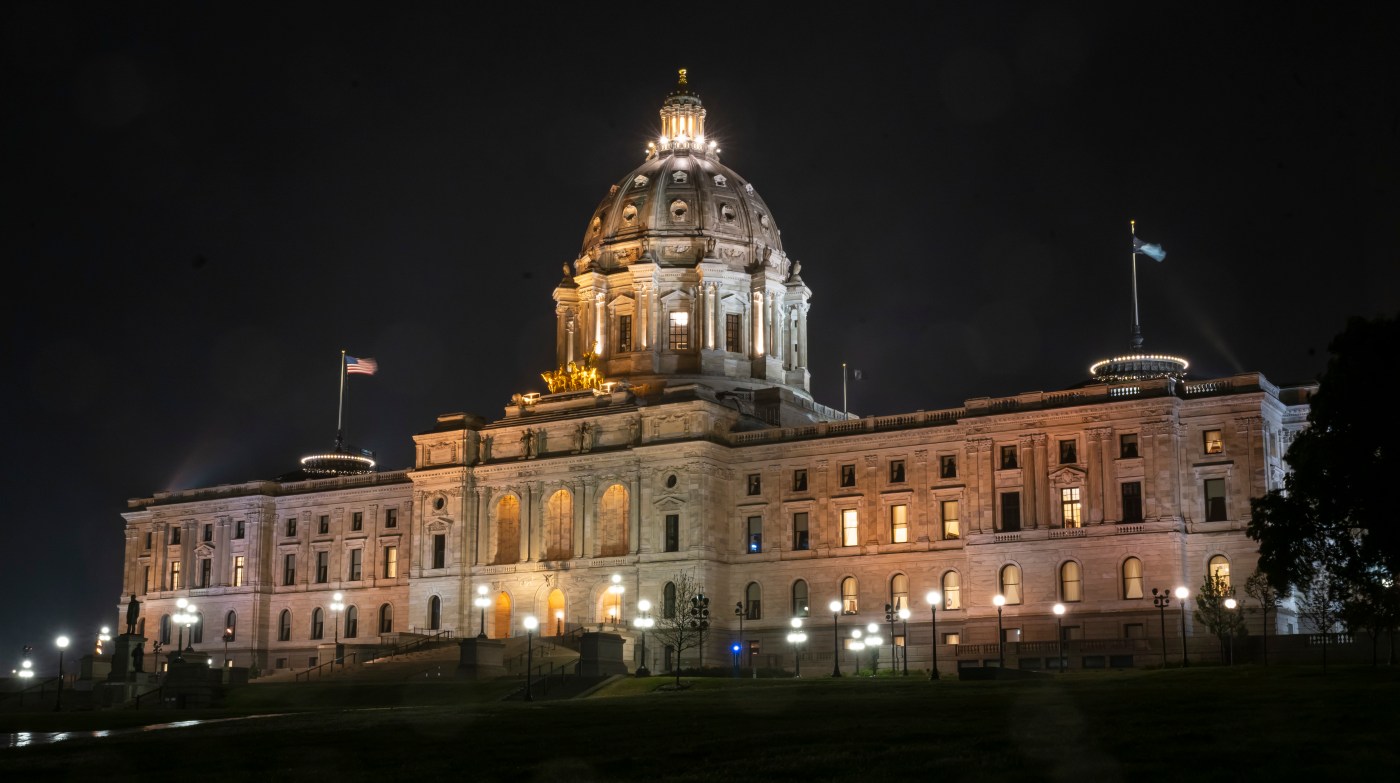
Gov. Tim Walz announced Friday that he has called for a special session for the Legislature after reaching a budget agreement with Republican and Democratic legislative leaders.
“This bipartisan budget agreement makes thoughtful reductions in state spending while keeping us on track to make Minnesota the best state in the country to raise a child,” Walz said in a statement. “It is the result of hundreds of hours of good-faith, bipartisan debate on the best ways to improve the health, safety, and wellbeing of Minnesotans. While all sides had to make concessions in order to reach a compromise, I’m grateful to our legislative partners for their collaboration and dedication to moving Minnesota forward.”
House Speaker Lisa Demuth, R-Cold Spring, said that despite the delay to the session Minnesota want lawmakers to finish work on the state’s two-year budget.
“I look forward to finishing the state budget with the largest cut to state spending in history, important reforms to Earned Sick and Safe Time and Paid Family Leave, and other important wins for Minnesotans across the state,” Demuth said in a statement.
Senate Majority Leader Erin Murphy, DFL-St. Paul, said the budget agreement indicates lawmakers can work through difficult issues to fond common ground.
“That means protecting generational gains made for workers, schools, healthcare, care givers, kids, seniors, and parents, and taking important action in addressing our future budget challenges,” Murphy said in a statement.” We are passing a stable budget before we reach the brink of a damaging government shutdown that would have punished people living in every county of our state.”
This story will update later today.
Related Articles
Timeline for Minnesota special session blurry as budget talks continue
MN government return to office order kicks in as shutdown layoffs loom
Ramsey County: Economic Development Authority to allow flexibility on housing projects
Special session looms as Minnesota lawmakers narrow remaining budget obstacles
Letters: St. Paul should take care of what it has before spending on new things
If you’re using your credit card issuer’s app or website just to pay your bills and check in on some recent transactions, you’re only tapping into a fraction of the features available to you.
We’ve been able to pay bills online for more than 25 years, but that’s table stakes now. Banks are competing with each other to roll out tools that can help customers see spending trends, set their budget, manage recurring charges and improve account security.
“We started looking at the online experience as the new battleground,” says Adam Winchester, head of experience for consumer and small business payments at U.S. Bank. “If we can win there, we can win market share.”
Get data on spending and tips to save more
Your banking app and website can translate your individual purchases into a longer-term look at your spending trends. Some provide virtual assistants, like Capital One’s Eno, the U.S. Bank Smart Assistant, and Bank of America®’s Erica, that can make suggestions on ways you can save money, including reviewing recurring charges to make sure you’re not spending without realizing it. Your spending can be displayed in helpful graphs that make data on your expenses clearer, so you can make adjustments to your budget if needed.
This works well if all of your accounts and credit cards are from one bank, but that’s not the case for many people. According to Winchester, a limitation of some banking apps is the inability to link accounts from other financial institutions. If you juggle multiple cards and have accounts elsewhere, what you see when logged into your account at one bank isn’t going to give you your full financial picture.
Some apps have solved this issue by allowing you to link outside accounts. Chase, for example, can show you information from your other credit cards, banking and investment accounts within its app.
If you have multiple apps with this capability, pick the one with the user experience you find the easiest to navigate and understand, says Beth Robertson, managing director of Keynova Group, a financial services intelligence firm. “You have to set it up one time, but from there on out, you can get a really good compilation of information.”
Keep your card secure
You can regularly check your card activity for suspicious purchases, and also set up alerts that will notify you of any charges over a certain amount. You can even freeze or lock your account if your physical card is missing to prevent someone else from using it (unfreezing also takes mere seconds, in case you realize your card was safe the whole time).
Related Articles
This is the phishing scam that gets an identity theft expert ‘really, very angry’
Data: First-time home buyers faced greater headwinds in Q1
Tax deductions might go up. Would you benefit?
7 things financial experts wish they knew in high school
Federal student loan rates soften for 2025-26, making borrowing slightly more affordable
But account security isn’t just about knowing where your physical card is. It’s also important to know who else has access to your account data, such as merchants storing your card information for later purchases, or businesses where you have a recurring membership payment, like gyms. Many banking apps let you see who has access to your data, and some allow you to revoke that access from within the app.
Robertson recently granted data access to a company that determined her eligibility for a mortgage. Once the approval process was complete, she took away that company’s ability to see her financial information.
Bank of America® offers a security meter on its website and app that shows your account security level and suggests steps you can take to protect your accounts even more. This includes actions like updating your password and setting up two-factor authentication.
Check in on your credit scores
Many banks offer customers the ability to not just see their credit scores, but also learn about how different actions can raise or lower those scores. This can provide important context for anyone who experienced a recent score change, or who is hoping to grow their credit before applying for a loan. Your app can also generate an action plan if you’d like to build your credit.
A year-long construction project on Snelling and St. Clair avenues wrapped up this week and the intersection now hosts two-lane traffic again, according to the Minnesota Department of Transportation.
The project, which began in May 2024, included resurfacing a half-mile of Snelling Avenue between St. Clair and Grand avenues and replacing the signal system. MnDOT also installed pedestrian bump-outs and ADA-compliant crossings at each intersection from St. Clair to Grand Avenue.
After intermittent closures last week, the intersection opened and the new signal system turned on Thursday. Minor construction activities, such as replacing the boulevard’s trees and sod, will continue throughout the summer.
Like many of his predecessors, President Donald Trump has affirmed the importance of historically Black colleges and universities, hailing them as a pathway to careers and a better life for students in the U.S.
The schools have not faced cuts to federal grants of the kind that have rocked Ivy League schools Trump has blasted as hotbeds of “wokeness” and antisemitism, and the president has said HBCUs’ core federal funding is not at risk.
But that is not to say it’s a comfortable time for HBCUs’ leaders. As the Trump administration cracks down elsewhere on programs to support underrepresented students, the colleges have been expressing gratitude for the administration’s recognition while mostly keeping quiet on its sweeping attacks against diversity, equity and inclusion policies.
“HBCUs, in general, I don’t believe are in a position to be adamantly and vociferously opposed to these attacks, but deep down we all know what’s going on,” said Deron Snyder, an alumnus of and professor at Howard University. “It’s just how much can you actually say without fear of retribution.”
An executive order signed by Trump in April recognizes HBCUs and pledges his administration’s support. It calls for an annual White House summit, private sector partnerships, and an advisory board with the Education Department, but it does not guarantee any new federal funding.
The order won praise from some Black universities, including Howard University and Morgan State University, as well as organizations that work with HBCUs. Harry Williams, president of the Thurgood Marshall College Fund, said the order should serve as a call-to-action for corporations, foundations and lawmakers to redouble support for HBCUs and their students.
But the colleges’ leaders have said little on other administration actions that are out of line with the mission of HBCUs, which were founded to educate formerly enslaved people.
FILE – President Donald Trump holds a signed an executive order relating to school discipline policies as Education Secretary Linda McMahon listens in the Oval Office of the White House, April 23, 2025, in Washington. (AP Photo/Alex Brandon, file)
FILE – A graduation themed printed mural is seen on the Howard University campus, July 6, 2021, in Washington. (AP Photo/Jacquelyn Martin, FILE)
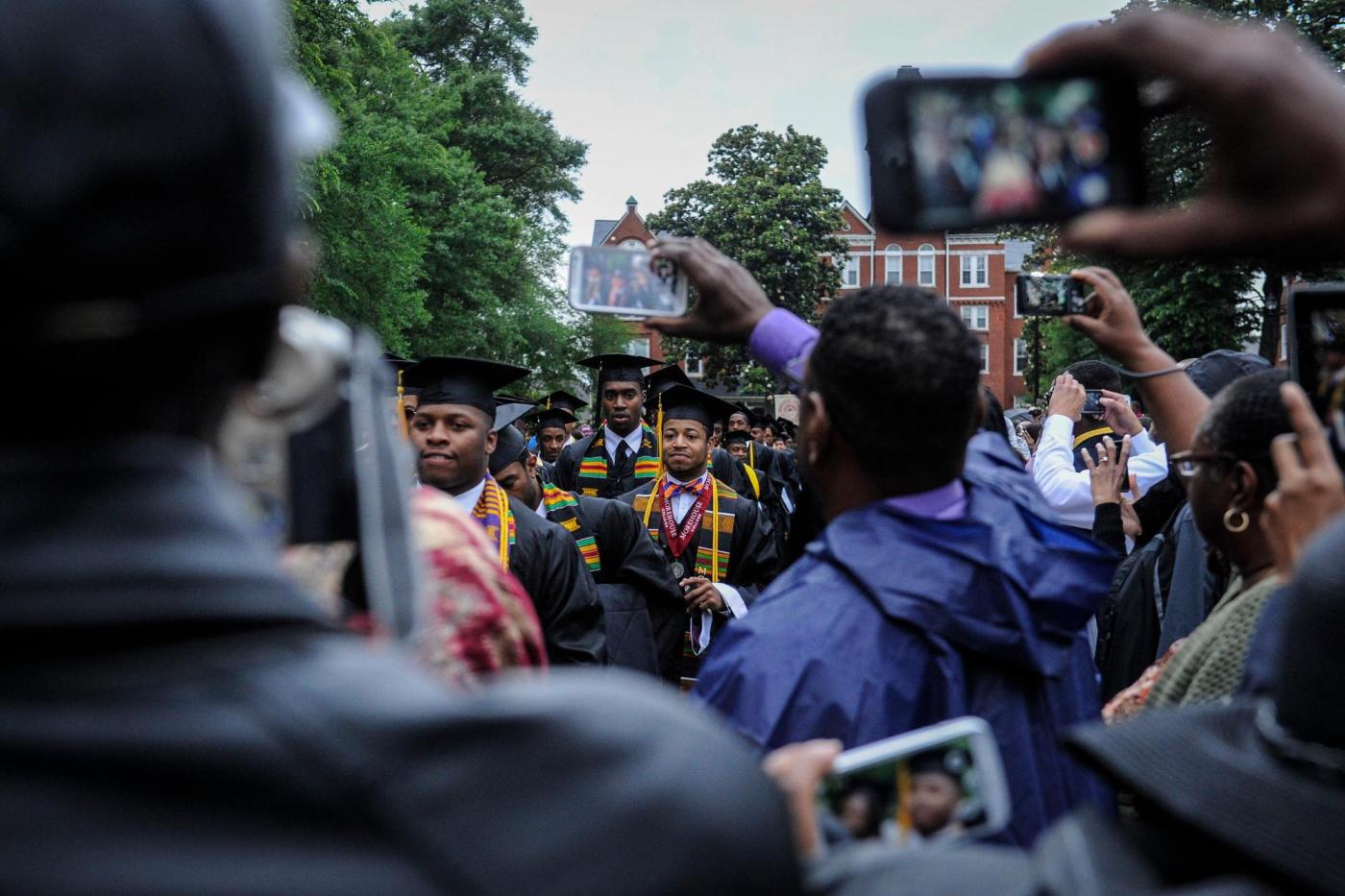
FILE – A Morehouse College student lines up before the school commencement, May 19, 2024, in Atlanta. (AP Photo/Brynn Anderson, File)
1 of 3
FILE – President Donald Trump holds a signed an executive order relating to school discipline policies as Education Secretary Linda McMahon listens in the Oval Office of the White House, April 23, 2025, in Washington. (AP Photo/Alex Brandon, file)
The administration’s campaign against DEI has encouraged restrictions on classroom discussions around racism and led to cuts in federal research grants. As it threatens to cut federal funding from schools, some colleges have shuttered diversity offices and ended other programs to support students of color.
For HBCUs, the moment is reminiscent of the era decades ago when Black colleges were compelled to argue that school segregation was wrong but also needed to maintain government support for their institutions, said Marybeth Gasman, a Rutgers University professor who has studied the history of HBCUs.
Black college leaders “don’t want HBCUs to be under the umbrella of DEI, but I don’t know any HBCU president who would agree with the way that Donald Trump is dismantling diversity, equity, and inclusion efforts,” she said.
The Trump administration has cut federal research grants for several universities, pressuring them to comply with his agenda. Since Harvard University refused the administration’s demands for changes to its policies and leadership, the government has slashed $2.6 billion in funding, which the Ivy League school has described as retaliation.
In an interview in April, Trump told NewsNation that Black colleges and universities should not be concerned about losing their funding.
U.S. Rep. Terri Sewell of Alabama, vice chair of the House HBCU caucus, said there has long been bipartisan support for the colleges. But she said there will be new vigilance of their federal support in light of the administration’s record on programs serving minorities.
Sewell, a Democrat, said it is also alarming to see the administration move to dismantle the Education Department.
“We’ll be pushing back fiercely against that and do all that we can to make sure that our HBCUs get the money that they deserve,” Sewell said. She said the Congressional Black Caucus has been paying close attention to the Republicans’ funding plan for a program that supports 19 HBCUs through the Department of Agriculture.
Related Articles
Trump administration asks Supreme Court to leave mass layoffs at Education Department in place
Judge puts temporary hold on Trump’s latest ban on Harvard’s foreign students
Top US universities raced to become global campuses. Under Trump, it’s becoming a liability
St. Paul’s Maxfield Elementary breaks ground on ‘community schoolyard’
Trump promised to welcome more foreign students. Now, they feel targeted on all fronts
Williams, of the Thurgood Marshall College Fund, said HBCUs have exceeded all expectations of the opportunities they have provided for for underrepresented students. He said he is grateful for the administration’s support, but when asked about its actions toward diversity initiatives, he said the administration has challenges it is working through.
“Hard work pays off and education pays off. That’s why these institutions are so critical to this country,” he said. “The realities of those other challenges that we’re grappling with right now in terms of what the administration is dealing with as it relates to their priorities, we were just pleased to know that they recognize the importance of what these institutions have done for the country will continue to do in a very deliberate way.”
AP journalists Collin Binkley and Matt Brown in Washington contributed to this report.
The Associated Press’ education coverage receives financial support from multiple private foundations. AP is solely responsible for all content. Find AP’s standards for working with philanthropies, a list of supporters and funded coverage areas at AP.org.