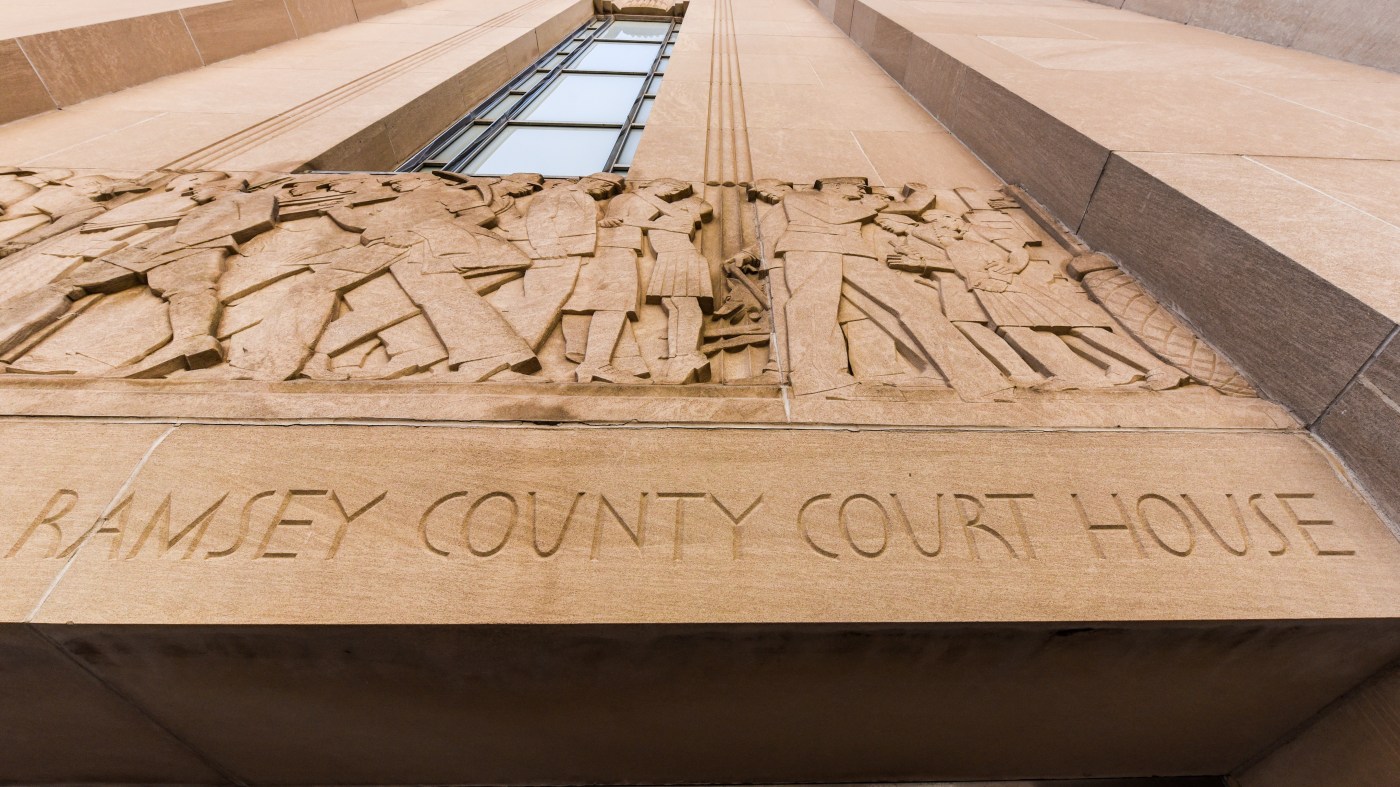
Minneapolis man sentenced for stabbing, hanging St. Paul woman’s dog after argument

posted in: All news | 0

A Minneapolis man with a significant recent criminal history was sentenced this week to four years in prison for killing a woman’s dog inside her St. Paul apartment after the two argued.

The sentence handed down to 25-year-old Emmanuel Joe Ware Jr. in Ramsey County District Court on Monday will run at the same time as a four-year term he received in Hennepin County in March for possession of a firearm and ammunition by a person who is not eligible due to a conviction for a crime of violence.

Emmanuel Joe Ware Jr. (Courtesy of the Hennepin County Sheriff’s Office)

The Ramsey County complaint says the woman told police that she left her West Side apartment on Jan. 9 to stay with her sister after she and Ware got into an argument. When she returned the next day, her bloodied and dead dog — a white Pomeranian named “Bug” — was hanging by his neck in her closet.

Officers saw a shattered mirror, blood “all over” the walls and the dog hanging. He had a deep cut to his eye. A knife block in the kitchen was missing two knives. A necropsy later revealed Bug had broken bones and stab wounds to his head.

The woman told police Ware sent her a series of threatening text messages after she went to her sister’s place. She said she is pregnant with Ware’s child and fearful of him because he was assaultive with her in the past, the complaint says.

Investigators spoke with Ware four days later at Hennepin County Jail, where he was booked Jan. 12 on the gun possession charge. Ware said he “loves Bug” and would never hurt him, and that he was with his girlfriend, “Fantasia,” in Minneapolis on the day in question, the complaint says.

Investigators pulled video surveillance footage from the apartment building, which showed Ware in the first-floor elevator lobby around 5 p.m. Jan. 9, and in the fourth-floor lobby around 7:45 p.m.

Investigators, with apartment surveillance photos in hand, returned to the jail on Jan. 27 to interview Ware again. He said that he had lied to them before and was at the apartment on Jan. 9, but reiterated he did not kill the dog.

Ware pleaded guilty to felony mistreating or torturing an animal on March 20 after reaching an agreement with the prosecution.

Related Articles


Ex-Metro Transit employee claims religious discrimination in lawsuit


Verdict awaits after closing arguments in Derrick Thompson’s trial for crash that killed 5


Ex-teacher of Hmong College Prep Academy in St. Paul sentenced for criminal sexual conduct with student


‘Felt as though they were going to kill me,’ Mahtomedi man beaten and robbed of casino winnings says in court


Macalester alum sues over animal testing in psychology labs; college responds

Another case was dismissed at sentencing as part of the plea deal: felony mail theft after police say video surveillance at the woman’s St. Paul apartment building showed him stealing a package of Christmas gifts from the mail room on Dec. 4.

Ware has one pending case. In December, he was charged with misdemeanor domestic assault stemming from a Dec. 11 incident involving the woman at the HealthPartners Clinic on Wabasha Street in St. Paul during an OB/GYN appointment. A jury trial is scheduled for next month.

At the time of the dog’s killing, Ware was on intensive supervised release after serving three years and three months for a 2021 conviction in Hennepin County for abetting and abetting first-degree robbery.

He has two other felony convictions out of Hennepin County: first-degree robbery in 2017 and fourth-degree possession of a controlled substance (cocaine and ecstasy) in 2019.


I Was an Undocumented Texas College Student. I’m Not Going Anywhere—and Neither Is Our Movement.

posted in: All news | 0

As a proud first-generation, undocumented graduate of the University of Texas at Austin, and a lifelong product of Texas public schools, I am outraged—but not surprised—by the latest cowardly attack on our immigrant community. 

The most recent attempt to gut the “Noriega Bill”—also known as the Texas Dream Act—a law that has opened college doors by providing in-state tuition for thousands of undocumented Texas residents over the past 24 years, is not just a political maneuver. It is a targeted act of cruelty—one meant to erase our contributions, crush our aspirations, and make us feel ashamed of our existence.

This isn’t new. Every legislative session since House Bill 1403 was passed in 2001, Texas Republicans have tried to repeal it. And, every time, undocumented students and allies have shown up in force—testifying late into the night, sharing how in-state tuition has changed lives, lifted up families, and strengthened entire communities. The 89th Legislative Session was no different. Students and graduates spoke their truths, urging lawmakers to preserve a policy that gave them hope and a chance at their dream professions. Even business leaders and Chambers of Commerce oppose repeal.

But because lawmakers lacked the political courage to force a floor vote at the Texas Capitol—Senate Bill 1798 died after passing out of committee—state leaders took a coward’s path. They kicked the issue up to the federal level, where the U.S. Department of Justice launched a lawsuit against the Noriega Bill (HB 1403) with which Texas Attorney General Ken Paxton swiftly agreed rather than defending his state’s law, hoping to do behind closed doors what they couldn’t accomplish in the sunlight.

Students and other immigrant rights activists protest at the University of Texas in February. (Shutterstock)

Let’s be clear: This was never about “protecting” college seats for U.S. citizens. The Noriega Bill simply gave undocumented Texans the same opportunity as documented Texans. It has always been about fear—about sending a chilling message to undocumented youth that they are not welcome, no matter how long they’ve lived here, how hard they’ve worked, or how much they’ve already given back.

I felt this hostility personally in April, when I testified before the Texas Senate Education Committee in opposition to SB 1798. As the bill’s author read it aloud, I felt the bitterness in every word. I’ve lived in Texas since 1992. I graduated from UT-Austin in 2005—one of the first undocumented students to do so—having paid in-state tuition thanks to the 2001 law. I remember graduating high school in 1998, unsure if all my honors and hard work would matter. When HB 1403 passed, I cried in my mother’s arms. It meant I could dream again.

Julieta Garibay after her naturalization ceremony in April 2018 (Courtesy/Julieta Garabay)

That policy allowed me to earn both a bachelor’s and a master’s degree in nursing with honors. I co-founded United We Dream, now the largest immigrant youth-led network in the country. I’ve helped others navigate college and even citizenship. In 2018, I became a U.S. citizen and bought a home. In 2024, I became a mother. And I’ve never stopped advocating and organizing—because I know firsthand that this law didn’t just change my life. It transformed entire communities.

Texas immigrants have proven time and again that, when we’re given a chance, we invest right back into the state we call home. Former undocumented students are now nurses, teachers, engineers, and business owners. They are parents, taxpayers, and voters. They are your neighbors, your co-workers, your children’s counselors. Repealing the Noriega Bill isn’t only unjust—it will be economically and socially devastating for Texas.

We’ve been here before. But this time, it’s different. Today, the thousands who’ve benefited from in-state tuition are ready to fight back because we learned to organize, to speak up, to fight back. We know we are not alone. We know our rights. And we know our worth.

That’s what terrifies Governor Greg Abbott and his fellow Trump loyalists—not the presence of immigrants, but the power we’ve built. Instead of focusing on real problems like teacher pay, public education, or access to healthcare, they choose to scapegoat immigrants yet again. It’s shameful. It’s dangerous. And it’s beneath the dignity of this great state.

Protesters outside the Texas Capitol in 2017 (Sam DeGrave)

To the undocumented students who had their hearts set on college, who received this news like a punch to the gut: I am so sorry. Your pain is real. Your anger is valid. But please remember: You are not alone. You are not defined by politicians who see you only as a talking point. Your dreams are still yours. Your value is immeasurable.

Do not let this political cruelty dim your light. You were always worthy of joy, of education, of safety—not because of a law, but because of who you are. No policy, no border, no hateful rhetoric can take that away.

Texas made a wise investment over two decades ago when it passed HB 1403. That investment has paid off in the form of stronger communities, a better-educated workforce, and a richer civic life. Dismantling that progress would not only harm immigrants—it would harm Texas.

We are here to stay. Texas is our home. And we will continue to fight until its policies reflect that truth.

The post I Was an Undocumented Texas College Student. I’m Not Going Anywhere—and Neither Is Our Movement. appeared first on The Texas Observer.

Movie review: Ana de Armas is better at killing than ballet in ‘Ballerina,’ a John Wick spinoff

posted in: All news | 0

By JOCELYN NOVECK, Associated Press

Watch a bunch of John Wick movies all in a row, and you can get pretty paranoid.

You start to think everyone’s an assassin. The guy at the newsstand, the street musician, the subway rider, that nice neighbor in the elevator — ruthless contract killers, all.

So perhaps it shouldn’t be too surprising that in “From the World of John Wick: Ballerina,” the latest installment in the Wickian world, we reach the logical endpoint: a town where every single inhabitant’s a killer. Yes, it’s a picture-perfect, snowy winterscape in Austria, where everyone wears wool beanies and very nice sweaters. But they also wield a mean flamethrower, and schoolkids have mandatory shooting practice.

This image released by Lionsgate shows Ana de Armas in a scene from “Ballerina.” (Larry D. Horricks/Lionsgate via AP)

The early scenes in this wacky place high in the mountains are the best part of “Ballerina” — they actually contain deft surprises and even a glimmer of humor, which is hardly something we expect in a John Wick film. (Have you ever see the guy smile?) Watching our energetic star, Ana de Armas, engage in a plate-smashing contest with a sweet waitress-turned-vicious-killer reminds us that action can be clever, even if most scenes in this series inevitably become numbing, as the body count rises stratospherically.

Before we go further, some clarification on where this film fits into the timeline. Let’s forget (for now) that there was a John Wick 4, because the events of “Ballerina” take place during the third movie. So, erase from your mind whatever huge, life-altering thing may or may not have happened in the last film. OK?

This image released by Lionsgate shows Ana de Armas in a scene from “Ballerina.” (Larry D. Horricks/Lionsgate via AP)

Eagle-eyed viewers may, in fact, remember a brief scene in the third movie where a ballerina is trying to do a series of fouettés, those whiplash turns on one leg that are a big attraction in “Swan Lake.” The same scene returns in “Ballerina,” where we see de Armas’ character, Eve, doggedly trying to master them in training. Why she keeps falling — every time, after years and years of class — is a mystery. We don’t aim for full realism in action films, guys, but may we suggest that falling flat on the floor in your pointe shoes every time you do a turn feels like much more difficult stunt work than anything else in “Ballerina” — including obliterating a horde of townspeople. It also speaks to a troubling lack of coordination, a definite problem for an assassin.

Anyway! We actually first meet Eve as a child, living alone with her cherished father in some wind-swept coastal abode. Suddenly, a crew of black-clad assassins arrives by sea, targeting the father. He manages to protect Eve, but dies from his wounds.

This image released by Lionsgate shows Ana de Armas in a scene from “Ballerina.” (Lionsgate via AP)

Soon, now-orphaned Eve is approached by Winston (Ian McShane, returning) owner of the Continental Hotel. Winston says he can bring her to her father’s family. He takes her to The Director (a haughty Anjelica Huston), who welcomes the budding dancer to what seems an elite ballet academy but is also the training ground of the Ruska Roma, the crime organization where Wick himself learned his trade.

The years go by. Eve is now a young woman determined to strike out on her own, though she still has problems completing a fouetté turn. (“Tend to your wounds before you get sepsis and we have to cut off your feet,” the Director suggests helpfully.) Luckily she shows more aptitude with firearms. And that’s important, because her overriding goal is to avenge the death of her father. So when Wick himself (Keanu Reeves, of course, appearing in a few key scenes) makes a crucial stop at the academy, Eve looks at him and asks, “How do I get out of here?”

This image released by Lionsgate shows Anjelica Huston in a scene from “Ballerina.” (Lionsgate via AP)

“The front door is unlocked,” Wick replies – a line that got applause at the screening I was at, but so did virtually everything Wick said or did. “No, how do I start doing what YOU do?” Eve asks. Wick tells her she can still leave — she has the choice to reject a killer’s life. The sad subtext: He does not.

But while Wick wants out — always — Eve wants IN. Otherwise we wouldn’t have a movie. And so, her quest for vengeance takes her, clue by dangerous clue (and against the Director’s strict orders) to the snowy hamlet of Hallstatt. There, the fearsome Chancellor (Gabriel Byrne, duly chilly) leads a band of assassins — all of whom want to kill her. Oh, also: the Chancellor killed her dad.

This image released by Lionsgate shows Norman Reedus in a scene from “Ballerina.” (Larry D. Horricks/Lionsgate via AP)

And so Eve has to fight, using all the training and ingenuity she has amassed. One lesson she must draw on, from a trusted teacher: “Fight like a girl.”

In this case, as you can imagine, that’s not a derogatory phrase. What it means is to lean into your strengths — you won’t beat a man by brute force, the teacher has told her, but with smarts and inventiveness.

That means using ever more interesting weapons to kill an endless supply of people (it must be said, the cheers from moviegoers are, as ever, disconcerting.) And, by the end, getting pretty comfortable with a flamethrower.

This image released by Lionsgate shows Ana de Armas in a scene from “Ballerina.” (Lionsgate via AP)

“From the World of John Wick: Ballerina,” a Lionsgate release, has been rated R by the Motion Picture Association “for strong/bloody violence throughout, and language. “ Running time: 125 minutes. Two stars out of four.

Senate Republicans revise ban on state AI regulations in bid to preserve controversial provision

posted in: All news | 0

By MATT BROWN

WASHINGTON (AP) — Senate Republicans have made changes to their party’s sweeping tax bill in hopes of preserving a new policy that would prevent states from regulating artificial intelligence for a decade.

Related Articles


HBCUs depend on federal funding. Their leaders are walking a tightrope on Trump’s DEI attacks


Billion-dollar battery plant pauses construction amid electric vehicle and tariff uncertainty


Transgender troops face a deadline and a difficult decision: Stay or go?


Planet-warming emissions dropped when companies had to report them. EPA wants to end that


Republicans urge Donald Trump and Elon Musk to end their feud

In legislative text unveiled Thursday night, Senate Republicans proposed denying states federal funding for broadband projects if they regulate AI. That’s a change from a provision in the House-passed version of the tax overhaul that simply banned any current or future AI regulations by the states for 10 years.

“These provisions fulfill the mandate given to President Trump and Congressional Republicans by the voters: to unleash America’s full economic potential and keep her safe from enemies,” Sen. Ted Cruz, chairman of the Senate Commerce Committee, said in a statement announcing the changes.

The proposed ban has angered state lawmakers in Democratic and Republican-led states and alarmed some digital safety advocates concerned about how AI will develop as the technology rapidly advances. But leading AI executives, including OpenAI’s Sam Altman, have made the case to senators that a “patchwork” of state AI regulations would cripple innovation.

Some House Republicans are also uneasy with the provision. Rep. Marjorie Taylor Greene, R-Ga., came out against the AI regulatory moratorium in the House bill after voting for it. She said she had not read that section of the bill.

“We should be reducing federal power and preserving state power. Not the other way around,” Greene wrote on social media.

Senate Republicans made their change in an attempt to follow the special process being used to pass the tax bill with a simple majority vote. To comply with those rules, any provision needs to deal primarily with the federal budget and not government policy. Republican leaders argue, essentially, that by setting conditions for states to receive certain federal appropriations — in this instance, funding for broadband internet infrastructure — they would meet the Senate’s standard for using a majority vote.

Cruz told reporters Thursday that he will make his case next week to Senate parliamentarian on why the revised ban satisfies the rules. The parliamentarian is the chamber’s advisor on its proper rules and procedures. While the parliamentarian’s ruling are not binding, senators of both parties have adhered to their findings in the past.

Senators generally argue that Congress should take the lead on regulating AI but so far the two parties have been unable to broker a deal that is acceptable to Republicans’ and Democrats’ divergent concerns.

The GOP legislation also includes significant changes to how the federal government auctions commercial spectrum ranges. Those new provisions expand the range of spectrum available for commercial use, an issue that has divided lawmakers over how to balance questions of national security alongside providing telecommunications firms access to more frequencies for commercial wireless use.

Senators are aiming to pass the tax package, which extends the 2017 rate cuts and other breaks from President Donald Trump’s first term along with new tax breaks and steep cuts to social programs, later this month.