A 61-year-old man was shot and injured in his St. Paul residence and police said they don’t believe he was the target.
Officers responded to the 400 block of West Maryland Avenue in the North End just before 1 a.m. Friday and found the man had been shot in the hand.
“Preliminary information indicates the round was fired outside of the home and the victim was randomly struck,” said Alyssa Arcand, a St. Paul police spokeswoman. “This investigation is active and ongoing.”
St. Paul Fire Department medics took the man to the hospital to be treated for a non-life threatening injury.
No one was under arrest as of Friday morning.
Related Articles
900-pound meth case investigated by St. Paul officers draws federal charges
Through tears, Sen. Nicole Mitchell testifies in her burglary trial
Fridley boy, 15, pleads guilty to fatally shooting man on St. Paul’s North End
‘Fear is the tool of a tyrant,’ fired federal prosecutor Maurene Comey tells colleagues
An Idaho judge has lifted a sweeping gag order in Bryan Kohberger’s quadruple murder case
WASHINGTON (AP) — The Education Department will release some previously withheld grant money for after-school programs, days after 10 Republican senators sent a letter imploring the Office of Management and Budget to allow the funds to be sent to states.
Related Articles
Civil rights work is slowing as Trump dismantles the Education Department, agency data shows
St. Paul school board will ask voters for tax hike on November ballot
Republicans press leaders of Georgetown, Berkeley and CUNY on antisemitism complaints
University of Michigan faces federal investigation after arrest of 2 Chinese scientists
Keith Ellison joins lawsuit against Trump administration over frozen education funds in Minnesota
President Donald Trump’s administration on July 1 withheld more than $6 billion in federal grants for after-school and summer programs, adult literacy and English language instruction, as part of a review to ensure spending aligned with the White House’s priorities. About $1.3 billion of that funding supported after-school programming for children.
In a letter sent Wednesday, Republican senators said the withheld money supported programs that had longstanding bipartisan support and were critical to local communities.
“We share your concern about taxpayer money going to fund radical left-wing programs,” the senators wrote. “However, we do not believe that is happening with these funds.”
The Associated Press’ education coverage receives financial support from multiple private foundations. AP is solely responsible for all content. Find AP’s standards for working with philanthropies, a list of supporters and funded coverage areas at AP.org.
DEATH VALLEY NATIONAL PARK, Calif. (AP) — When the running gets hard in this desert dubbed “hell on Earth,” Danny Westergaard tells himself: “Slow and steady” or “smooth as butter.”
Related Articles
Alan Bergman, Oscar-winning lyricist who helped write ‘The Way We Were,’ dies at 99
After years of tough rules on liquids and footwear, US air travel may be on the cusp of a new era
Chevron gets go ahead for $53B Hess deal, and access to one of the biggest oil finds this decade
Wall Street drifts near records as it heads for the finish of a winning week
Today in History: July 18, Nadia’s perfect 10
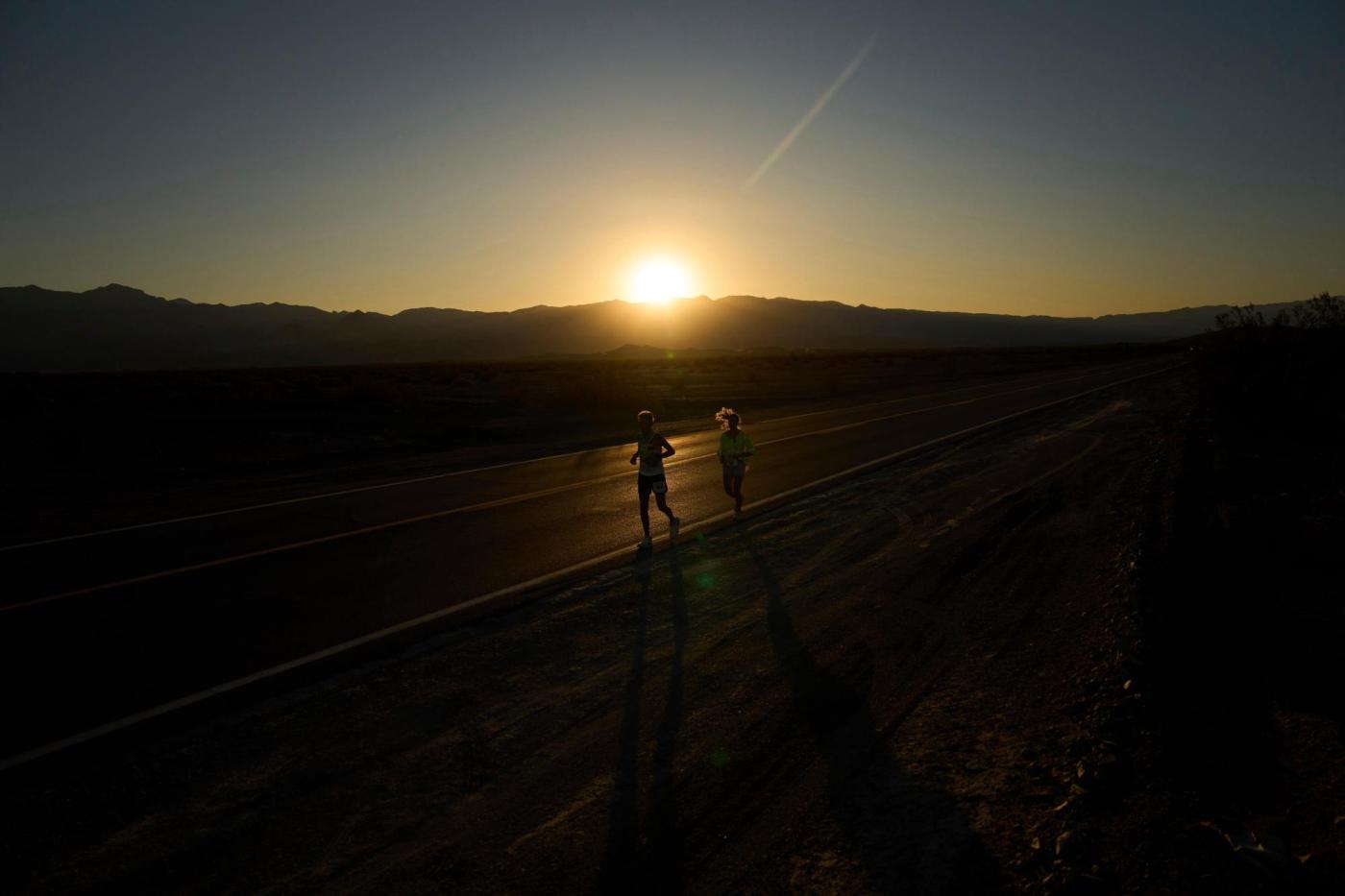
For 18 years, Westergaard, 66, has braved the scorching summer heat of California’s Death Valley in an ultramarathon billed as the world’s toughest. Last week, 99 runners from across the globe embarked on a grueling 135 mile competition from the lowest point below sea level of North America to the trailhead of the highest peak in the contiguous U.S. They had 48 hours to do it. Few have completed the competition as many times as Westergaard, a retired aerospace project manager, though finishing is not a given.
“It’s just become like a summer ritual and a family reunion,” he said. “I feel at home when I’m here. It’s my tribe.”
For the 37th year, the Badwater 135 Ultramarathon challenged athletes to withstand stretches of this dry, searing desert. The race takes place in July, when temperatures have soared into the 130s F. Even as a place of extremes, Death Valley is not immune to global warming. Seven of its hottest summers have occurred in the past 10 years, according to the National Park Service. And if planet-warming greenhouse gas emissions continue at their current pace, more places could experience its broiling temperatures.
Over two days, Westergaard would trek up and down mountain ranges, past sand dunes and salt flats, through quaint towns and vast desertscapes amid temperatures as high as 117 F. He tried to smile throughout, even when he felt miserable.
Danny Westergaard, left, cools of with water with pacing help from daughter Madison Westergaard as the sun rises during the Badwater 135 Ultramarathon, Tuesday, July 8, 2025, in Death Valley National Park, Calif. (AP Photo/John Locher)
“It just lifts you up,” he said of smiling so others smile back.
First night: The race begins
At 8 p.m., the first wave of runners take off. Westergaard jogs up a ramp into the pale light of dusk. It’s 113 F, and it feels like a blow dryer to the face.
Leap frogging in a van behind him is his cheer squad and support crew – Jennifer Drain, his smiley cousin back for the 17th year, and daughters Meagan, who has attended before, and Madison, a first timer. The crew, who playfully call Westergaard “wiener dog,” are hauling everything he needs: food, ice, water, electrolytes.
This heat can kill. Soaring body temperatures can lead to organ failure and strain the heart, especially for people with heart disease, and cause heat stroke. To prevent that they keep him cool. They spray mist on him and pour ice into his hat and a bandana wrapped around his neck. His drinking water is ice cold.
Danny Westergaard cools off in the shade while taking a short break during the Badwater 135 Ultramarathon, Tuesday, July 8, 2025, in Death Valley National Park, Calif. (AP Photo/John Locher)
A few hours in, Meagan asks her dad if he’s peed. “Long stream,” he responded of his amount of urine. Staying hydrated is critical. As he sweats, he’s losing liquids that can critically stress kidneys if not replenished. Dehydration can cause organs to fail from lack of blood, oxygen and nutrients, leading to seizures and death.
No runners have died doing the competition, but heat-related issues are common, said Megan Dell, the race’s medical director. Stomach issues can lead to vomiting and dehydration. Hyponatremia — which happens when your blood’s sodium is too low — has sent runners to the hospital.
Westergaard has learned to embrace the rollercoaster. One moment he feels like Superman — the next he could be throwing up on the side of the road, questioning if he’ll make it. “You just suck it up, just like in life, and get through the lows, and it always gets better.”
The next day: Running through “the oven”
The runners dash toward mile 50.8, the critical cut off point they must get to by 10 a.m. or be eliminated. The sun is peaking over the mountains, casting a warm glow over dune fields. It’s 85 F.
“Living the dream, ey?” Westergaard said with a smile, his perky strut now a droopy shuffle.
He pours water on his face and arms and munches some watermelon. Madison paces behind him as they crack jokes. “Get er done! Junior wiener in training!” Meagan yelled.
Danny Westergaard, right, competes with pacing help from daughter Meagan Westergaard during the Badwater 135 Ultramarathon, Tuesday, July 8, 2025, in Death Valley National Park, Calif. (AP Photo/John Locher)
Westergaard makes it to the cut off point before 9 a.m. It’s 90 F.
Mile 56: After moving for 14 hours straight, Westergaard rests and eats some avocado toast. “Great! Let’s motor!” he said after 10 minutes sitting on a chair.
Miles later, he begins his descent into “the oven” that is Panamint Valley, usually the hottest part of the race during the hottest part of the day. It’s 96 F and the heat sizzles from above and below. Westergaard runs on the white line on the road because it’s cooler. In hotter years, the asphalt got so hot the bottoms of his shoes felt sticky on the ground.
Westergaard trains year round to acclimate to the heat. As he gets older, he doesn’t tolerate heat as well and has slowed down. His two-hour sauna sessions are now one, and he runs a few times a week instead of daily.
“I’m just out there longer,” he said, “but still getting it done.”
Tony Wolf, kinesiology professor at the University of Georgia, said aging adults generally have reduced heart function compared to younger adults. When combined with the cardiovascular demand of exercise and heat stress, it can cause difficulties.
There isn’t much research about how the bodies of fit older adults, including competitive athletes, regulate internal temperature. “There aren’t a ton of people in their 60s and older who are doing those kinds of events,” said Wolf.
Danny Westergaard cools off with water before starting up after a short break during the Badwater 135 Ultramarathon, Tuesday, July 8, 2025, in Death Valley National Park, Calif. (AP Photo/John Locher)
Studies focused on adults before and after a training program found that exercise improved heart function and thermoregulation. That could suggest that the heart and thermoregulation impairments linked to aging are largely mitigated by lifelong fitness, Wolf said.
Second night: Sleepy hallucinations
The runners are spread out now, their flashing lights twinkling in the distance. This night is the toughest for Westergaard as sleep deprivation sets in. He zigzags on the road, barely awake. The runners ahead of him look like they’re running toward him.
In past years, his hallucinations have included people luring him to rest on couches that were actually bushes. Another time, he struck up a conversation with a kid skateboarding by him with a dog. And once, he watched for hours as a guy swung off the edge of the crescent moon, waving down at him.
“It was just clear as day,” Westergaard said of the hallucination.
At 3:10 a.m. at mile 98, he sleeps for 15 minutes under the moonlight.
“No one really quite understands” why he does this, said Madison.
Final day: The push toward the finish
At 11:50 a.m. and around mile 123, Westergaard shuffles through the town of Lone Pine. Mount Whitney, the tallest peak in the continental U.S., soars some 14,500 feet into the blue sky.
Danny Westergaard, leading the center group of runners, competes during the Badwater 135 Ultramarathon, Monday, July 7, 2025, near Badwater Basin in Death Valley National Park, Calif. (AP Photo/John Locher)
Danny Westergaard, left, competes with pacing help from daughter Madison Westergaard as the sun rises during the Badwater 135 Ultramarathon, Tuesday, July 8, 2025, in Death Valley National Park, Calif. (AP Photo/John Locher)
Danny Westergaard takes a break while competing in the Badwater 135 Ultramarathon, Tuesday, July 8, 2025, in Death Valley National Park, Calif. (AP Photo/John Locher)
Danny Westergaard runs during the Badwater 135 Ultramarathon, Tuesday, July 8, 2025, in Death Valley National Park, Calif. (AP Photo/John Locher)
Danny Westergaard reacts while taking a break around the 24-hour mark during the Badwater 135 Ultramarathon, Tuesday, July 8, 2025, in Death Valley National Park, Calif. (AP Photo/John Locher)
Danny Westergaard reacts while taking a break around the 24-hour mark during the Badwater 135 Ultramarathon, Tuesday, July 8, 2025, in Death Valley National Park, Calif. (AP Photo/John Locher)
Danny Westergaard rests beside Jennifer Drain, his cousin and crew lead, during the second night of the Badwater 135 Ultramarathon, Tuesday, July 8, 2025, in Death Valley National Park, Calif. (AP Photo/John Locher)
Danny Westergaard runs as the sun rises during the Badwater 135 Ultramarathon, Wednesday, July 9, 2025, near Lone Pine, Calif. (AP Photo/John Locher)
Danny Westergaard, left, competes during the Badwater 135 Ultramarathon beside Jennifer Drain, his cousin and crew lead, Wednesday, July 9, 2025, near Lone Pine, Calif. (AP Photo/John Locher)
Danny Westergaard, second from right, nears the finish line of the Badwater 135 Ultramarathon beside daughters Meagan Westergaard, right, Madison Westergaard, and cousin Jennifer Drain, left, Wednesday, July 9, 2025, at Whitney Portal near Lone Pine, Calif. (AP Photo/John Locher)
Danny Westergaard, second from right, embraces daughters Meagan Westergaard, right, and Madison Westergaard after finishing the Badwater 135 Ultramarathon, Wednesday, July 9, 2025, at Whitney Portal near Lone Pine, Calif. (AP Photo/John Locher)
1 of 11
Danny Westergaard, leading the center group of runners, competes during the Badwater 135 Ultramarathon, Monday, July 7, 2025, near Badwater Basin in Death Valley National Park, Calif. (AP Photo/John Locher)
It’s 92 F as he approaches the final 4,750 foot mountain ascent to the finish line. Westergaard is walking at a snail’s pace and says he’s falling asleep. But his smile hasn’t waned.
“We’ve come a long way,” Westergaard said, Madison pacing behind and spraying him.
“Long way for a burger!” she responded. They giggle while thinking about the veggie burger they’ll buy upon finishing.
Then he does, crossing the finish line with his crew at exactly 45 hours and 29 minutes.
It was his most special Badwater 135 race by far, he says misty eyed, having Meagan and Madison at his side.
The Associated Press receives support from the Walton Family Foundation for coverage of water and environmental policy. The AP is solely responsible for all content.
Twin Cities native Isaac Thompson, currently president and CEO of the Oregon Symphony, has been appointed the Minnesota Orchestra’s president and CEO, the symphony announced Friday.
Isaac Thompson will begin his new role on Oct. 14, 2025. (Courtesy of the Minnesota Orchestra)
“It is a great pleasure to welcome Isaac back to his ‘home’ orchestra as its new administrative leader,” said board chair Nancy Lindahl in a news release. “We were drawn to Isaac’s vision for what an orchestra can mean to its community when it knits together artistic, social and civic connections with real impact. He comes to this role with an impressive background encompassing creative collaborations with orchestra musicians and artistic leaders, significant experience securing private and public support, an understanding of how to truly strengthen community connections and a bold, entrepreneurial spirit — not to mention a deep-seated love for the Minnesota Orchestra.”
Thompson succeeds interim president and CEO Brent Assink, who began serving in that role in September following the departure of Michelle Miller Burns, who took the top administrative role with the Dallas Symphony. Thompson will begin his new role on Oct. 14.
Thompson played in the Minnesota Youth Symphonies and studied violin with Nancy Lokken and former Minnesota Orchestra Concertmaster Jorja Fleezanis in high school. He received a bachelor of music in violin performance from the University of Cincinnati College-Conservatory of Music and a master’s from the University of Texas at Austin.
He worked for the Milwaukee Symphony, the Cincinnati Symphony and the New York Philharmonic before joining the Oregon Symphony. Thompson serves on the boards of the League of American Orchestras and Minnesota Public Radio/American Public Media.
“The opportunity to return to Minnesota to lead my hometown orchestra at this moment is deeply meaningful,” Thompson said. “Many of my formative musical experiences occurred at Orchestra Hall in Minneapolis, and I credit my knowledge of and love for the symphonic repertoire to the Minnesota Orchestra.”
Related Articles
Alan Bergman, Oscar-winning lyricist who helped write ‘The Way We Were,’ dies at 99
MPR says rescission bill will ‘dismantle the public media system as we know it’
Steve Miller Band cancels Minnesota State Fair Grandstand show due to climate change
Connie Francis, whose hit songs included ‘Who’s Sorry Now?’ and ‘Pretty Little Baby,’ dies at 87
What to know about the killings of an ‘American Idol’ music supervisor and her husband in LA