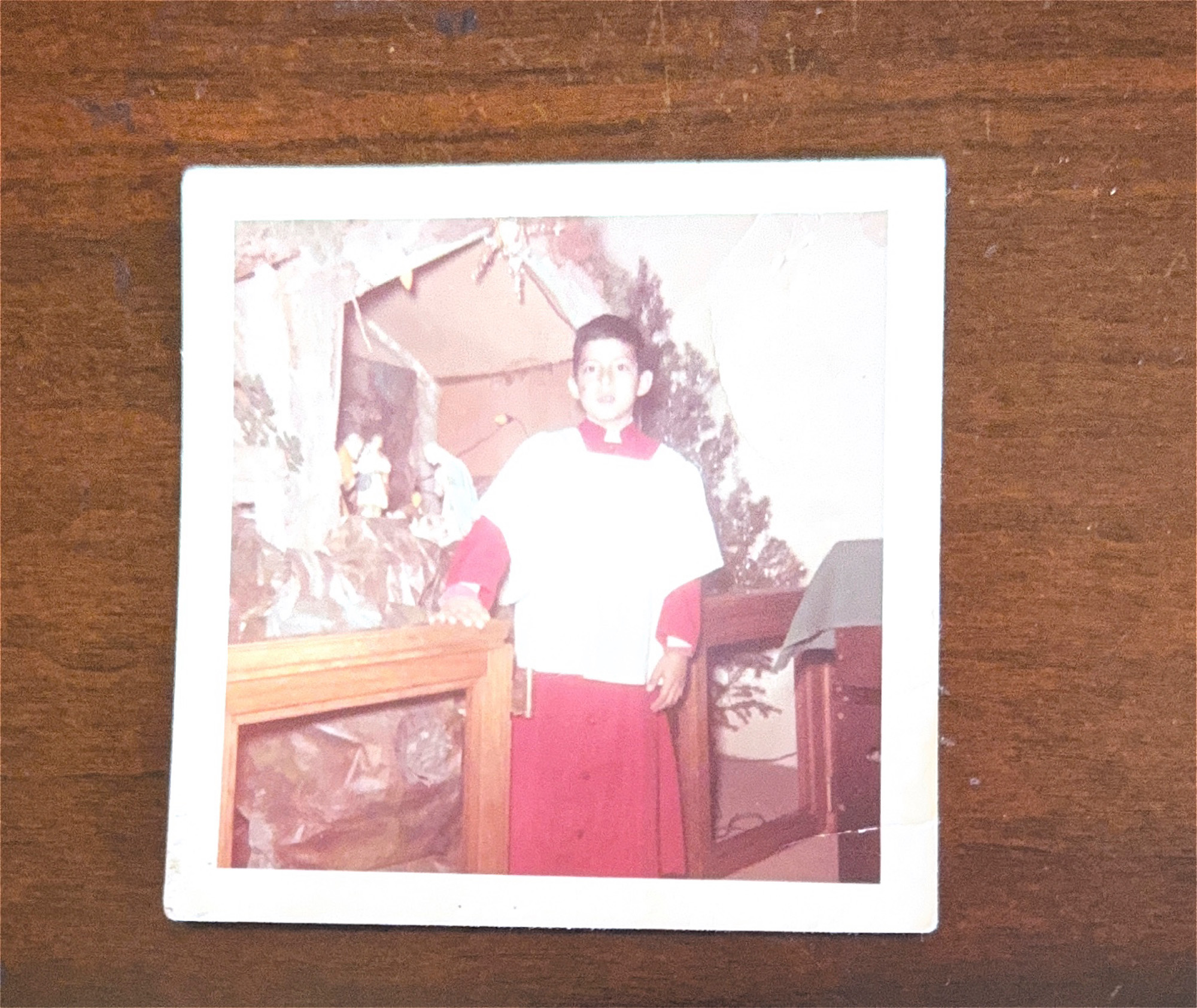
I was 7 years old the first time I put on the vestments. White surplice over red cassock, the fabric stiff and foreign against skin that was more accustomed to sweat and South Texas dirt. I had been born on East Hackberry Avenue in the McAllen labor camps. I was delivered at home, not in a hospital. The world I came from smelled of my mother’s handmade flour tortillas and arroz con pollo with little salted shrimp rehydrating in the rice, of honeysuckle and pomegranates growing wild in the back alley, of dust devils spinning in the summer heat. My father drove a GMC truck and hauled oranges for a produce warehouse called Griffin & Brand. We were farmworker people. We were poor. And on Sunday mornings, I carried the cross.
I served at that altar through baptism, catechism, confirmation, and Communion. I believed what I was taught. I rang the bells at the elevation of the host and meant it. But even then, even as a child who did not yet have the language for what he was seeing, I watched my community from that altar and I wondered. The families in those pews—farmworkers, migrants, the working poor of South Texas—came every Sunday carrying burdens the Church preached about but did very little to lift. The suffering around me was concrete. The poverty was concrete. The Church’s response, as best as I could tell, was to pass the collection plate and promise a better world somewhere else.
I always wondered why. Now I know.
The author as a child (Courtesy/Jorge Meave)
I am no longer a believer. After more than 30 years as a bilingual educator, instructional coach, and administrator in the public schools of East Austin serving the children of families not unlike the one I came from, I understand religion as a human social construct. One that’s capable of extraordinary good and profound harm, often at the same time, in the same building, on the same Sunday morning. I hold that view without bitterness. The Church built hospitals. Educated generations. Did genuine good. But I have carried that childhood question with me for nearly seven decades, and I have never received a satisfying answer.
So when Pope Leo XIV released Magnífica Humanitas in May 2026, I read it with the particular attention of someone who learned to read at the feet of this institution and then spent a lifetime watching it fail the people it claimed to serve.
I want to be honest: The encyclical is serious and it is good. Pope Leo XIV draws an explicit parallel to Leo XIII’s Rerum Novarum, the 1891 document that addressed factory workers and industrial exploitation, and applies that same moral framework to the age of artificial intelligence. He sees, clearly and without equivocation, how AI-driven automation threatens workers, concentrates wealth, and compounds the suffering of those already at the margins. He defends human dignity. He defends organized labor. He calls for concrete social criteria to govern technological innovation. This is the Church’s social teaching at its best, and this pope appears to mean it.
But I keep coming back to the loaves.
Whether you read it as miracle or metaphor, the story of the loaves and fishes has always struck me as the Gospel at its most honest. Jesus did not look out at a hungry crowd and deliver a homily about the spiritual virtues of hunger. He did not instruct them to pray for bread and trust in divine providence. He fed them, hand to mouth. Bread in hand. Fish on the ground. That is the standard the Church set for itself 2,000 years ago, and it is the standard by which I am measuring this document today.
In post-Citizens United America, words are not enough. The 2010 Supreme Court decision opened the floodgates to unlimited dark money in American politics, and the right has used it with devastating efficiency. From the Koch brothers to the Wilks brothers, the Heritage Foundation to the Chamber of Commerce, a network of ideologically aligned donors has poured billions into dismantling the very protections—labor rights, social safety nets, public education—that this encyclical claims to defend. And they do this not by writing treatises but by writing checks.
The Vatican holds an estimated $73 billion in assets. The Catholic Church commands the loyalty of nearly one in five American adults. That is not a church that needs to pass the plate; that is an institution with the resources to move policy, fund organizing, and match the moral urgency of its own documents with the kind of financial and political commitment that actually changes the conditions of people’s lives. Progressive institutional investment is just as legal as the right’s dark money. The question is whether the will is there.
I think about the families I taught in East Austin. The kids who came to school hungry. The parents working two jobs at wages that hadn’t kept pace with rent since before their children were born. I think about my own family on East Hackberry Avenue, my mother’s tortillas stretching to feed us. These are the people Magnifica Humanitas is written for. These are the people who have been filling Catholic pews for centuries while the institution sat on wealth that could have built a different world.
I know something about waiting.
When I was a boy, after my parents divorced, I decided I wanted to go live with my father. I called him myself, without telling my mother. He said he would come get me. She packed me a suitcase and set it on the sofa and told me to wait.
I waited six or seven days. My father never came.
My mother never said a word against him. She let me find out for myself who he was. That is a particular kind of love, the kind that trusts you with the truth even when the truth is going to hurt.
I have been thinking about that suitcase my whole life without knowing it. The boy on the sofa waiting for someone who promised to come. The community in the pews waiting for an institution that preaches abundance and sits on billions. The workers waiting for the protections the Church endorses in documents and withholds in action.
THE VATICAN HOLDS AN ESTIMATED $73 BILLION IN ASSETS.
Pope Leo XIV is saying the right things. He sees the world clearly. And I give him that credit freely, from a man who no longer prays, who understands religion as a human social construct, and who learned at a very young age that the distance between a promise and a kept promise is where people actually live.
The altar boy from South Texas is still here. He is 68 years old. He has spent his life serving the same communities he watched suffer from behind the Communion rail. He is not asking for a miracle.
He is asking for the concrete thing. He has been asking his whole life.
Holy See, distribute the loaves.
The post It’s Time for the Catholic Church to Distribute the Loaves appeared first on The Texas Observer.
Leave a Reply