“Instead of a society organized around enabling corporate profits and giving the market an outsized power over our lives, a government grounded in the theory of radical municipalism addresses the core material needs of its citizens and gives them a voice.”
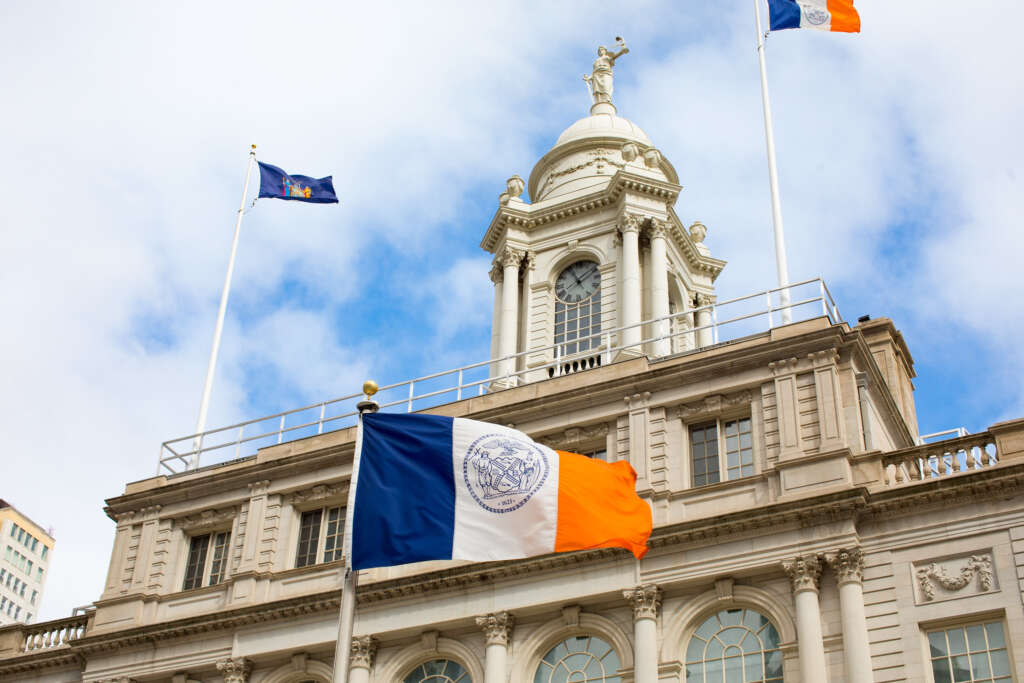
New York City Hall. The next mayor’s term will start Jan. 1, 2026. (Benjamin Kanter/Mayoral Photo Office)
The recent electoral victory of Zohran Mamdani in the Democratic primary for New York City mayor reflects a growing desire among New Yorkers for transformative change in core areas of everyday life: housing, transportation, and food. His campaign centered affordability and inspired a wave of civic participation—mobilizing new voters, reactivating disengaged ones, and reaching what some have described as “in-between voters.”
While political analysts dissect the dynamics of Mamdani’s campaign, this article highlights an underlying strategy that has long guided social movements: radical municipalism. This approach emphasizes local governance as a site of meaningful political change—an idea gaining traction since the 2008 financial crisis and amplified during COVID-19, when communities turned to mutual aid networks to meet basic needs amid government inaction. The mass protests following George Floyd’s murder further underscored the deep structural inequalities that remain unaddressed at the state and federal levels.
Ongoing neoliberal economic policies, which enable greater corporate power over our daily lives and diminish the government’s role in regulating the market, have only intensified the economic precarity faced by working-class and middle-class families. The wealth gap has grown dramatically in recent decades, exacerbating inequality and disillusionment.
In this context, radical municipalism—a grassroots political movement grounded in neighborhoods as the principal political unit—has reemerged as a powerful strategy for change. It enables communities, given their proximity to local governance, to mobilize for changes in law and policy. It has become a political strategy for social movements advancing childcare, the Green New Deal, labor rights, and racial justice.
Importantly, this strategy is not new. As far back as 1936, Daniel Hoan, the socialist mayor of Milwaukee, observed that “no unit of government deals more intimately and frequently with the daily life of the average citizen than the local municipality.” Later, theorist Murray Bookchin argued that radical municipalism could dismantle socioeconomic hierarchies and replace them with egalitarian, participatory structures rooted in collective responsibility.
In other words, instead of a society organized around enabling corporate profits and giving the market an outsized power over our lives, a government grounded in the theory of radical municipalism addresses the core material needs of its citizens and gives them a voice in our little “d” democracy.
Historically, radical municipalism has gained salience in response to national crises—post-Depression, post-civil rights era, and post-2008 economic collapse. The election of Donald Trump further accelerated the embrace of local strategies. In New York, Mamdani’s campaign was propelled by organizing groups like the Democratic Socialist of America, immigrant justice groups such as DRUM and CAAAV, faith-based organizations, and a new generation of politically active Black voters.
Already, Mamdani faces attacks—legal, political, and personal. His opponent, Eric Adams, now running as an independent, has questioned the feasibility of Mamdani’s proposals, many of which will require state support. Because cities are creatures of state law, opponents argue that Mamdani’s agenda may be stymied.
But many of his proposals are not novel; they build on existing city initiatives—like rent freezes, free public buses, and expanded childcare—that have already proven both popular and feasible. Moreover, because cities across the U.S. have been experimenting with municipal approaches, the legal appetite for greater local control, referred to as home-rule, has been shifting. Democratic governors like Kathy Hochul would be hard pressed to override or create obstacles for popular proposals among the electorate.
Over the past two decades, New York City has seen considerable policy innovation through municipal action. I have worked as a lawyer advocating for racial and economic justice throughout this time, including as the general counsel for litigation for the Office of the New York City Public Advocate. More recently, as a law professor, I have studied social movements transnationally, focused on the hyper-local level, investigating what has worked and what are lessons we can learn from past efforts.
I’ve witnessed participatory budgeting, paid sick leave legislation, app-based driver protections, and the adoption of “just cause” laws. In 2022, New Yorkers voted to establish the NYC Commission on Racial Equity, a charter amendment mandating racial equity across city governance. During COVID, state-level advocates secured $2.1 billion for the Excluded Worker Fund, offering support to jobless New Yorkers otherwise left out of federal relief. I’ve seen firsthand how local politics—when energized by grassroots movements—can yield transformative results.
These victories demonstrate that where political will exists, progressive change is possible—especially at the municipal level, and with an activated electorate.
Given this real potential, Mamdani’s critics have resorted to well-worn tactics: red-baiting, conflating democratic socialism with communism, and invoking racist, Islamophobic tropes to undermine his legitimacy. They question whether a Muslim man of color can represent New Yorkers—a tactic historically used to bar people of color from office. False narratives also claim he lacks support among Black voters, despite data showing he performed well in communities where outreach occurred, including my neighborhood in Harlem.
These fear tactics date back to the founding of our country, which is why our electoral system is based on a representative form of democracy where leaders are elected to speak for the people, rather than direct democracy, where every voice has a say. However, at the municipal level, we have the opportunity to build a political and electoral culture that trust its citizens. Constitutionally, our federalist form of government has reserved powers to states, which is why we have state constitutions. States like New York have also enabled local autonomy through a home rule provision in their constitutions and City Charters.
These attacks obscure what has already been achieved—and what remains possible—through local governance. Mamdani has not ideologically branded his campaign as “municipalist,” but his strategy aligns with its principles: building relationships, fostering trust, and centering community.
We can draw two key lessons from past municipalist movements:
Community-based political education: There is widespread misunderstanding of democratic socialism and Mamdani’s policy proposals. Grassroots education is essential to clarify how such policies—like rent stabilization, Social Security, and unemployment insurance—are part of a tradition that views the state as responsible for ensuring the welfare of its people. These principles trace back to Martin Luther King Jr.’s Freedom Budget, co-authored with labor leader A. Philip Randolph, which called for an end to poverty through guaranteed employment and income. As this article seeks to do, we need to share with the voters concrete examples and proposals from the past, point out where there have been successes, and draw lessons from those wins.
Sustaining the movement through popular assemblies: Mamdani’s campaign engaged over 50,000 volunteers and secured the most votes in a New York primary in history. This momentum should not dissipate after the election. Past campaigns—like those of Barack Obama and Bernie Sanders—struggled to maintain grassroots energy, often redirecting volunteers into institutional or electoral channels. Instead, Mamdani’s campaign can take a page from radical municipalism by creating neighborhood popular assemblies—grassroots forums where community members deliberate and decide on issues affecting them. The civic momentum that has been generated from the campaign needs to be channeled to local formations.
New York City already has an infrastructure to support this radical municipalism model. The NYC Civic Engagement Commission (CEC), created through a voter-approved ballot initiative, is tasked with supporting participatory budgeting, developing civic engagement programs, and aiding community boards. It offers a ready framework for democratic experimentation and public participation. Community boards, which I have previously served on, can be reoriented to serve as a vehicle for neighborhood-based civic activism within the model of radical municipalism.
At a time when national politics feels gridlocked, cities like New York are sites of bold experimentation. The blueprint for success already exists—built through years of community-led municipal activism. But to realize the full promise of this political moment, we must continue organizing, educating, and building institutions that keep communities engaged beyond the ballot box.
Chaumtoli Huq is a professor of law at CUNY School of Law. Her scholarship focuses on transnationalism and social movements. She has over two decades of experience advocating for low-income New Yorkers and advancing racial and economic justice.
The post Opinion: Radical Municipalism Offers New York a Path Forward appeared first on City Limits.