Weinstein could be sentenced next month, but only if there’s no retrial on an unresolved rape charge

posted in: All news | 0

By MICHAEL R. SISAK and JENNIFER PELTZ, Associated Press

NEW YORK (AP) — Harvey Weinstein faces sentencing and a possible retrial in his New York City sex crimes case, but when they’ll happen — and whether he’ll be back in front of another jury — is still up in the air.

Manhattan Judge Curtis Farber said Wednesday he could sentence Weinstein on Sept. 30 — but only if there’s no retrial on a rape charge that the last jury failed to reach a verdict on.

Weinstein, 73, was convicted in June of forcing oral sex on TV and movie production assistant and producer Miriam Haley in 2006. The charge carries a possible sentence of up to 25 years in prison.

At the same time, the jury acquitted him of forcing oral sex on another woman, one-time model Kaja Sokola, but couldn’t decide a charge that he raped hairstylist and actor Jessica Mann in 2013.

Related Articles


Federal agents will be out 24/7 on patrol in Washington, the White House says


Floodwaters from glacier near Alaska’s capital city break record levels and prompt evacuations


Trump pledged to move homeless people from Washington. What we know and don’t know about his plans


Don’t scan QR codes on unsolicited packages delivered to your house, FBI warns


Wall Street drifts around its records following a worldwide rally

Manhattan prosecutors told Farber that they’re ready to take Weinstein to trial for a third time on the rape charge, which is punishable by up to four years in prison. That’s less time than Weinstein has already served.

Mann is on board to testify again, they said.

Prosecutors requested a January trial date, citing witness availability and their own caseload. Farber balked at that, saying a January date is too far away and conflicts with another, unrelated trial he’s already scheduled. He proposed having the trial in the fall.

“The case needs to be tried this year,” Farber said.

Weinstein lawyer Arthur Aidala agreed, telling Farber he’d prefer a trial at “the earliest the court can accommodate us.”

Assistant District Attorney Nicole Blumberg said she would ask Mann and other witnesses about their availability for a trial in the fall.

If a fall trial happens, it would likely put Weinstein’s high-profile #MeToo case back in court as Manhattan District Attorney Alvin Bragg is in the final throes of his reelection bid.

Bragg, a first-term Democrat who made prosecuting sex crimes cases a priority, has expressed satisfaction with Weinstein’s conviction on a criminal sex act charge in the Haley assault and has been resolute in wanting the Oscar-winning studio boss retried on the Mann rape charge.

“The jury was not able to reach a conclusion as to Ms. Mann, and she deserves that,” Bragg said in June. “This work, first and foremost, is about the survivors and that’s why we’re prepared to go forward.”

Aidala told reporters outside court that, in his view, it’s on prosecutors to resolve the rape charge — either by dropping it and clearing the way for sentencing, or promptly taking it to trial again.

Weinstein sat in court in a wheelchair while wearing a blue suit and black-rimmed glasses. The “Pulp Fiction” and “Shakespeare in Love” producer is committed to fighting the rape charge at another trial, Aidala said, though the lawyer didn’t rule out the possibility of reaching a deal with prosecutors to end the case.

For now, the trial date remains unresolved, leaving Weinstein’s possible Sept. 30 sentencing in limbo.

At Weinstein’s first trial in 2020, jurors convicted him of raping Mann and forcing oral sex on production assistant and producer Miriam Haley.

Then an appeals court overturned those convictions and sent the case back for retrial because of legal issues involving other women’s testimony.

This spring, a new jury convicted him again of sexually assaulting Haley and acquitted him of doing the same to another woman who wasn’t part of the first trial. But amid fractious deliberations, the majority-female jury got stuck on the charge related to Mann.

Mann has testified that she also had a consensual, on-and-off relationship with the then-married Weinstein, but that she told him “I don’t want to do this” as he cornered her in the hotel room. She said he persevered with advances and demands until she “just gave up.”

Weinstein already stands convicted of sex crimes in California. He denies all of the allegations against him.

2 found dead after house fire in northern Minnesota

posted in: All news | 0

Two people were found dead Wednesday after a home caught fire in rural Cass County.

The Cass County Sheriff’s Office responded to the fire at 2:43 a.m. on Shady Lane Northeast in Crooked Lake Township, east of Outing. According to a news release from the sheriff’s office, first responders arrived on scene and found a residential structure engulfed in fire. While efforts were underway to extinguish the fire, the remains of two deceased victims were located inside the residence.

Autopsies will be scheduled with the Ramsey County Medical Examiner’s Office in St. Paul.

The investigation is ongoing with the assistance of the Crooked Lake Fire Department, the Minnesota State Fire Marshal’s Office and the Minnesota Bureau of Criminal Apprehension.

Related Articles


Minnesota could owe IRS nearly $7M over tax benefit error


Gov. Walz names four to fill UMN Board of Regents vacancies


Man dies after jumping from waterfall at Minnesota state park


Iron Range elected official pleads guilty to vandalizing power line


With upcoming closure of Stillwater prison, inmates’ legal documents at risk, group says

Federal agents will be out 24/7 on patrol in Washington, the White House says

posted in: All news | 0

By LINDSAY WHITEHURST and ASHRAF KHALIL

WASHINGTON (AP) — As a wary Washington waited, the White House promised a ramp-up of National Guard troops and federal officers on the streets of the nation’s capital around the clock starting Wednesday, days after President Donald Trump’s unprecedented announcement that his administration would take over the city’s police department for at least a month.

The city’s Democratic mayor and police chief framed the influx as a plus for public safety, though they said there are few hard measures for what a successful end to the operation might look like. The Republican president has said crime in the city was at emergency levels that only such federal intervention could fix even as District of Columbia leaders pointed to statistics showing violent crime at a 30-year low after a sharp rise two years ago.

For two days, small groups of federal officers have been visible in scattered areas of the city. That is about to change, the administration says.

A “significantly higher” presence of guard members was expected Wednesday night, and federal agents will be out 24/7 rather than largely at night, according to the White House. Hundreds of federal law enforcement and city police officers who patrolled the streets Tuesday night made 43 arrests, compared with about two dozen the night before.

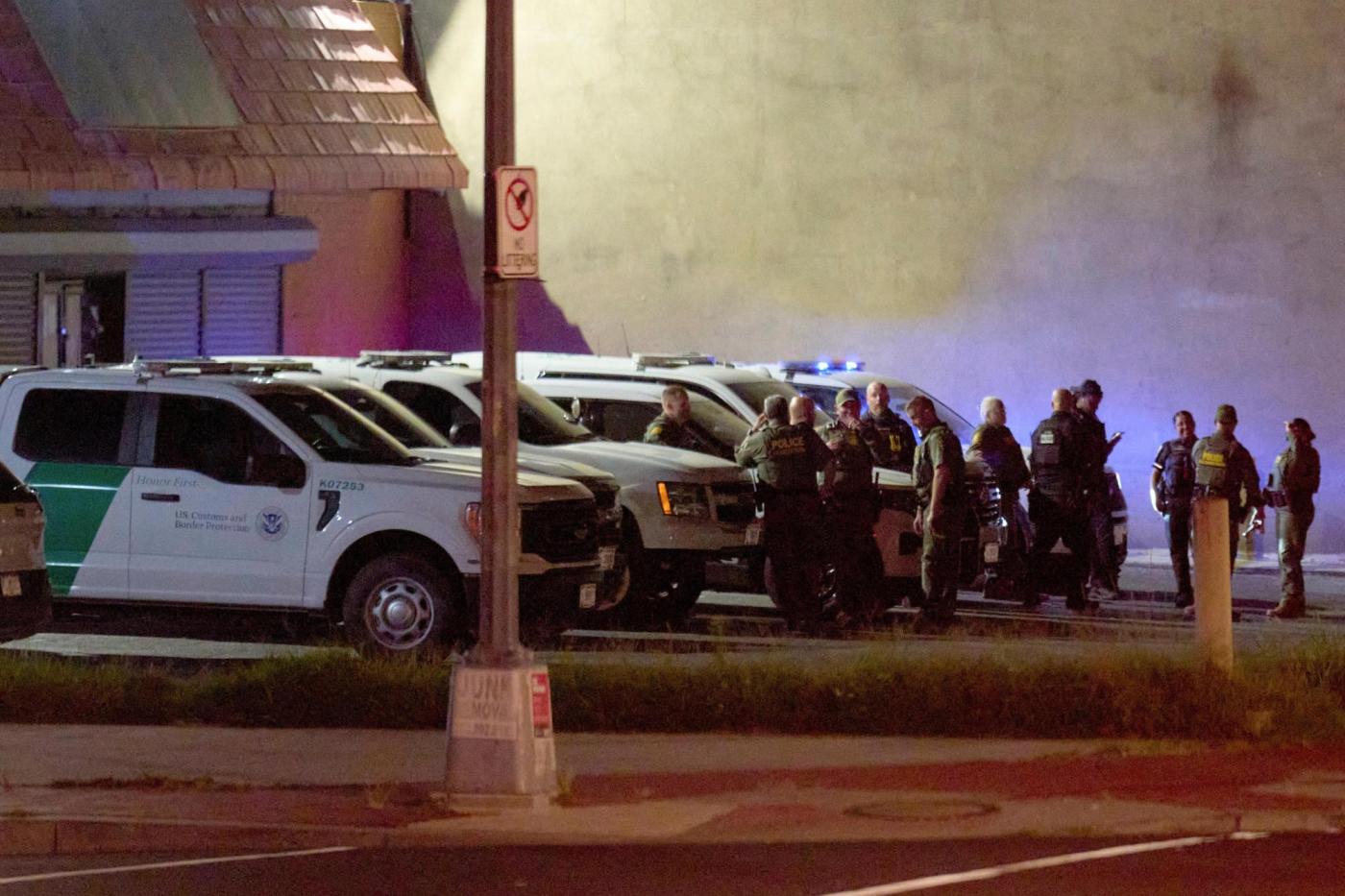
In one neighborhood, officers from the Bureau of Alcohol, Tobacco, Firearms and Explosives and the FBI could be seen along with the U.S. Park Police searching the car of a motorist parked just outside a legal parking area to eat takeout and drop off a friend. Two blocks away, U.S. Customs and Border Protection officers gathered in a parking lot before driving off on patrol.

In other parts of the city, including those with popular nightlife hot spots, federal patrols were harder to find. At the National Mall, there was little law enforcement activity aside from Park Police cruisers pulling over a taxi driver near the Washington Monument.

Unlike in other U.S. states and cities, the law gives Trump the power to take over Washington’s police for up to 30 days. Extending his power over the city for longer would require approval from Congress, and that could be tough in the face of Democratic resistance.

A variety of infractions are targeted

The arrests made by 1,450 federal and local officers across the city included those for suspicion of driving under the influence, unlawful entry, as well as a warrant for assault with a deadly weapon, according to the White House. Seven illegal firearms were seized.

Unlike in other U.S. states and cities, the law gives Trump the power to take over Washington’s police for up to a month. Extending Trump’s power over the city for longer would require approval from Congress, and that could be tough in the face of Democratic resistance.

The president has full command of the National Guard, but as of Tuesday evening, guard members had yet to be assigned a specific mission, according to an official who was not authorized to discuss the matter publicly and spoke on condition of anonymity. As many as 800 troops were expected to be mobilized in a support role to law enforcement, though exactly what form remains to be determined.

The push also includes clearing out encampments for people who are homeless, Trump has said. U.S. Park Police have removed dozens of tents since March, and plan to take out two more this week, White House press secretary Karoline Leavitt has said. People are offered the chance to go to shelters and get addiction treatment, if needed, but those who refuse could be fined or jailed, she said.

City officials said they are making more shelter space available and increasing their outreach.

Related Articles


Trump pledged to move homeless people from Washington. What we know and don’t know about his plans


Judge skeptical of Trump administration’s suit against Maryland judges, will rule by Labor Day


Trump-Putin summit on Ukraine is latest chapter in Alaska’s long history — and tension — with Russia


South Korean president will meet Japanese leader ahead of summit with Trump


Appeals court lets the White House suspend or end billions in foreign aid

Violent crime has dropped in the district

The federal effort comes even after a drop in violent crime in the nation’s capital, a trend that experts have seen in cities across the U.S. since an increase during the coronavirus pandemic.

On average, the level of violence Washington remains mostly higher than averages in three dozen cities analyzed by the nonprofit Council on Criminal Justice, said the group’s president and CEO, Adam Gelb.

Police Chief Pamela Smith said during an interview with the local Fox affiliate that the city’s Metro Police Department has been down nearly 800 officers. She said the increased number of federal agents on the streets would help fill that gap, at least for now.

Mayor Muriel Bowser said city officials did not get any specific goals for the surge during a meeting with Trump’s attorney general, Pam Bondi, and other top federal law enforcement officials Tuesday. But, she said, “I think they regard it as a success to have more presence and take more guns off the street, and we do too.”

She had previously called Trump’s moves “unsettling and unprecedented” while pointing out he was within a president’s legal rights regarding the district, which is the seat of American government but is not a state.

For some residents, the increased presence of law enforcement and National Guard troops is nerve-wracking.

“I’ve seen them right here at the subway … they had my street where I live at blocked off yesterday, actually,” Washington native Sheina Taylor said. “It’s more fearful now because even though you’re a law-abiding citizen, here in D.C., you don’t know, especially because I’m African American.”

Associated Press writers Konstantin Toropin and Will Weissert, photographer Jacquelyn Martin and video journalist River Zhang contributed to this report.

Texas Lawmakers Push ‘Massive Secrecy Grab’ to Shield Police Files

posted in: All news | 0

In 1998, the San Antonio Police Department (SAPD) began requiring officers to fill out reports any time they had to use force, a big step toward tracking when and why police resorted to strong-arming residents of the state’s then-third largest city. Members of the public, including reporters, could already access incident reports and offense reports—which had been public by law for decades—but these new documents could offer a more detailed look into how officers were reacting to tense situations. 

That same year, a young San Antonio Express-News reporter named John Tedesco asked to see the use of force reports, but the department declined. SAPD had tucked these particular reports away in confidential files, separate from officers’ main personnel files, shielding them from the prying eyes of the public. 

This secret file, commonly referred to as the “G-file” because of the subsection of the Texas Local Government Code that created it, was meant to be a repository for what lawmakers considered to be the most sensitive law enforcement and fire department personnel records, including those related to unsubstantiated misconduct complaints. Under Texas open records law on the books since 1973, Police officers’ general personnel files are public, but the G-file has served as a carve-out since the late ’80s. 

In 1999, the Texas Attorney General’s Office sided with the Express-News, but the San Antonio police still refused to release the documents until an appeals court finally ruled that the department had no reason to put the records in a confidential file. “San Antonio spent thousands of taxpayer dollars on legal fees to withhold information from the public—and kept losing at every turn,” Tedesco told the Texas Observer in early August. He said the records allowed him to look at trends in use-of-force data, resulting in stories about problematic officers and units, as well as analyses of racial disparities.

This legal fight exemplified what’s proven true in the ensuing decades: Allowing police departments the discretion to silo off certain parts of police personnel records is a recipe for abuse. The headlines over the San Antonio legal fight may have run alongside coverage of the coming Y2K disaster, but the issue is no thing of the past. 

In his agenda for the current special legislative session, Governor Greg Abbott called for “legislation that protects law enforcement officers from public disclosure of unsubstantiated complaints in personnel files.” Lawmakers in both chambers swiftly filed bills to meet the governor’s demand, SB 14 and HB 14—repeats of measures that failed to pass in the earlier regular session. The proposed legislation would shield large swaths of records about officers—including complaints of misconduct that didn’t result in discipline—from public view. This would allow hundreds of departments that would have previously disclosed these records to keep them secret. 

The state Senate passed SB 14 on Tuesday, but the House remains at a standstill as Democrats maintain a quorum break in protest of proposed congressional redistricting, setting up a likely additional special session (and possibly even more).

The bills, which are being presented as a way to standardize personnel records in departments across the state, are based on a model created by the regulatory agency the Texas Commission on Law Enforcement (TCOLE). Critics say the measure could have devastating consequences for police transparency.

“This is the most massive secrecy grab in Texas since the adoption of the Public Information Act,” Kathy Mitchell, senior advisor with the criminal justice policy nonprofit Equity Action, told the Observer. 

Transparency advocates like Mitchell point out that many Texas police departments currently operate without a G-file—and without the sky falling. Only municipalities whose voters have adopted the state’s civil service law for police and firefighters actually have the secret police files, and most of these votes occurred around the middle of the 20th century, prior to 1989 when the G-file was added to that statute. Seventy-eight Texas municipalities fall into this civil service category, including most major cities: Houston, San Antonio, and Austin—but not Dallas, where the public has access to unsubstantiated misconduct complaints.

Meanwhile, statewide groups that support the reduction in police transparency—including TCOLE and the state’s largest police union the Combined Law Enforcement Associations of Texas (CLEAT)—point to this very variance across cities as the reason for the current legislation. In August, SB 14 was heard before the Senate State Affairs Committee. “The legislative intent behind these model policies was to establish a standardization of the way we do things in law enforcement in certain areas where we lack standardization,” said Jennifer Szimansky, deputy executive director of CLEAT.

Throughout the hearing, lawmakers and bill proponents repeatedly stated that the measure would only protect officers’ sensitive personal information and regularize practices across the state. Prominent representatives from Dallas, the largest Texas city that doesn’t maintain a G-file, showed up to testify on the bill. Lieutenant Jonathan Blanchard with the Dallas Police Department spoke in favor, on behalf of the department, emphasizing the need to keep things like sick days and vacation time confidential. 

But the wording of the proposed legislation has raised alarms for advocates, who say it would not only spread the existing G-file system to more cities but would essentially super-size the secret file: creating a catch-all “department file” to ferret away even more information about police misconduct. The bill states the file would contain documents including “any letter, memorandum, or document relating to the license holder not included in a personnel file.”

Other opponents worried the bill would make it more difficult for citizens to successfully level complaints and that it didn’t account for all the agencies and people who should legally have access to the information, including independent oversight boards and the Legislature itself. 

“SB 14 should be named the ‘Protect Bad Cops and Let the People Eat Cake Act,’” said CJ Grisham, a retired federal agent, right-wing activist, and civil rights attorney.

The details of the legislation may still change, but underlying any minor modifications is a fundamental debate about whether unsubstantiated complaints should see the light of day. Proponents say unconfirmed complaints can show patterns of behavior on the part of an officer and the department. According to the National Police Accountability Project, most civilian complaints are deemed unsubstantiated, regardless of whether the officer violated policy. The executive director of that project, Lauren Bonds, said access only to complaints that resulted in discipline provides “a very, very small snapshot of the types of problems that people might be having.” 

Similar concerns hold for records related to county jailers. “‘Unsubstantiated’ doesn’t mean ‘false,’” said Krishnaveni Gundu, executive director of the Texas Jail Project. “‘Unsubstantiated’ could also mean ‘did not get a thorough investigation,’ or maybe ‘it wasn’t investigated at all.’”

Michael Bullock, president of the Austin Police Association, testified at the hearing that the capital city should serve as a cautionary tale about the need for legislation shielding unsubstantiated complaints. 

In 2023, local voters passed the Austin Police Oversight Act, which effectively opened up the previously confidential G-file. After about a year of pushback from the department and the police union—and following a judge’s order that the records must be released—city officials agreed to open up the G-file. This promise was written into a 5-year contract between the city and the police union, which was signed in 2024 after protracted negotiations. In his testimony, Bullock said that Austin officers “are being tried in a court of public opinion before they ever have a chance to get a fair trial” and urged state lawmakers to overrule the transparency outlined in his own union contract.

As originally filed, SB 14 contained a carve-out that specifically grandfathered in existing union contract provisions about disclosure of police files. That language was removed in committee, but the bill still allows disclosure “as required by law.” In a floor exchange that Austin state Senator Sarah Eckhardt had entered into the written record, bill author Phil King stated the new language was still meant to protect union contract provisions—including those agreed to going forward.

The post Texas Lawmakers Push ‘Massive Secrecy Grab’ to Shield Police Files appeared first on The Texas Observer.