PORTLAND, Maine (AP) — A network of clinics that provides health care in Maine is expected to ask a judge Thursday to restore its Medicaid funding while it fights a Trump administration effort to keep federal money from going to abortion providers.
Related Articles
Congress looks to ease restrictions on veterans’ use of non-VA clinics and hospitals
DC Mayor Bowser walks delicate line with Trump, reflecting the city’s precarious position
Social Security has existed for 90 years. Why it may be more threatened than ever
European leaders praise Trump for offering US military support for future peace force in Ukraine
As Canada wildfires choke US with smoke, Republicans demand action. But not on climate change
President Donald Trump’s policy and tax bill, known as the “ big beautiful bill,” blocked Medicaid money from flowing to Planned Parenthood, the nation’s largest abortion provider. The parameters in the bill also stopped funding from reaching Maine Family Planning, a much smaller provider that offers health care services in one of the poorest and most rural states in the Northeast.
A federal judge ruled last month that Planned Parenthood clinics around the country must continue to be reimbursed for Medicaid funding as the provider wrangles with the Trump administration over efforts to defund it.
Maine Family Planning filed a federal lawsuit last month seeking to restore reimbursements.
Lawyers and representatives for Maine Family Planning say its 18 clinics provide vital services across the state including cervical cancer screenings, contraception and primary care to low-income residents. They also say the funding cut occurred even though Medicaid dollars are not used for its abortion services.
“Without Medicaid, MFP will be forced to stop providing all primary care for all patients — regardless of their insurance status — by the end of October,” the organization said in a statement, adding that about 8,000 patients receive family planning and primary care from the network.
It also said many Maine Family Planning clinics “provide care in very rural areas of the state where there are no other health care providers, and around 70% of their patients rely exclusively on MFP and will not see any other health care provider in a given year.”
In court documents, Anne Marie Costello, deputy director for the Center for Medicaid & CHIP Services, called the request to restore funding “legally groundless” and said it “must be firmly rejected.”
“The core of its claim asks this Court to revive an invented constitutional right to abortion — jurisprudence that the Supreme Court decisively interred — and to do so in a dispute over federal funds,” Costello said.
While advocates of cutting Medicaid for abortion providers focused on Planned Parenthood, the bill did not mention it by name. Instead it cut off reimbursements for organizations that are primarily engaged in family planning services — which generally include things such as contraception, abortion and pregnancy tests — and received more than $800,000 from Medicaid in 2023.
The U.S. Senate’s parliamentarian rejected a 2017 effort to defund Planned Parenthood because it was written to exclude all other providers by barring payments only to groups that received more than $350 million a year in Medicaid funds. Maine Family Planning asserts in its legal challenge that the threshold was lowered to $800,000 this time around to make sure Planned Parenthood would not be the only entity affected.
It is the only other organization that has come forward publicly to say its funding is at risk.
Planned Parenthood’s legal fight with the Trump administration over Medicaid funding is still in the court system also.
DEIR AL-BALAH, Gaza Strip (AP) — More than 100 nonprofit groups warned Thursday that Israel’s rules for aid groups working in the Gaza Strip and occupied West Bank will block much-needed relief and replace independent organizations with those that serve Israel’s political and military agenda — charges that Israel denied.
At the same time, hospital officials reported more deaths from Israeli airstrikes and an increasing toll from malnutrition.
The mounting backlash over aid restrictions and the worsening humanitarian crisis in Gaza have been cited by several countries as a factor in their moves toward recognizing Palestinian statehood. Yet on Thursday, Israel advanced plans for a new settlement expansion in the occupied West Bank, with one far-right government minister describing the move as a way to “bury the idea of a Palestinian state.”
Israeli Finance Minister Bezalel Smotrich arrives for a press conference about new settlement construction in the Israel-occupied West Bank near Maale Adumim, Thursday, Aug. 14, 2025. (AP Photo/Ohad Zwigenberg)
A Palestinian patient sweats during a heat wave, inside a warehouse set up in the yard of Shifa Hospital in Gaza City where there is no air conditioning, Wednesday, Aug. 13, 2025. (AP Photo/Jehad Alshrafi)
Displaced Palestinians gather to collect water from a truck during a heat wave at a makeshift tent camp in Khan Younis, Gaza Strip, Wednesday, Aug. 13, 2025. (AP Photo/Abdel Kareem Hana)
1 of 3
Israeli Finance Minister Bezalel Smotrich arrives for a press conference about new settlement construction in the Israel-occupied West Bank near Maale Adumim, Thursday, Aug. 14, 2025. (AP Photo/Ohad Zwigenberg)
The nonprofit groups, including Oxfam, Doctors Without Borders and CARE, were responding to registration rules announced by Israel in March that require organizations to hand over full lists of their donors and Palestinian staff for vetting. They contend doing so could endanger their staff and give Israel broad grounds to block aid if groups are deemed to be “delegitimizing” the country or supporting boycotts or divestment.
The aid groups stressed on Thursday that most of them have not been able to deliver “a single truck” of life-saving assistance since Israel implemented a blockade in March. Their letter called on other countries and donors to pressure Israel “to end the weaponization of aid, including through bureaucratic obstruction.”
The aid that the groups provide supplements assistance from the United Nations, airdrops organized by foreign governments and the Gaza Humanitarian Foundation — the new Israel and U.S.-backed contractor that since May has been the primary distributor of aid in Gaza.
Related Articles
Malnourished kids arrive daily at a Gaza hospital as Netanyahu denies hunger
Israeli gunfire kills at least 25 in Gaza as Netanyahu says he will allow Palestinians to leave
Netanyahu hints that Gaza ceasefire talks now focus on the release of all hostages at once
Israel is in talks to possibly resettle Palestinians from Gaza in South Sudan
Increasing the danger: Journalist killing in Gaza sends a chilling message
Despite those channels, the amount of aid reaching Gaza remains far below what the U.N. and relief groups previously delivered.
Meanwhile, the U.N. agency helping Palestinian refugees, known as UNRWA, said Thursday that dehydration is increasing in Gaza amid limited water supplies and a heatwave that has pushed temperatures above 104 degrees Fahrenheit (40 degrees Celsius).
U.N. agencies and a small number of aid groups have resumed delivering assistance, but say the number of trucks allowed in remains far from sufficient.
COGAT, the Israeli military body in charge of humanitarian aid to Gaza, denied the claims in the NGOs’ letter. It said 380 trucks entered Gaza on Wednesday. And on Thursday, the Israeli military said, 119 aid packages containing food for Gaza residents were airdropped by six different countries.
During the two-month ceasefire, aid groups demanded Israel allow entry for 600 trucks per day.
“The alleged delay in aid entry … occurs only when organizations choose not to meet the basic security requirements intended to prevent Hamas’s involvement,” COGAT said.
Hamas has been designated as a terrorist organization by the United States, Canada and the European Union.
Israel has pressed U.N. agencies to accept military escorts to deliver goods into Gaza, a demand they’ve largely rejected, citing their commitment to neutrality. The standoff has been the source of competing claims: Israel maintains it allows aid into Gaza that adheres to its rules, while aid groups that have long operated in Gaza decry the amount of life-saving supplies stuck at border crossings.
U.N. spokesperson Stephane Dujarric said U.S. envoy Steve Witkoff had met with U.N. humanitarian officials in New York about the “need to, speedily, scale up aid into Gaza.”
Death toll mounts from airstrikes and malnutrition
Hospitals throughout Gaza on Thursday reported casualties from Israeli strikes on Gaza City, which Israel identified as a combatant stronghold last week when it announced plans to launch a new offensive against Hamas. An Israeli strike on Gaza City killed one person and wounded three others, an official at Shifa Hospital said. A separate strike killed five people in Gaza City on Thursday morning, according to al-Ahli hospital, which received the casualties.
Israel’s military did not immediately respond to questions about the strikes.
The casualties add to the tens of thousands of Palestinians who have been killed since the war started when Hamas-led terrorists stormed into Israel on Oct. 7, 2023, killing around 1,200 people and abducting 251 people.
Israel’s retaliatory campaign has killed more than 61,700 Palestinians, according to Gaza’s Health Ministry, which does not specify how many were fighters or civilians but says around half were women and children. Most of the hostages have been released in ceasefires or other deals but 50 remain inside Gaza. Israel believes around 20 of them to be alive.
The health ministry is part of the Hamas-run government and staffed by medical professionals. The U.N. and independent experts consider it the most reliable source on casualties. Israel disputes its figures but has not provided its own.
The ministry on Thursday also reported four additional malnutrition-related deaths, raising the total to 239, a toll that includes 106 children.
Israel announces settlement expansion in West Bank
In the occupied West Bank, Israel’s far-right finance minister on Thursday announced the construction of a new settlement expansion that Palestinians and rights groups worry will scuttle plans for a future Palestinian state by effectively cutting the West Bank into two separate parts.
Minister Bezalel Smotrich said doing so “buries the idea of a Palestinian state, because there is nothing to recognize and no one to recognize.”
“Anyone in the world who tries today to recognize a Palestinian state – will receive an answer from us on the ground,” he said, referencing the many countries moving toward recognition.
The 3,500 apartments in question would expand the settlement of Maale Adumim into an open tract of land east of Jerusalem known as E1. Development in the area has been under consideration for more than two decades, but was frozen due to U.S. pressure during previous administrations. The E1 plan has not yet received its final approval, which is expected next week.
Rights groups swiftly condemned the plan. Peace Now called it “deadly for the future of Israel and for any chance of achieving a peaceful two-state solution.”
Italy evacuates Palestinians from Gaza, including injured kids
As European countries amplify their criticisms of Israel and the humanitarian crisis in Gaza, some are expanding evacuations.
Italy’s foreign affairs ministry said it received 114 Palestinian evacuees from Gaza on Wednesday, including 31 children suffering from either severe injuries and amputations or serious congenital diseases.
Since the beginning of the war Italy has evacuated more than 900 Palestinians from Gaza, including those who have arrived as part of a family reunification program.
Metz reported from Jerusalem. Associated Press writers Melanie Lidman in Tel Aviv, Israel, Sally Abou AlJoud in Beirut, Lebanon, Farnoush Amiri at the United Nations and Andrea Rosa in Rome contributed reporting.
LONG BEACH, Calif. (AP) — It’s a beach run, a coastal row and a music party rolled into one, and it’s about to become an Olympic event.
Related Articles
LA Olympics to sell naming rights to some venues in game-changing deal for 2028
The Loop 2025 Fantasy Football Preview: Our Non-favorites
Joe Ryan dominant in Twins’ win over Yankees
Shipley: No sale, no change for stuck-in-time Twins
Takeaways from Day 14 of Vikings training camp
On a sunny Southern California morning, nearly two dozen athletes gathered to try their hand at beach sprints at a camp run by USRowing in Long Beach, not far from where the inaugural Olympic races will be held in 2028.
Many were long-time flatwater rowers who wanted to take a shot at something new. Others were already hooked on the quick-paced and unpredictable race format and have been training with an eye on LA28. Two at a time, athletes run to the waterline, hop in a boat, row a slalom course, then turn around and return to shore to jump out and dash across the sand to hit a finish-line buzzer — all in about three minutes.
“You don’t just have to be a good rower — you also have to be a good athlete, and what that means is you’ve got to be able to be dynamic and adapt to whatever Mother Nature throws at you,” said Maurice Scott, a long-time rower from Philadelphia who moved to Long Beach to prepare for the Olympics.
The next summer Olympics will be held in Los Angeles and nearby cities. Interest in beach sprints has risen since the International Olympic Committee announced its inclusion, especially since the games will no longer feature a lightweight rowing category popular among smaller athletes.
Athletes train at a beach sprints camp organized by USRowing in Long Beach, Calif., Sunday, Aug. 10, 2025. (AP Photo/Damian Dovarganes)
Rowing officials developed the beach sprint format a little over a decade ago hoping to engage spectators in a sport that’s otherwise removed from people watching from the shore. A standard 2,000 meter-flatwater race is typically only visible closer to the finish line.
In beach sprints, athletes compete close to the crowds in a dynamic and much shorter race that fans can easily track from the sand. Guin Batten, chair of World Rowing’s coastal commission, said the vision is to have a fun, lively event on the beach where spectators can listen to good music, be close to the action and follow their favorite athletes. The entire event runs just an hour.
“It’s knockout. It’s chaotic,” said Batten, an Olympic rower who helped develop the format. “Until you cross a finish line, anyone can win that race.”
Many traditional flatwater rowers accustomed to steady strokes on calm waterways have no interest in the ups and downs of wind and waves.
But other long-time rowers are hooked. Christine Cavallo, a beach sprinter on the U.S. national team, said she loves the unpredictability of the waves, which can humble even the most incredible athletes.
Athletes train at a beach sprints camp organized by USRowing in Long Beach, Calif., Sunday, Aug. 10, 2025. (AP Photo/Damian Dovarganes)
“You could be the best rower in the world and get flipped by the wave,” Cavallo said.
Coastal rowing has long been popular throughout the world but different cultures have used different boats and rules. Part of the appeal of beach sprints is the boat has been standardized and is provided at competitions, which makes it easier for more athletes to try it.
The first major international beach sprints competition was at the 2015 Mediterranean Beach Games in Italy.
Head of the Charles, known for its yearly October flatwater regatta in Massachusetts, hosted its first beach sprints event in July. About 100 rowers, twice as many as expected, participated, said Brendan Mulvey, race director.
Since the Olympic announcement, Tom Pattichis, British Rowing’s head coach for beach sprints, said he now has athletes training full-time in the event.
An athlete trains at a beach sprints camp organized by USRowing in Long Beach, Calif., Sunday, Aug. 10, 2025. (AP Photo/Damian Dovarganes)
Meanwhile, Marc Oria, the USA Beach Sprint head coach, said camps in Massachusetts, New Jersey and Long Beach aim to bring the race to long-time rowers and others who haven’t tried it. Athletes find it exhilarating because it requires them to be agile and adaptive as well as superb rowers, he said.
“It’s growing exponentially in the last four years all around the world,” Oria said. “Our goal for U.S. rowing is to create more events, more opportunities, and to create a good pipeline for 2028.”
At the camp in Long Beach, competitors included a teacher, an Olympic rower, a marketing professional who began rowing a few weeks earlier and a high school senior.
“I tried it and I really loved it, so I came back,” said Bridgette Hanson, a 17-year-old rower from Arizona who raced in beach sprints for the first time this year in Florida. “It requires a lot more brute force.”
Veronica Toro trains at a beach sprints camp organized by USRowing in Long Beach, Calif., Sunday, Aug. 10, 2025. (AP Photo/Damian Dovarganes)
John Wojtkiewicz, coach of the Long Beach Coastal Team, called out to racers to help guide them through the course. He said he’s eager to see how the Olympic venue is set up and hopes spectators can get a good view like they do at surfing events.
“What is great about the beach sprint — and this may have helped its development — is you can watch the entire race,” Wojtkiewicz said. “Anything can happen.”
GAINESVILLE, Fla. (AP) — To earn his freedom, 15-year-old Cayden Gillespie had to complete three school assignments a day. But school had gone virtual for Cayden and other incarcerated young people in Florida. And sometimes, he didn’t understand it.
One day last summer, he kept failing an online pre-algebra test. There were too many words to read. He didn’t know how to find the value of x. And there were no math teachers to show him.
“I couldn’t figure it out, and it kept failing me,” Cayden says. He asked the adult supervising the classroom for help. “She didn’t understand either.”
Frustrated, Cayden picked up his metal desk and threw it against the wall. A security guard radioed the office for help.
Cayden worried what might happen next.
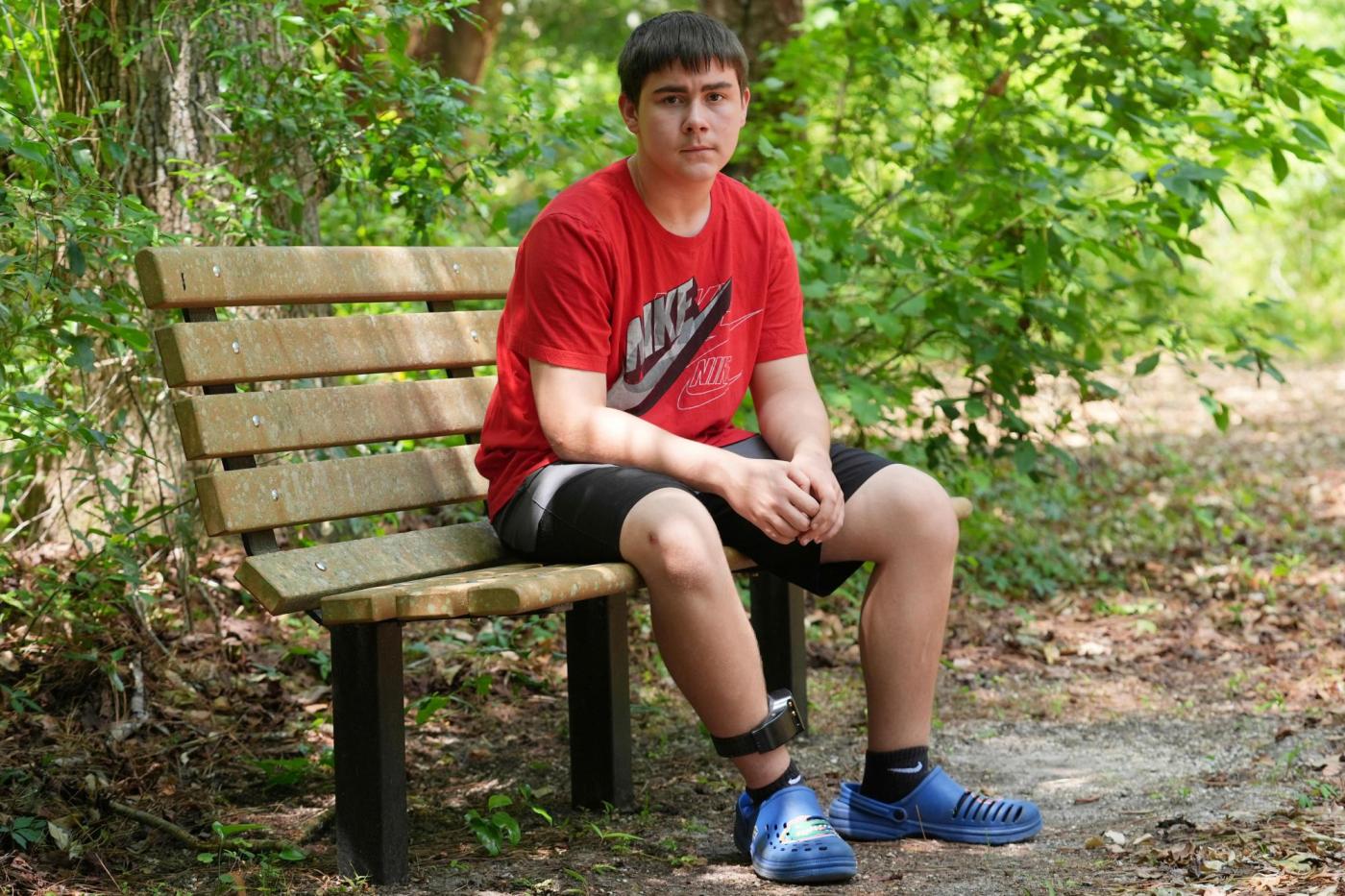
Cayden and his mother Robyn Gillespie walk in a county park Saturday, April 26, 2025, in Gainesville, Fla. (AP Photo/Marta Lavandier)
A respected online school — and a rocky rollout
No matter the offense, states must educate students in juvenile detention. It’s a complicated challenge, no doubt — and success stories are scarce.
Struggling to educate its more than 1,000 students in long-term confinement, Florida embarked last year on a risky experiment. Despite strong evidence that online learning failed many students during the pandemic, Florida juvenile justice leaders adopted the approach for 10- to 21-year-olds sentenced to residential commitment centers for offenses including theft, assault and drug abuse.
The Florida Virtual School is one of the nation’s largest and oldest online school systems. Adopting it in Florida’s residential commitment facilities would bring more rigorous, uniform standards and tailored classes, officials argued. And students could continue in the online school, the theory went, once they leave detention, since incarcerated youth often struggle to reintegrate into their local public schools.
But students, parents, staff, and outside providers say the online learning has been disastrous, especially since students on average spend seven to 11 months in residential commitment. Not only are students struggling to learn online, their frustration with virtual school is sometimes leading them to get into more trouble — and thus extending their stay.
In embracing Florida Virtual School, the residential commitment centers stopped providing in-person teachers for each subject, relying instead on online faculty. The adults left to supervise classrooms rarely can answer questions or offer assistance, students say.
A dozen letters from incarcerated students, written to lawmakers and obtained by The Associated Press, describe online schoolwork that’s hard to access or understand — with little support from in-person or online staff.
“Dear Law maker, I really be trying to do my work so I won’t be getting in trouble but I don’t be understanding the work,” wrote one student. “They don’t really hands on help me.”
Illustration of an excerpt from incarcerated students’ letters, written to Florida lawmakers and obtained by The Associated Press. (AP Illustration)
Illustration of an excerpt from incarcerated students’ letters, written to Florida lawmakers and obtained by The Associated Press. (AP Illustration)
Illustration of an excerpt from incarcerated students’ letters, written to Florida lawmakers and obtained by The Associated Press. (AP Illustration)
Illustration of an excerpt from incarcerated students’ letters, written to Florida lawmakers and obtained by The Associated Press. (AP Illustration)
Illustration of an excerpt from incarcerated students’ letters, written to Florida lawmakers and obtained by The Associated Press. (AP Illustration)
1 of 5
Illustration of an excerpt from incarcerated students’ letters, written to Florida lawmakers and obtained by The Associated Press. (AP Illustration)
When Cayden arrived at the Orlando Youth Academy in January 2024, after four months in juvenile detention waiting for a bed in long-term confinement, he felt disoriented. He and his family had been told he would be placed at a residential center near their Gainesville home so they could visit on the weekends. The judge had recommended 30 days in the residential center — called “treatment” — after Cayden pleaded guilty to two fraud felonies for using stolen credit cards, including one belonging to his parents.
As he sat in a metal chair at his new case manager’s desk, she described the routine and expectations of what she called “the program.” He’d attend more than six hours of school a day and therapy five days a week, including with his parents over Zoom. None of this surprised Cayden.
But then she said something that got his attention. “The program” would likely last six to nine months.
Panicked, he asked to call his mother.
A monthslong stay in ‘a teenage jail’
Robyn Gillespie stepped outside the Gainesville McDonald’s she managed when she saw a call from the Department of Juvenile Justice. That can’t be true, she said, when Cayden told her his sentence was far longer than expected.
So Cayden, still sitting next to his case manager, put down the phone and asked her again: Ma’am, you said six to nine months, right?
Gillespie hung up and cried. “They wouldn’t understand him,” she remembers thinking.
Gillespie’s husband, Kenny Roach, initially thought going to juvenile detention could help Cayden, who had grown out of control. The family had recently moved to Florida to care for aging relatives, but Cayden’s beloved older brother decided to return to Virginia, where they’d lived before.
Cayden, who has autism, struggled being in a new place without his brother. He began leaving the house in the evening with neighborhood teens when the parents worked late. That led to shoplifting and, eventually, credit-card fraud. Roach and Gillespie pressed charges against their son.
“He really needs to get a week in a detention home,” Roach thought. As a youth, he himself had gone to juvenile detention twice, for as long as two weeks, and credited it for a life turnaround. “I thought it would be a learning experience.”
When he learned Cayden’s time in the juvenile detention system would last much longer, he was in shock.
“Good lord, what do they hope to accomplish? A kid his age, with his diagnosis?” Roach remembers thinking. “That’s like being in a teenage jail.”
Robyn Gillespie listens to her son Cayden as he recalls his educational experience while in juvenile detention, April 26, 2025, in Gainesville, Fla. (AP Photo/Marta Lavandier)
Life in custody: Not much privacy, avoiding a ‘level freeze’
Cayden and the other detainees inside Orlando Youth Academy woke up every day at 6 a.m. and cleaned their cells. Only when they passed inspection could they enter the common area.
Each detained youth had a toilet in their cell. For privacy, they were encouraged to lodge notebook paper into the door jamb to cover the narrow vertical window in their doors.
Related Articles
Multiple Texas students are injured in a school bus rollover crash on the first day of class
Trump administration ordered to restore some withheld grant funding to UCLA
St. Paul Public Schools to host paraprofessional hiring event Thursday
Gov. Walz names four to fill UMN Board of Regents vacancies
Center for School Change gets new director, name change
Phone calls with their parents were monitored. At family visits, Cayden’s parents couldn’t get too close or hug him more than once at the beginning and end, to prevent visitors from sharing contraband with the teens.
To relax, Cayden would lie on his stomach on his plastic-covered mattress and draw and write. He developed a Pokemon-inspired story about a hero named One — the only time he allowed his mind to wander away from Orlando Youth Academy.
When the teens got in trouble, they had to go to bed early — 5:30 p.m. — and skip playing cards or watching TV, some of the only downtime they got. But the real punishment was called a “level freeze.” When a detainee got in trouble for fighting, damaging property, not attending therapy or refusing to log into online school, they stopped making progress toward release.
Online school lacked special education supports
Before Orlando Youth Academy and Florida’s other commitment centers adopted virtual learning in July 2024, Cayden’s main source of stress was the other students. They antagonized Cayden until he exploded. Therapists and staff coached him to avoid these situations.
School wasn’t a source of stress or conflict. Four teachers from the local schools came to their portable classroom and lectured students ages 12 to 18 from the front of the room.
Cayden came to the program midway through what should have been his seventh grade year. But after assessing him, the teachers placed Cayden in sixth grade.
When the state adopted virtual schooling, it was partly trying to meet the needs of students across different ages and abilities. But Cayden felt some of the new classes were too advanced, and he didn’t receive help he needed to do the work.
The complaints from other Florida detainees are similar.
“My zoom teachers they never email me back or try to help me with my work. It’s like they think we’re normal kids,” one youth wrote in a letter to Florida lawmakers. “Half of us don’t even know what we’re looking at.”
Under Cayden’s special education plan, which federal law requires detention center schools to follow, he’s entitled to receive assistance reading long texts. But he didn’t receive it after the virtual school started.
Florida Virtual School wouldn’t comment on Cayden’s case, citing privacy concerns. Within their school for students in long-term confinement, “every student with a disability receives specially designed instruction, support, and accommodations comparable to those listed in the student’s Individualized Education Plan (IEP),” says Robin Winder, chief academic officer of Florida Virtual School.
The instructor assigned to help Cayden and more than a dozen other students with their online work was overwhelmed by the students’ needs, Cayden says. Three different people held that job during the nine months he attended virtual school inside Orlando Youth Academy.
When Cayden threw the desk out of frustration with the new online learning program, he received a “level freeze” of three to five days, essentially extending his time at the residential commitment center.
Julie Nicoll shows shows an undated photo with her grandson Xavier Thursday, April 24, 2025, in Naples, Fla. Julie and her husband have spent more than $20,000 in legal fees trying to get him released from a youth detention center. (AP Photo/Marta Lavandier)
Julie Nicoll sits in her grandson Xavier’s bedroom Thursday, April 24, 2025, in Naples, Fla., after Xavier’s juvenile detention sentence was lengthened for breaking multiple laptops out of frustration with online learning. . (AP Photo/Marta Lavandier)
The Miami Youth Academy, a residential facility for male juveniles, is seen in this photo Friday, June 6, 2025, in Kendall, Fla. (AP Photo/Marta Lavandier)
A photo and letter from Xavier Nicoll is posted on the kitchen of his grandparents Bill and Julie’s home Thursday, April 24, 2025, in Naples, Fla. Xavier has been incarcerated longer than his original sentence due behavioral issues during virtual school. (AP Photo/Marta Lavandier)
1 of 4
Julie Nicoll shows shows an undated photo with her grandson Xavier Thursday, April 24, 2025, in Naples, Fla. Julie and her husband have spent more than $20,000 in legal fees trying to get him released from a youth detention center. (AP Photo/Marta Lavandier)
Internal documents obtained by The Associated Press, plus interviews with parents, staff and outside specialists, show staff have recommended or given level freezes when students have broken laptops, refused to log into Zoom and even sent an email to ask for help initiating an online class. And when students don’t participate in virtual school, the department’s written protocol calls for taking away points they earn toward getting out.
“Students who have their heads down will be prompted by the teacher no more than two times to sit up and participate,” reads the Classroom Behavior Management Plan for Florida’s juvenile justice schools.
The first time Xavier Nicoll, 15, broke a laptop at his residential commitment center in Miami, it was because an online teacher wouldn’t respond to his questions, according to his grandmother, Julie, who has raised him. He was arrested and sent to a different detention center to face charges. The three weeks he spent there didn’t count toward his overall sentence because he can’t receive “treatment” there. Detainees call it “dead time.”
Once back at the residential center, he broke another laptop, his grandmother says, because a teen dared him to. Back he went to county detention and court for more dead time. Then, in January, when the in-person class supervisor wouldn’t help him get into a locked online assignment, he broke a third, says Julie Nicoll.
Xavier was initially meant to be held for six to nine months after breaking into a vape store. He’s now on track to be confined at least 28 months.
He’s grown at least five inches in detention — and gone through puberty. Yet in school, Nicoll said in April, he was making no progress. “He went in as an eighth grader and is still an eighth grader — and failing,” Nicoll said.
Xavier’s March report card showed he was earning a 34% in Civics and Career Planning, 12% in Pre-Algebra, 13% in Comprehensive Science and 58% in Language Arts.
Nicoll has complained that her grandson, who has attention deficit hyperactivity disorder, or ADHD, hasn’t been receiving special education services. The Department of Juvenile Justice and Florida Virtual School have canceled multiple meetings to discuss his education plan because Xavier keeps getting arrested and sent for dead time.
“He’s trapped,” says Nicoll. “No matter what we do, we can’t seem to get him out.”
Trouble rejoining the community?
Nicoll and her husband have spent more than $20,000 in legal fees trying to win his release. They argue untreated brain inflammation due to mold exposure in detention, plus his disability, make it impossible for him to control his frustration during online school.
In May, Xavier was arrested a fourth time. After turning in an assignment, he realized he’d made a mistake and asked the in-class supervisor to return it. The supervisor wouldn’t give back his work, and he broke another laptop.
Xavier pleaded guilty in August to two felonies for breaking laptops. “They’re setting him up to go into the community a failure,” said Nicoll.
It’s unclear how many students are getting in trouble or extending their time because of behavior during virtual school. Arrests inside residential centers increased slightly in the first nine months after the department adopted virtual school, compared with the same period during the previous year. An analysis of publicly available data shows staff use of verbal and physical interventions has also risen slightly, to 2.4 physical or verbal interventions per 100 days from 1.8 interventions the previous year.
The total number of youth in Florida’s residential commitment centers increased to 1,388 in June, the latest data reported by the state, up 177 since July 2024, when the department adopted virtual instruction. That could indicate detainees are staying in confinement longer.
“Correlation does not equal causation,” responded Amanda Slama, a Department of Juvenile Justice spokeswoman. “Other contributing factors could explain an increase in arrests if there is one.”
Since December, the department has ignored or refused AP requests to visit juvenile confinement, speak to officials and release anonymized exit documents for students leaving commitment centers.
John Terry holds a photograph of his son Jalen Wilkinson, Saturday, April 26, 2025, in Haines City, Fla. Jalen’s academic experience changed when the detention center he was in switched to virtual learning. (AP Photo/Marta Lavandier)
Not all students are getting in trouble during online schooling, but that doesn’t mean they’re learning. Jalen Wilkinson, 17, received punishment during detention for fighting, but his father was unaware of punishment related to school.
But when school went online in July 2024, Jalen started complaining that there weren’t enough adults to help students with the virtual program. School, he says, is basically free time.
Jalen has been especially frustrated that he couldn’t complete his GED while confined — even though Florida Virtual School leaders say they’ve made it easier for detainees to take the exam.
He was released in July. His father, John Terry, worries the time locked up was a waste and Jalen will struggle to re-enter high school and graduate. “There’s no rehabilitation whatsoever.”
Cayden is still trying to restart school
In March, shackled with an ankle monitor, Cayden Gillespie finally left Orlando Youth Academy. The six to nine months his case manager predicted turned into 15. Between that and the “dead time” waiting for a residential center bed, he was detained 19 months.
Through therapy at the residential center, Cayden learned how to recognize his anger building and to take a break. His parents say the family therapy helped them better understand Cayden’s needs and helped them all communicate.
“But the school part,” Robyn Gillespie says, “that was a disaster.”
Gillespie, her husband and Cayden are still trying to understand the consequences of going so long without proper schooling. Initially, they thought he’d go to the local public middle school, but the school said, at 15, he’s too old. This spring, they tried to sign him up for Florida Virtual School, the same program he did in custody. Indeed, this was one of the arguments the state made for using virtual school inside confinement. But Robyn Gillespie says Florida Virtual told them he couldn’t join so late in the year.
Asked about Cayden’s case, Florida Virtual said all students “released from a facility receive one-on-one support from an FLVS transition specialist.”
But Cayden’s family said they were never offered transition help or told how he could continue where he left off in detention.
The best option, they’ve been told by the local school district, is a charter school, where he can make up coursework quickly.
“That’s the kind of place where they dismiss you if you don’t show up on time,” says Robyn Gillespie. “And there’s no transportation. I’m just not sure that’s going to work well for our family.”
The terms of Cayden’s probation require him to attend school or face confinement again. He starts at the charter school later this month. Says Gillespie: “He has to be in school.”
The Associated Press receives support from the Public Welfare Foundation for reporting focused on criminal justice, and AP’s education coverage receives financial support from multiple private foundations. AP is solely responsible for all content. Find AP’s standards for working with philanthropies, a list of supporters and funded coverage areas at AP.org.