In September, we featured 19 cats and 10 dogs in the pet corner of our newsletter (as well as a photo of a doe in someone’s backyard).
We highlight our readers’ pets at the end of every weekday editon of the Morning Report.
To sign up for this free newsletter, follow the prompts at twincities.com/newsletters.
For more photos, here are the 14 dogs and 13 cats featured in the Morning Report in August.
Tuesday, Sept. 30
Elsa and Sissy can now stretch out on their outdoor seating.
“I recently got these sisters, Elsa and Sissy, a mix of multiple breeds according to genetic analysis: Great Pyrenees, Golden Retriever, Alaskan Malamute, Anatolian Shepherd, Siberian Husky,” Steve writes. “It’s safe to say they won’t be cold when living outside this winter. At a little less than nine months, they both weigh nearly 90 pounds and their massive paws indicate they aren’t done growing! Fortunately, they keep watch on our five acres in rural western Wisconsin as we’ve seen fox and bobcats who are interested in our chickens. They were a little big for ‘their’ deck chairs, so naturally I had to buy lounge chairs for both …”
Monday, Sept. 29
Fiasco
“My cat Fiasco crossed the Rainbow Bridge four years ago,” Deb wrote. “He was a ‘dog/cat’ always running to the door to welcome me home! Happy fall.”
Friday, Sept. 26
A curious doe.
“I had a surprise visitor to my courtyard one morning,” Ken writes. “I heard an unusual noise at my water feature and turned around to see this doe drinking water and checking to see what I was doing … how she even knew it was there shows how smart wildlife can be.”
Thursday, Sept. 25
Maki, we salute you!
“This is Maki, our soon-to-be 5-year-old American Miniature Shepherd,” Tim writes. “He was born in the Czech Republic and at one year was re-homed to a breeder in France. Maki turned out to be too big as a miniature, so he needed to be re-homed again. We acquired him a year ago and he now lives with us in Germany. Maki spends his days playing with his neighborhood besties, zooming through the fields and volunteering with the USO to comfort travelers at the nearby air base.”
Wednesday, Sept. 24
Wisdom didn’t appreciate the feedback on her use of the bathroom counter.
“When I asked Wisdom to get off the counter, she went into full pout mode,” Theresa writes.
Tuesday, Sept. 23
Louie
“I’d like to introduce you to little Louie, the Cavapoo puppy,” Jeannie wrote in Aug.. “Breeds: King Charles Cavalier and Poodle. Weighing in at a wee-but-mighty three pounds, nine ounces. Age: 3.5 months old. Family: Matt, Jeannie and Clay; Dozer (75-pound Black Lab). Foxy (52-pound Australian Cattle Dog mix). Instagram: @ourfriendlouie. Favorite places in town: The Dabbler Depot on West Seventh Street, the patio of Saint Paul Brewing and the patio of Dark Horse in Lowertown.”
Monday, Sept. 22
Cali’s hike in Switzerland.
“It’s been awhile since I’ve shared any photos of my granddog, Cali,” Linda writes. “She had a great time hiking in the mountains last weekend. She didn’t get to stay there, but in one photo she is looking over Hotel Weisshorn in Saint-Luc Switzerland that does allow dogs. Maybe next trip, Cali! For reference, Saint-Luc is north of Zermatt, home of the Matterhorn. Keep up the great work! I love looking at pet photos!”
Friday, Sept. 19
Skol, Gordy!
“Our grandkitty, Gordy of Eagan, is ready for another hopeful season. Skol, Gordy!”
Thursday, Sept. 18
Pico
“Love your column!” Shari wrote earlier this month. “Here is a current photo of Pico, who has previously been featured in your column. This was taken on one of those cool days over the weekend. He loves to be under a blanket when he is cold and does not want to come out!”
Wednesday, Sept. 17
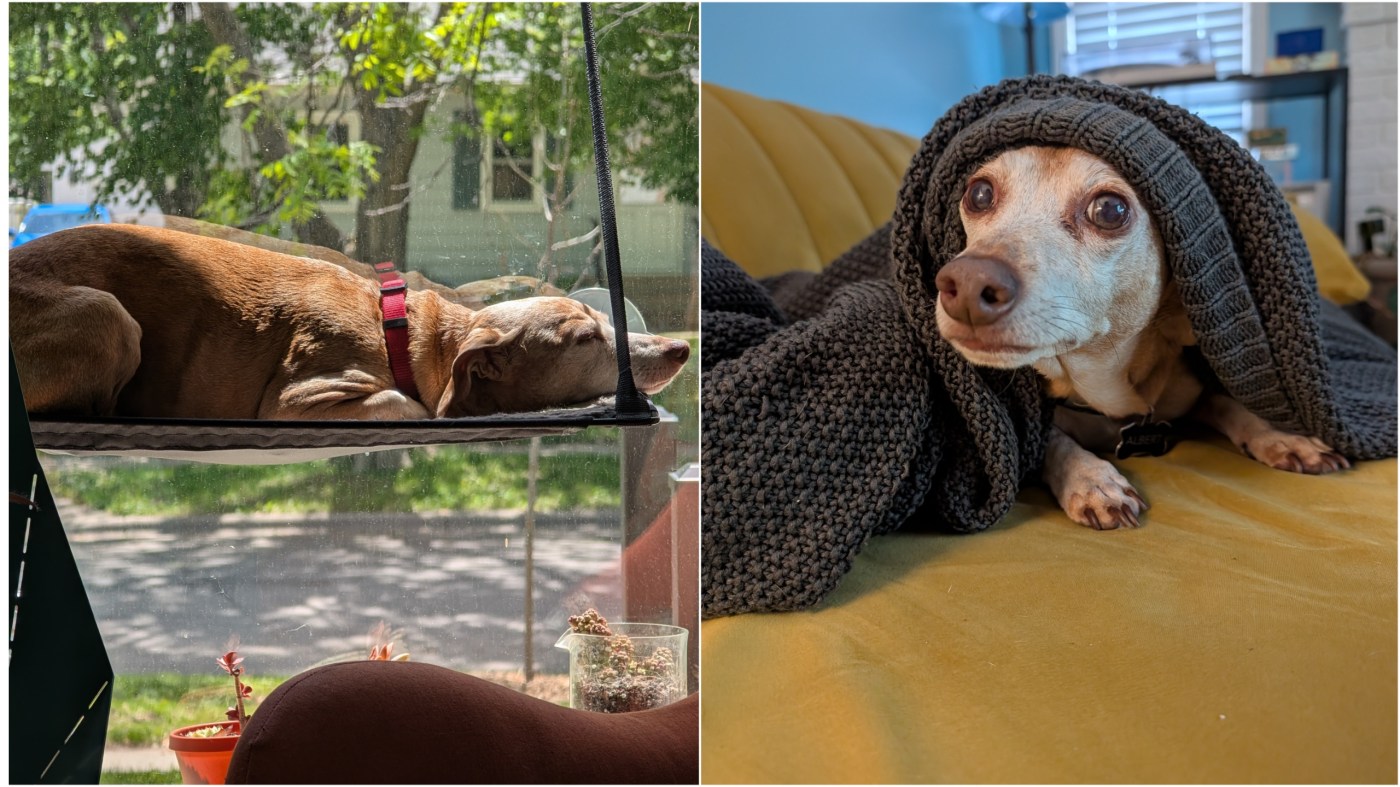
Albert in the cat hammock and under a blanket.
“These are photos of our 14-year-old Chiweenie, Albert,” Chris writes. “Albert loves long walks around the Como neighborhood, which is full of wildlife for him to bark at. He also amuses the neighborhood (including our mail carrier) by sunning himself in the cat window hammock. Most often, you will find him buried underneath a blanket, snuggled up to his humans. He’s a very special dog!”
Tuesday, Sept. 16
Happy Gotcha Day, Miss Nosey!
“Good morning … Happy September! Where did summer go?” Joyce wrote earlier this month. “Our sweet Miss Nosey will be celebrating her fourth ‘Gotcha Day’ here with us on Sept. 16th (today!). How time flies when you have a goofy cat, seen here with her bright eyes and asleep in her favorite box … a Christmas gift from last year. Take care and enjoy each fall day!”
Monday, Sept. 15
Bozie’s hobbies include finding interesting places to nap.
“Our daughter’s cat Bozie excels at finding good, unique places to take his naps,” Norbert writes.
Friday, Sept. 12
Bo
“Bo, a 10-year-old French Bulldog rescue, holds court at my brother David’s assisted living home,” Leslie writes. “Bo has won the hearts of all he meets, very cuddly and sweet.”
Thursday, Sept. 11
Maya (left) and her son, Gordy Jr.
“Maya (left) and her son, Gordy Jr., chilling this morning,” wrote Cameron of Roseville on Monday. “We rescued Maya and her four kittens from the remote desert in Baja, Mexico, two years ago. We found good homes for three of the kittens here in St. Paul. We kept Maya because she was feral and unadoptable and also kept her only boy kitten, Gordy Jr. Both are loving, wonderful cats that enrich our life’s on a daily basis.”
Wednesday, Sept. 10
Happy Birthday, Jameson.
“Birthday bone for Jameson,” Lon writes.
Tuesday, Sept. 9
Buttercup, Poppet and Olympia.
“These three always need a nap after they get up in the morning, before they’ve done even a bit of housework,” writes Claire of Highwood Hills of St. Paul.
Monday, Sept. 8
SunnyD and Moonsun
“These are my grandkittens, SunnyD and Moonsun (named by grandsons ages two and four),” Maureen writes. “They are a joy. Little purr factories.”
Friday, Sept. 5
Leo’s clover.
“Our pup, Leo, brought us a clover to express that he feels lucky to have been rescued in New Mexico,” Sal and Tom of Edina tell us. “Leo spent his formative years in Durango, Colorado, with our daughter and then relocated to Minnesota to live with us (his grandparents). He is loved and living his best life. It is amazing how many pups end up with the grandparents!”
Thursday, Sept. 4
Khaleesi, Nubia and Barney.
“After losing our beloved dowager countess Tina this spring, we have started the adventure of fostering cats (for Feline Rescue),” Meg writes. “Khaleesi (Calico, left) and Nubia (shorthair tabby, middle) have joined our household temporarily while they await medical clearance for adoption. They are both sweet and affectionate, with personality to spare! They’ve been isolated from resident hermit Barney (longer-fur tabby, right) which is probably for the best for everyone, haha. I strongly recommend fostering for a way to enjoy and care for animals temporarily. The shelter has been incredibly supportive. Cheers!”
Wednesday, Sept. 3
Zephyr and Ziva.
“This is Zephyr (left) and Ziva,” Wendie writes. “Zephyr loves to bask in the sun after exhausting herself chasing feather toys. Ziva (right), gives her opinion on having photos taken. They were adopted from the Humane Society as a bonded pair in early June, due to the Northern Minnesota forest fires.”
Tuesday, Sept. 2
Stella and Luna.
“Stella and Luna are 3-year-old littermate sisters who recently braved a move from New Jersey to Minnesota, ” Madeline writes. “They are adjusting well and loving their new favorite sun window!”
St. Paul cat show to feature over 100 felines competing for prizes
14 dogs, 13 cats: Meet the Morning Report pets of August
7 pets featured in our Morning Report newsletter in July
Toxic blue-green algal blooms are fouling Minnesota waters this summer
Roseville rehab opens new Washington County campus with more ‘space and quiet’ for recovering wildlife