Loons ride Kelvin Yeboah’s goal for a 1-0 win in home opener

posted in: All news | 0

During a cold home opener in St. Paul on Saturday, Minnesota United sent its bundled-up fans home with three points. Amid 20 degrees temperatures, the Loons edged FC Cincinnati 1-0 at Allianz Field.

Kelvin Yeboah scored in the 66th minute. The Loons striker was in the right spot when Tomas Chancalay’s free kick from 19 yards out took a deflection, ricocheted off the post and Yeboah headed it into the net.

Yeboah, who scored in 2-2 season-opening draw at Austin, received a warm applause Saturday when he exited the game in stoppage time.

Minnesota (1-0-1, 4 points) remained unbeaten, while FC Cincinnati (1-1-0, 3 points) took their first defeat.

New Loons coach Cameron Knowles gave a fist pump at the final whistle. It was his first win as a permanent head coach.

Loons captain Michael Boxall was subbed out in the 77th minute after he appeared dazed from receiving contact to the head from Cincinnati forward Tom Barlow. The play did not result in a card from referee Marcus DeOliverira.

James Rodriguez was on the Loons bench for the first time, but the Colombian superstar did not make his MLS debut. Knowles said the game state would determine if Rodriguez would play, but MNUFC was in the lead when likely would have subbed into the match.

Cincinnati controlled the opening 25 minutes of the match with five corner kicks and seven shots to one corner and one shot for Minnesota.

The Loons gained a foothold to close out the half and both teams had eight attempts on goal in the first half. Five of Minnesota’s shots were outside the box in the opening 45 minute, which led to frustration from teammates that weren’t on the ball.

FC Cincinnati played without creative attacking midfielder Evander, who’s hamstring injury led to an early exit the 2-0 win over Atlanta last weekend.

Related Articles


Loons vs. FC Cincinnati: Keys to the match, storylines and a prediction


Why Minnesota United didn’t say more about local ICE raids


Minnesota United fans embrace rebel loon logo to help community hurt by ICE


For 10th anniversary season, Minnesota United identifies 63 top moments


Former Loons coach Eric Ramsay fired at West Bromwich Albion

What to know about Iran’s Supreme Leader Ayatollah Ali Khamenei

posted in: All news | 0

By LEE KEATH and CARA ANNA

When targeted by nationwide protests early this year, Iran’s Supreme Leader Ayatollah Ali Khamenei unleashed the bloodiest crackdown of his nearly four decades in power. But now a U.S. or Israeli military strike may have ended his rule.

There was no immediate Iranian comment about him Saturday after President Donald Trump said Khamenei was killed in a major new attack by U.S. and Israeli forces. Trump also urged Iranians to topple the theocracy.

The 86-year-old Khamenei had tried to avert such strikes as the U.S. built up its military presence in the region to pressure Tehran over its nuclear program. He warned that if the U.S. struck, a regional war would ensue. At the same time, he allowed Iran to enter negotiations with the U.S. over its nuclear program.

Long before the supreme leader’s compound was among the first targets on Saturday, Khamenei was under growing pressure.

The suppression of the protests, with thousands of people killed amid chants of “Death to Khamenei,” was a sign of the threat that popular anger represented. Years of sanctions, economic mismanagement and corruption have gutted Iran’s economy.

Israeli and U.S. bombardment during last summer’s 12-day war had heavily damaged Iran’s nuclear program, missile systems and military capabilities. Iran’s network of regional proxies, including Hamas in Gaza, Hezbollah in Lebanon and the Houthis in Yemen, has been weakened by Israeli and U.S. attacks since the war in Gaza began, along with Tehran’s influence across the Middle East.

Here’s what to know about Khamenei:

Transforming the Islamic Republic

When he rose to power in 1989, Khamenei had to overcome deep doubts about his authority. A low-level cleric at the time, Khamenei lacked the religious credentials of his predecessor, Ayatollah Ruhollah Khomeini, the leader of the Islamic Revolution.

But Khamenei has ruled three times longer than the late Khomeini and has shaped Iran perhaps even more dramatically.

He entrenched the system of rule by the mullahs, or Shiite Muslim clerics. Under the Islamic Republic, clerics stand atop the hierarchy, drawing the lines to which the civilian government, the military and the intelligence and security establishment must submit.

In the eyes of hard-liners, Khamenei stands as the unquestionable authority — below only that of God.

At the same time, Khamenei built the paramilitary Revolutionary Guard into the dominant player in military and internal politics. It boasts Iran’s most elite military and oversees its ballistic missile program. Khamenei also gave the Guard a free hand to build a network of businesses and dominate the economy.

In return, the Guard became his loyal shock force.

Domestic challenges

The first major threat to Khamenei’s grip was the reform movement that swept into a parliamentary majority and the presidency soon after he became supreme leader. It advocated for giving greater power to elected officials, which Khamenei’s hard-line supporters feared would lead to dismantling the Islamic Republic system.

Khamenei rallied the clerical establishment, and unelected bodies run by mullahs shut down major reforms and barred reform candidates from elections.

Since then, waves of popular protests have been crushed.

Huge nationwide demonstrations erupted in 2009 over allegations of vote-rigging. Under the weight of sanctions, economic protests broke out in 2017 and 2019. More came in 2022 over the death of Mahsa Amini, who was detained by police for not wearing her mandatory headscarf properly.

Crackdowns against the protesters killed hundreds, and hundreds more were arrested amid reports of detainees tortured to death or raped in prison.

The deadliest crackdown yet

The latest demonstrations touched off in late December in Tehran’s traditional bazaar after the country’s currency, the rial, currency plunged to a record low of 1.42 million to the U.S. dollar. Protests quickly spread across the country.

“Rioters must be put in their place,” Khamenei declared. When hundreds of thousands took to the streets Jan. 8 and 9, security forces fired on crowds, and veterans of past demonstrations said they were stunned by the firepower unleashed.

Activists said they documented more than 7,000 killed and were working to verify more. The government has acknowledged more than 3,000 dead, which is still higher than the toll from past crackdowns.

Nuclear negotiations

By agreeing to nuclear negotiations, Khamenei likely sought to buy time to avert U.S. strikes. But Iran opposed Washington’s main demands that it halt all nuclear enrichment and surrender its uranium stocks.

Trump initially threatened strikes to stop Khamenei and Iran’s other leaders from killing peaceful protesters. He then wielded the threat to push Tehran to engage seriously in nuclear negotiations.

Some in Iran and the large Iranian diaspora expressed hope that the U.S. would use military force to bring down Khamenei. But there were also strong voices even among Khamenei opponents who were against foreign intervention to topple the theocracy.

No successor

Officially a panel of Shiite clerics is tasked with choosing one of their own to succeed Khamenei, and multiple names have been touted among including his son.

Danny Citrinowicz, an Iran expert at Israel’s Institute for National Security Studies, told The Associated Press this week that a key lesson Tehran drew from last year’s war was the need to ensure regime continuity in case of Khamenei’s death. He added that power could shift to a small committee of top officials until hostilities subside.

“It is possible that Khamenei has indicated a preferred successor behind closed doors,” Citrinowicz said. “However automatic implementation of a preselected successor will increase internal friction during war.”

But the Revolutionary Guard has grown to become Iran’s most powerful body. If the supreme leader is confirmed to be dead, that could prompt Guard commanders or its regular military to seize power more overtly. And that could set off a bloody conflict over control of the oil-rich country of 85 million people.

Women’s hockey: Gophers win, Tommies lose in WCHA playoffs

posted in: All news | 0

Minnesota fought to fight another day in the WCHA playoffs, while the season came to a close for St. Thomas. The fourth-ranked Gophers battled back from a frustrating 1-0 overtime loss to St. Cloud State to defeat the Huskies and force a deciding third game in their opening round series, while the Tommies were swept at No. 2 Ohio State on Saturday.

Gophers 4, St. Cloud State 1

One day after coming up empty despite launching 42 shots on the opposing net, Minnesota cracked SCSU goaltender Emilia Kyrkkö’s code with 49 shots in a 4-1 defeat of the Huskies at Ridder Arena to even their best-of-three series at a game apiece and force a winner-takes-all third game at 3 p.m. Sunday in Minneapolis.

Tereza Plosova put Minnesota (25-10-1) in the lead with the game’s opening goal at 8:15 of the first period. It was a lead that the hosts didn’t relinquish, adding three more tallies off the sticks of Abbey Murphy and Chloe Primerano to take a 3-0 edge into the final frame.

Maria Mikaelyan kept matters interesting by scoring for the Huskies (12-22-2) at 4:50 of the third to bring the visitors to within two goals, but Murphy’s empty-netter with a minute to play clinched the contest for the hosts. Gophers netminder Hannah Clark made 17 saves in the win.

Sunday’s rubber game at Ridder will be broadcast on both Fox 9+, as well as BTN+. Game 3’s winner will advance to the WCHA Final Faceoff on March 5 and 7 at the Lee & Penny Anderson Arena on the St. Thomas campus.

Ohio State 4, Tommies 1

Unfortunately for St. Thomas, the Tommies will not be part of the tournament being hosted at their arena as Ohio State ended UST’s season with a 4-1 loss in Columbus, Ohio.

One day after falling 5-1 to the Buckeyes at the OSU Ice Rink, St. Thomas (12-23-1) saw its season come to a close. Maddie Brown scored the Tommies’ final goal of the winter midway through the second period, but her tally barely made a dent in the mighty titan’s armor. UST goaltender Julia Minotti made 27 saves, while her teammates put 20 shots on the Buckeyes (32-4-0).

Related Articles


Men’s basketball: Gophers upset UCLA


Women’s basketball: Win streak dead, Gophers vow to focus on what’s next


Men’s basketball: Tommies wallop Bison


Men’s hockey: Gophers stun No. 2 Michigan


Women’s basketball: St. Thomas keeps rolling with win against Kansas City

Trump’s ‘America First’ campaign battle cry gives way to military strikes abroad

posted in: All news | 0

By STEVEN SLOAN

WASHINGTON (AP) — President Donald Trump, whose fierce denunciation of military adventurism abroad fueled his unlikely rise to the top of the Republican Party, risks becoming ensnared by that very type of conflict.

Related Articles


UN chief condemns US-Israeli attacks on Iran during emergency Security Council meeting


World leaders react cautiously to US and Israeli strikes, death of Ali Khamenei


War powers debate intensifies after Trump orders attack on Iran without approval by Congress


What to know about the new US-Israel attacks on Iran


More than 200 Minnesota service members currently deployed to area that includes Mideast

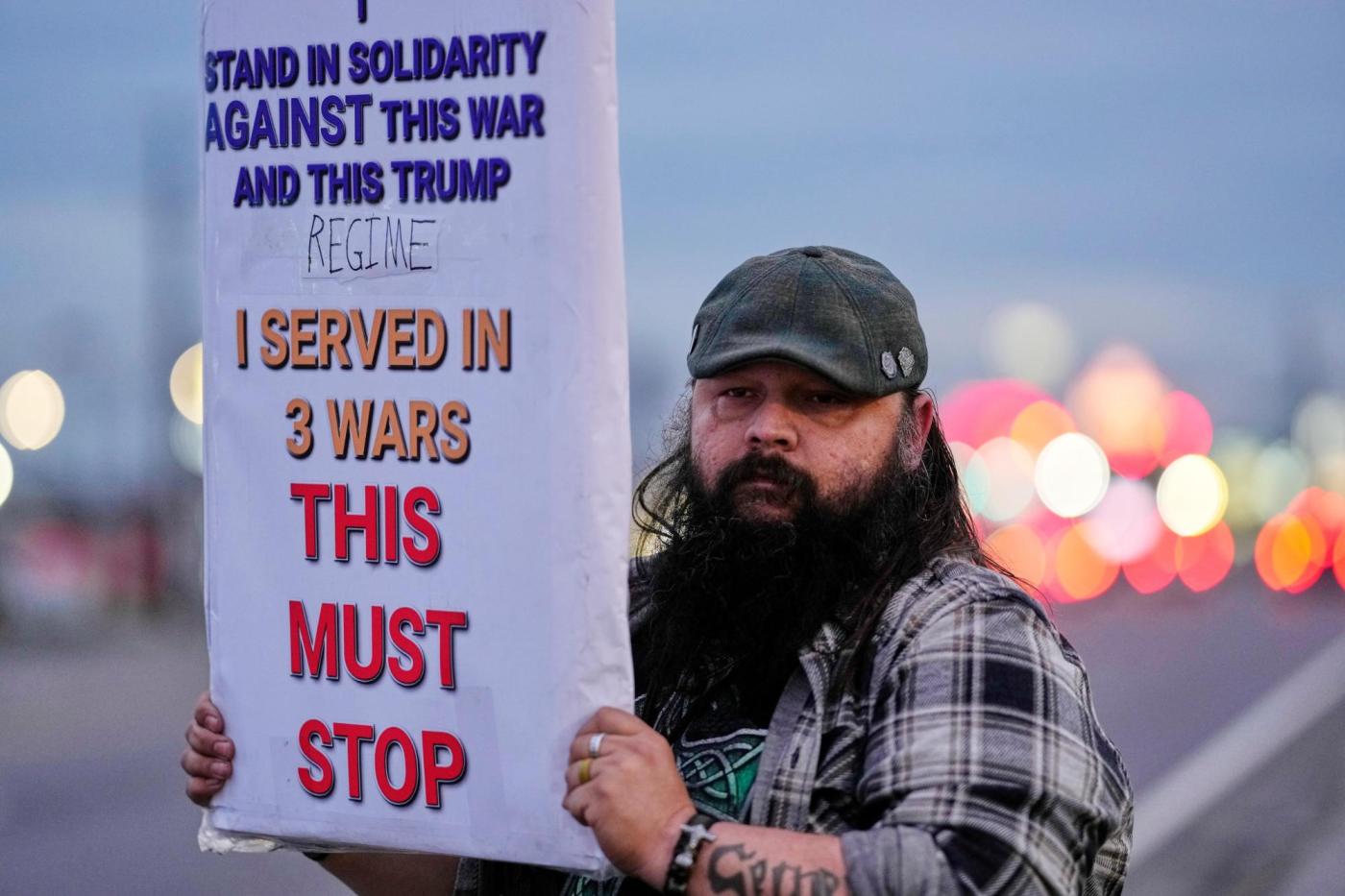
The U.S. and Israeli attack on Iran Saturday cemented Trump’s decade-long transformation from a candidate who in 2016 called the Iraq War a “big, fat mistake” to a president warning Americans to prepare for potential casualties overseas and encouraging Iranians to “seize control of your destiny.” The strikes were also at odds with Trump’s warnings during the 2024 campaign that his Democratic rival, Kamala Harris, was surrounded by “war hawks” eager to send troops overseas.

Trump justified the action as necessary to prevent Iran from obtaining nuclear weapons or developing missiles capable of reaching the US, less than a year after he said airstrikes “obliterated” their capability. US intelligence has also said Iran’s weapons capability was substantially degraded.

For Trump, memories of the false pretenses underlying the Iraq War could lead to pressure to prove his assertion that Iran’s weapons production posed an imminent threat to Americans. And for Republicans already facing a challenging election year weighed down by economic anxiety, the shift could force a reassessment of how the attacks fit into the “America First,” isolationist-leaning movement the party has embraced during the Trump era.

While Trump might benefit from an early rally-around-the-flag effect, that could be hard to sustain for weeks and months, if not longer, a far different scenario from the swift effort to remove Nicolás Maduro from power earlier this year in Venezuela.

Success on day one is one thing. The days after are inherently unpredictable.

“The question is whether Iran’s goal is simply to outlast America and whether Trump has strategic attention deficit disorder, which will allow the Iranians to rise from the ashes and claim victory,” said Michael Rubin, a historian at the American Enterprise Institute who worked as a staff adviser on Iran and Iraq at the Pentagon from 2002 to 2004.

Many Republicans get behind Trump

Many Republicans were quick to line up behind the president, including Texas Sen. John Cornyn and state attorney general Ken Paxton, who are fighting a competitive Senate primary election on Tuesday.

“Hopefully lives will not be lost needlessly, but this always entails risk,” Cornyn said Saturday at a campaign stop near Houston. “But we know that Iran will not stop unless the United States and our allies stop them.”

Others, like Sen. Todd Young of Indiana, praised the military and were critical of Iran while noting that Americans will have questions that “must be answered.”

And there was outright opposition from some who have long criticized overseas entanglements, including Sen. Rand Paul, the Republican of Kentucky, who lamented the start of “another preemptive war.” Former Rep. Marjorie Taylor Greene, the Georgia Republican who was once a close Trump ally, rejected the president’s warning of Iran’s nuclear capabilities.

“It’s always a lie and it’s always America Last,” she wrote online. “But it feels like the worst betrayal this time because it comes from the very man and the admin who we all believed was different.”

Little advance preparation for Americans

The administration did little in advance to prepare Americans for such a dramatic action.

Vice President JD Vance told The Washington Post this week there was “no chance” that the U.S. would become involved in a drawn-out war as it did in Iraq. During his State of the Union speech on Tuesday, Trump dedicated just a few lines to Iran, arguing the country and its proxies have “spread nothing but terrorism, death and hate.”

That stands in stark contrast to the lengthy runup to the Iraq War.

President George W. Bush, for example, named Iraq as a member of the so-called axis of evil in January 2002. Then-Secretary of State Colin Powell delivered a now-infamous speech to the United Nations in February 2003, making the case for war based on the inaccurate assertion that Iraq possessed weapons of mass destruction. The invasion, which ultimately dominated Bush’s second term, didn’t begin until March 2003.

“We just have to be honest that there is a sense that this was not sold to the American public sufficiently,” Andrew Kolvet said Saturday on “The Charlie Kirk Show,” an online program founded by the late conservative activist who was close to Trump. “Perhaps there will be an opportunity on the backend of this.”

Kolvet was willing, however, to give Trump leeway, noting these are the types of challenging decisions presidents are entrusted with.

“President Trump has earned a big, long leash,” he said. “Not an unlimited one. But a very long one to make tough decisions.”

Polling suggests that many Americans share Trump’s concerns about Iran’s nuclear capabilities, even if they’re less confident in the president’s response. About half of U.S. adults were “extremely” or “very” concerned that Iran’s nuclear program poses a direct threat to the U.S., according to a poll this month from The Associated Press-NORC Center for Public Affairs Research.

Most Americans, 61%, said Iran is an “enemy” of the U.S., which is up slightly from a Pearson Institute/AP-NORC poll conducted in September 2023. But their confidence in the president’s judgment when it comes to relationships with adversaries and the use of military force abroad is low, the new poll shows, with only about 3 in 10 Americans saying they have “a great deal” or “quite a bit” of trust in Trump.

Democrats sense an opening

Democrats sense a political opening on the issue. In Maine, Gov. Janet Mills and Graham Platner are competing for the Democratic nomination to challenge incumbent Sen. Susan Collins in the fall. They both issued statements on Saturday pressing Collins, the only Republican on the ballot this year in a state won by Harris, to step up her oversight of the administration.

Collins was one of three Senate Republicans who backed an unsuccessful push last month for a war powers resolution that would have limited Trump’s ability to conduct further attacks on Venezuela. Democrats said Saturday they would quickly seek a vote on a similar proposal for Iran.

“If we’ve started a war where we begin to lose American lives, that starts changing the political calculus,” said Republican strategist Ron Bonjean.

But he noted that Democrats have vulnerabilities of their own, particularly if there’s a domestic terror attack while the Department of Homeland Security is closed as they demand changes to how immigration operations are conducted.

For now, Trump isn’t offering much of a detailed strategy on what comes next. In a social media post Saturday evening, he said bombings could continue “as long as necessary.”

Associated Press writer Sean Murphy in Oklahoma City contributed to this report.