STEWARTVILLE, Minn. — The man who shot and critically injured a student on Friday and then is believed to have taken his own life outside of Stewartville High School has been identified as 19-year-old Logan Moyer, a 2024 graduate of the school.
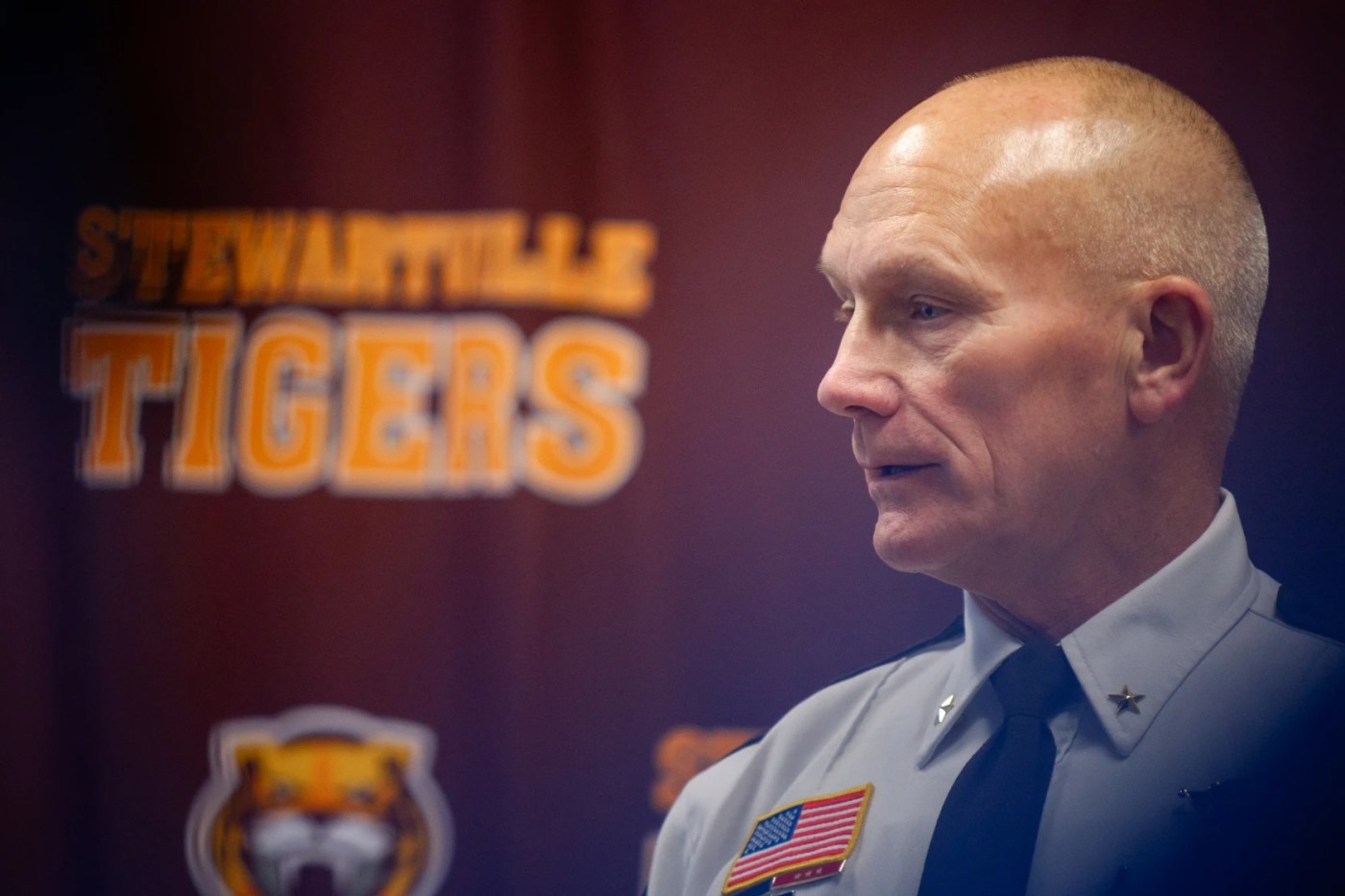
Officials from the Olmsted County Sheriff’s Office and Stewartville Public Schools spoke at a press conference about the investigation Monday morning.
The motive for the shooting remains unclear.
“We don’t know, and we might not ever know why,” Sheriff Kevin Torgerson said.
Authorities still are not releasing the name of the injured student, but he was a part of the Stewartville wrestling team, Torgerson said. As of Sunday night, he said, the student remains hospitalized in critical but stable condition.
Torgerson said Moyer was not a coach, volunteer or paid staff member of the wrestling program.
Although Moyer was a member of the school’s wrestling team when he was a Stewartville student himself, officials were not able to confirm whether he was on the team at the same time as the injured student.
Torgerson said the investigation will continue and that authorities will be reviewing video footage and relying on interviews, among other resources, as they move forward.
The shooting happened at about 5 a.m. Friday, Dec. 12, as the wrestling team was preparing to travel to Grand Forks, North Dakota, for a two-day wrestling meet. There were approximately 40 students and coaching staff at the school at the time.
“One of the teammates was walking in the parking lot when a gunshot was heard by others,” Torgerson said on Friday. “The victim was located on the ground in the parking lot by coaching staff. As other staff and students were looking around at that moment to see what had happened, they heard a second shot.”
An autopsy was performed Friday afternoon by the Southeastern Minnesota Medical Examiner’s Office. The results so far are consistent with suicide, Torgerson said.
When asked on Monday, Torgerson estimated that the shooting took place 100 to 200 yards away from the bus and the rest of the activity surrounding the trip.
Torgerson said he could not comment on the nature of the injuries for either Moyer or the student. However, he said the firearm found with Moyer was a .223 caliber, bolt-action “hunting-style” rifle.
It is unclear what the immediate plans for the school’s wrestling team are, but the team does plan to continue its season, said Superintendent Belinda Selfors. Classes resumed on Monday.
The district will be providing resources for the students including support from chaplains from the Olmsted County Sheriff’s Office, the Southeast Minnesota Crisis Team, Zumbro Valley Mental Health Services, as well as the district’s own counseling and social work staff.
“Several school districts in the area have offered to send their counseling staff to support us,” Selfors said. “We are well staffed in the area of providing support for our students and our staff.”
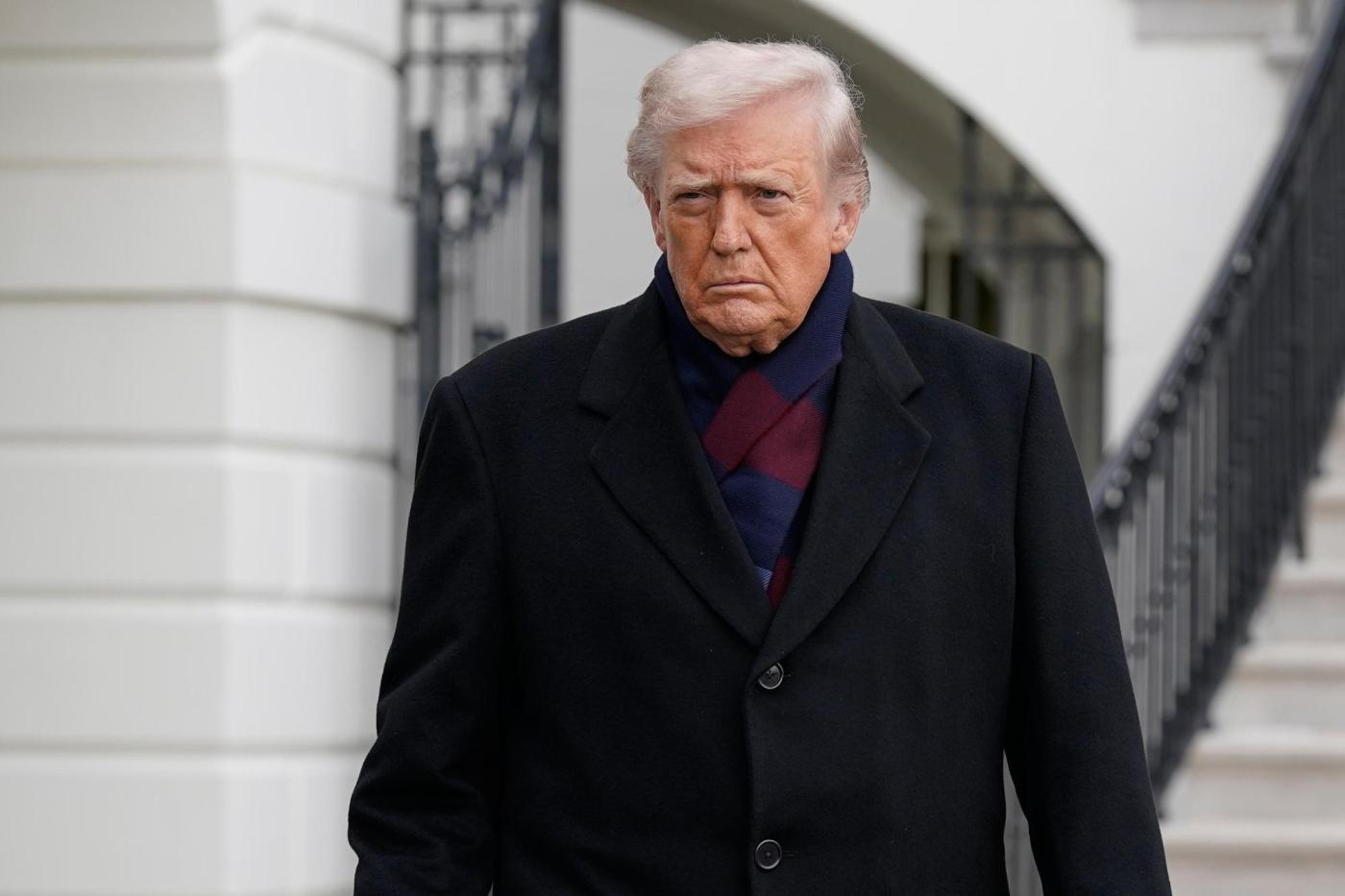
WASHINGTON (AP) — President Donald Trump on Monday blamed Rob Reiner’s outspoken opposition to the president for the actor-director’s killing, delivering the unsubstantiated claim in a shocking post that seemed intent on decrying his opponents even in the face of a tragedy.
The statement, even for Trump, was a shocking comment that came as police were still investigating the deaths of the beloved director and his wife as an apparent homicide. The couple were found dead at their home Sunday in Los Angeles. Investigators believe they suffered stab wounds and the couple’s son Nick Reiner, was in police custody early Monday.
Trump has a long track record of inflammatory remarks, but his comments in a social media post were a drastic departure from the role presidents typically play in offering a message of consolation or tribute to the death of a public figure. His message also laid bare Trump’s unwillingness to rise above political grievance in moments of crisis.
Trump, in a post on his social media network, said that Reiner and his wife were killed “reportedly due to the anger he caused others through his massive, unyielding, and incurable affliction with a mind crippling disease known as TRUMP DERANGEMENT SYNDROME.”
He said Reiner “was known to have driven people CRAZY by his raging obsession of President Donald J. Trump, with his obvious paranoia reaching new heights as the Trump Administration surpassed all goals and expectations of greatness.”
Kentucky Republican Rep. Thomas Massie, who has bucked much of his party’s lockstep agreement with the president, criticized Trump for the comment.
“Regardless of how you felt about Rob Reiner, this is inappropriate and disrespectful discourse about a man who was just brutally murdered,” Massie wrote in a post on X. “I guess my elected GOP colleagues, the VP, and White House staff will just ignore it because they’re afraid? I challenge anyone to defend it.”
Rep. Marjorie Taylor Greene, a Georgia Republican whom Trump branded a “traitor” for disagreeing with him, responded to Trump’s message by saying, “This is a family tragedy, not about politics or political enemies.”
Related Articles
A Brown University student survived being shot in high school. Then came the active shooter alerts
New York is the 8th state found to have improperly issued commercial driver’s licenses to immigrants
GOP chairman threatens Clintons with contempt of Congress in Epstein inquiry
US accuses Rwanda of violating the peace deal as M23 rebels seize a key eastern Congo city
TSA renews push to end collective bargaining agreement for airport security screeners
Reiner was one of the most active Democrats in the film industry, regularly campaigning on behalf of liberal causes and hosting fundraisers. He was a vocal critic of Trump, calling him in a 2017 interview with Variety “mentally unfit” to be president and “the single-most unqualified human being to ever assume the presidency of the United States.”
The unsympathetic message was the latest example of Trump’s unsparing prism through which he views those he perceives as enemies.
He made retribution against political enemies a prime focus of his campaign for the White House last year. And he has in the past made light of violence when it’s befallen those on the other side of the political aisle.
That’s in despite of his comments after the assassination of conservative activist Charlie Kirk earlier this year. Trump said Kirk’s killing was “the tragic consequence of demonizing those with whom you disagree.”
His administration then sought consequences for people who were critical of Kirk or even celebrated his killing.
When Trump spoke at Kirk’s memorial service, he used his remarks to underline how he views his adversaries.
BERLIN (AP) — Russia has indicated it’s open to Ukraine joining the European Union as part of a potential peace deal aimed at ending Russia’s war on Ukraine, and there’s now consensus on about 90% of the U.S.-authored peace plan, U.S. officials said Monday.
The officials said that robust negotiations between President Donald Trump’s envoys, Steve Witkoff and Jared Kushner, and Ukrainian President Volodymyr Zelenskyy and his team led to progress on narrowing differences on security guarantees Kyiv said must be provided to Ukraine as well as the contentious issue on Moscow’s demand that Ukraine concede land in the eastern Donbas.
Kushner and Witkoff are expected to meet over dinner on Monday evening with Ukrainian as well British, German and French leaders for further talks. Trump, who has been briefed twice on the Berlin talks, plans to dial in to the dinner from Washington.
The negotiators and others involved in the peace talks will likely meet in Miami or elsewhere in the United States this weekend to continue their work, according to the U.S. officials.
The U.S. officials also said the administration plans to put forward the security guarantees agreement before the Senate for its approval, although they didn’t specify whether it would be ratified like a treaty, which needs two-thirds approval from the chamber.
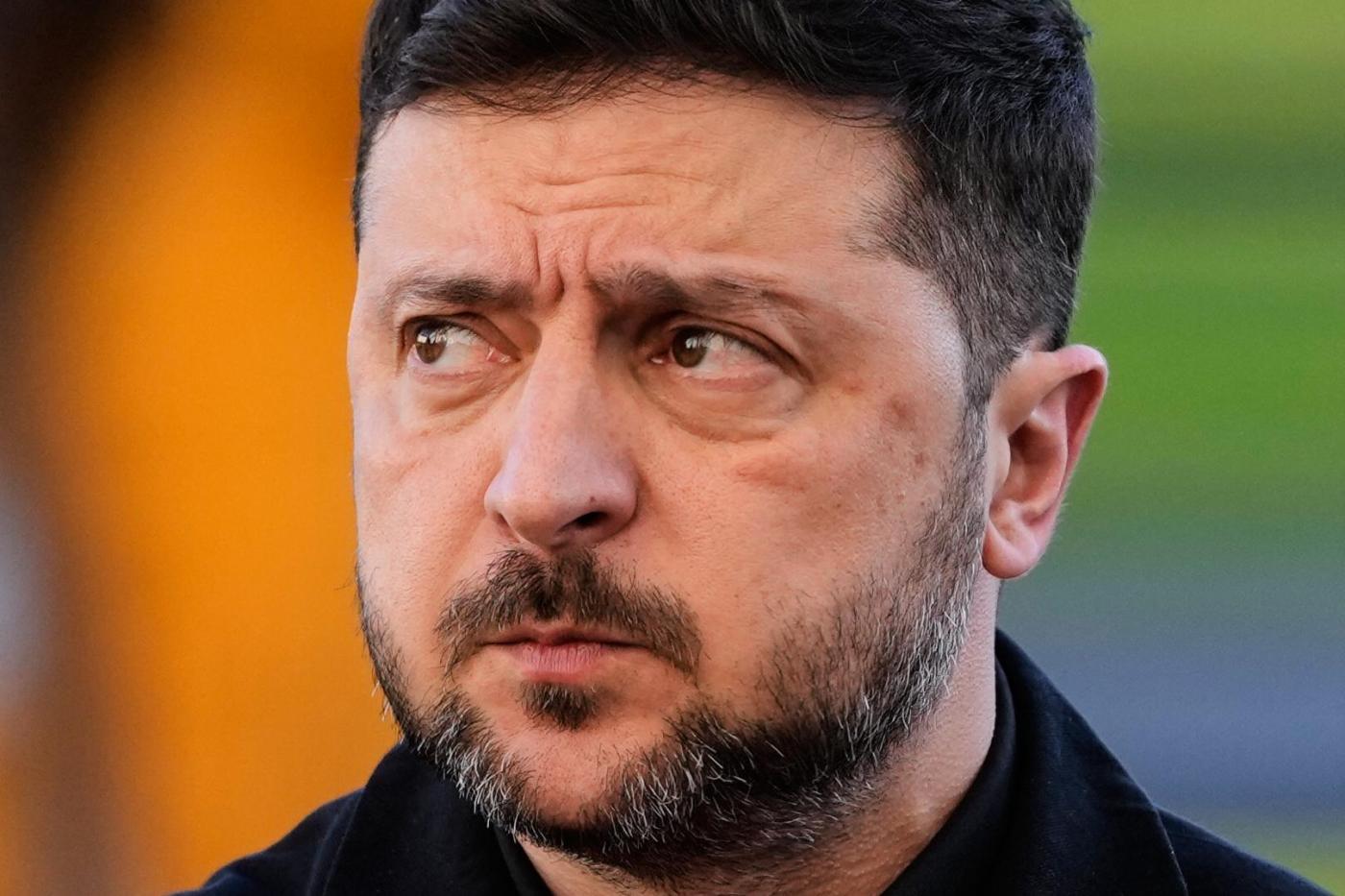
German President Frank-Walter Steinmeier welcomes Ukraine’s President Volodymyr Zelenskyy at the Bellevue Palace in Berlin, Germany, Monday, Dec. 15, 2025. (AP Photo/Maryam Majd)
German President Frank-Walter Steinmeier, center right, and Volodymyr Zelenskyy, center left, President of Ukraine, leave the Bellevue Palace in Berlin, Germany, Monday, Dec. 15, 2025. (Kay Nietfeld/dpa/dpa via AP)
Ukraine’s President Volodymyr Zelenskyy smiles during a visit of the German federal parliament, Bundestag, in the Reichstag building in Berlin, Germany, Monday, Dec. 15, 2025. (Christoph Soeder/dpa via AP)
1 of 3
German President Frank-Walter Steinmeier welcomes Ukraine’s President Volodymyr Zelenskyy at the Bellevue Palace in Berlin, Germany, Monday, Dec. 15, 2025. (AP Photo/Maryam Majd)
The U.S. officials who briefed reporters after Witkoff and Kushner met with Zelenskyy and other European officials in Berlin over the last two days said that such an offer over Ukraine joining the EU would be a major concession by Moscow. But Russia has previously said it does not object to Ukraine joining the EU.
The U.S. officials, who were not authorized to comment publicly by the White House and spoke on the condition of anonymity, said that the U.S. has also agreed to provide unspecified security guarantees to Kyiv as part of the deal but that such an offer won’t be on the table “forever.”
Ukraine’s lead negotiator, Rustem Umerov, said on social media that “real progress” had been achieved at the talks in Berlin with President Donald Trump’s special envoy Witkoff and Trump’s son-in-law Kushner as well as European officials. The talks lasted roughly 90 minutes, after a five-hour session Sunday.
The U.S. government said in a social media post on Witkoff’s account after Sunday’s meeting that “a lot of progress was made.”
The search for possible compromises has run into major obstacles, including control of Ukraine’s eastern Donetsk region, which is mostly occupied by Russian forces.
Zelenskyy has expressed readiness to drop Ukraine’s bid to join the NATO military alliance if the U.S. and other Western nations give Kyiv security guarantees similar to those offered to NATO members. But Ukraine’s preference remains NATO membership as the best security guarantee to prevent further Russian aggression however this option doesn’t currently have full backing from all allies.
Still, Ukraine has continued to reject the U.S. push for ceding territory to Russia. Russian President Vladimir Putin wants Ukraine to withdraw its forces from the part of Donetsk region still under its control as one of the key conditions for peace.
Zelenskyy’s itinerary on Monday also included meetings with German and other European leaders. French President Emmanuel Macron’s office confirmed he would travel to Berlin later Monday.
Related Articles
Today in History: December 15, Bridge collapses into Ohio River, killing 46 people
What to know about the US military’s role in Syria after deadly IS attack
Father and son gunmen kill at least 15 people in attack on Hanukkah event at Sydney’s Bondi Beach
Today in History: December 14, Vaccinations begin as COVID-19 death toll hits 300,000
Trump pledges retaliation after 3 Americans are killed in Syria attack that the US blames on IS
“The issue of security in particular will ultimately determine whether this war actually comes to a standstill and whether it flares up again,” a spokesperson for German Chancellor Friedrich Merz, Stefan Kornelius, told reporters.
The Russian president has cast Ukraine’s bid to join NATO as a major threat to Moscow’s security and a reason for launching the full-scale invasion in February 2022. The Kremlin has demanded that Ukraine renounce the bid for alliance membership as part of any prospective peace settlement.
Zelenskyy emphasized that any Western security assurances would need to be legally binding and supported by the U.S. Congress.
The Kremlin said Monday it expected to be updated on the Berlin talks by the U.S. side.
Asked whether the negotiations could be over by Christmas, Kremlin spokesperson Dmitry Peskov said trying to predict a potential time frame for a peace deal was a “thankless task.”
“I can only speak for the Russian side, for President Putin,” Peskov said. “He is open to peace, to a serious peace and serious decisions. He is absolutely not open to any tricks aimed at stalling for time.”
Putin has denied plans to attack any European allies.
In London, meanwhile, the new head of the MI6 spy agency was set to warn on Monday how Putin’s determination to export chaos around the world is rewriting the rules of conflict and creating new security challenges.
Blaise Metreweli was using her first public speech as chief of the United Kingdom’s foreign intelligence service to say that Britain faces increasingly unpredictable and interconnected threats, with emphasis on “aggressive, expansionist” Russia.
Drone strikes continue
Russia fired 153 drones of various types at Ukraine overnight Sunday into Monday, according to Ukraine’s Air Force, which said 133 drones were neutralized, while 17 more hit their targets.
In Russia, the Defense Ministry on Monday said forces destroyed 130 Ukrainian drones overnight. An additional 16 drones were destroyed between 7 a.m. and 8 a.m. local time.
Eighteen drones were shot down over Moscow itself, the defense ministry said. Flights were temporarily halted at the city’s Domodedovo and Zhukovsky airports as part of safety measures, officials said.
Damage details and casualty figures were not immediately available.
Madhani reported from Washington. Seung Min Kim in Washington, Pietro De Cristofaro in Berlin, Illia Novikov in Kyiv, Ukraine, and Katie Marie Davies in Manchester, England, contributed to this report.
SYDNEY (AP) — A father and son are suspected by officials to have killed 15 people on a popular Australian beach, shocking a country where gun violence is rare. The government on Monday, a day after the shootings, proposed tougher new gun laws amid criticism that officials didn’t take seriously enough a string of antisemitic attacks.
Here’s a look at what to know from the attack at Bondi Beach:
The suspects attacked a Jewish beachside gathering
Little is known about the suspects in the attack on Sydney’s famous Bondi Beach, but there was widespread shock when officials said that the two men pictured firing weapons in social media videos were related.
The 50-year-old father, who was killed, arrived in Australia in 1998 on a student visa, authorities said, and was an Australian resident when he died. Officials wouldn’t confirm what country he had migrated from.
His 24-year-old Australian-born son, who was shot and wounded, is being treated at a hospital
The target was a Hanukkah celebration where hundreds had gathered to celebrate the first day of the eight-day Jewish holiday. Prime Minister Anthony Albanese called it an act of antisemitic terrorism.
Albanese said that Australia’s main domestic spy agency, the Australian Security Intelligence Agency, had investigated the son for six months in 2019. The Australian Broadcasting Corp. reported that the agency had examined the son’s ties to a Sydney-based Islamic State group cell. Albanese did not describe the associates, but said the spy agency was interested in them rather than the son.
The dead included a 10-year-old girl, a rabbi and a Holocaust survivor. Dozens of others were injured, some seriously.
Police said the father held a firearms license and that he was a member of a gun club, which suggests he was a target shooter.
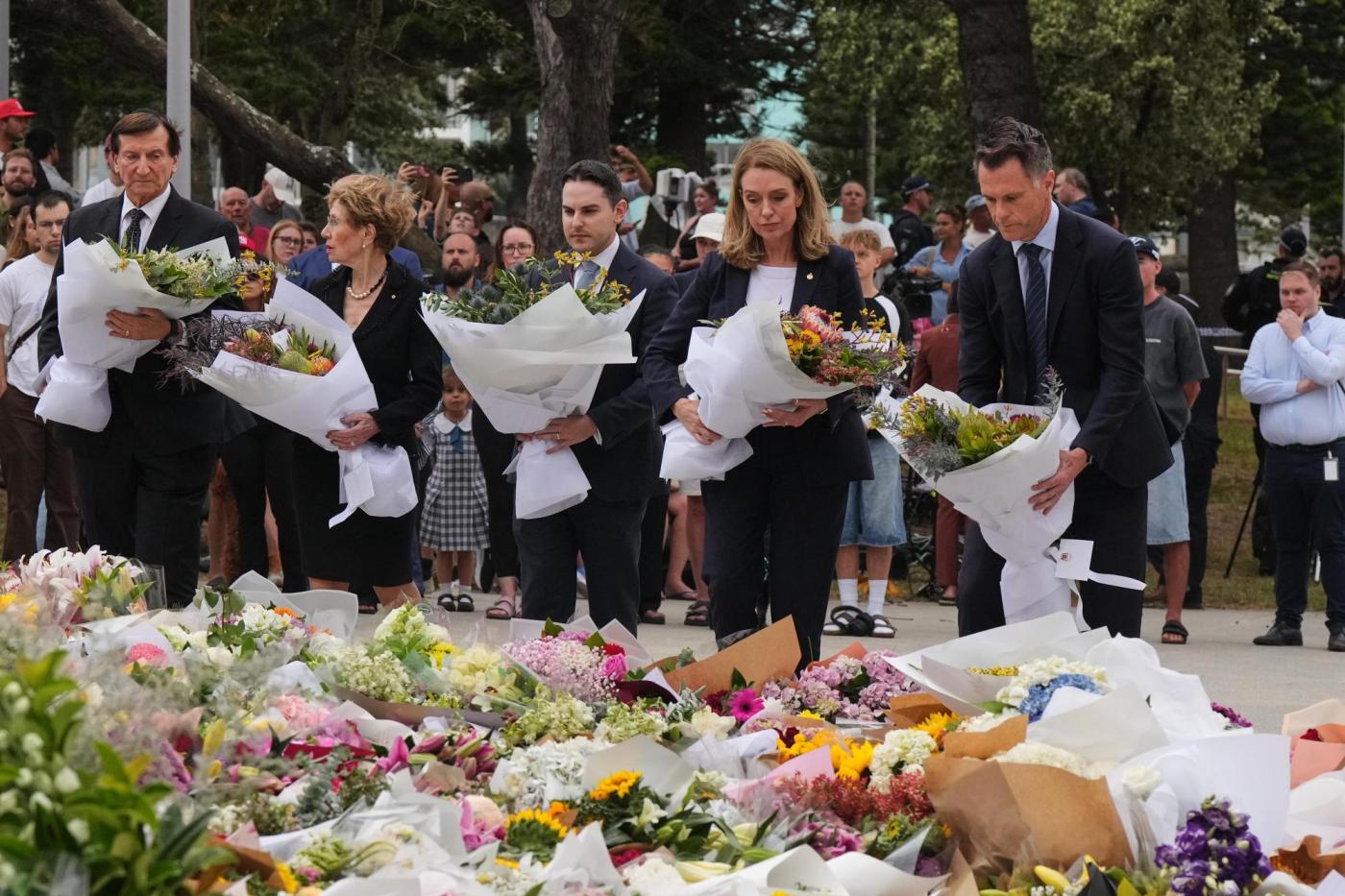
People leave notes at a flower tribute for shooting victims outside the Bondi Pavilion at Sydney’s Bondi Beach, Monday, Dec. 15, 2025, a day after a shooting. (AP Photo/Mark Baker)
Praise for a man who tried to help
One dramatic clip broadcast on Australian television showed a man appearing to tackle and disarm one of the gunmen, before pointing the man’s weapon at him, then setting the gun on the ground.
The man was identified by Home Affairs Minister Tony Burke as Ahmed al Ahmed. The 42-year-old fruit shop owner and father of two was shot in the shoulder by the other gunman and survived.
Hate crimes targeting Jews in Australia are on the rise
Australia has 28 million people and about 117,000 Jews.
Related Articles
Today in History: December 15, Bridge collapses into Ohio River, killing 46 people
What to know about the US military’s role in Syria after deadly IS attack
Father and son gunmen kill at least 15 people in attack on Hanukkah event at Sydney’s Bondi Beach
Today in History: December 14, Vaccinations begin as COVID-19 death toll hits 300,000
Trump pledges retaliation after 3 Americans are killed in Syria attack that the US blames on IS
Antisemitic incidents, including assaults, vandalism, threats and intimidation, surged more than threefold in the country during the year after Hamas attacked Israel on Oct. 7, 2023, and Israel launched a war on Hamas in Gaza in response, the government’s Special Envoy to Combat Antisemitism Jillian Segal reported in July.
Last year, there were antisemitic attacks in Sydney and Melbourne. Synagogues and cars have been torched, businesses and homes vandalized with graffiti, and Jews attacked in cities where 85% of the nation’s Jewish population lives.
Israel urged Australia’s government to address crimes targeting Jews. Prime Minister Benjamin Netanyahu said he warned Australia’s leaders months ago about the dangers of failing to take action against antisemitism. He claimed Australia’s decision — in line with scores of other countries — to recognize a Palestinian state “pours fuel on the antisemitic fire.”
This is the deadliest shooting in Australia in three decades
Australia has strict gun control laws.
Mass shootings are extremely rare. A 1996 massacre in the Tasmanian town of Port Arthur, where a lone gunman killed 35 people, prompted the government to drastically tighten gun laws, making it much more difficult to acquire firearms.
Significant mass shootings this century included two murder-suicides with death tolls of five people in 2014 and seven in 2018, in which gunmen killed their own families and themselves.
In 2022, six people were killed in a shootout between police and Christian extremists at a rural property in Queensland state.