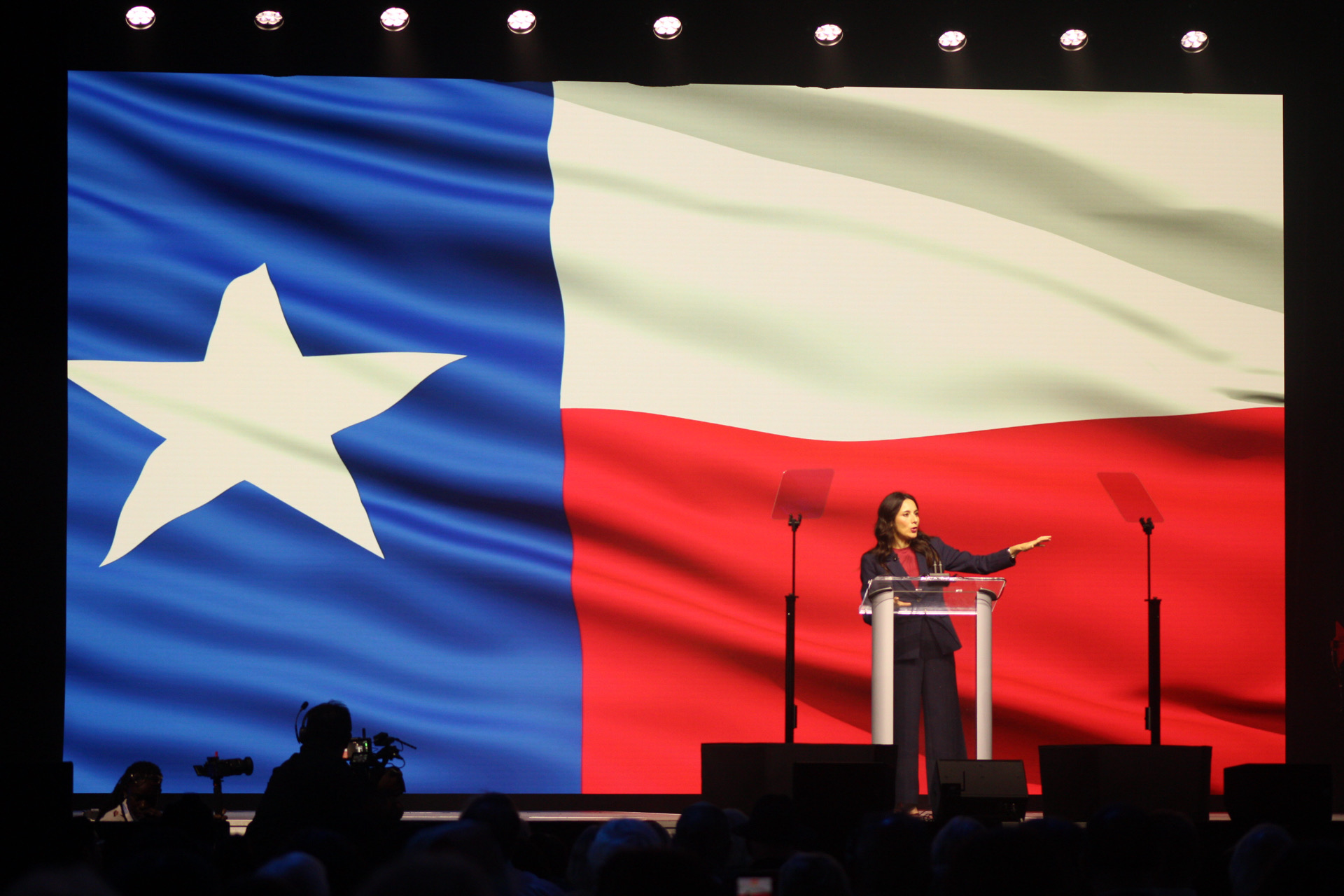
At this year’s Texas Democratic Party convention, sounds of the Corpus Christi coastline lulled Lone Star liberals into the recurring dream of a blue wave crashing over the state. After 30 years of Republican rule, Democrats once again insisted that 2026 would be their best shot at flipping Texas in decades. Emboldened by a viral U.S. Senate candidate in James Talarico and the toxic failures of President Donald Trump, the conditions almost mirror 2018 when the last blue wave turned the tides of several down-ballot races but, at the top, ultimately turned out to be little more than a message written in the sand.
Over the course of the three-day convention, a long line of speakers attacked Republicans on the high price of groceries and healthcare as well as the shuttering of public schools across the state. In the drought-stricken city of oil refineries and the original Whataburger, the most prominent climate issues mentioned weren’t tied to fossil fuels and the oil and gas industry but water-wasting data centers and cattle-killing screwworms. They adopted a new party platform focused on populist policies protecting workers’ rights, expanding public transportation, and making healthcare more affordable.
On the surface, the Democrats asserted themselves as a unified party of the working class against the all-powerful billionaires. The party boasted of advances in GOP strongholds that include a state Senate seat in Tarrant County, new chapters of the Young Democrats in West Texas, and putting forth Democratic “Challengers” for every legislative and congressional race in the state. Yet tension stirred within the ranks of delegates and party officials. The lack of diversity at the top of the ticket, clashes over Israel, and debates over progressivism versus moderation represent a battle for the future of the party that was thinly veiled by constant calls to unity.
The population of Texas is over 30 million people, of which about 40 percent are Hispanic and 13 percent are Black—yet this year’s slate of Democrats for statewide office is made up mostly of white candidates from Central Texas. Three politically experienced women—including state Representative Gina Hinojosa for governor, state Representative Vikki Goodwin for lieutenant governor, and state Senator Sarah Eckhardt for comptroller, all from Austin—are helping lead the ticket, but the ballot is noticeably lacking in racial diversity that has left some Black voters, politicians, and activists who form the base of the Texas Democratic Party feeling disenfranchised.
The Democratic primary battle for the Senate nomination between Dallas Congresswoman Jasmine Crockett and Austin state Representative James Talarico unleashed controversy over the topic of “electability” in a state dominated by the politics of whiteness, Christianity, and masculinity. Talarico’s victory in March didn’t fully quell the debate as he tries to shore up the vast majority of Black voters cast their ballots for Crockett in the primary, particularly in Dallas, Houston, and East Texas.
“I saw how excited my students were for Jasmine Crockett,” said Laura Longoria, a delegate and high school teacher in East Texas. “I’m worried we’re going to lose some of that excitement.” Since then, Talarico has attempted to forge a stronger connection with Black Texans by speaking at Black churches and universities. He also announced a policy plan to combat maternal mortality, which disproportionately affects Black women.
(Photo by Eden Shamy)
Talarico invited Crockett to be a keynote speaker at the convention, an offer she reportedly denied. As she told the Dallas Morning News: “I had a missed call that I’ve not returned, nor have I listened to the message from Talarico.” She added that the invitation seemed like an afterthought, but “I can’t say for sure because I haven’t listened to it.” Some perceived the comments as deliberately undermining Talarico, although Crockett endorsed him immediately after losing the primary. Her office told KVUE that Crockett was simply busy doing her job in Congress, and attending the convention would not be feasible.
On the second day of the convention, Talarico spoke before Texas Democrats’ Black Caucus, where he was well received. “The Democratic Party has a troubling history of taking Black voters for granted,” he said. “And I am committing to you to not make those mistakes.”
Talarico and candidates Vikki Goodwin, Nathan Johnson, and Sarah Eckhardt also stumped before the Tejano and Hispanic caucuses. They vowed to end cooperation with ICE and shut down inhumane migrant detention centers. Vice Chair for Finance Kolby Duhon emphatically stated that “Black women are the backbone of this party,” to roaring applause during the general session, which featured a more diverse array of candidates running up and down the ballot.
Speaker after speaker took the stage at the Hilliard Center to address the “rice and beans issues,” as Senator Chuy Hinojosa put it. The Texas Democrats’ adoption of a more populist platform—one that emphasizes a commitment to kitchen table economic issues targeting the working class—was fortified by special guest Dolores Huerta, the Chicana civil rights leader, Tennessee state Representative Justin J. Pearson, and keynote speaker Senator Bernie Sanders.
“Today we must refound this nation once again against a tyrannical government,” said Pearson, who’s been on the forefront of the battle against racially gerrymandered maps in Tennessee. “If the Republican Party is going to be the party licking the boot of the billionaires who are taking our land, polluting our water, and taking our jobs, then let us be the party of the working class.” Dolores Huerta’s surprise appearance moved the entire arena to their feet in chants of “Sí se puede.” Yet in the on-stage interview, little was actually said about the state of labor organizing in Texas.
Pearson and Huerta were immediately followed up by the keynote speaker U.S. Senator Cory Booker, a mainstream Dem from New Jersey. Last year, the senator’s record-breaking filibuster speech against Republican spending cuts surged his popularity among rank-and-file liberals. But for progressives, Booker remains an unpopular figure due to his past support for Israel and education reform like school choice. While Booker preached for 25 minutes about living up to Democratic values, three young women stood up from the front of the crowd in protest. “Why should Texans listen to you when you’ve accepted almost a million dollars from AIPAC?” they shouted. “We deserve better than sell-out Democrats like you!”
Many in the surrounding crowd sought to quell the dissent, yelling at them to be quiet and leave. Police were called in and escorted the protestors out of the arena.
The three protesters are members of the Austin chapter of Sunrise Movement, a youth-led group for climate justice and anti-fascism. Rosario Lopez-Cadenas, a 26-year-old progressive who participated in the protest, said she attended the convention to better understand the Democrat’s vision of the future. “I really got a sense that a lot of them were campaigning on being anti-Trump but not much else,” said Cadenas. “Working-class people don’t want to be complicit in genocide, and it makes Cory Booker kind of untrustworthy.”
(Photo by Eden Shamy)
This year’s convention was dotted by keffiyehs and other nods of solidarity with Palestine. In the exhibit hall, attendees gathered around the “Falasteen Street Museum,” a collection of posters that detail the history of occupation, apartheid, and ethnic cleansing. The mobile exhibit has been a recurring educational feature of pro-Palestine gatherings around Austin.
The two leading non-Texan speakers—Booker and Sanders—have found themselves in frequent opposition over the years, particularly on lowering prescription drug prices and cutting off aid to Israel. After greenlighting arms sales to Israel for two years while it’s committed what a United Nations commission has found to be a genocide in Gaza, Booker finally supported Sanders’ bill this April to block military aid to the apartheid state—not necessarily because of Palestine but because of his opposition to “Trump’s war” in Iran.
When Sanders took the stage the following Saturday night to close out the convention, he received a standing ovation for promising to end aid to Israel. In his typical always-on-message fashion, the 84-year-old Vermont democratic socialist’s speech detailed all the ways in which billionaires have corrupted American democracy through their super PACs and ownership of the media. “The American people do not want establishment status quo policies,” Sanders said. “This country is facing major crises, and they want bold proposals.”
(Photo by Eden Shamy)
Days before the convention, Sanders (and an acolyte in Mayor Zohran Mamdani) helped fuel recent victories for the Democratic Socialists of America (DSA) in the New York primaries. But Texas is no New York. Top-of-the-slate candidates such as Talarico and Hinojosa have focused their broadly popular messages on pocketbook populist issues and taking on political corruption, and have made explicit appeals to moderates and disillusioned Republicans.
On Friday night, Hinojosa harnessed broad discontent into a sharp criticism of Governor Greg Abbott and the political establishment. “There is a name for what you have been paying. It is the Greg Abbott Corruption Tax,” she said. “You pay it when your electricity bill arrives, when your local school closes, when your grocery bills go up. You pay it when you can’t get the care you already paid for and need to survive—all while Greg Abbott and his donors get richer.”
To close the night, Talarico gave a speech that went right after his opponent. “This isn’t a partisan thing. Republicans know just as well as Democrats that there’s no place for guys like Ken Paxton in Texas,” said Talarico. “That’s why these two parties that don’t seem to agree on anything these days came together to impeach the most corrupt politician in America.”
Still, rising socialist factions within the Democratic Party have spurred fear in the more moderate wing, and some have even formed their own group to swear their allegiance to capitalism. Congressman Vicente Gonzalez Jr. and congressional candidate Bobby Pulido—both running highly contested races in South Texas—were among the first of 13 Democrats to sign the “Promise to America.” Both of them are conservative Blue Dog Democrats that believe it will take moderation to win over traditional voters in South Texas.
Congressional candidate and Tejano performer Bobby Pulido performs at the Texas Democratic convention in Corpus Christi. (Photo by Eden Shamy)
“We are capitalist, not socialist,” and “We are mainstream, not extreme,” are among the core tenants of the Promise to America. Despite these undercurrents of ideological conflict, Democrats stayed focused on a message of unity and getting out the vote to flip Texas this November. People danced and cheered for Pulido during his opening night performance, and they applauded both Booker and Sanders alike. In the end, the party voted overwhelmingly to “Keep Kendall” Scudder as party chair in an election that featured two other challengers.
“We are one party with one purpose,” said Scudder in his fiery closing remarks. “When we leave Corpus Christi today, we leave with a unified message and a shared promise to the people of Texas: Texans don’t need more political theater, they need leaders.”
The post Unity and Discontent at the Texas Dems’ Corpus Convening appeared first on The Texas Observer.
Leave a Reply