I made $7.25 an hour at my first job back in 2015, peddling candles and soaps and other good-smelling baubles at a French boutique near Rice University. It was a good job, as far as first jobs go; I was a junior in high school, and I did my homework behind the counter. I knew even then that $7.25 an hour wasn’t a dignified wage, one you could build a life on, a family. In the 11 years since, the minimum wage in Texas hasn’t budged.
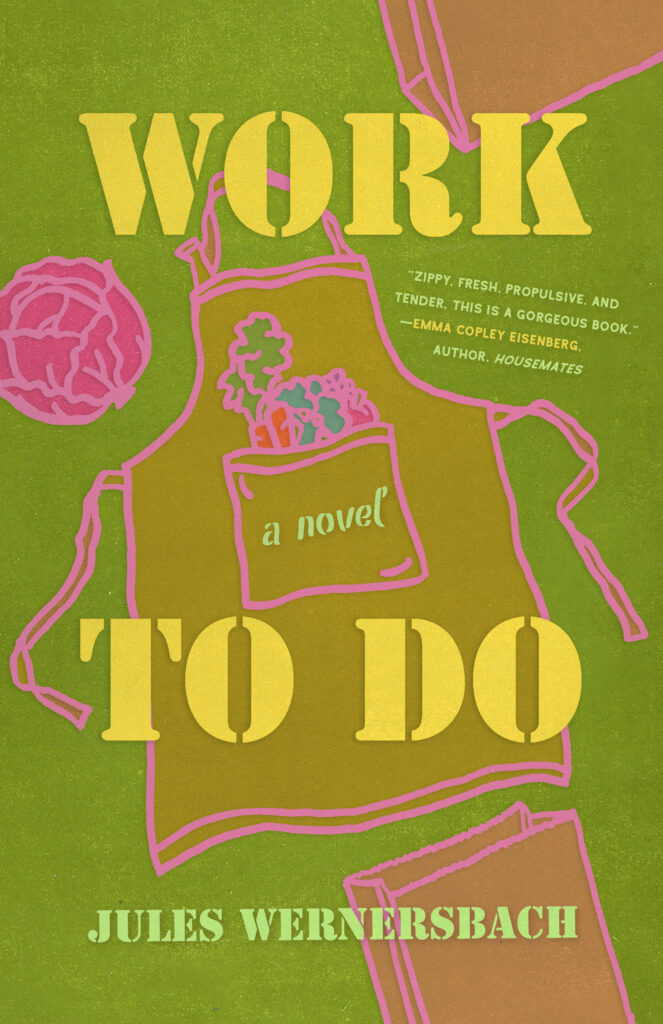
In Jules Wernersbach’s new novel, Work to Do (out in April from University of Iowa Press), the entry-level workers at the Guadalupe Street Co-Op in Austin make $12 an hour. Though it’s more than minimum wage (as management loves to remind them), it’s one of many reasons why the staff is organizing a union. The book unfolds over one week in late August across three perspectives at the organic grocery store: Eleanor, the store’s founder, who’s never gotten over the ex she founded the store with; Roz, the senior floor manager desperate for Eleanor to give her some real power to modernize the co-op; and Randy, the middle-aged trans dairy manager leading the fight for a union. All three protagonists of Work to Do are starving for a sense of community and trying to find it through their work.
Set in 2019, the novel pays homage to both pre-pandemic and pre-gentrification Austin and features haunts gone by like gay bar Dirty Sally’s and UT watering hole Spider House. I wouldn’t say the Austin of Work to Do feels particularly lived-in—these places are more akin to set dressing. But perhaps that’s exactly the point: to show the reader how work alienates us from our surroundings.
The novel unfolds during hurricane season, and it was the climate change angle that first attracted me to the book. The novel opens with a flood, and the storm prep (or lack thereof) lights the powder keg of the workers’ unionizing efforts. After repeated requests to close early, a staff member injures his arm trying to get the doors open after the power blinks out, and an unflattering video circulates of the manager forcing everyone back to work amid the chaos.
Part of what keeps ownership from preparing adequately are Eleanor’s misguided comparisons to Austin’s real-life Memorial Day flood of ’81, and Wernersbach does an excellent job later in the narrative of jumping back in time to the owner’s lived experience of that flood and the larger-than-life role it plays in her sense of both herself and the business she runs. Climate change makes fools of us when we live in the past, when we don’t imagine that the world could be different than it once was. And though the weather is just peachy for the majority of the book, it comes back in a big way at the conclusion.
But, at the end of the day, this is a workplace drama. It’s an age-old genre in American letters, though one that changes through the years as much as the nature of work does. It’s full of the things that make workplace novels interesting: clandestine group chats, coworkers hearing secret conversations through a door, unsanctioned (and ill-advised) romance.
I’ve heard it said that Americans don’t like didacticism in their art. If so, some may balk at the book’s decided point of view on precarity. Eleanor must face her own mortality, navigating life and legacy post-breast cancer diagnosis. Roz is burning through the inheritance (and the monthly allowance) left to her by her middle-class family, unclear what lies on the other side. At one point, Randy has only $18.41 in his bank account, and, facing eviction, he stares down the tent he lived in during his early days in Austin as a 20-something and wonders if he can do it again.
Who has a safety net? the book asks. What is required to make our work dignified? For while it might be true, as the book notes, that “They all passed around what little they had when it was needed, their pooled resources shifting from person to person, a free-floating mutual aid GoFundMe,” we need structures that can sustainably hold us up.
My one quibble with the book’s stance on labor is not what is said but what is shown. The predominantly white cast of characters, particularly those who get the bulk of the airtime to articulate their political positions at the group’s organizing meetings and around the store, don’t reflect the reality of who is doing frontline work in Texas—those who have the most to gain from a union like the one in the book. According to an Associated Press analysis of U.S. Census Bureau data, frontline workers in Texas are more likely to be people of color. There’s still a beautiful tapestry painted of what it means to be a worker and to organize together; it just feels as if there are a few colors missing.
There is, though, a delicious array of gay mess in the book. The first girl who made you believe in a future, as a queer person; girls who are taken who you desperately wish weren’t—the kind who make you reckless; ex-girlfriends who have clearly moved on even when you haven’t; families who wish you were different, wish you’d just settle down, get a better job, a different way of life, a respectable one.
Work to Do is an ode to the service jobs that keep a place like Austin running, the bartenders and grocery store workers and booksellers, the underloved proletariat that keeps those businesses going. When Randy’s roommates suggest that he might find a better-paying job, he puts it this way: “The co-op wasn’t a job for college kids. It was a job for people who didn’t fit in anywhere else. … To earn more you had to buy into the whole American package, you had to want a house and cars and marriage and family and center the comfort of the individual, which was a form of isolation.”
In an age of increasingly frequent disasters, natural and man-made, community is a precious thing indeed. Work to Do is a rousing portrayal of how we might go about the work of making that community together, and in so doing, make our lives a bit less precarious.
The post An Ode to Austin’s Unsung Proletariat appeared first on The Texas Observer.
Leave a Reply