Opinion: To Fight Hunger in New York City, Start With Schools

posted in: All news | 0

“Our schools are incredibly well-positioned to address hunger. They’re connected to nearly 1 million students and their families, and are one of the few resources that reach a citywide scale.”

A school lunch tray. (Michael Appleton/Mayoral Photography Office)

Mayor Zohran Mamdani is entering City Hall during one of the most dire hunger crises in recent New York City history. Unprecedented cuts to federal food assistance and the lapse in Supplemental Nutrition Assistance Program (SNAP) benefits during last year’s shutdown have brought this crisis into the spotlight.

However, the rising cost of groceries, threats to food benefits, and economic factors like inflation have been driving children and families into hunger since the pandemic. According to a March 2025 poll from No Kid Hungry, 86 percent of New Yorkers said the cost of food is rising faster than their income.

New York’s hunger crisis has been devastating for kids and families, but it also represents an opportunity for the new mayor—who made affordability his central campaign issue—to take a bold stance and ensure that every New Yorker stays fed.

Mayor Mamdani already has a solid track record on the issue. As a State Assembly member, he championed legislation to expand free meals for public school students. On the campaign trail, he also acknowledged that kids must eat to thrive. If he wants to make an immediate impact on the hunger crisis, there’s a place he can start reaching families on his first day in office: New York City Schools.

Our schools are incredibly well-positioned to address hunger. They’re connected to nearly 1 million students and their families, and are one of the few resources that reach a citywide scale. There are three things Mayor Mamdani can do at the start of his tenure to ensure kids get the food they need: maximize the reach of tried-and-true school meal programs; provide in-school resources to help families apply for SNAP and other benefits; and increase the number of school pantries. 

The Mamdani administration should work to ensure that successful school-based meal programs reach even more kids and families. Since New York City started adopting Breakfast in the Classroom programs in 2008, students have had higher attendance rates, better test scores, and fewer chronic health problems. Schools can go even further by fully implementing Breakfast After the Bell in every school to reduce the stigma of free breakfast programs and increase participation, especially as participation has tapered off. Similarly, the administration should actively promote and expand access to summer meal programs that help connect kids to meals when school isn’t in session. 

The administration can also tackle the hunger crisis by providing in-school resources to help families apply for SNAP and other benefits. With 1.8 million recipients in New York City, SNAP is the first line of defense against hunger. Yet many families don’t know they’re eligible or that enrollment in SNAP qualifies them for other programs, like Summer EBT grocery benefits. Schools are trusted messengers for kids and families and they have remarkable infrastructure in place to keep families informed. From creating resource pages on school websites to providing on-site eligibility and application assistance in schools, a little extra support can go a long way in helping eligible families make the most of these programs. 

Finally, adding more school pantries would help put healthy food back within reach for thousands of New York City children. Back in 2016, in partnership with the New York City Council, New York City Schools launched its first-in-the-nation food and hygiene pantries, which provide free food, cleaning supplies, and hygiene products in some school buildings. While many schools have taken steps to create their own pantries, the need is still there: a back-to-school poll from No Kid Hungry found that 40 percent of New York City families were worried about running out of food. Schools can collaborate with city agencies and nonprofit organizations to take inventory of existing pantries, assess school needs, and get new pantries or mobile markets up and running. 

New York City’s progress in the fight against hunger has come thanks to our schools and school nutrition staff, as well as our elected officials. In just the past few years, New York City schools have expanded access to school meal programs, rolled out even more food and hygiene pantries, and launched farm-to-school programs to bring healthy, local produce into classrooms. 

Mayor Mamdani will need to act quickly to build on that progress and address the city’s hunger crisis. If he wants to make an early impact, he should start with our schools. 

Rachel Sabella is the director of No Kid Hungry New York.

The post Opinion: To Fight Hunger in New York City, Start With Schools appeared first on City Limits.

US nearly triples list of countries whose citizens must post bonds up to $15,000 to apply for visas

posted in: All news | 0

By MATTHEW LEE, Associated Press

WASHINGTON (AP) — The Trump administration is nearly tripling the number of countries whose passport holders will be required to post bonds of up to $15,000 to apply to enter the United States.

Less than a week after adding seven countries to the list of nations subject to visa bonds, bringing the total to 13, the State Department on Tuesday added 25 more. The bond requirement for the latest additions will take effect Jan. 21, according to a notice posted on the travel.state.gov website.

The move means that 38 countries, most of them in Africa but some in Latin America and Asia, are now on the list, which makes the process of obtaining a U.S. visa unaffordable for many.

Related Articles


Trump says his voters loved the Venezuela attack — here’s what they really think


Cuba releases details of 32 officers killed in US strike on Venezuela as US defends attack


Georgia sets March 10 election to replace Marjorie Taylor Greene in Congress


Trump tells Republicans to be ‘flexible’ on abortion restrictions to get a health care deal


At least 24 Venezuelan security officers killed in US operation to capture Maduro, officials say

It’s the latest effort by the Trump administration to tighten requirements for entry to the U.S., including requiring citizens from all countries that require visas to sit for in-person interviews and disclose years of social media histories as well as detailed accounts of their and their families’ previous travel and living arrangements.

U.S. officials have defended the bonds, which can range from $5,000 up to $15,000, maintaining they are effective in ensuring that citizens of targeted countries do not overstay their visas.

Payment of the bond does not guarantee a visa will be granted, but the amount will be refunded if the visa is denied or when a visa holder demonstrates they have complied with the terms of visa.

The new countries covered by the visa bond requirement as of Jan. 21 are Algeria, Angola, Antigua and Barbuda, Bangladesh, Benin, Burundi, Cape Verde, Cuba, Djibouti, Dominica, Fiji, Gabon, Ivory Coast, Kyrgyzstan, Nepal, Nigeria, Senegal, Tajikistan, Togo, Tonga, Tuvalu, Uganda, Vanuatu, Venezuela and Zimbabwe.

They join Bhutan, Botswana, the Central African Republic, the Gambia, Guinea, Guinea-Bissau, Malawi, Mauritania, Namibia, Sao Tome and Principe, Tanzania, Turkmenistan and Zambia on the list.

Trump says his voters loved the Venezuela attack — here’s what they really think

posted in: All news | 0

By JESSE BEDAYN, MIKE CATALINI, MIKE HOUSEHOLDER, SOPHIE BATES, OBED LAMY and CALVIN WOODWARD, Associated Press

It’s only been days since an audacious U.S. raid snatched Nicolás Maduro from a Venezuelan military base and sped him to a Brooklyn prison, yet Detroit-area Trump supporter Aaron Tobin can already see it all playing out on the big screen.

It’ll be the subject of movies for years to come, he predicts. “I am thrilled.” Plenty of others who voted for President Donald Trump and spoke to The Associated Press about the raid are applauding, too — at least for now.

Aaron Tobin, a supporter of President Donald Trump, listens to a question during an interview, Jan. 5, 2026, in Bloomfield Hills, Mich. (AP Photo/Mike Householder)

The seizure of Venezuela’s authoritarian leader and his wife has forced another reckoning on the “Make America Great Again” coalition, already rocked by the Trump administration’s handling of the Jeffrey Epstein files and strained by rising health insurance premiums and living costs.

Trump promised his voters that “America First” would stand against more foreign entanglements. Instead, he intervened with force and without congressional approval in a new frontier, a South American capital so far from Washington that Google Maps says it “can’t seem to find a way there.”

The geopolitical action film that Tobin sees in his mind is only at its opening scene, before all the complexities of uprooting a foreign government by a U.S. president’s fiat come rushing in. U.S. forces entered and exited swiftly. But what happens next?

Trump finds early but not endless support

Early on, the pushback from congressional Republicans and Trump’s core constituencies has been guarded, in contrast to their uproar over the Epstein episode or the tensions coursing through Republican politics over the now-expired health insurance subsidies.

Against that backdrop, Trump voters interviewed by AP journalists around the country praised the operation and expressed faith in Trump’s course. But not always limitless faith. They did not all back up Trump’s claim that those who “voted for me are thrilled. They said, ‘This is what we voted for.’”

“I support him so far,” Paul Bonner, 67, told AP while browsing at a Trump merchandise store in Bensalem, Pennsylvania. “Until he messes up, I support him.”

Paul Bonner, 67, talks at the Trump Store in Bensalem Pa., Monday, Jan. 5, 2026, looking for a Trump 2028 sign. Speaking about the U.S. raid that captured Venezuela’s president. Bonner said he supports Trump “so far.” (AP Photo/ Mike Catalini)

Trump’s apparent willingness to stay involved in Venezuela and his intensifying rhetoric about expanding U.S. power elsewhere in the hemisphere are making some of his die-hard supporters nervous.

Not all of them are reaching for the popcorn yet.

In Mississippi, a conflicted Trump voter

Chase Lewis, 24, of Philadelphia, Mississippi, said the move caught him off guard and he still isn’t sure whether he supports it. “It’s good that they’re finally freed from that dictatorship,” he said of Venezuelans, “but I don’t know what it’s going to cost us.”

He added: “I don’t want my friends that are serving right now to be dragged into a war because we went and stuck our nose in Venezuela’s business.” He noted that Trump had campaigned against starting new wars. “Depending on how you look at it,” he said, “this was an act of war.”

An electrician apprentice who gave up his delivery job because he needed to make more money, Lewis said he wants to see the Trump administration focus on bringing down costs for young people like himself. He also wants the president to make life better for veterans and worries about plunging the country into more conflicts.

In Colorado, cheers and caution from Trump voters

To Trump voter Travis Garcia, leaning against his red pickup truck on a chilly evening in Castle Rock, Colorado, it’s a slam-dunk. “Of course I’m going to be happy that they captured a dictator that’s constantly sending drugs our way,” he said, “If we’re not gonna do it, who’s gonna do it?”

Related Articles


Cuba releases details of 32 officers killed in US strike on Venezuela as US defends attack


Georgia sets March 10 election to replace Marjorie Taylor Greene in Congress


Trump tells Republicans to be ‘flexible’ on abortion restrictions to get a health care deal


At least 24 Venezuelan security officers killed in US operation to capture Maduro, officials say


Trump administration thanks the media for keeping quiet before the strike that captured Maduro

The 45-year-old, who works in remodeling, said the operation reinforces Trump’s stature as “a powerful man who follows through on his word and isn’t going to be shy and timid and let other countries run the rules.”

Mary Lussier, 48, a flight attendant from the town of Larkspur, was so amazed by the success of the mission in Venezuela that she would be OK with more such operations. She recalled videos of Venezuelans tearfully celebrating Maduro’s removal and said fewer bad leaders “would make the world a little bit lesser of a bad place.”

Still, Lussier wouldn’t want U.S. soldiers stuck in a prolonged conflict, and much of her admiration for the operation hinged less on the possible benefits to the U.S. than on the smooth efficiency and bravado of the raiders.

Outside a Safeway grocery store in Castle Rock, Patrick McCans, 66, said delicately that Trump’s intervention was “a little contrary to what he campaigned on.”

“I would like to see more of a diplomatic way of making change,” said the retired engineer. Still, he said, pondering for a moment, “I think in this case it might have been warranted.”

Instead of playing ball, Maduro was “playing chicken with Trump, and Trump doesn’t like chicken,” he said, chuckling from beneath a Baltimore Ravens baseball cap.

The Colorado Trump supporters interviewed by AP all applauded the military operation’s smoothness and “class,” as one described it. But that support could waver if the U.S. is drawn into a longer conflict, which none of them would support.

Few mentioned Trump’s plans for Venezuela’s oil, but thought Maduro’s removal would benefit citizens and slow the drug trade and immigration to the U.S.

From Pennsylvania: Good riddance to Maduro

At the Golden Dawn Diner in Levittown, Pennsylvania, Ron Soto, 88, expressed unreserved faith in the president’s ability to manage what comes next. The retired tractor-trailer driver regularly visits the diner to meet friends, drink coffee and catch up.

Maduro is an “awful man,” he said. But should U.S. forces go into other countries, like Cuba, as it did in Venezuela? “I don’t think they’ll have to,” he said. “Because he (Trump) put the fear in them.”

As for Trump’s comment at one point that his administration would “run” Venezuela, Soto said the president will “straighten that country out and make it into a democracy if he can. I don’t know if he can.”

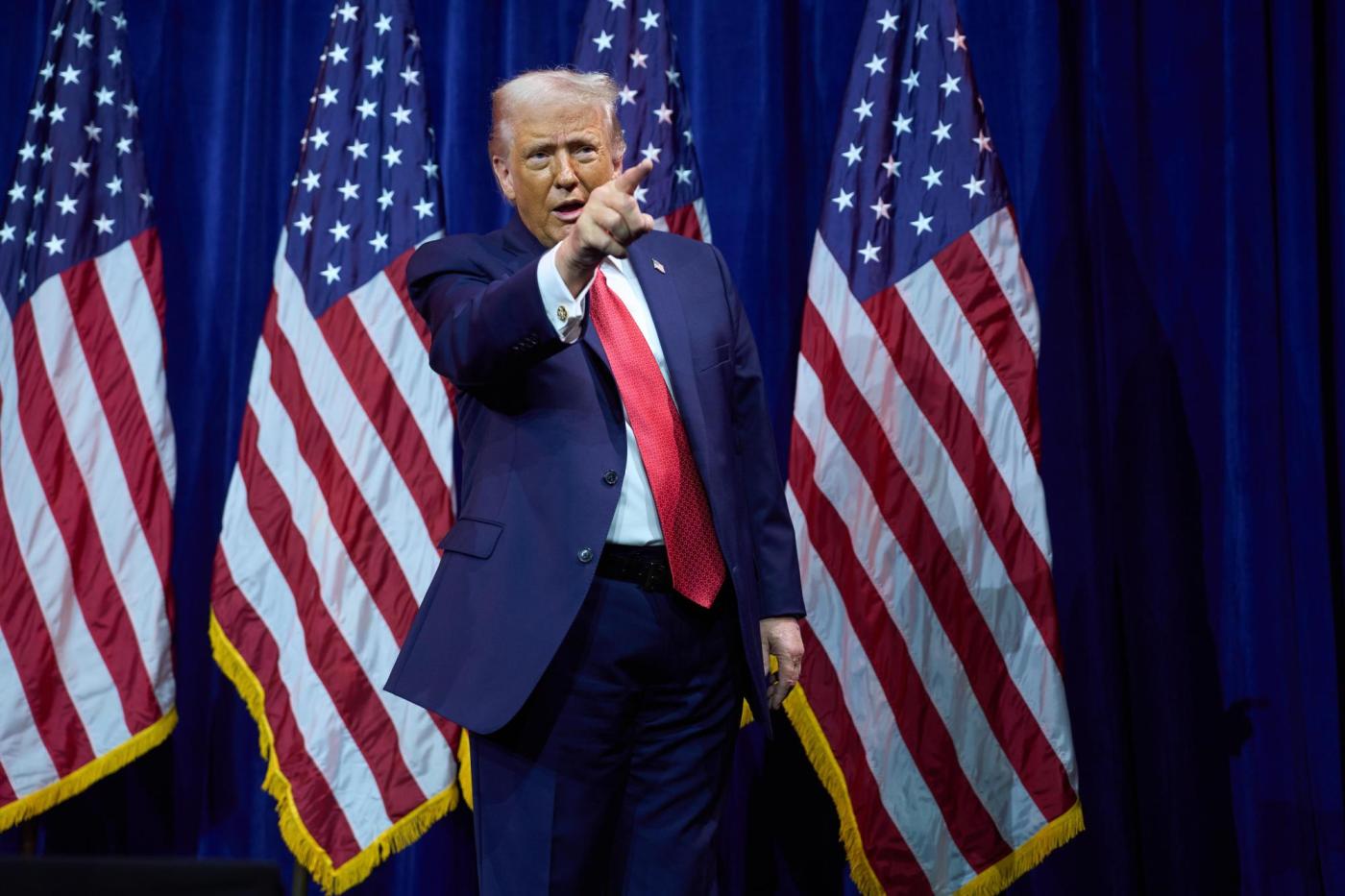
President Donald Trump speaks to House Republican lawmakers during their annual policy retreat, Tuesday, Jan. 6, 2026, in Washington. (AP Photo/Evan Vucci)

At the Neshaminy Mall, in Bensalem, retired firefighter Kevin Carey, 62, pronounced himself supportive of what Trump did but aware of the risks.

“I wouldn’t say thrilled but I’m cautiously optimistic,” he said. Carey recalled the seizing of U.S. hostages by Iranian revolutionaries in 1979 as an indication of what might happen if the conflict escalates. But “he’ll take all actions to avoid that, I believe,” he said of Trump.

On any further foreign intervention, Carey broke out laughing when he said: “He wants Greenland to be part of America!”

At the Trump merchandise store where Bonner shopped, banners and other items proclaiming “Trump 2028” are on display. Trump is constitutionally prohibited from running in 2028.

“I know he can’t run for president” in 2028, said Bonner, a propane company worker. Still, he wanted a lawn sign “just to irritate people” but didn’t find one.

The crisp military operation plainly left him impressed. “They got in and they got out, did what they had to do,” he said. Of Maduro, he said: “He’s an enemy of the United States so I support Trump 100%.”

Affirmation from the Midwest

Exiting a Walmart in Martinsville, Indiana, Mark Edward Miller, 75, from nearby Mooresville, said the only thing that surprised him about Trump’s intervention was that word of it did not leak in advance. The consistent Trump voter was an aircraft maintenance specialist in the Air Force before his retirement.

“I don’t feel like he’s actually taken over a country,” Miller said. “I believe that he’s doing exactly what our country should be doing — supporting, especially in our hemisphere, governments that are friendly with us” and challenging those that are hostile.

Tobin, the man in Michigan who sees a cinematic future for the raid, not only approved of the operation but wants more of them.

“Especially if they were as successful as this last one where we didn’t lose any troops, we didn’t lose any planes or ships,” Tobin said during a visit to the Oakland County Republican Party headquarters, where he was surrounded by Trump and GOP memorabilia. “I am thrilled and surprised” by what happened.

“Cuba’s very nervous right now,” he said. “And the Cuban people are suffering immensely from their horrible situation and their economy. Iran might be next.”

The three-time Trump voter is an active member of the local Republican Party, a certified firearms instructor and head of a bicycling group in his hometown of Oak Park, Michigan.

His takeaway: “President Trump does not speak idly. If he says he’s going to do something, he does something.”

Bedayn reported from Colorado, Catalini from Pennsylvania, Householder from Michigan, Bates from Mississippi, Lamy from Indiana and Woodward from Washington.

Burger Dive to open its own location in Rosedale Center

posted in: All news | 0

Burger Dive, the local burger-centric outfit from Josh Thoma, Kevin Fitzgerald and chef Nick O’Leary, is moving from the Potluck Food Hall in Rosedale Center to its own space in the mall.

The restaurant will occupy the spaces that previously housed Chipotle and Potbelly. It’s closer to the AMC Theaters and has its own exterior entrance.

“We’ve had great success at Potluck for the last six years and are excited to offer even more at our new location,” Thoma said in a news release. “The bigger footprint allows us to offer a larger menu, including breakfast, plus space for a pull tab booth, karaoke, trivia, and more.”

This Burger Dive, which will open Jan. 12, will seat 180 and has a large bar and patio space.

Keeping with the theme, the interior will sport wood paneling and neon beer signs.

Breakfast, which includes items such as omelettes, corned beef hash, country fried steak and a breakfast burrito, will be available until 5 p.m. daily, but the full menu is also available starting at 8 a.m.

The space inside Potluck, which was previously shared by Burger Dive and Smack Shack, will still be a Smack Shack. Its menu will expand to include more appetizers, sandwiches, chicken wings, mac and cheese, and gourmet hot dogs.

The new Burger Dive will be open from Sunday through Thursday from 8 a.m. until 11 p.m. and Friday and Saturday from 8 a.m. until midnight.

Burger Dive’s other location is on Randolph Avenue and Bay Street in St. Paul.

Burger Dive (Roseville): 1595 Minnesota 36, Roseville; 651-340-2389; burgerdivemn.com

Related Articles


Our favorite dishes and drinks from 2025


2025 St. Paul restaurants in review: Openings, closures and coming soon


328 Grill to run a pop-up inside Alary’s during the World Juniors Hockey Tournament


Handsome Hog, formerly linked to chef Justin Sutherland, will close at end of year


Headed to MSP airport? Get your holiday cheer on with these festive cocktails