By JOSHUA GOODMAN and TIM SULLIVAN, Associated Press
The government lawyer knew what was coming as she stood inside a courtroom and texted an Immigration and Customs Enforcement agent waiting in a corridor a few feet away.
Jurors to hear closing arguments in trial of Ohio officer charged in the killing of Ta’Kiya Young
Former Treasury Secretary Larry Summers quits OpenAI board after release of Epstein emails
Today in History: November 19, Edsel era ends at Ford
Judge orders man accused of starting deadly LA wildfire jailed while awaiting trial
Sharp disagreements over economy threaten Federal Reserve interest rate cut
“I can’t do this,” the lawyer said in a text message as she looked at her docket of cases. “This is a new emotional load.”
“I understand,” the agent responded. “Hopefully we meet again in a better situation.”
Nearby, a Cuban man who had lived in the United States for years stepped from an elevator and into the courtroom where the government lawyer was waiting for what the man thought was a routine hearing.
The man was doing what the law required, and brought along his wife, a legal resident, and their 7-month-old infant.
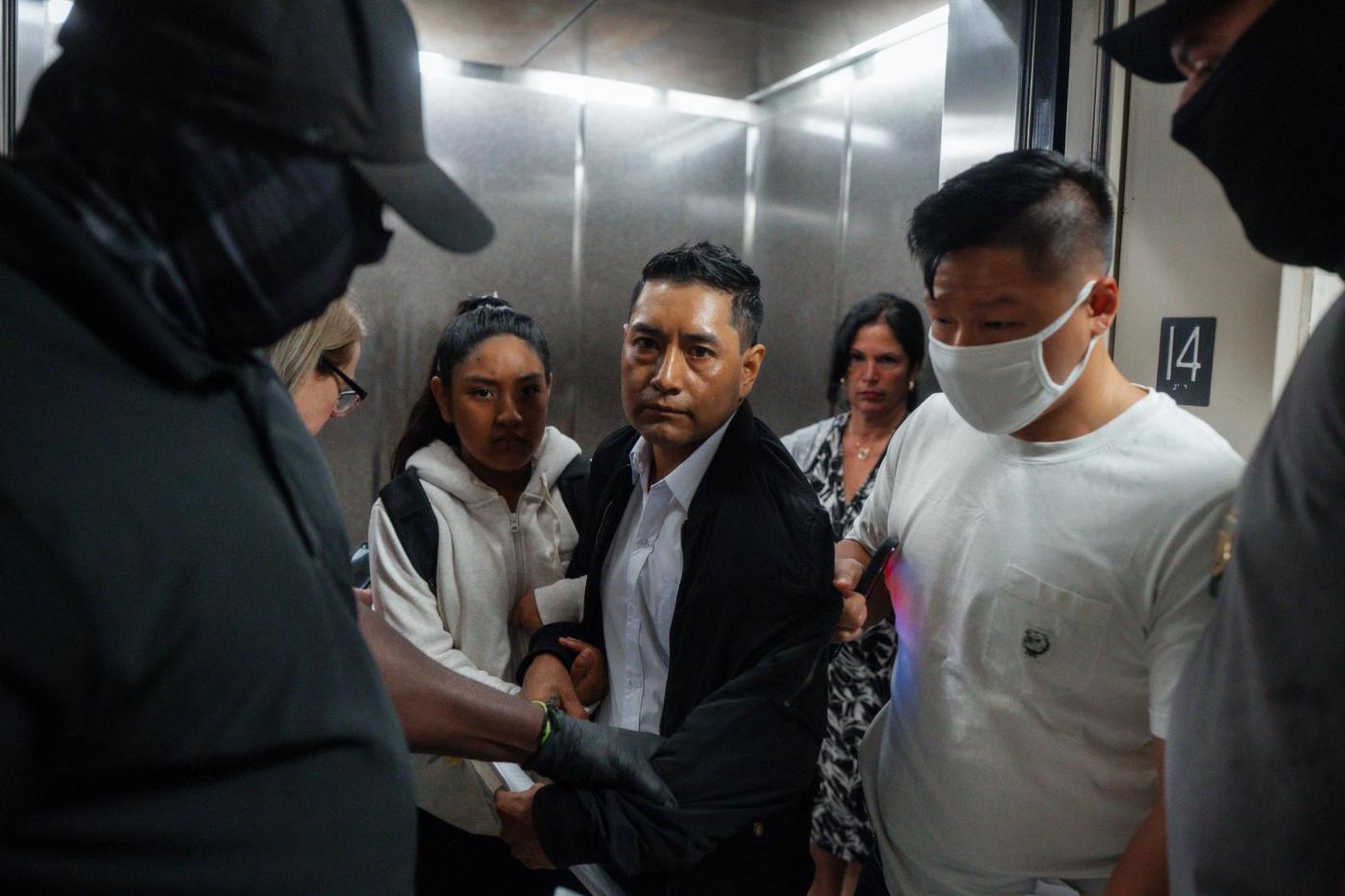
Then the lawyer quickly moved to have the man’s asylum claim dismissed and a judge agreed, making the man eligible for “expedited removal.” As he left the courtroom, the man was swarmed by plainclothes immigration agents who had been surveilling him. A struggle ensued and the wife’s shouts could be heard from the hallway as the lawyer moved on to the next case.
The agent replied four minutes later: “Got him.”
Similar scenes of courthouse arrests, part of a makeover of the immigration courts under President Donald Trump, are playing out across the United States as his call for mass deportations of migrants is executed with unusually aggressive tactics.
Trump’s pledge during his 2024 campaign, to impose hardline immigration policies was a major reason he won a second term. Now that Americans have seen how the his plan is being implemented, there are signs that many think he has gone too far. About 57% of adults disapprove of Trump’s handling of immigration, according to a survey this month by The Associated Press-NORC Center for Public Affairs Research.
Over several months, reporters for The Associated Press observed immigration court proceedings in 21 cities. Hearings repeatedly ended with cases dismissed by the government, allowing plainclothes federal agents to carry out arrests in courthouse hallways in close coordination with attorneys from the Department of Homeland Security.
Screenshots of the text messages were obtained by The Associated Press from a government official who feared reprisal and provided them on condition of anonymity. The messages offer a rare look at how the nation’s 75 immigration courts are churning out rulings in an assembly-line like fashion and how, for many people, the courtrooms have become deportation traps.
Courthouse arrests coordinated days in advance
Federal agents escort handcuffed detainees after arresting them during a regular check-in with U.S. Immigration and Customs Enforcement, Wednesday, June 4, 2025, in New York. (AP Photo/Olga Fedorova)
In a court system with a backlog of about 3.8 million asylum cases, families have been torn apart and lives upended. Due process seemingly is an afterthought.
“When Americans picture a courtroom, there are a few core expectations” of fairness, dignity and impartiality, said Ashley Tabaddor, a former immigration judge in Los Angeles and past president of the National Association of Immigration Judges.
“That’s what makes a court — not a room with a bench or person with a robe,” she said. “But what we have here is a vision completely turned on its head.”
Over the past nine months, the Trump administration has fired almost 90 immigration judges seen by Trump’s allies as too lenient, directed masked officers to handcuff migrants at closed asylum hearings and sent memos instructing judges to fall into line.
Unlike federal courts, where there are strict rules of procedure and judges have lifetime tenure, the Justice Department runs immigration courts and the attorney general can fire the judges with fewer restraints.
Nine current officials spoke on the condition of anonymity for fear of retaliation. Most expressed deep misgivings about punishing people who had followed the rules and showed up for court hearings.
“As a government attorney, my duty is to uphold the law and protect the public interest — not to secure removal or detention outcomes by default,” a government lawyer wrote to the American Bar Association seeking professional guidance.
But that is not how cases are often unfolding.
Courthouse arrests are coordinated days in advance to meet quotas with little regard for the particulars of a case, according to several of the U.S. officials.
According to one official, Homeland Security lawyers note on a spreadsheet which cases are “amenable” to dismissal, allowing an asylum-seeker to be immediately rearrested and placed in expedited removal proceedings. Most of those detained are men without lawyers who entered the U.S. alone and are expected to appear in court in person. Contrary to Trump’s claims that he is targeting the ‘worst of the worst,’ most don’t have a criminal conviction, according to a Cato Institute analysis of ICE data.
ICE reviews the spreadsheet and selects which people it wants to pursue if cases are dismissed. On the hearing date, federal agents communicate directly with DHS lawyers, who act as prosecutors in immigration courts. The lawyer often provides near verbatim updates of the proceedings over text message to agents waiting outside the courtroom.
“Black shirt? Let me know if the judge dismissed,” an ICE agent texted during one hearing.
Lack of independence limits immigration court’s authority
Almost from the outset, immigration courts were plagued by a lack of resources, authority and judicial independence.
The courts were established in 1952, but it was not until 1973 that “special inquiry officers” were given the “judge” title and allowed to wear judicial robes. The Executive Office for Immigration Review, or EOIR, was created in 1983. But that agency remained a part of the Justice Department, giving the attorney general authority to override decisions.
“We were a legal Cinderella,” said Dana Leigh Marks, who retired as an immigration judge in 2021 after a 34-year career. “No other court in the nation functions like this.”
The first Trump administration undertook a series of changes to reduce the case backlog, including instructing judges to deny entire categories of asylum claims such as for victims of gang or domestic violence.
It also set up a dashboard that would become the bane of many judges: Red, yellow and green gauges measure each judge’s performance on goals ranging from completed cases — a minimum of 700 annually, regardless of complexity — to how many custody cases were decided on their first hearings.
To meet the metrics, judges must race through dockets, sometimes devoting mere minutes to evaluate asylum-seekers’ claims.
“It’s like deciding death penalty cases in a traffic court setting,” Marks said.
Administration refers to immigration judges as ‘inferior officers’
When Trump returned to the White House in January, his allies took direct aim at the court.
Since then, the Justice Department has issued 52 policy memos — more than the previous six years combined — making it easier to hire and fire judges and warning against pro-migrant bias.
The memos highlight the courts’ weakened status by referring to judges as “inferior officers” — a rarely used term taken from the Constitution.
In early September, Defense Secretary Pete Hegseth said he would lend 600 military lawyers to the immigration courts, about equal to the current number of judges. The goal, according to the administration, is to more effectively reduce caseloads by widening the pool of potential judges to include people already steeped in administrative law. But many migrant advocates are concerned the incoming judges lack the necessary experience to decide asylum cases.
“It makes as much sense as having a cardiologist do a hip replacement,” said Ben Johnson, executive director of the American Immigration Lawyers Association.
The administration has pushed back against criticism it is co-opting the courts to accelerate its deportation goals. In a statement, Justice Department spokeswoman Natalie Baldassarre said DHS decides whether to arrest migrants and that most judges consider it an “honor rather than an insult” to be called an inferior officer empowered by the Constitution and serving at the will of the attorney general.
Baldassarre likened a record surge of asylum seekers during the Biden administration to an “improper conspiracy between DHS and the Immigration Courts to effectuate an unlawful amnesty for hundreds of thousands of illegal aliens.” The Justice Department, she said, had “restored the integrity, impartiality, and independence of the Courts.”
DHS did not respond to repeated email and phone requests for comment.
Government attorneys fear harassment, haunted by arrests
For some inside the courts, work has become a stressful, lonesome grind. Fear prevails. Resumes are being updated.
One DHS lawyer described being haunted at night by the sound of jangling shackles of migrants the lawyer helped arrest. The lawyer joined the government after the attacks of Sept. 11, 2001, believing that protecting America’s borders was a patriotic duty.
American Gateways attorney Erika Gonzalez talks with a woman before she attends her court hearing, Wednesday, Sept. 24, 2025, in San Antonio. (AP Photo/Eric Gay)
The lawyer still cherishes a signed copy of Nobel Prize winner Elie Wiesel’s memoir “Night,” which was handed out at a work seminar. “Think higher, feel deeper,” reads the author’s inscription of the book, which is marked DHS “Training Material.”
Today, its message torments.
“This isn’t what any of us signed up for,” the lawyer said.
After a turbulent summer, the courthouses are starting to look lonely, too. With word spreading that a trap had been laid, many migrants, fearing arrest, are asking to appear online or are skipping hearings altogether.
Meanwhile, ambitious managers are publicly upbraiding those who raise doubts about the legality of locking up migrants with no criminal record in packed facilities. In a recent town hall with DHS principal legal adviser Charles Wall, several lawyers complained about the pressure, confusing orders and lack of resources, according to notes from the meeting shared with AP.
Wall said the pace is likely to continue for years, the notes say. When one federal employee asked about bringing firearms to work for fear of harassment by activists inside courthouses, Wall said that judges should not hesitate to kick out the public. Wall could not be reached for comment.
‘I want to go back to my country’
The harsh tactics have had one effect the administration wants: Voluntary migrant departures have soared, with more than 14,000 people seeking court permission to self-deport in the first eight months of 2025, according to federal data collected by Mobile Pathways, a San Francisco-based nonprofit that pushes for transparency in migration proceedings. That is more than the previous five years combined. The number is almost certainly an undercount because most migrants do not withdraw their asylum claim before self-deporting.
At immigration court in Tacoma, Washington, the detainees came up one after the other with the same plea.
“I want to go back to my country,” a Venezuelan man told Judge Theresa Scala.
“I want to leave the country,” said a man from Mexico.
Immigrants know what they face: detention centers with ominous names — “Alligator Alcatraz,” “Louisiana Lockup” and “Speedway Slammer” — as well as workplace raids and neighborhood dragnets.
Fired judges targeted as too liberal
Tania Nemer believes she was cut out to be a judge. From the bench at immigration court in Cleveland, she prided herself on listening carefully to each person’s asylum claim.
“There’s a simplicity about it that I just loved,” she told the AP. “If you can provide justice in an efficient manner, you can really help a lot of people.”
The decision to apply to become an immigration judge in 2023 was deeply personal. Her father fled turmoil in Lebanon and arrived in Ohio at 16 with $6 in his pocket. He washed cars, learned English and eventually opened a namesake bar — Manny’s Pub — that allowed him to provide for his family. When Nemer married, her wedding gift was the unspent dollar bills, so she would never forget her roots.
But Nemer’s fondness for the law came crashing down Feb. 5. In the middle of a hearing, her supervisor opened the door of her packed courtroom and told her she needed to come with him.
Tania Nemer, right, poses for a portrait with her father, Manuel Nemer, inside his business, Manny’s Pub, Thursday, Oct. 9, 2025, in Akron, Ohio. (AP Photo/Sue Ogrocki)
“As soon as he said ‘Grab your ID,’ I knew I was being terminated,” she said.
Still in shock, she was handed a two-paragraph letter, digitally signed by Sirce Owen, the acting director of the Executive Office for Immigration Review. It said she was being removed because the agency “has determined that retaining you is not appropriate, and we thank you for your service.”
No justification was given. But she thinks she knows some of the reasons: her Arab-sounding name, a history of previously representing migrants and diversity, equity and inclusion, or DEI, course work from Cornell University. She filed a discrimination claim with the Justice Department to find out why she was fired; the complaint was dismissed.
Nemer was the first judge fired after Trump returned to the White House. But 86 have been sacked since. Dozens more took the Department of Government Efficiency’s “Fork in the Road” resignation offer.
The majority were hired under Democratic President Joe Biden and are still serving two-year probationary periods, according to a list of the fired judges obtained by the AP.
It is unclear who ordered the firings or how they were selected. But those removed granted asylum at markedly higher rates than their peers — in about half of all cases since August 2023 compared with 34% nationwide, according to Mobile Pathways.
Among those purged were all 10 that appeared on the DHS Bureaucrat Watch List, a website created last year with funding from The Heritage Foundation, whose Project 2025 was a blueprint for the Trump administration’s policies and personnel decisions.
The list includes names, Facebook photos, salaries and campaign donations for what it calls “America’s most subversive immigration bureaucrats.” One target was Emmett Soper, a judge in northern Virginia who worked at EOIR headquarters during the Biden administration.
“As soon as I saw that, I knew the rules were changing, that I was under some kind of microscope that didn’t exist before,” he said.
Tom Jones, the conservative creator of the website, declined to be interviewed.
Baldassarre, the Justice Department spokeswoman, said the department is not targeting specific individuals for firing but does continually evaluate all judges.
“All judges have a legal, ethical, and professional obligation to be impartial and neutral in adjudicating cases,” Baldassarre said. “If a judge violates that obligation by demonstrating a systematic bias in favor of or against either party, EOIR is obligated to take action to preserve the integrity of its system.”
The wave of firings and new directives from the Justice Department has had a chilling effect. Denial of motions to appear for hearings online tripled after a March memo repealing Biden-era guidelines instructing judges to generally grant such requests, according to Mobile Pathways data. Denial of continuances, which allow migrants extra time to seek legal counsel, have also spiked as have the number of cases classified as abandoned.
Nemer returned to immigration court in October for the first time since being fired to represent a Mexican client she has known for 20 years and who was picked up by unidentified agents. While the man was jailed, his girlfriend, who was five months pregnant, miscarried.
Word of the former judge’s return quickly spread and a stream of former colleagues came to the courtroom to hug her and express their dismay over her firing.
“By the third hug I couldn’t hold it in and just started crying,” she said.
Legal assistance for migrants dries up after Trump budget cuts
Bug spray, sunscreen, fans and umbrellas compete with legal binders in the bed of a Toyota pickup across the street from immigration court in San Antonio.
This is the new office of American Gateways.
In April, the administration eliminated programs worth $30 million to provide free legal assistance to migrants, the vast majority of whom represent themselves in court.
But lawyers for American Gateways keep coming, four times a week, setting up in a parking lot. The conference room they once occupied inside the courthouse is now used as a break room for ICE agents.
Assistance ranges from helping immigrants file motions to rehearsing what they will say to judges. When they can, they sign people up for virtual appearances to minimize the risk of arrest.
Migrants rush to federal court to seek release from detention
The gutting of the immigration court has driven migrants to one place where standards of judicial independence are upheld: federal court.
Since May 15, when courthouse sweeps began, migrants have filed more than 3,000 habeas corpus petitions — to determine if someone is lawfully held in custody — seeking release.
The flood of claims threatens to clog the already crowded federal docket, which has little authority in immigration cases.
“The administration is attempting to press the gas at such an unreasonable speed without considering due process,” said Annelise Araujo, a Boston-based immigration attorney.
One petition, filed in Miami, was from a Cuban man detained the same day he and his American wife and 10-month-old daughter were moving into their first home. Several petitioners said they had survived torture at the hands of gangs in Mexico, Ecuador and Venezuela.
Another legal challenge was introduced by an HIV-positive man from Brazil taken into custody four days after his husband died of a heart attack. With the body of Frederico Abreu’s husband still at the funeral home, ICE officials knocked on his door stating they had documents belonging to the deceased man.
A father pulled away from his sobbing family
Those unable to afford a lawyer so they can sue in federal court have little recourse.
The wife and daughters of an asylum seeker from Ecuador cry after he was detained in immigration court, Thursday. July 31, 2025, in New York. (AP Photo/Olga Fedorova)
One was a man from Honduras who showed up at the northern Virginia immigration court with his wife and their infant baby. Another child, a son, unable to walk, pushed himself in a wheelchair studded with flashing, colorful lights. The family, fearful of further immigration problems, did not want to be identified.
The judge denied a government request to deport the man. But seconds later, as the family stepped from the courtroom, they were stopped by four ICE agents.
The wife sobbed, hanging on her husband’s arm as she pleaded: “Por favor, Por favor.”
The husband clutched the sleeping infant’s carrier. Their son sat playing with a cell phone.
“I need you to go ahead and say goodbye,” an agent told the man. Crying, the man knelt to hug his son, who clung to his father, yelling repeatedly: “Papa! Papa!”
Finally, the father managed to pull himself away and started to leave with the ICE officers.
The boy tried to chase them. But the ICE agent was holding the back of the wheelchair as the boy futilely pumped his arms.
The Department of Homeland Security confirmed his July arrest. The family said he was later deported. Homeland Security said he voluntarily agreed to leave the country and returned to Honduras on Oct. 8 after three months in detention.
Goodman reported from Cleveland and Sullivan from Minneapolis; AP reporters who contributed are: Cedar Attanasio in New York; Martha Bellisle in Seattle and Tacoma, Washington; Jacques Billeaud in Phoenix; Kate Brumback in Atlanta; Eric Gay in San Antonio, Texas; Valerie Gonzalez in Harlingen, Texas; Aaron Kessler in Washington; Gisela Salomon in Miami; Rebecca Santana in Annandale and Sterling, Virginia; Lea Skene in Baltimore; Hannah Schoenbaum in Salt Lake City; Colleen Slevin in Denver; Elliot Spagat in San Diego; Sophia Tareen in Chicago and Indianapolis; Amy Taxin in Santa Ana, California; Julie Watson in San Diego.