AP visual analysis: Rocket from Gaza appeared to go astray, likely caused deadly hospital explosion

posted in: Society | 0

Shortly before 7 p.m. Tuesday, a volley of rockets lit up the darkened sky over Gaza. Videos analyzed by The Associated Press show one veering off course, breaking up in the air before crashing to the ground.

Seconds later, the videos show a large explosion in the same area — the site of Gaza’s al-Ahli Arab Hospital.

Who is to blame for the fiery explosion has set off intense debate and finger pointing between the Israeli government and Palestinian militants, further escalating tensions in their two week-long war.

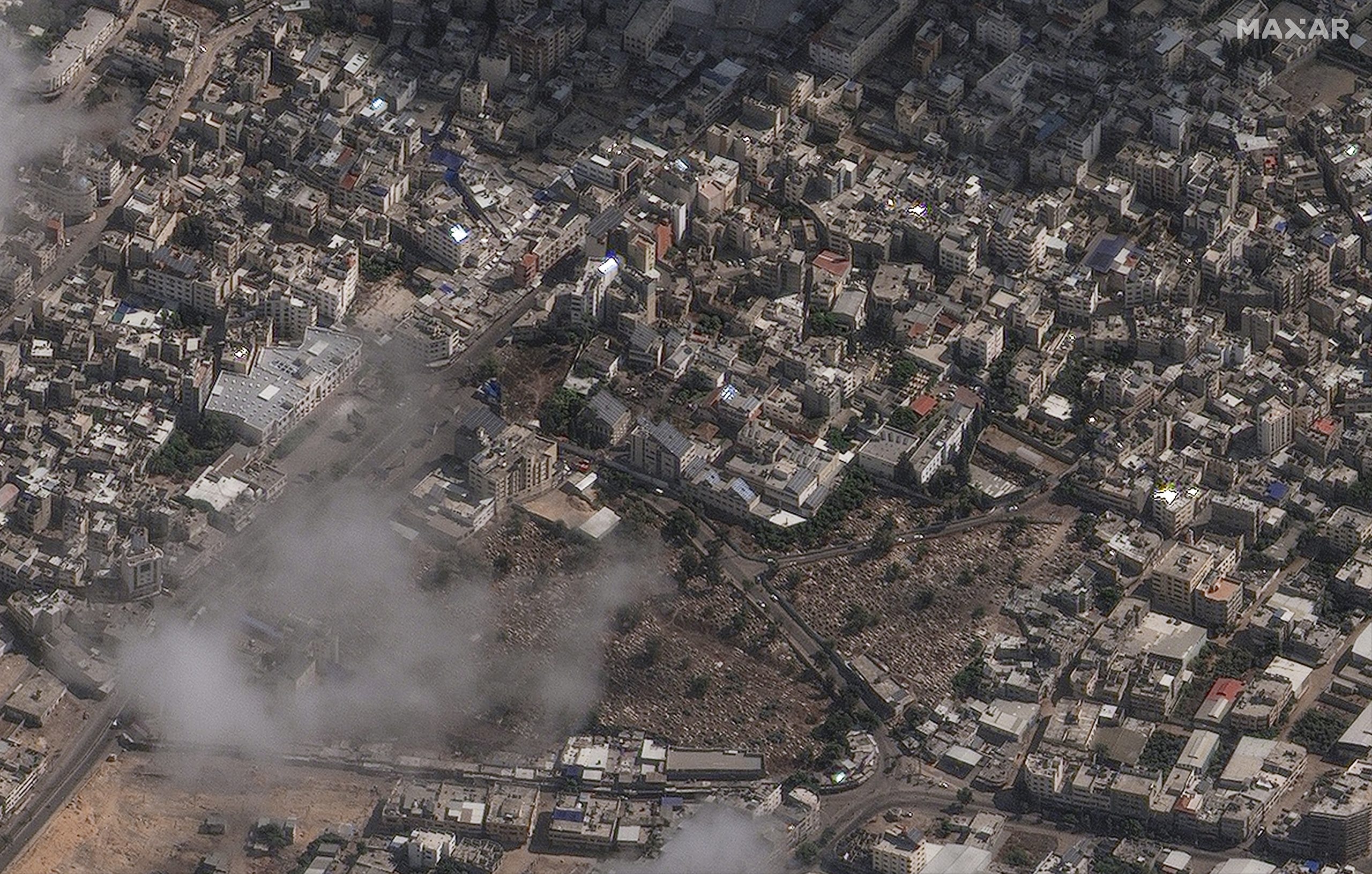
The Associated Press analyzed more than a dozen videos from the moments before, during and after the hospital explosion, as well as satellite imagery and photos. AP’s analysis shows that the rocket that broke up in the air was fired from within Palestinian territory, and that the hospital explosion was most likely caused when part of that rocket crashed to the ground.

A lack of forensic evidence and the difficulty of gathering that material on the ground in the middle of a war means there is no definitive proof the break-up of the rocket and the explosion at the hospital are linked. However, AP’s assessment is supported by a range of experts with specialties in open-source intelligence, geolocation and rocketry.

“In the absence of additional evidence, the most likely scenario would be that it was a rocket launched from Gaza that failed mid-flight and that it mistakenly hit the hospital,” said Henry Schlottman, a former U.S. Army intelligence analyst and open-source intelligence expert.

The AP reached its conclusion by reviewing more than a dozen videos from news broadcasts, security cameras and social media posts, and matching the locations to satellite imagery and photos from before the explosion.

A key video in the analysis came shortly before 7 p.m. local time, when the Arabic-language news channel Al Jazeera was airing live coverage of the Gaza City skyline. As a correspondent speaks, the camera pans to zoom in on a volley of rockets being fired from the ground nearby.

One of the rockets appears to veer from the others, away from the distant lights of Israel and back toward a darkened Gaza City, where electricity has largely been cut. The camera follows the light from the rocket’s tail as it arches in the sky upwards and toward the left. Suddenly, the rocket seems to fragment, and a piece appears to break off and fall. Another fragment shoots sharply up and to the right, blazing before it explodes in a fireworks-like flash, leaving a brief trail of sparks.

A small explosion is then seen on the ground in the distance, followed two seconds later by a much larger blast closer to the camera. The corner of the scroll at the bottom of the live broadcast reads 6:59 p.m. Gaza time.

Using maps and satellite imagery, the AP was able to match the view of the explosion from Al Jazeera’s live camera feed to an upper floor of the building that houses Al Jazeera’s Gaza bureau, which is less than a mile from the al-Ahli Arab Hospital. Using other buildings visible in the frame, the AP was able to confirm that the larger explosion seen at 6:59 p.m. was in the precise direction of the hospital.

A second video, taken from a camera inside Israel at the exact time as the Al Jazeera footage and obtained by the AP, shows a barrage of at least 17 rockets being launched from inside Gaza before a large explosion lights up the horizon on the Palestinian side of the border. The camera is on a building in Netiv Ha’asara, an Israeli community footsteps from the border wall, and faces southwest, confirming that the rocket launches and explosion were in the direction of Gaza City.

A third video by Israeli news station Channel 12 — taken from a camera on the upper floor of its building in Netivot, a town about 10 miles southeast of the hospital in Gaza City — also captured the barrage of rockets fired at 6:59 p.m.

Seen together, the three videos show multiple rockets were launched from inside Gaza before one appears to have come apart in midair about three seconds before the explosion at the al-Ahli Arab Hospital.

Hamas’ military wing al-Qassam Brigades said in a social media post at 7 p.m. that “al-Qassam Brigades strikes occupied Ashdod with a barrage of rockets.” Minutes later, it posted that “al-Qassam Brigades strikes Tel Aviv in response to Zionist massacres against civilians.”

At 7 p.m., one minute after the explosion, Hamas’ military wing al-Qassam Brigades said in a post to its Telegram channel that it “fired at occupied Ashdod with a barrage of rockets.” Ashdod is an Israeli coastal city about 30 miles north of Gaza.

Minutes later, Islamic Jihad, a militant group that works with Hamas, also posted on Telegram that it had launched a rocket strike on Tel Aviv in response “to massacre against civilians.” Over the next hour, there were five more posts from the militant groups announcing rocket attacks against Israel.

Israel’s military has repeatedly said it did not strike the hospital and blamed an errant rocket fired from within Gaza by the Islamic Jihad. Israel’s assessment, backed by U.S. intelligence and President Joe Biden, also cited the lack of both a large crater and extensive structural damage that would be consistent with a bomb dropped by Israeli aircraft.

Hamas calls Israel’s narrative “fabricated” and accuses it of punishing the hospital for ignoring a warning to evacuate two days earlier, though it has not released any evidence to support its claims.

Hamas spokesperson Ghazi Hamad told the AP the group would welcome a United Nations investigation into the cause of the blast.

“Look at the stupid position that was taken by the President of the United States of America who said, ‘I agree with Israel’s version’ without any investigation,” Hamad said. “Unfortunately, the Western world is full of hypocrisy.”

AP ran its visual analysis by a half-dozen experts who all agreed the most likely scenario was a rocket from within Gaza that veered off and came apart seconds before the explosion.

Andrea Richardson, an expert in analyzing open-source intelligence who is a consultant with the Human Rights Center at the University of California, Berkeley, School of Law, said specific landmarks visible in the videos show where the rockets were launched.

“From the video evidence that I have seen, it’s very clear that the rockets came from within Gaza,” said Richardson, a human rights lawyer and experienced war crimes investigator who has worked in the Middle East. She added that the timing of the rocket launches, the explosion and the first reports that the hospital had been hit also seemed to confirm the sequence of events.

While still potentially lethal, the explosive warheads carried by the homemade rockets used by militants in Gaza can be relatively small when compared with the munitions used by large militaries like those of the U.S. and Russia. With Gaza’s borders and ports blockaded for the past decade, militants often build rockets and launch tubes inside Gaza using whatever parts and materials they can scavenge, including underground water pipes.

Justin Crump, a former British Army officer and intelligence consultant, said the failure rate of such homemade rockets is high.

“You can see obviously it fails in flight, it spins out and disintegrates, and the impacts on the ground follow that,” said Crump, CEO of Sibylline, a London-based strategic advisory firm. “The most likely explanation is this was a tragic accident.”

Such a scenario unfolded last year, when Islamic Jihad-fired rockets malfunctioned and killed at least a dozen Gaza residents. The AP reported at the time that live TV footage showed the militant rockets falling short in densely packed residential neighborhoods.

Some of the questions about who is to blame focus on the three-second gap between the rocket’s explosive breakup in the sky and the explosion on the ground at the al-Ahli Arab Hospital, and whether those two events are linked, especially because the videos analyzed by AP don’t appear to show a trace of light that follows the rocket to the ground.

Outside experts said it’s not possible to rule out with absolute certainty that the rocket launches occurring near the hospital and the timing of the explosion seconds later are just a coincidence. However, they also noted there is no evidence to support that scenario.

Richardson said the timestamps on videos showing the rocket launches from within Gaza, the midair malfunction and the large explosion striking the hospital below within seconds of each other provided a logical chain of events.

“An incredibly small timeframe,” she said.

Intelligence analyst Schlottman said the most likely scenario remains that it was a militant rocket that somehow had some kind of malfunction mid-flight and then landed on the hospital.

“We have video of when the explosion happened and the only rocket visible in that video was the one that kind of had that diverging trajectory,” he said. “We cannot possibly exclude other scenarios. … Just what we have right now points to that.”

About 10 minutes after the multiple rocket launches from Gaza were captured on video Tuesday night, posts began to appear on social media. The AP verified a video taken from a balcony near the hospital that shows the moment of impact, with the loud whizzing sound followed by a huge fireball and the clap of a massive explosion. AP could find no visual evidence to support speculation that the blast was triggered by a car bomb or other such device.

“Oh God! Oh God!” a man’s voice exclaims in Arabic. “The hospital!” says a second male voice.

Other videos and photos reviewed by AP appear to show the explosion in the hospital’s central parking lot and courtyard, where civilians had taken refuge after orders to evacuate the city. Some footage shows burning cars and more than a dozen dead bodies, including those of children.

AP photos taken the morning after Tuesday’s explosion showed no evidence of a large crater at the impact site that would be consistent with a bomb like those dropped by Israeli aircraft in other recent strikes. The hospital buildings surrounding the outdoor area at the center of the explosion were still standing and did not appear to suffer significant structural damage.

A small crater photographed in the hospital’s parking lot appeared to be about a meter across, suggesting a device with a much smaller explosive payload than a bomb. While Israel’s extensive arsenal includes smaller missiles that can be fired from helicopters and drones, there has been no public evidence of such missile strikes in the area around the al-Ahli Arab Hospital on Tuesday night.

David Shank, a retired U.S. Army colonel and expert on military rockets and missiles, said the large fireball captured on video at the hospital could potentially be explained by the fact the malfunctioning militant rocket impacted prematurely and was still full of propellant. That highly volatile fuel then ignited when it hit the ground, setting off a large explosion but leaving a relatively small crater.

After Hamas’ Oct. 7 surprise attack on southern Israel that killed 1,400, with another 200 people taken hostage, Israel’s military said it dropped more than 6,000 bombs on Gaza in the first week of the war alone, and Gaza officials say that campaign has so far resulted in more than 4,100 deaths.

Hamas spokesperson Hamad said that Israeli officials had threatened al-Ahli Arab hospital and other medical facilities, and ordered their evacuation before the deadly blast. He argued that the missiles belonging to Hamas and the Islamic Jihad would not have been capable of inflicting such damage.

Al-Ahli Arab Hospital’s operators posted on its website that the facility’s cancer center was struck by Israel three days before the deadly blast, leaving a hole in an exterior wall and an unexploded artillery shell next to an ultrasound machine.

Speculation has circulated on social media in the days since the explosion that the breakup of the rocket and the explosion on the ground was caused by Israel’s Iron Dome defense system, which is designed to shoot such rockets out of the sky.

Israel has said it does not use its Iron Dome system within Gaza, but to intercept and destroy rockets coming into Israeli airspace.

Experts also noted multiple videos from around the time of the hospital explosion showed no visible evidence of Iron Dome missiles being fired from Israel into the airspace over Gaza.

John Erath, the senior policy director at the Center for Arms Control and an expert on missile defense, said that while it might be technically possible for Iron Dome to intercept a missile over Gaza, it would be unlikely in this case because the projectile was very early in its flight path — still on the way up — and the system is designed to only intercept projectiles it determines are on a flight path to a populated part of Israel.

“I’m not saying that it’s impossible,” Erath said. “But based on my understanding of how the system works, it is unlikely.”

Added missile expert Shank: “They don’t engage a target unless it’s going to impact a critical asset such as a population area, maybe a power grid, maybe a military base.”

“It’s technically designed to take the best shot that gives it the highest probability of kill,” he said. “And for Iron Dome … that is not over Gaza.”
8 candidates, heavy fundraising, Rondo land bridge, Summit bikeway heat up Ward 1 council race

posted in: News | 0

By early September, James Lo’s campaign for the Ward 1 seat on the St. Paul City Council had raised more than $115,000, significantly more than any of the other seven candidates in the race. That’s no small feat for a school guidance counselor in a political ward that spans low- to moderate-income corners of Frogtown, Summit-University and part of the city’s North End.

As fundraising goes, his totals are almost on par with that of the four council candidates in the wealthier Ward 3 area (Highland Park, Macalester-Groveland, part of West Seventh) combined.

Lo, who has put former Ward 1 council member Dai Thao on his campaign payroll, has been able to rely on broad support from the Hmong community across the metro and into Wisconsin. But whether the cash translates into votes remains to be seen. His positions on several city council priorities include opposing a proposed Summit Avenue bikeway and a sales tax increase to fund road reconstructions and park projects.

“Right now, City Hall in St. Paul is not listening to you all to make our city better,” said Lo, addressing an audience during a recent forum sponsored by the League of Women Voters of St. Paul.

In addition to a large concentration of Hmong families, the racially and ethnically diverse ward includes Somali, Oromo and Karen immigrant communities, Black families that have called Rondo home for decades, middle-class white families, and the homes and businesses that line long swathes of Marshall, Selby and Summit avenues.

Other candidates also have made inroads with likely voters. Omar Syed, a Somali immigrant who sits on the city’s Planning Commission, had raised roughly $90,000 as of early September. When Anika Bowie — who can trace her roots in the historically-Black Rondo neighborhood back three generations — challenged Thao for the office four years ago as a first-time candidate, she landed 47% of the vote.

Then there’s Suz Woehrle, a vocal proponent of the proposed Summit Avenue bikeway who has said the seven other candidates failed to articulate a strong understanding of climate change.

“The people I’m running against don’t use environmental talking points at all,” said Woehrle, the only avid cyclist and public transit user in the group. “In some ways, I’m the only environmental candidate.”

Eight candidates

Eight candidates are vying for the open Ward 1 seat, which represents the neighborhoods of Thomas-Dale (Frogtown), Summit-University, the portion of Union Park that is east of Snelling Avenue, a portion of the North End, and the Lexington-Hamline and Snelling-Hamline communities.

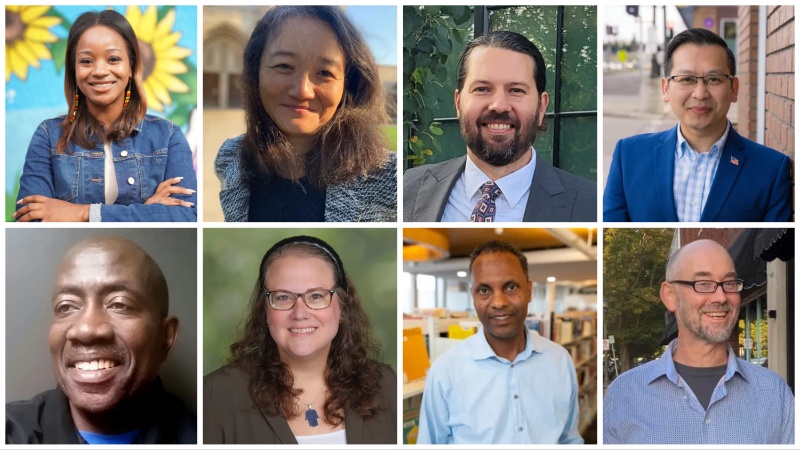
The candidates are Bowie, Lo, Syed, Woehrle, Yan Chen, Travis Helkamp, Lucky “Tiger Jack” Rosenbloom and Jeff Zeitler. The ranked-choice election, which is officially nonpartisan, will be held Nov. 7.

Thao, who joined the council in a special election in November 2013, made history a decade ago as the city’s first Hmong council member. After Thao resigned his office last year to take a job out of state, the city council last August appointed Russel Balenger to complete the term, with the expectation that Balenger not run for the seat.

Five candidates fruitlessly sought the St. Paul Democratic-Farmer-Labor Party endorsement in April. After just three ballots in nearly 10 hours, the convention ended in a walkout, with Bowie leading Syed by a handful of votes.

During the recent candidate forum, each candidate was asked their view on the “ReConnect Rondo” proposal to cover multiple blocks of Interstate 94 with a cap, or land bridge, effectively reuniting portions of the Rondo neighborhood lost to highway construction in the 1960s. Candidates were also asked about a 5-mile elevated bikeway that the city has proposed installing along Summit Avenue as funding is found.

In a subsequent candidate questionnaire for the Pioneer Press, the candidates were asked their views on the city’s voter-approved rent-control policy, which was heavily amended by the city council last September; a proposed 1 percentage point sales tax increase to raise nearly $1 billion for arterial road reconstructions and parks projects; and a proposal on the 2024 ballot that would increase city property taxes to pay for child care subsidies.

Anika Bowie

Bowie, 31, a third-generation Rondo resident, is a progressive organizer and leader of the successful “Restore the Vote” Minnesota coalition, which reinstated voting rights for more than 50,000 felons on probation and parole. In 2017, she became one of the youngest vice presidents of the Minneapolis NAACP.

Anika Bowie, candidate for St. Paul City Council, Ward 1, in the November 2023 election. (Courtesy of the candidate)

Bowie, who recently completed training to become a first-time community real estate developer, said her priorities include investing in public infrastructure, public safety, fair and affordable housing and working families.

“Ward 1 needs someone who is courageous,” said Bowie, during the League of Women Voters forum.

After initially raising cost concerns and fears about tree impacts, Bowie more recently indicated she fully supports the Summit Avenue bikeway proposal approved by the city council earlier this year. Asked to give a one-word summary of her feelings about the bikeway during a lightning round of questions at the end of the Sept. 28 candidate forum, she said she was a “no,” but later went on social media to say the question had been worded confusingly.

“Without us moving forward with a plan, we’ll just be in the same place where we’re at now,” Bowie said.

On rent control, she said she would work on maintaining but “refining” it, without deep changes, while “championing a substantive, fair housing policy” that centers tenants rights.

She planned to vote for the sales tax increase for roads and parks, which would capture revenue from city visitors, as “our city thrives when we invest in robust infrastructure. … We are worth the penny.”

Bowie said she would host listening sessions on the question of property tax-funded child care subsidies. “I recognize the need for affordable childcare but question the property tax strategy,” she wrote. “Our budget should prioritize essential city services.”

Her campaign has been endorsed by AFSCME Council 5, Take Action Minnesota, Women Winning, OutFront MN, student climate advocates with Twin Cities Sunrise, Minnesota Attorney General Keith Ellison, St. Paul Mayor Melvin Carter and Ramsey County Commissioner Rena Moran, state Sen. Sandy Pappas and Ramsey County Attorney John Choi, among others.

Yan Chen

Chen, 53, came to the U.S. from China on a student visa at age 19 and worked her way through school despite financial hardships, earning a doctorate in biophysics from the University of Illinois Urbana-Champaign.

Yan Chen, a candidate for the Ward 1 seat on the St. Paul City Council in the November 2023 election. (Courtesy of the candidate)

Chen, a researcher in the School of Physics and Astronomy at the University of Minnesota, said “the city council position is about solving problems for the voters. … I have learned to solve problems for myself, my family and in science with minimal resources ever since I came to America 34 years ago.”

Her priorities include strengthening core city services, working with neighborhoods and police to reduce crime and stabilizing the city budget.

“Once we have a sound budget, my goal is to fight for affordable first-time homeownership for the residents of Ward 1 and the rest of the city,” said Chen, who believes the city has too many apartment buildings but lacks condos and townhomes. “It’s possible to solve problems in our community with a few modifications, without changing what you love about St. Paul.”

She opposes the “ReConnect Rondo” land bridge proposal:

“When I talked to the neighborhood in Rondo, the overwhelming response for the land bridge was negative,” Chen said. “They’re concerned it will change their neighborhood, and they’re concerned about gentrification.”

She has said the city should not focus on the Summit Avenue bike trail, given that existing in-street lanes are in “excellent condition and doesn’t need much modification everywhere except from Lexington to Arundel” where they could be widened, wrote Chen, in a policy memo.

Chen, who owns multiple rental properties in Ward 1, said she would maintain the city’s current rent-control policy “until we find a better solution. We need to protect renters by making rent pricing transparent,” a proposal she outlines on her campaign website. She said rent control creates an incentive for renters to stay put, creating a stagnant market closed to newcomers.

She plans to vote against a proposed sales tax for roads and parks: She also plans to vote “no” against property tax-supported child care subsidies as they should be “universally provided by the state.”

Service St. Paul, a coalition of Teamsters, heavy equipment operators and the construction trades, has endorsed Lo first and Chen second on the ranked-choice ballot.

Travis Helkamp

Helkamp, 40, who works in commercial construction, is a former buyer and senior manager in the retail industry. He was born and raised in St. Paul and said in a candidate questionnaire that he can balance his compassion toward others with a strong work ethic and understanding of “history both local and global, ancient and recent.”

Travis Helkamp, candidate for a Ward 1 seat on the St. Paul City Council in the November 2023 election. (Courtesy of the candidate)

Helkamp, who has been endorsed by the Republican Party, said he opposes many of the mayor’s “foolish, experimental policies,” such as a universal basic income pilot program, which he said would be difficult to fund on an ongoing basis on a limited city budget.

“St. Paul has always had a reputation of having this quiet, small-town feel. … We are losing that more and more,” said Helkamp, during the recent candidate forum. “If you ride the light rail in this city, it’s disgusting. … And that is squarely on the shoulders of City Hall. … We are capable of (fixing) all these things, and within a reasonable budget.”

In a candidate questionnaire, Helkamp said his top priorities include getting crime under control, “clean(ing) up the light rail and ensuring at the same time that all citizens’ civil rights are respected; and attracting new businesses to the city while retaining existing ones.”

On the “ReConnect Rondo” proposal over I-94: “Spending $1 billion to build a land bridge in Rondo, I don’t know how you can possibly square that economically with how it is going to pay itself back.”

On the Summit Avenue bikeway, he opposed any changes to the existing in-street lanes.

On rent control: “This policy has failed everywhere it’s been tried,” wrote Helkamp, a renter. “Price controls don’t work. Housing availability and affordability is very important to me. … We can increase average incomes by improving the business environment. And we can incentivize good development.” He said he’s personally aware of real estate projects that were canceled because of rent control.

He also opposes the proposed sales tax for roads, as well as proposed child care subsidies backed by St. Paul property taxes. “The current city government has wasted enough taxpayer money,” he wrote. “Why should they be trusted with more of it? … They can’t even plow the streets, but you’re going to entrust your children to them?”

James Lo

Lo, 38, immigrated to St. Paul from Thailand as a child refugee in 1994. “Navigating the system here in St. Paul was very difficult,” said Lo, now a guidance counselor at Harding High School, licensed residential and commercial Realtor and a father of seven children.

James Lo, candidate for Ward 1 St. Paul City Council in the November 2023 election. (Courtesy of the candidate)

From 2020 to 2022, he was a representative of the Lo clan to the Hmong 18 Council, where he helped facilitate conversations between the Hmong community, City Hall and St. Paul police around gun, community and domestic violence.

He said his priorities are promoting public safety, essential city services and property taxes, as well as “saving Summit Avenue from the expensive $12 million revision plan,” referring to the city’s proposed bikeway. “Friends, family, and neighbors are moving out of St. Paul because of high property taxes. Our money should go towards potholes, plowing, policing and our other core basic services.”

On the land bridge: He said he would support the “ReConnect Rondo” proposal if the state pays for it.

On rent control: Lo said the policy needs to be revisited “in every aspect. It needs to be fair for both sides. … Tenants need to be protected from predatory practices. Landlord investments should be economically fair.”

He’s planning to vote against the proposed sales tax for road reconstructions and park projects. “Our businesses cannot handle reduced sales and our people can’t afford to pay more,” he said Wednesday.

Lo said the city should first look to state funding, rather than property taxes, to support child care subsidies.

Lo has been endorsed by the St. Paul Federation of Educators, the International Brotherhood of Electrical Workers, International Union of Operating Engineers, Teamsters Local 120, state Sen. Foung Hawj, state Sen. Susan Pha, former Ward 1 city council member Dai Thao and former St. Paul school board Member Keith Hardy.

Lucky ‘Tiger Jack’ Rosenbloom

Rosenbloom is a longtime St. Paul firearms instructor, social studies teacher and paralegal who has been active with the Minnesota Internship Center and other youth outreach efforts. He is a past chair of the governor’s Council on Black Minnesotans Legacy Committee and a past recipient of the Children and Family Services community service award. He’s been recognized by Pillsbury United Communities, Ramsey County Corrections, the Stillwater state prison and the National Society of Leadership and Success for his youth and community work.

Lucky “Tiger Jack” Rosenbloom. (Courtesy of Lucky Rosenbloom)

Rosenbloom, who did not share his age, said his priorities include increasing funding for law enforcement, promoting “victim rights over criminal rights,” implementing restorative justice practices for low-level crimes and encouraging the use of “stop and frisk” police procedures.

On the land bridge: “The only people to benefit from this goofy idea will be the contractors, and all other entities involved in the construction,” said Rosenbloom on Wednesday. “The neighbors that had their homes taken, their descendants shall have zero benefit.”

On the Summit Avenue bikeway, he called it a “fast no-go” if he’s elected.

On rent control: “The outcome of this policy is too early to evaluate,” he wrote. “Establish and sustain new sources for state funding to support affordable housing.”

Rosenbloom said he opposed a proposed sales tax for roads and parks, as well as proposed child care subsidies that would be funded by city property taxes: “No tax hikes without careful impact study on our neighbors. … Tax cuts increase disposable income, encourage businesses. Tax increases do the reverse.”

Omar Syed

Syed, who manages a staffing service for personal care attendants and runs Chilly Time Coffee on McKnight Road South, sits on the city’s Planning Commission, where he serves as the vice chair of the zoning committee. Syed, a former pharmacy tech, described himself as the only Ward 1 candidate with hands-on experience in drafting zoning, transportation and business regulations.

Omar Syed, candidate for St. Paul City Council Ward 1 in the November 2023 election. (Courtesy of the candidate)

If elected, Syed, the father of a 13-year-old boy, would be the first Somali-American on the council and one of its only renters. He said his priorities include building affordable housing, improving public safety through “community investments, better police relations and improved accountability,” and increasing community engagement with city offices.

On a land bridge over Rondo: Syed, in the candidate forum, said he supports the “ReConnect Rondo” proposal as “I want to see businesses in Rondo, and a Black history center built here on I-94, and affordable housing on I-94.”

On the Summit Avenue bikeway: Syed voted for the bikeway when the proposal came before the Planning Commission, but later expressed reservations about tree impacts. In a phone interview Wednesday, he said he is still generally supportive of the proposal despite ongoing concerns.

On rent control: Syed said that he voted for the 2021 ballot measure and supports it in its current form. “I know ensuring buy-in from all parties has been difficult,” he wrote. “I believe in a balanced approach that protects renters while still bringing in new development and housing supply. The changes made since implementation have brought the policy in line with that vision.”

On a sales tax to fund road reconstructions and parks projects: “As a small business owner, I am willing to take a hit in my margins if it means that we will have better, safer roads in St. Paul,” said Syed, in a written questionnaire. “I do not want this to be a precedent for more sales tax increases in the future. We need to be thinking about how we expand our tax base long-term as opposed to continuing to squeeze our most disadvantaged communities.”

On child care subsidies funded by property taxes: “I am still listening. All families deserve quality, culturally responsive early learning options. However, I also know people are also struggling to keep up with continual tax increases.”

Syed has been endorsed by St. Paul City Council member Jane Prince, state Sen. John Hoffman, former school board member John Brodrick and other community members.

Suz Woehrle

Woehrle, 41, is a personal care attendant for a wheelchair-using St. Paul resident. A longtime DFL Party and campaign worker, she assisted former Minneapolis City Council member Phillipe Cunningham for two years. Woehrle, who commutes predominantly by bicycle and public transit, said her 70-year-old father, also an avid cyclist, moved to Roseville recently because “he couldn’t deal with another St. Paul winter without plowed streets.”

Suz Woehrle, candidate for Ward 1 St. Paul City Council in the November 2023 election. (Courtesy of the candidate)

“I would like to make our streets, buildings and websites more accessible,” said Woehrle, who has been the most resolute supporter among the candidates of the Summit Avenue bikeway, as well as of biking infrastructure in general. “Getting around St. Paul should be safe and easy whether by foot, wheelchair, bus, train or bicycle.”

Woehrle said rather than a land bridge, she’d like to see the freeway replaced entirely by an at-grade boulevard “integrated into the community.” She supported the general concept of “a Black commercial corridor. That’s the least that we can do after I-94 destroyed a prosperous Black community.”

On rent control: “As a renter for 20 years, there are several times I would have been made homeless by a sudden, unexpected increase in my rent. … I support a 3% cap on rent increases.”

On a sales tax to fund road reconstructions and parks projects: Woehrle called herself a reluctant “yes” vote, given that sales taxes tend to hit the poor hardest. At the same time, “we have a short time to come up with matching funds for the (federal) Inflation Reduction Act funds our city could qualify for. We cannot afford to leave that money on the table.”

On child care subsidies funded by property tax increases: “Early childhood education is the best possible investment a community can make for its future health and prosperity. … Parents are able to work without worrying about their children, who get a high-quality education before starting kindergarten.”

Woehrle has been endorsed by Our Revolution, former state Rep. Susan Allen, Columbia Heights Mayor Amada Marquez Simula, former candidates for St. Paul City Council Elizabeth Dickinson and Bob Blake, former Planning Commissioner Bill Lindeke (who chairs her campaign) and Andy Singer, longtime co-chair of the St. Paul Bicycle Coalition.

Jeff Zeitler

Zeitler, 51, a landscape architect by training, launched the Urban Forage micro-winery in South Minneapolis. He is running for city council at the same time his wife, Gita Rijal Zeitler, runs for St. Paul school board.

Jeff Zeitler, candidate for the Ward 1 seat on the St. Paul City Council in the November 2023 election. (Courtesy of the candidate)

“I’m socially liberal and fiscally conservative, and only fiscally conservative because I see St. Paul running into some issues with high taxes, the inability to plow our streets, fill our potholes or provide police services,” said Zeitler, in the candidate forum.

Zeitler said his priorities include improving public safety, maintaining and improving infrastructure such as streets and sidewalks and “keeping taxes at the same level.”

Zeitler said the “ReConnect Rondo” land bridge “looks to be an excellent proposal … (to) create a bridge between these two neighborhoods that have been cut off from each other.”

On the Summit Avenue bikeway: “It’s a strong no. The money would be better spent elsewhere.”

On rent control: “We need to respect the will of the voters,” said Zeitler, a landlord. “I’d be in favor of keeping rent control as it is now.” He said that if rent increases are capped at 3% annually, property taxes and city utilities should be capped for landlords, as well.

On a proposed sales tax for roads and parks: He’ll vote no. “Increasing the sales tax will make doing business in St. Paul more difficult, and we already are losing small businesses at present. The sales tax is the most regressive tax. … Those with cars may well decide to drive to the suburbs to shop.”

On child care subsidies: “No. This is a great initiative, but this is the sort of service that should be provided by the state of Minnesota, with our large budget surplus. This isn’t a core city service.”

Related Articles

Elections |


St. Paul City Council votes 4-3 to overhaul zoning code, allow duplexes, density

Elections |


How a member of a hiring panel landed — and quickly lost — a job on the St. Paul City Council’s reparations commission

Elections |


Six St. Paul City Council candidates vie for open seat in Ward 7

Elections |


St. Paul City Council to revisit citywide rezoning on Oct. 18

Elections |


Election 2023: St. Paul City Council Ward 5

Massachusetts emergency shelter numbers: An updated dashboard ‘provides a more holistic view’

posted in: Society | 0

State officials updated the look of an online dashboard that tracks how many families are in Massachusetts emergency shelter system, a key metric that tells the public how close the state is to a new capacity limit Gov. Maura Healey outlined this week.

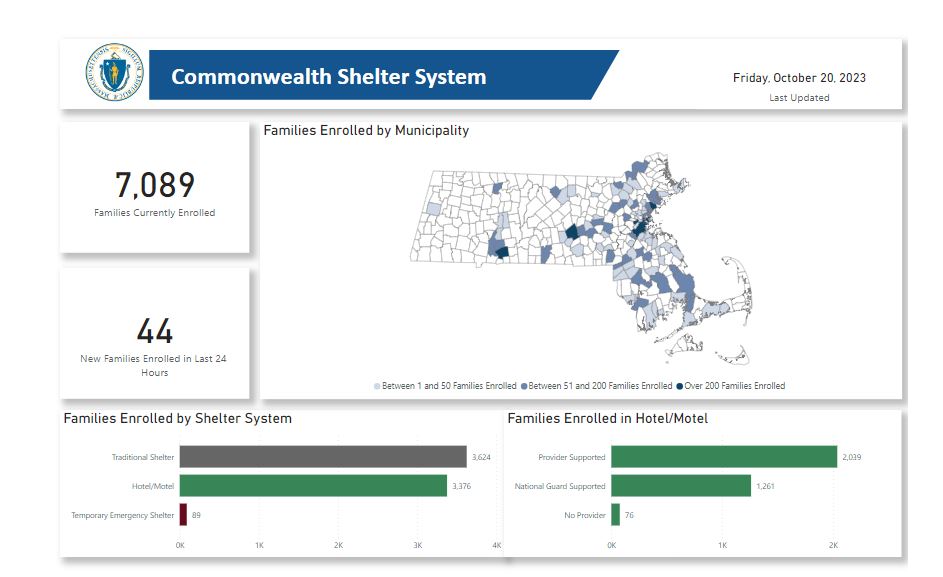
The dashboard, updated daily Monday through Friday, showed 7,089 families were in the system as of Thursday, which is propped up by a network of hotels and motels across the state to deal with an influx of migrants from other countries.

Forty-four families enrolled in the emergency shelter system Wednesday into Thursday, which was the latest available data on the dashboard, which is updated on weekdays to reflect the prior weekday’s numbers. More than 3,600 families were staying in traditional shelters, more than 3,300 were hotels and motels, and 89 were in temporary shelters, according to the dashboard.

“This is a new look for a dashboard that previously existed on the site. It provides a more holistic view of the emergency shelter system,” a spokesman for the Executive Office of Housing and Livable Communities said in a statement to the Herald.

The look of the dashboard was updated around Sept. 30, the spokesman said, and it is run by an “Incident Command,” a cross-government group Healey said she set up to respond to an overburdened and strained emergency shelter system.

The dashboard is updated with information “from various platforms that the state uses to operate the shelter system and to support families,” the spokesman said.

Healey said Monday the state is limiting the number of families in the emergency shelter system to 7,500, arguing Massachusetts does not have enough funding, serving providers, or space to keep expanding the system.

Howie Carr: Massachusetts’ plan for gun safety is to surrender guns to the corrupt State Police

posted in: News | 0

Who will guard the guards themselves?

That’s the eternal question that comes to mind as you read the Democrats’ unconstitutional 122-page gun grab bill now hurtling towards the governor’s desk at the State House.

Much of the confiscation of legal firearms from law-abiding citizens will be charged to the second-most corrupt law-enforcement agency in the United States (after the FBI).

I refer of course to the Massachusetts State Police.

By rough count, the disgraced MSP are mentioned 38 times in the new legislation, and the colonel pops up 44 times.

What could possibly go wrong?

William F. Buckley Jr. once famously said that he would rather be governed by the first 100 names in the Boston telephone book than by the faculty of Harvard University.

To update Buckley’s comment, I would prefer the state’s gun laws be enforced by the first 100 names on the membership rolls of the Gun Owners Action League (GOAL) than by the MSP.

For sure, GOAL members are a much more law-abiding bunch than the troopers. Gun owners with LTCs have much lower rates of recidivism than the State Police when it comes to, among other crimes, embezzling, drunk driving (with fatalities), drug overdoses, spousal abuse and lewd and lascivious conduct.

This the State Police m.o.: They alter crime reports to protect the junkie children of hack state judges. Troop E out on the Pike openly operated as a racketeering enterprise, stealing millions of dollars.

The troopers send “inappropriate texts.” At least one of them used to routinely post racist messages on social media and cheered whenever there was a police shooting. Then he went out on the road and shot a black guy, after which he was charged with a&b with a deadly weapon.

Am I right “Big Irish?”

These are the cops who are about to be charged with grabbing your guns. They have a motto: To protect and steal. Their other motto is: To protect and (over)serve.

Today let’s ponder the priors of the people who will be abrogating your Constitutional rights in this outrageous power grab.

Consider Section 121C, which states that the State Police colonel “shall promulgate rules and regulations implementing a statewide firearm surrender program.”

Really? Surrendering firearms to the State Police?

Do you recall any of these headlines?

“State Police trooper admits getting free guns, is cooperating in criminal probe.”

“Two retired state troopers face charges for allegedly illegal arrangements with gun dealers.”

Until a few months ago, the colonel was an arrogant, overbearing hack named Christopher Mason. He had a young son named Reid Mason. The lad was encountered by cops in Hyannis one morning after last call hanging out of his SUV, reeking of booze.

Inside Mason’s van, the Barnstable PD found five firearms, one of which, a Glock 17, was both unregistered and unlicensed. The local cops never released details on the magazines he had for his unregistered, unlicensed Glock 17, some of which are much less available to non-law enforcement, if you get my drift.

Nothing serious happened to young Mason because… professional courtesy. Col. Daddy now pockets an annual state pension of $194,602 a year.

Speaking of guns, remember the drunkard trooper from Bristol County who had himself a third-rate romance, low-rent rendezvous in Providence in 2020?

He and his gal pal guzzled $200 worth of martinis — this came out in the official MSP report. The lovebirds then checked into a no-tell hotel in downtown Providence. In his eagerness to get down to hanky-panky, the trooper neglected to lock his unmarked MSP cruiser. Local gangbangers stole his fully loaded Smith & Wesson.

These are the law-enforcement professionals who will be oppressing you, but not themselves or the colonel’s son.

The bill includes a massive expansion of “red flag” laws to confiscate guns from Enemies of the Deep State.

The solons might as well call them “red hat” laws, because they’ll only be used against US citizens wearing MAGA caps.

Do you suppose any red flag laws will ever be enforced against the state trooper charged in Wrentham with beating his second wife? Or the trooper who was arrested in Attleboro for allegedly threatening to kill his girlfriend four times? Or the one who assaulted the woman who wasn’t his wife in New Hampshire, or the one who broke a woman’s tibia outside a bar in Dorchester?

How about the cop in western Mass who was charged in court with pushing his wife’s face into an unflushed toilet? That trooper didn’t get fired, or jailed. He got promoted to lieutenant, and now makes $172,080 a year.

These are the very ethical cops who will be writing a “uniform curriculum” for your firearms training. I’m sure they’ll say don’t use drugs while armed, although a trooper in the gang unit confiscated 23 grams of cocaine, went home to Middleborough and immediately suffered a “medical emergency.”

How about the trooper who ran over a motorcyclist in Dorchester in 2021? He’d been barhopping all night. Detectives said he “spoke with a thick tongue.”

Remember the Foxboro Flasher? He shot a bad guy in Boston, and was never the same. He was bagged in a drunken brawl in Las Vegas. Two weeks later, at a country music concert in Foxboro, he ingested another bad ice cube. The trooper exposed himself in the stands and then came on to a guy, as his girlfriend watched.

For his lewd, lascivious and wanton conduct, the Foxboro Flasher now grabs a lifetime tax-free state pension of $66,688, even though he’s not yet 40.

Under the new gun-grab law, do you think you would be ever able to get an LTC if you were a) a drug dealer, b) a drug abuser, c) a money launderer, d) the live-in moll of a drug kingpin, and e) an admitted perjurer?

Probably not, but Leigha Genduso copped to all the above, and was immediately appointed to the State Police. The crooked MSP gave the ex-barmaid a cruiser, a badge, a K-9 and… a gun. After ratting out her gangster boyfriend, the career criminal set up light housekeeping with a future lieutenant colonel of the State Police who is now collecting a pension of $162,638 a year.

One final provision of the new law: the colonel “shall produce” an annual report detailing crimes committed in the Commonwealth using firearms.

I think the report should include an appendix of all the crimes committed by the MSP. Some years it’ll run longer than all the crimes committed by the rest of us.

Order Howie’s new book, “Paper Boy: Read All About It!” at howiecarrshow.com or amazon.com.