Halloween marks 40 years since Chicago Bears founder, owner, coach and player George Halas died.
Just a child then, I now have questions about his remarkable life. What were the key moments that shaped his career? And, what don’t I know about one of the founding fathers of the National Football League?
I picked up a copy of his autobiography, “Halas by Halas,” from a local library to help with this research. He cowrote the 338-page memoir with longtime husband-and-wife Tribune reporting team Gwen Morgan and Arthur Veysey in 1979.
Don Pierson, a former sports reporter who covered the Bears for the Tribune from the late 1960s through the team’s Feb. 4, 2007 loss to the Indianapolis Colts in Super Bowl XLI, provided invaluable guidance.
It was difficult to consolidate the list into just 10 highlights. And the surprises were plentiful. Did you know Halas narrowly avoided Chicago’s deadliest boating mishap? That he played right field for the New York Yankees? He started one of the city’s first professional basketball teams? Or, worked as an engineer for a railroad company? I didn’t.
“He touched seven decades,” NFL commissioner Pete Rozelle said at Halas’ funeral. “He was to us what Dr. James Naismith was to basketball.”
What follows is a sprinkling of Halas’ legendary life with insights from “Papa Bear” himself.
Chicago history | More newsletters | Puzzles & Games | Today’s eNewspaper edition
Halas graduated from what was then known as Crane Technical High School in June 1913, but didn’t leave for the University of Illinois until fall 1914. After talking with his mother and siblings, he decided to stay home for a year to focus on his conditioning — “get some meat on that skinny frame,” his brother Frank said in “Halas by Halas” — and work to save money. He accepted a position in the payroll department at Western Electric Company in Cicero and played on its baseball team.
After his freshman year in college, Halas returned to Western Electric. On July 24, 1915, he planned to join his co-workers aboard the SS Eastland to cross Lake Michigan for the telephone company’s picnic in Michigan City, Ind.
But by the time Halas reached the Chicago River dock, the Eastland was overturned with 2,500 employees and their families aboard. It’s known as the deadliest day ever in Chicago and the greatest peacetime inland waterways disaster in American history; 844 people died. Halas’ name was initially listed among the victims in the July 27, 1915, edition of the Tribune.
“The magnitude of my good fortune overwhelmed me. Mother suggested I saw a rosary. I found the advice sound. Luck was with me that day,” he wrote in “Halas by Halas.”
He joined the U.S. Navy in January 1918 and was based at Naval Station Great Lakes where he played on the baseball, basketball and football teams.
The Rose Bowl hosted — for the first and only time — two military teams for the Tournament East-West Football Game. The New Year’s Day event in Pasadena, Calif., featured a team of wartime recruits from Great Lakes against the Mare Island Marines of Vallejo, Calif., who were undefeated while outscoring opponents by an average of 42 points a game.
Halas proved to be the Bluejackets’ star. He scored on a 30-yard pass from Paddy Driscoll, made several key tackles and ended a Mare Island drive by returning an interception almost 80 yards to the 3-yard line. Great Lakes won 17-0.
The game’s referee Walter Eckersall wrote in the Tribune afterward the game was “as prettily played a gridiron struggle as one would care to see and easily the best the writer has witnessed during the 1918 season.”
Halas, who would be discharged from the Navy two months later, was named the game’s MVP. But for the rest of his life, he regretted not gaining those final 3 yards.
“After I took up coaching, I told the carriers that when they reach the 3-yard line, they should dive across the goal. Anyone who can’t dive 3 yards should play Parcheesi,” he wrote in “Halas by Halas.”
Halas was signed by the New York Yankees but a hip injury limited his career to just two singles in 12 games. His brief tenure as a right fielder was punctuated by a run-in with Detroit Tigers legend Ty Cobb, who became a friend.
Armed with a bachelor’s degree in civil engineering from Illinois, Halashe then found a job in the bridge design department of the Chicago, Burlington & Quincy Railroad — and time to play on a Hammond, Ind., football team that faced Jim Thorpe and the Canton Bulldogs. (Halas and Thorpe are not only enshrined in the Pro Football Hall of Fame in Canton, Ohio, but the facility is located on George Halas Drive and there’s a statue of Thorpe in its rotunda.)
By March 28, 1920, Halas was aboard a train to Decatur as a new employee of A.E. Staley Co.
“I would learn how to make starch, putting my engineering and chemical training to use and (start) a lifetime career in the fast-growing concern,” he wrote in “Halas by Halas.”
But that’s not all. Halas was also tasked with recruiting players, coaching and playing for the company’s football team.
“I was elated,” he said. “I saw the offer as an exciting opportunity but did not suspect the tremendous future Mr. Staley was opening for me.”
Professional football was completely unorganized at the time. Teams called or wrote to set up a game, advertised it quickly, then collected what they could from the small crowds that showed up.
Halas wrote to Ralph Hay, owner of the organized Canton Bulldogs, expressing his belief that a league needed to be formed. Hay replied he agreed. Soon, owners from teams in Akron, Cleveland and Dayton were on board.
Representatives of 12 teams — including a 25-year-old Halas for the Decatur Staleys — met in Hay’s automobile dealership showroom in Canton, Ohio, on Sept. 17, 1920. The American Professional Football Association, which would become the National Football League, was born during that two-hour discussion.
The Decatur Staleys proclaimed themselves the new league’s champions after a 0-0 tie against Akron at Wrigley Field on Dec. 12, 1920. The next year, the Chicago ballpark became the team’s new home.
On Jan. 28, 1922, the two-time championship team became the Chicago Bears. Halas took on two partnerships. The first one split ownership duties 50-50 with Ed “Dutch” Sternaman. Then, just weeks later, Halas married Wilhemina “Min” Bushing, who had heckled him during a high school game years earlier.
Halas chose not only the plays and colors of the University of Illinois — his alma mater — for the Bears but also its star player.
He signed Wheaton native Harold “Red” Grange, who left school after the final game of his junior year in 1925, which was unheard of at the time. Grange played his first game with the Bears only four days after his final game as a collegian, joining Halas and his crew for their annual Thanksgiving game against the Cardinals. Most Bears games drew about 5,000 fans, but 36,000 packed Wrigley Field to get a glimpse of Grange. The Bears and Cardinals fought to a scoreless tie, with Grange gaining 36 yards on the ground.
Then came two barnstorming tours. Although the crowds weren’t always as big or enthusiastic as they would have liked, the tour definitely generated publicity — and money. The Bears earned their first dividend and Grange — the first pro football player to have an agent — reaped bonuses.
“Red came to the Bears famous,” Halas wrote in his autobiography. “Ten weeks later he was rich.”
There was a push to give Grange a one-third share of the team, but Halas refused. Grange left the Bears for a year to become player/owner of the American Football League’s New York Yankees. That league folded after a year and then the team did, too, but not before Grange sustained a severe injury to his knee in a game against the Bears. He thought about retiring, but Halas persuaded Grange to return to the Bears in 1929.
After making a tackle to end the 1933 title game and give the Bears their second consecutive championship, he toughed out one more season before his knee gave out for good. Grange served as an assistant coach for the Bears for three seasons, then as radio play-by-play man for 14 years while going into the real estate and insurance businesses. He was inducted into the College Football Hall of Fame in 1951 and the Pro Football Hall of Fame, with Halas, in 1963. Grange died at 87 on Jan. 28, 1991, at his retirement home in Lake Wales, Fla.
Halas’ entrepreneurship led him to create a professional basketball team (the short-lived Chicago Bruins of the American Basketball League) and invest in stocks and real estate. Soon he would work with Tribune sports editor Arch Ward to create the All-Star Charity Football Game, which pitted the Bears against a team of college players.
The fall brought not only a losing season (4-8-2) for the Bears, but also a stock market collapse.
It was time for reevaluation. Halas’ playing days had ended, but more change was needed.
“The time had come for Dutch and me to stop coaching, or, more accurately, miscoaching,” Halas wrote in his autobiography. “We had to put coaching under one mind. We decided to bring in someone who would pull the team together.”
They hired Ralph Jones, who had been the football coach at Lake Forest Academy for a decade. His teams went 82-8, averaging 30 points to four by opponents.
Jones ran the Bears for three seasons — posting a 24-10-7 record — and won a title in 1932. He was the father of the T-formation, an innovator credited with being the first coach to position the quarterback under center.
The financial losses incurred during the Great Depression, however, saw Halas resume coaching duties in an effort to save on salary. By then he had ownership of the team after buying Sternaman’s shares in 1931. The 1933 team went 10-2-1 and defeated the New York Giants 23-21 in the NFL’s first championship game. Bears rookie kicker Jack Manders had 11 points.
Jones became Lake Forest College’s football (1933-48) and basketball (1933-39, 1945-46) coach.
Innovation brought a modern era to the NFL. Halas was the first head coach to hold daily practice sessions, use film study to study opponents, schedule a barnstorming tour and have his games broadcast on radio, according to the Pro Football Hall of Fame.
With his first pick in the league’s first draft in 1935, Halas selected Joe Stydahar. When it was suggested his team could benefit from placing an assistant high in the stands to get a better view of the field — and the opposing team’s setup — he installed a phone line there directly to the coach.
Halas’ plan for the championship game, in which the Bears met the Redskins at Griffith Stadium in Washington, was formidable. During the two weeks prior, he and his coaching team dissected the opponent’s movements.
“We discussed for hours which of our plays might be most effective against the Washington defense,” he wrote in “Halas by Halas.” “We stayed up all night to review again the game movies. We chose about twenty plays. We selected other plays to fit every conceivable pertinent defense Washington might adopt.”
The preparation not only worked, but resulted in a blowout.
“All thirty-three Bears saw action in the game. Ten players scored a touchdown One had made two,” Halas wrote. “We used so many kickers that one sports writer said he was waiting for us to bring on Mrs. O’Leary’s cow.”
In the most lopsided championship game in NFL history, maybe in sports history, the Bears beat the Redskins 73-0 before 37,034 fans. The winners received $836 each and the losers took in $606. Many other teams soon copied the Bears’ style of play.
“In the welter of records in this one-sided triumph by Chicago’s Bears over Washington’s Redskins, compounded from 11 touchdown for 73 points, (Sid) Luckman’s generalship unquestionably was the factor which smashed Washington’s defenses,” Tribune reporter Wilfrid Smith wrote. “Not since the British sacked this city more than a 100 years ago has Washington seen such a rout.”
Two years later, Halas again departed from coaching the Bears. This time it was to rejoin the Navy — nearly a quarter century after he was discharged — as a lieutenant commander. Luke Johnsos and Hunk Anderson were left in charge of the team.
“Halas hasn’t answered his country’s call on a sudden impulse,” Ward wrote in his “In the Wake of the News” column. “He has been planning the move since that day at Comiskey park in December 1941, when the Bears-Cardinal game was interrupted momentarily by the announcement that (Japan) had attacked Pearl Harbor.”
The 47-year-old was sent to a base in Norman, Okla., then became welfare and recreation officer for the Seventh Fleet in Australia. As commander, he was awarded a Bronze Star by Adm. Chester W. Nimitz and later was made a captain in the Navy Reserve.
Halas stepped away from coaching briefly in the 1950s, but decided to back away completely in 1968.
“I have made this decision with considerable reluctance, but no regrets,” the 73-year-old veteran told a stunned crowd on May 27, 1968. “There was a strong temptation to continue for another season. Next year is the Bears’ golden jubilee and I would like to have been on the field in 1969 rounding out 50 years as a player and a coach.
“But looking at practical realities, I am stepping aside now because I can no longer keep up with the physical demands of coaching the team on Sunday afternoons.
“The arthritic condition in my hip has progressed to the point where I simply cannot move quickly enough on the sidelines.”
In 40 seasons as head coach, Halas compiled one of football’s most amazing records. He coached the Bears to six world championships, with his last title in 1963 at age 68. In his only appearance in the Pro Bowl as a coach in 1964, he led the Western team to victory over the Eastern division All-Stars.
Halas had 318 regular-season wins and 324 total victories. Only former Miami Dolphins coach Don Shula has more NFL wins. Halas’ teams lost 148 games and tied 31 times.
Seven of his teams lost only one game and two had perfect records: in 1934 with 13-0 and 1942 with 11-0. Only 6 of his 40 teams finished below the .500 mark.
Halas hand-picked his successor, Jim Dooley.
George “Mugs” Halas Jr., the youngest of Halas’ two children, was expected to take over the Bears after their father died.
“I just assumed he would be the one to take over for my dad, and that put me in a great position,” Virginia McCaskey told the Tribune. “I would be able to enjoy all the perks and not have any of the problems. But God had other plans for all of us.”
She and her husband, Edward McCaskey, moved to Des Plaines, where they raised 11 children.
Mugs died at 54 of a heart attack, the same ailment that killed their mother in 1966. This left Halas without his only son, who was team president and his only plan for succession. Just as Halas didn’t expect his first child to be a girl, he also didn’t plan for her to inherit the team.
Still, her goal had always been to join the family business. When she graduated from Philadelphia’s Drexel University in 1943 with a degree in Secretarial Studies, her aspiration was to work for one executive — her father.
“Dad finally got around to his estate planning,” Virginia McCaskey said in “A Lifetime of Sundays.” “There was a small paragraph that ‘in matters relating to football operations, Virginia would have the final word.’ And to me that was his vote of confidence.”
As a player, Ditka was so feisty he punched a teammate in his first pro game as a rookie in 1961 because he thought he wasn’t trying. Next, he feuded with Halas over quarterbacks and paychecks, leaving the Bears after the 1966 season for the Philadelphia Eagles, where he admitted drinking nearly ruined his life.
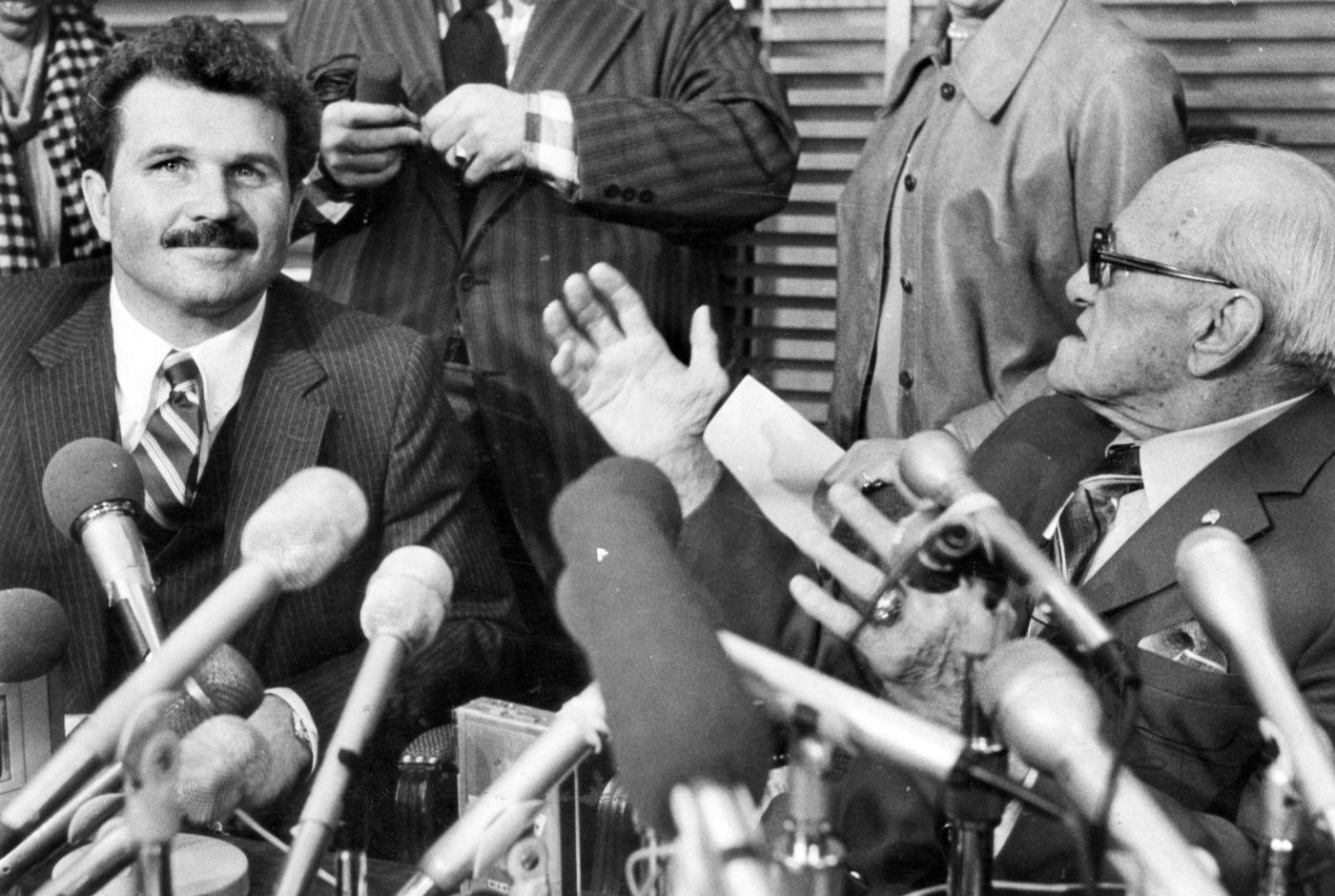
Resurrected by coach Tom Landry in Dallas as a player and then an assistant coach, Ditka aimed for his dream and wrote a letter to Halas asking for a reconciliation and a chance to coach the floundering Bears.
Halas, who was 86 years old, gave Ditka the opportunity but refused to name the other candidates for the job calling them “losers.”
“I like his ability to handle himself and handle other people,” Halas told reporters when Ditka was introduced as head coach. “And I know he’ll do a good job getting people to play according to his desires.”
Responding to suggestion he was getting old, Halas said: “There’s no goddamn senility in this carcass.”
It was the last coaching hire Halas would make. Ditka kept the role until 1993.
“More than the Super Bowl, the six NFC Central Division titles and 106 victories in 11 years, Ditka brought passion to the Bears,” Pierson wrote after Ditka was fired in January 1993. “He reminded his entire sport that football is first and foremost a game of emotion. Loved or hated, Ditka made Chicago care about football. Unlike peers, Ditka’s behavior never left any confusion over whether the Bears had won or lost.”
Halas died of cancer in his North Sheridan Road apartment on Oct. 31, 1983. He never revealed his diagnosis to his only daughter, who was with him when he died. He is interred in a family mausoleum at St. Adalbert Cemetery in Niles. Virginia succeeded him in ownership of the team and holds it today at 100 years old.
Virginia’s life has been marked by tragedy, which unexpectedly accelerated her career trajectory and led a former league commissioner to call her the “First Lady of the NFL.”
In addition to Halas, Virginia’s mother died of a heart attack in 1966. The same ailment killed her younger brother in 1979. Virginia’s husband of 60 years died in 2003. She’s outlived two of her own children and one of her favorite Bears players, Walter Payton.
She told the Tribune in 1983 she and her father talked frequently about the future of the team during the last month of his life, but that there was a “gap” in their conversations that left some questions unanswered.
“More than most people, he considered himself immortal,” McCaskey said.
Those who know the famously private Bears owner think she’s carried on her father’s wishes.
“Virginia and the McCaskey family inherited the Bears without any experience, without much background, without any expectation, without any real desire on Virginia’s part, but she’s made it her lifelong, solemn duty to do what she thinks her father would want her to do,” Pierson told the Tribune earlier this year. “She cherishes that legacy and she’s done a terrific job of trying to maintain that legacy.”
Does Pierson think McCaskey will ever sell the team her father established in Chicago?
“As long as she’s alive, the Bears will never be sold,” he said.
Want more vintage Chicago?
Become a Tribune subscriber: It’s just $12 for a 1-year digital subscription
Follow us on Instagram: @vintagetribune
And, catch me Monday mornings on WLS-AM’s “The Steve Cochran Show” for a look at “This week in Chicago history.”
Thanks for reading!