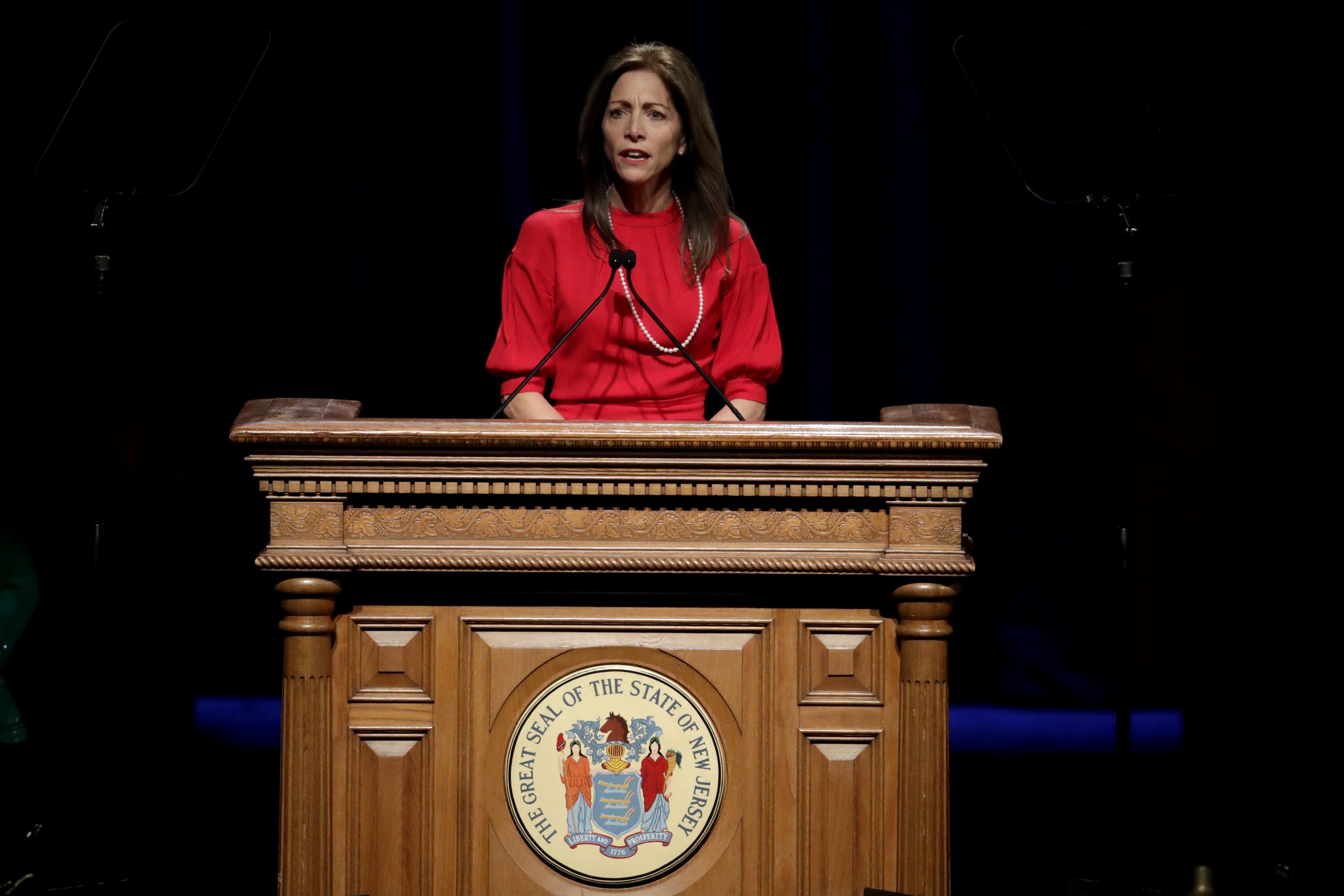
New Jersey First Lady Tammy Murphy enters US Senate race to replace Menendez

posted in: Politics | 0

New Jersey First Lady Tammy Murphy, who has taken an active role in helping govern the state, is running in the 2024 Democratic U.S. Senate primary to replace the indicted U.S. Sen. Bob Menendez.

The 58-year-old former Republican is the second major Democratic figure to declare her candidacy, following Rep. Andy Kim (D-N.J.). But she instantly becomes the frontrunner thanks not just to her husband’s position as governor but her long list of contacts with party leaders, for whom she’s spent the last six years as a prolific fundraiser.

Murphy did not name Menendez specifically, but she included his image in part of her video launch decrying Capitol politics.

“Right now Washington is filled with too many people more interested in getting rich or getting on camera than getting things done for you,” she said.

Menendez, who’s facing extensive federal charges of bribery and acting as an unregistered foreign agent for the Egyptian government, has not said whether he plans to seek reelection but hinted at it Friday, saying in a statement that he is “used to tough fights and next year won’t be any different.” Menendez, who has pleaded not guilty to all charges, also took a vague swipe at Tammy Murphy last month, saying that if she runs “she’ll have to deal with a lot of baggage.”

But while Menendez won reelection by 10 points in 2018 a year after beating previous corruption charges with a hung jury, his popularity has cratered in New Jersey, with an October poll showing his favorability at just 8 percent.

Tammy Murphy, who grew up in Virginia, has said she was a Republican until the mid-2000s, when she began considering herself a Democrat due to her views on abortion, guns and the environment — issues she highlighted in her campaign announcement. The New York Times reported earlier this month that she voted in a Republican primary as recently as 2014, which was after her husband’s time as Democratic National Committee finance chair and U.S. ambassador to Germany in the Obama administration.

Signs appeared that Tammy Murphy would be more involved in her husband’s administration than most of her predecessors shortly after Phil Murphy was sworn into office in 2018, when the administration transformed a conference room down the hall from the governor’s office into a private office for her.

Tammy Murphy, who has four grown children, made maternal mortality her chief cause, highlighting New Jersey’s relatively high maternal death rate and how Black women were nearly seven times as likely as white women to die from childbirth-related complications. Her campaign noted that New Jersey has moved its national ranking for maternal deaths from 47th to 27th during her “Nurture NJ” initiative.

Murphy focused on that in her campaign video, acknowledging that she didn’t have to worry about surviving childbirth or the level of care for her newborns because of built-in advantages she had.

“The money in our family’s bank account, and frankly, the color of my skin meant I could get the best care available,” she said. “But that’s not the case for a lot of women.”

Murphy also highlighted her work on the environment, specifically making New Jersey the first in the nation to incorporate climate change into school curriculum.

Politically, Tammy Murphy has been one of the New Jersey Democratic Party’s top fundraisers, helping her develop relationships with party bosses who hold sway over county party endorsements. Those endorsements could award Murphy “the line” in most counties — a unique feature of ballot design in New Jersey that allows county party-endorsed candidates to run in primaries in the same column or row as every other country-endorsed candidate, from town council to president.

Murphy’s entry into the race wasn’t greeted with enthusiasm by some progressives, who saw it as nepotism and somewhat ironic, considering that Menendez had paved the way for his own son to be elected to the House of Representatives more than a year before his indictment.

Tammy Murphy has also faced controversy over her role in leading a political nonprofit called Stronger Fairer Forward that promotes her husband’s policies and has refused press requests to publicly release its donors. She and her husband also faced criticism early in the governor’s first term for poor living and playing conditions for the women’s soccer team they co-own, then called Sky Blue. Tammy Murphy pledged to improve conditions for the team, which changed its name to Gotham FC and last week won its league championship.

Kim has already won support from some of the groups on the party’s left flank. But Murphy’s campaign is expected to take advantage of the party infrastructure as well as her policy achievements that appeal to Black voters, who make up a big portion of the Democratic Party’s base.

In addition to Kim, left-wing activist Lawrence Hamm, who unsuccessfully challenged Sen. Cory Booker (D-N.J.) in 2020, is also seeking the Democratic nomination. Kyle Jasey, a real estate lender from Jersey City and son of Assemblymember Mila Jasey (D-Essex), had filed to run for Senate but on Monday night announced he would drop out of the race to instead challenge Menendez’s son, U.S. Rep. Rob Menendez (D-N.J.).


What Paul Pelosi’s attacker has in common with Jan. 6 rioters 

posted in: News | 0

SAN FRANCISCO — The man who attacked the husband of Rep. Nancy Pelosi came armed with a hammer, zip ties and fevered delusions about her role in a make-believe plot by elites to destroy the nation.

Now, facing trial a year later, the 43-year-old Canadian’s lawyers are trying to beat serious felony charges on a technicality — arguing that he wasn’t interfering with Pelosi’s role in Congress when he broke into the couple’s home demanding to know “Where’s Nancy?” and striking her elderly husband in the head with a hammer.

Instead, David DePape’s attorneys say, he sought to hold her captive over her “wholly unrelated” role in a bizarre conspiracy theory. They are effectively claiming that he was living in an alternate reality where her role as speaker of the House did not factor into his thinking.

As a result, the trial has become something of a test — not just of DePape’s guilt or innocence, but of what happens when certain far-out strains of digital-age American radicalism collide with the criminal justice system.

The defense’s argument reflects the growing prevalence of a certain kind of extremism in American politics — internet fever swamps, supercharged during the Covid-era as many isolated and marginalized Americans scoured fringe message boards. Now, many of those who pursued fantastical plots to violent ends — including the Jan. 6, 2021, attack on the Capitol — are asking judges and juries to factor in those breaks from reality when they render judgment.

For DePape, a verdict on that argument could come as soon as Wednesday when jurors get the case after a weeklong trial in federal court in San Francisco.

DePape’s argument is reminiscent of one lodged by dozens of people charged in the Jan. 6 attack, including some who burst into the halls of Congress shouting “Where are you, Nancy?” While many stormed inside the Capitol with a plan to prevent lawmakers from certifying Joe Biden’s presidential victory, others have claimed they were unaware that lawmakers were conducting business that day — or believed the job had already been done when they got inside. In some cases, that argument has helped defendants wriggle out of the most serious charges they faced: obstruction of an official proceeding.

Judges and juries have largely rejected the claims of Jan. 6 rioters. But a handful of judges have found that some rioters could not face weightier charges because they had no clue what was happening in the Capitol and therefore couldn’t have intended to block certification of Biden’s victory over Donald Trump.

U S. District Court Judge Amy Berman Jackson found that one defendant— who surged with the Jan. 6 mob onto the Senate floor — had such a “unique stew in his mind” that she couldn’t be sure he had any idea he was breaking the law.

The parallel arguments, in high-profile cases of political violence that gripped the nation, are emblematic of America’s descent into online and social media-driven conspiracy theories. That trend has created a more complicated path for prosecutors, who must prove criminal intent to convince juries to convict DePape and the Jan. 6 rioters on more severe felony charges that carry longer prison terms.

DePape told jurors Tuesday during his rambling and tear-filled testimony that he didn’t target Pelosi to prevent her from serving in Congress. He said his real intent was to reveal a sinister plot.

“I wanted to use her to expose the truth,” DePape said, testifying that he planned to wear a unicorn costume he brought to her home and interrogate Pelosi on camera about what he believes are Democratic plots against former President Trump.

He’s facing two charges: attempted kidnapping of a U.S. official (which requires the intent to interfere with official duties) and assault on an immediate family member of a U.S. official (which also requires the intent to interfere with or retaliate against the official over their duties). The kidnapping charge carries a 20-year prison sentence and the assault has a 30-year term.

Prosecutors have called the defense’s argument outlandish. Assistant U.S. Attorney Laura Vartain Horn said DePape’s actions and words before and after the attack show “there is ample evidence of retaliation” against Pelosi over her official role as the former speaker of the House.

DePape and his attorneys have admitted that he planned to hold Pelosi captive and struck Paul Pelosi with a hammer, a brutal attack captured in grainy police body camera footage.

The defense has, instead, leaned into the Hail Mary argument that DePape shouldn’t be found guilty on more severe charges that he sought to impede, interfere or retaliate against Pelosi over her role in Congress.

DePape’s attorneys are essentially implying that the charges against him belong in state court, not federal court. DePape faces a separate trial on state charges for the attack, and defeating federal charges could make it easier for his attorneys to negotiate a potential plea deal with local prosecutors.

“He did something awful, but as you will hear, it was not on account of Nancy Pelosi’s duties as a member of Congress,” Jodi Linker, DePape’s attorney, told the jury. “This case here in federal court is a narrow one. The case here is about the ‘why.’”

That nuanced argument is strikingly similar to the case of a young Pennsylvania woman who broke into Pelosi’s office on Jan. 6 but claimed she didn’t know the building was the U.S. Capitol.

Defendant Riley Williams argued that despite her conduct that day — which included pushing against police officers in the Capitol rotunda and cheering a mob in Pelosi’s office as several others purloined a laptop — she couldn’t be convicted of obstructing Congress’ business because she didn’t have any awareness of what was happening in the building.

Williams was ultimately convicted of multiple felonies for her actions, but jurors deadlocked on the obstruction charge.

DePape’s attorneys have focused heavily on the far-right podcasts and internet echo chambers that influenced him in the months before the attack. He testified Tuesday that he spent most of his free time playing video games while listening to fringe podcasters like Tim Pool, Jimmy Dore and Glenn Beck.

The defendant said the podcasts convinced him that Pelosi and other Democratic officials were smearing Trump with lies and protecting a cabal of pedophiles. DePape is a follower of the QAnon conspiracy movement, an evolving series of allegations against celebrities and political figures that attempts to tarnish them with false allegations of pedophilia and other crimes.

DePape’s list of targets included Pelosi, Hunter Biden, Rep. Adam Schiff, Gov. Gavin Newsom, actor Tom Hanks and a queer studies professor and scholar — all of whom he believes are villains sprung from delusional online conspiracy theories.

“Many of us do not believe any of that,” Linker told the jury. “But the evidence in this trial will show that Mr. DePape believes these things, he believes them with every ounce of his being.”

Orioles’ Brandon Hyde named AL Manager of the Year, joins elite company as 4th Baltimore skipper to win award

posted in: News | 0

Amid the Orioles’ poor start to the 2022 season, manager Brandon Hyde expressed confidence in not only the club’s future, but also his place in it.

“I’m in this for the long haul,” Hyde told The Baltimore Sun last April. “I’ll be here when we’re winning.”

At that point, early in his fourth season leading Baltimore’s baseball team, Hyde possessed one of the five worst winning percentages of any manager in major league history. Hired as a first-time manager before the 2019 season to guide the club through a rebuild, Hyde had overseen as many campaigns with more than 100 losses as every preceding Orioles manager had in the franchise’s first 65 years in Baltimore.

Tuesday night, little more than a year and a half after his declaration, Hyde was named the 2023 American League Manager of the Year. In his fifth season at the helm, the Orioles won 101 games, winning the AL East and possessing the circuit’s top record. Hyde, 50, joins Frank Robinson (1989), Davey Johnson (1997) and Buck Showalter (2014) as Baltimore managers who have won the honor since its introduction in 1983. Hyde joins Showalter and seven others as managers who won the award after never playing in the major leagues.

He received 27 of 30 first-place votes from the Baseball Writers’ Association of America and came in second on the other three ballots. Texas’ Bruce Bochy received the other first-place votes and finished second ahead of Tampa Bay’s Kevin Cash. Miami Marlins manager Skip Schumaker won the National League award.

With infielder Gunnar Henderson named the AL Rookie of the Year on Monday, 2023 marks the third season in Orioles history the team has had multiple winners of the BBWAA’s annual awards. Robinson’s 1989 honor came as reliever Gregg Olson was the AL Rookie of the Year, which outfielder Al Bumbry took home in 1973 as Jim Palmer was the AL Cy Young Award recipient.

The club’s performance this season put Hyde alongside Hall of Famer Earl Weaver as the only managers to lead the Orioles to a 100-win season. The campaign marked the second straight in which Baltimore massively exceeded external expectations. About a month after Hyde said he would manage Baltimore when it went from rebuilding to competing, the Orioles promoted top prospect Adley Rutschman, and the winning started soon after. Projected to be among the majors’ worst teams as they had been in Hyde’s first three seasons, the Orioles ended 2022 with an 83-79 record, the best of any AL team that missed the postseason. The finish made Hyde the runner-up in AL Manager of the Year voting, though he won Sporting News’ honor, which was voted on by fellow managers.

Despite the Orioles’ breakout success, sports books and projection systems expected regression in 2023. They instead won the best division in baseball, going the entire regular season without being swept. Under Hyde, Baltimore has set an AL record for most consecutive multigame series with at least one victory.

“We were disrespected, honestly, going into this year,” Hyde said hours before the Orioles clinched their first playoff berth since 2016. “Just from where we were from projections, smart people thinking they know what the records are gonna be at the end of the year, casinos, et cetera. I thought we were underappreciated. Everybody thought we were going to have a setback this year. I wanted our players to be offended by that a little bit, the guys that were here last year. I thought that wasn’t accurate.

“I thought we were going to be better than everybody thought.”

As he was in April 2022, Hyde was right. The Orioles entered the year with a core composed of players who weathered the rebuild alongside Hyde and young talent developed during it. With only a handful of relatively inexpensive veterans in the mix, the Orioles’ front office, as it has throughout Hyde’s tenure, handed him a roster built with one of the lowest payrolls in the majors.

He helped make it a division champion. Despite their frugality, the Orioles’ roster featured depth on both sides of the ball, with Hyde deftly deploying his bench and bullpen throughout the year. Almost half of the Orioles’ victories came in games decided by two or fewer runs, and Baltimore’s .662 winning percentage in such games was 100 points better than the next-best AL club. They tied for the major league lead in comeback wins.

Many players credited Hyde for his role in the clubhouse culture that fueled that success.

“I have a ton of respect for him,” said first baseman Ryan O’Hearn, one of a handful of players who embraced and thrived in part-time roles under Hyde. “I think that’s a common denominator around the locker room is you have guys who go out there and play their ass off for him.”

Players also vouched for him to be Manager of the Year in 2022, but the award went to Terry Francona after he led the Cleveland Guardians to the AL Central title. Hyde’s Orioles won their division in 2023, helping him fend off Bochy, Cash and others in BBWAA voting, which took place before the postseason.

In it, Bochy’s Rangers swept Hyde and the Orioles in the AL Division Series en route to win the World Series. Days after Baltimore’s elimination, the possibility of this award gave Hyde little solace.

“That’s nice,” Hyde said. “I’m still pissed, to be honest with you.

“I don’t like to lose, and I don’t like to lose like that,” he added later. “I wanted our players to jump around again. It’s a really cool group. You didn’t want to have to get on the plane after something like that. You wanted to see them continue to play. That’s the bottom line. We didn’t want the season to be over.”

In a few months, another will begin. Hyde will spend it as the reigning AL Manager of the Year.

This story will be updated.

()

Review: The Hunger Games return in ‘The Ballad of Songbirds and Snakes,’ with the odds in its favor

posted in: Society | 0

Two hours and 37 minutes is pretty long for a “ballad,” but you can’t call it “The Hunger Games: The Three-Cycle Opera of Songbirds and Snakes” now, can you?

Concision was never much in favor in the four “Hunger Games” films, which reached a seeming finale with 2015’s “The Hunger Games: Mockingjay — Part 2.” The intervening years have done nothing to shrink the ambitions of this unapologetically gaudy dystopic series where the brutal deaths of kids are watched over by outrageously styled Capitol denizens with names like Effie Trinket.

That clash of YA allegory and color palette is just as pronounced, if not more so, in “The Hunger Games: Ballad of Songbirds and Snakes,” a prequel set 64 years before the original books, adapted from Suzanne Collins’ 2020 book of the same name.

“The Ballad of Songbirds and Snakes,” which opens in theaters Nov. 16, is an origin story of the Hunger Games, themselves, as well as numerous characters — primarily the devious President Coriolanus Snow, played by Donald Sutherland in the first four films. Here, Snow is an impoverished but opportunistic 18-year-old student played by Tom Blyth.

Just as in the “Hunger Games” films led by Jennifer Lawrence’s Katniss Everdeen, the new one proves how much you can sacrifice in story when you’ve got a thrilling young performer commanding the screen.

Francis Lawrence’s prequel often wobbles, especially in the early going. And yet, in the end, “The Ballad of Songbirds and Snakes,” propelled by Blyth’s performance, manages to be the deepest expression yet of the series’ melodrama of adolescence. In Panem, the only thing more tragic than the suffering inflicted by adults on the young may be a bright kid warping wickedly into one of those elders, too.

That generational divide was always at the heart of the appeal of “The Hungers Games,” a fantasy where no adult or institution can be trusted, and the normal pressures of teendom are amplified in a modern, televised Roman Coliseum — an “American Idol” with murder — concocted by elders. It’s madness shrugged off as, “That’s just the way it is.”

In “The Ballad of Songbirds and Snakes,” we see how it got to be that way. The 10th annual Hunger Games are approaching but it feels more like pre-Super Bowl times when the NFL and the AFL played in separate leagues. The broadcast is low rent, the ratings are poor and the games themselves are staged in a dilapidated stadium.

With little food in the fridge, Coriolanus is living with his cousin Tigris (Hunter Schafer) and grandmother (Fionnula Flanagan). Their family has fallen on hard times, in part because of a family rivalry with Casca Highbottom (Peter Dinklage), the dean of the academy who harbors hatred for the Snows. (Dinklage, whose wry presence adds a kick to the film, has managed to appear once again in an outlandish fantasy with a man named Snow. )

As the students gather amid Third Reich architectures (the production design by Uli Hanisch is stellar) and the games’ founder Volumnia Gaul (Viola Davis, majestic in blue, with a turquoise eye) gazes on, Coriolanus is assigned his tribute, Lucy Gray Baird, a bold young woman from District 12 (also the home of Katniss) who wears a rainbow skirt and sports a dubious Southern accent. During the reaping ceremony, she makes an immediate impression, putting a snake down the back of a rival and bursting into song for the cameras. See, now there’s concision, I thought. You get your songbird and snake, straight off.

Lawrence’s Katniss was a thrilling female warrior whose seizing of center stage had reverberations off screen, paving the way for blockbuster female protagonists. Rachel Zegler’s Lucy Gray is inevitably a disappointment by comparison. Lawrence’s film, scripted by Michael Arndt and Michael Lesslie, for a while has the stale feeling of an unneeded retread. The tonal fluctuations, always a tricky balance in Panem, can be ridiculous. The stadium is abruptly bombed by unseen rebels. Once the games begin, one tribute concocts rabies.

The main thing holding our attention at this point is Jason Schwartzman’s Lucretius Flickerman, a TV host with a Salvador Dali mustache who wants the games wrapped up just so he can make his dinner reservations. (It’s been a very good year for Schwartzman, who transformed himself in Wes Anderson’s “Asteroid City” and transmogrified in “Spider-Man: Across the Spider-Verse.” )

But “Songbirds and Snakes” sneakily begins making a case for itself. The relationship between Coriolanus and Lucy Gray is compellingly complex. He works desperately to help her survive the games because he believes in her, and maybe loves her, but also because her success benefits him, too. Whether Lucy Gray is as purehearted as her songs, too, is up for debate. Both, we sense, are cunningly playing the hands they’ve been delt, seeking an advantage where they can. When Coriolanus begins making suggestions for the games to Volumnia, he proves himself a natural-born marketer.

That there’s tension in Coriolanus’ character, considering we know how he ultimately ends up, is a tribute to just how good Blyth is. We’ve by now seen plenty of prequels that show us how some famous villain broke bad, but there’s nothing in Blyth’s performance that telegraphs his future. He’s a sincere striver — we root for him because of his poverty and his puck — who’s operating in the society he’s found himself. He’s a villain born entirely of circumstance.

“The Ballad of Songbirds and Snakes” extends the saga for a third act that takes places in District 12, an addition that another franchise might have saved for the next installment. But it’s also where that tragedy of “The Hunger Games,” and Coriolanus’ fate, earns some of the Shakespearean touches that have liberally been sprinkled throughout. (Shakespeare’s “Coriolanus,” is likewise about an ambiguous warrior set amid times of famine and class struggle.)

“The Hunger Games” kicked off a YA craze in film that had its ups and downs but petered out several years ago. Whether “The Ballad of Songbirds and Snakes” is enough to relight those embers remains to be seen, but it is a reminder how good a platform they offered young actors. It’s a ritual worth returning to.

“The Hunger Games: The Ballad of Songbirds & Snakes,” a Lionsgate release is rated PG-13 by the Motion Picture Association for strong violent content and disturbing material. Running time: 157 minutes. Two and a half stars out of four.

Related Articles

Movies & TV |


Movie review: ‘Dream Scenario’ busy with cultural commentary but not exactly deep

Movies & TV |


Movie review: ‘The Marvels’ skips along with zippy humor, lightness

Movies & TV |


7 Thanksgiving movies to stream this month

Movies & TV |


What to watch: ‘The Holdovers’ could be a new holiday classic

Movies & TV |


What it takes for a movie to get a rare ‘F’ CinemaScore — and why it’s a badge of honor