The bye week is over and the Chicago Bears are about to begin the final five-game stretch of the season with many important questions looming.
What would they have to accomplish, beginning Sunday at Soldier Field against the Detroit Lions, for coach Matt Eberflus to return for a third season in 2024? Brad Biggs takes a swing at that and many more questions in his weekly Bears mailbag.
Is 7-10 enough to save Matt Eberflus’ job? Is 7-10 enough to save his job but with conditions on his coaching staff moving forward? How do you see this playing out? — @oldvulture23
That is one of the biggest questions to be answered in the stretch run as the Bears prepare for Sunday’s NFC North meeting with the Detroit Lions, whom they should have beaten three weeks ago at Ford Field. The Bears are seeking to win consecutive games for the first time under Eberflus, and that would be a step in the right direction. The Lions (9-3) are a high-quality opponent, which makes this a very important game for Eberflus. I can’t call his first division win in Week 12 in Minnesota a signature win because it came against a Vikings team that started Joshua Dobbs at quarterback and was without Justin Jefferson.
I’ve written previously that an evaluation of Eberflus has to lean heavily on this season. You need to separate 2022 from this year because last year’s roster wasn’t designed to be competitive and the Bears were resetting their salary cap by carrying more than $85 million in dead cap space before the season ended. The 3-14 record always will be on Eberflus’ resume (and that of general manager Ryan Poles), but it was understood what the team was doing to position itself for the future.
The Bears were expected to be more competitive this season, and at 4-8 and having blown the first meeting against the Lions and the Week 4 game against the Denver Broncos, they’re not quite where you would want them. With five games remaining, the Bears could get to 7-10 or perhaps even 8-9 (9-8 would be a stretch) if they continue to play solid defense and get a little more consistency on offense.
A judgment on Eberflus and his coaching staff likely will lean a little more heavily on how the team performed in the second half of the season than the first half. Do you ignore the first half? No, but one primary question you are trying to answer is how did the roster perform as the season progressed. Was the arrow pointing up at the end of the season? What’s the logical next step in 2024 if the coaching staff returns?
Poles and the leadership at Halas Hall need to consider a ton of questions. Do the Bears want an offensive-minded head coach if they are going to draft a quarterback? Do they believe Luke Getsy and the offensive staff would be a good match for a new quarterback? There are a ton of questions to sift through, and while many have made out Getsy to be the bogeyman, I don’t get the sense that sentiment is shared inside the building.
Eberflus definitely can help his cause if the Bears can get to 8-9 or even 7-10. That’s within the range of victories most people probably figured was realistic before the season. More importantly, though, it’s about a feel. Are the Bears headed in the right direction with the current coaching staff? Is that group getting the most it can out of the players? Is development happening as it should?
Five more games is a lot of action for Poles, President/CEO Kevin Warren and ultimately Chairman George McCaskey to sift through. It will happen quickly. The Bears are relatively healthy, and coming off a late bye, they are also well-rested. Let’s see how things shake out.
Is there any real hope of making the playoffs? Tough few games ahead that I don’t think the Bears will win. — @just_acy
There was a little buzz Sunday when some of the network graphics included what appeared to be any team that had not been more or less eliminated from the postseason as “in the hunt.” Is there hope for the Bears? Anything is possible. There’s almost always hope. To remain in the hunt, they probably would have to win the next five games, which would mean closing the regular season with a six-game winning streak. That’s to have a realistic shot at a wild-card berth. You do realize that since the start of last season, the Bears have won only seven games total and have yet to win consecutive games, correct? Their most recent win came against a No. 3 quarterback in Minnesota and they were unable to score a touchdown.
The remaining five games — Sunday versus the Lions, at the Cleveland Browns, home against the Arizona Cardinals and Atlanta Falcons and at the Green Bay Packers — appear winnable. I’m quite certain those opponents will mark the Bears on their schedule as a “winnable” game for them as well. I wouldn’t have a ton of confidence in the Bears going to Lambeau Field on Jan. 9 and winning. Not if the Packers remain healthy. They could have a playoff spot on the line, Jordan Love is playing very well and the Packers have won the last nine meetings and 14 of the last 15.
That said, the Bears pass the eye test of late when you’re looking for improvements, especially on defense. I’m toying with the idea of picking them to win Sunday at home against a Lions team that hasn’t been sharp for a while. The way the Bears have been playing, I believe they have a chance to close out the season with some momentum and maybe win three more games. If they catch a spark and play a little better, perhaps they go 4-1 the rest of the way.
But, man, that’s asking them to do something we haven’t seen with any level of consistency for a long time. A 3-2 or 4-1 finish would leave them 7-10 or 8-9, and that’s probably in the range most folks had them before the season.
If Kevin Warren and the Bears decide to line up their GM, HC and QB, is there risk with potentially all three being rookies? Even if it’s just HC and QB, is there any kind of success rate with rookie head coaches paired with a rookie QB? — @bobszafranski
It sure looks like the Houston Texans, with first-time head coach DeMeco Ryans and rookie quarterback C.J. Stroud, are headed down the right path. Stroud looks like a slam dunk to win offensive rookie of the year honors. He leads the league with 3,540 passing yards.
Jalen Hurts was in his second year in Philadelphia when the Eagles hired a first-time head coach in Nick Sirianni. Zac Taylor was in his second season as a head coach (after a 2-14 first year) when the Cincinnati Bengals drafted Joe Burrow. Those are recent examples of new or very inexperienced head coaches working out with young quarterbacks. I would not worry about the possibility the Bears have a rookie quarterback or rookie head coach. I would be more concerned they draft the right quarterback and hire the right coach.
There’s a cliche regarding the Bears that they often screw up hiring the coach because they don’t hire one with prior head coaching experience. That didn’t help John Fox. Lovie Smith was a first-time head coach. So was Mike Ditka.
The following teams are pretty competitive right now — or have been historically — with a head coach who had no prior experience in the role (interim tags not included):
Ravens: John Harbaugh
Bills: Sean McDermott
Bengals: Zac Taylor
Lions: Dan Campbell
Packers: Matt LaFleur
Rams: Sean McVay
Dolphins: Mike McDaniel
Vikings: Kevin O’Connell
Eagles: Nick Sirianni
Steelers: Mike Tomlin
49ers: Kyle Shanahan
Should previous head coaching experience be considered? No question. Should it be a deal breaker? No way. Again, it’s about finding the right fit organizationally. Criticizing the Bears for not hiring more head coaches with previous experience in the role is lazy. Criticize them for hiring the wrong coaches and/or not outfitting the roster with enough talent for the coaches to have success.
Any chance the Bears draft a QB at Nos. 1 or 2 in the draft and keep Justin Fields? Or is Fields definitely traded if a QB is drafted? — @jtr_1994
If the Bears draft a quarterback in the first round, it would be because they are ready to move on from Fields. I would expect them to explore trade options if they go in that direction. It would not make sense to have a rookie you’ve deemed to be the future of the franchise and Fields.
If the Bears do draft a quarterback, I’d bet top dollar Fields would be eager to move on as well. No one has presented a case to me for drafting a quarterback and keeping Fields that makes sense. The Bears have a quarterback they would feel pretty good about developing as a backup in Tyson Bagent.
Do you expect the Bears to make a big play for Chris Jones in the offseason? — @danno561
Initial instinct would tell me no. Is it something they have to discuss? Yes. Maybe check in on? Sure. Make a “big play” for Jones? I tend to think no. I don’t think the Bears are at the point where they are one massive signing of a free agent who has reached the peak in his career from getting over the top.
Jones is a fantastic player who has maybe been overshadowed a little in his career by Aaron Donald, one of the best defensive tackles of all time. Jones has 7 1/2 sacks for the Kansas City Chiefs this season and tied a career high with 15 1/2 last season. He’s a disruptive force against the pass and the run.
He also will turn 30 in July and will be entering his ninth season in 2024. He’s a high-mileage guy who has missed only eight games in his career. Eventually Jones will look slower and less explosive than he was in his prime, and then whoever is paying him will be getting a fraction of the return on its investment.
I hedge a little on this because I didn’t think the Bears would be involved with 30-year-old defensive tackle Javon Hargrave last March. The Bears at least checked out the market on Hargrave before it got way more expensive than they wanted to go. He eventually signed a four-year, $84 million contract with the San Francisco 49ers that included $40 million guaranteed.
You go after a player like Jones in free agency when you feel like your roster is at a point where maybe you’re one player away. The Bears don’t look like they’re one player away to me. They have to see what the defensive tackle market looks like and consider some additions, but they also want to see rookies Gervon Dexter and Zacch Pickens take big steps forward in 2024.
In my opinion, you reserve the “big plays” in free agency for guys coming out of their first NFL contract and entering their prime years. Jones is beyond that at this point. He will cash in big time. I’m just a little skeptical the Bears would be in that group of teams pursuing a 30-year-old who will get a deal near the top of the market.
I feel like the Bears are close to being competitive. I like where the defense is going. I like a lot of the offense too. QB play is something that is holding them back from ascending. Is it possible the Bears could bring in a guy like Baker Mayfield? We know what he is. He’s been pretty consistent. I think teaming him with DJ Moore and Marvin Harrison would make the offense one of the better units in the league and provide him with one of the best opportunities he’s had since coming into the league. It would also allow the Bears to use draft picks on the positions like DT/DE and OL where they still need a bit of help. — John R., Vietnam
If I had a $5 bill for every scenario floated my way in which the Bears acquire a bridge quarterback to allow them to use draft capital to address other positions, I’d be close to paying for a villa in Cabo San Lucas for a week.
Mayfield is throwing to Mike Evans and Chris Godwin with the Tampa Bay Buccaneers. He has passed for 2,790 yards, completing 260 of 409 passes (63.6%) with 18 touchdowns and eight interceptions. I’d take Moore and Harrison over that pair, but Evans and Godwin isn’t a bad duo and you can certainly do a heck of a lot worse. It’s not like Mayfield — who has turned into a journeyman since being picked No. 1 in 2018 by the Cleveland Browns — has no skill-position help.
The Bucs began the season 3-1, including a Week 2 victory over the Bears at Raymond James Stadium, and then really struggled, losing six of seven games before a 21-18 win over the hapless Carolina Panthers on Sunday. Since the first month of the season, they have scored more than 20 points only twice.
You can do a lot worse than Mayfield if you have to lean on a bridge quarterback for a season, but the Bears simply cannot consider this option or a similar one. We’re trying too hard to overthink the situation. Let me explain.
If you recall when Ryan Poles was hired as general manager in January 2022, the main theme he highlighted was putting the franchise in a position where it can enjoy sustained success. That’s obviously one of the goals — if not the main goal — he hammered home with Chairman George McCaskey that led to his hiring. It’s something the Bears, who haven’t had consecutive winning seasons since 2005-06, desire in the worst way.
What are the common denominators for teams that are routinely in the playoff hunt? Usually you find a stable front office and a head coach with some longevity and a track record for success. Those components are often in place for teams that have what? A top-tier quarterback. It’s extremely difficult to be a legitimate Super Bowl contender without a franchise quarterback, and it’s darn near impossible to sustain that level of competition without one.
Keeping Poles’ overarching goal in mind, and understanding that the Bears probably have not checked all of the boxes they would like to at this point with Justin Fields, it seems like most signs point in one direction: selecting a quarterback at or near the top of a draft that should offer some excellent choices.
Timing could be on the Bears’ side. This isn’t a poor quarterback class like 2022, when Kenny Pickett was the first one selected at No. 20 by the Pittsburgh Steelers. If the Bears deem they need to take another swing at the position — and I’ve been clear I think it’s headed in that direction — this is the year to do it. They won’t achieve sustained success until they get that position right, and I don’t think Mayfield or another journeyman would fill that need.
You know what the Bucs are going to do this offseason? See if they can find an upgrade over Mayfield.
At the three-quarter point of the season (roughly), who would you nominate for offensive rookie of year, defensive rookie of the year, all-around player of the year for offense and defense, most improved and biggest disappointment? — Mike P., Madison, Wis.
Interesting questions with a couple of obvious answers and a few good debates. I’m assuming you are asking specifically about the Bears.
Offensive rookie: RT Darnell Wright. He has played a team-high 797 offensive snaps (99.4%) and has flashed the dominance that makes it clear why the Bears used the No. 10 pick on him. One knock on Wright is consistency. His play can dip from snap to snap, and that should be ironed out moving forward. He also has a team-high 10 penalties (five false starts, four holding calls, one illegal block above the waist), and that needs to be cleaned up. Overall, I think the team will be pretty happy with Wright heading into his second season.
Defensive rookie: CB Tyrique Stevenson. While Wright doesn’t have a lot of competition as the offensive selection, defensive tackle Gervon Dexter is gaining on Stevenson. The second-round pick from Miami has started 11 games — he missed the Week 12 game in Minnesota with an ankle injury — and has one interception, one forced fumble and seven passes broken up. His play has been more up and down than Wright’s as teams have targeted Stevenson, but he has flashed more consistently than Dexter, who has been coming on in the last month.
Offensive player: WR DJ Moore. This is a slam dunk. Moore probably could stand on his numbers right now — 70 receptions for 1,003 yards with six touchdowns — and be the winner at the end of the season. He’s averaging 14.3 yards per reception and 10.8 yards per target. It’s fair to say the Bears have gotten everything they expected and maybe a little more from the receiver they acquired in the trade of the No. 1 pick to the Panthers.
Defensive player: CB Jaylon Johnson. This also appears to be a pretty easy selection, although weak-side linebacker T.J. Edwards has been a tackling machine and defensive end Montez Sweat has been the kind of multiplier GM Ryan Poles was hoping he would be since arriving. I’d also note that nose tackle Andrew Billings has performed well, clearly earning the two-year contract extension he received with the Bears ranking No. 1 in the league against the run. Johnson bet on himself entering the final year of his rookie contract and will be rewarded either with a nice extension from the Bears or by hitting the jackpot in free agency. He has three interceptions and eight passes broken up as the main cog in a talented and improving secondary.
Most improved: LG Teven Jenkins or CB Kyler Gordon. This looks like a toss-up. Jenkins has played very well since returning from a calf injury suffered in the preseason and looks like he could be a building block on the offensive line. Questions about his durability remain, but he has been starting and finishing games and has been excellent in both pass protection and run blocking. Gordon has settled in nicely in the nickel role and brings a combination of coverage ability and strength and toughness. There’s a lot to like about both players projecting to 2024 and beyond.
Biggest disappointment: WR Velus Jones. The third-round pick from 2022 has struggled to make an impact on special teams and has been removed from the punt returning role. He also has been unable to create more than a tiny niche for himself as a gadget player on offense. He’s the easy choice, although I considered quarterback Justin Fields, who has not consistently elevated his play as a pocket passer.
A lot of people talk about the QB race at the top of Round 1 as either Caleb Williams or Drake Maye. Do you see another QB who could be a third option the Bears would be more interested in than the front-runners for media/fans? — @barbersquires
Assuming Williams, Maye and Michigan’s J.J. McCarthy declare for the draft, I think you’re looking at a group of four quarterbacks who will be discussed thoroughly in advance of the draft, which begins April 25 (it only feels like that’s about nine months away). LSU’s Jayden Daniels is out of college eligibility and would be the fourth quarterback in the mix.
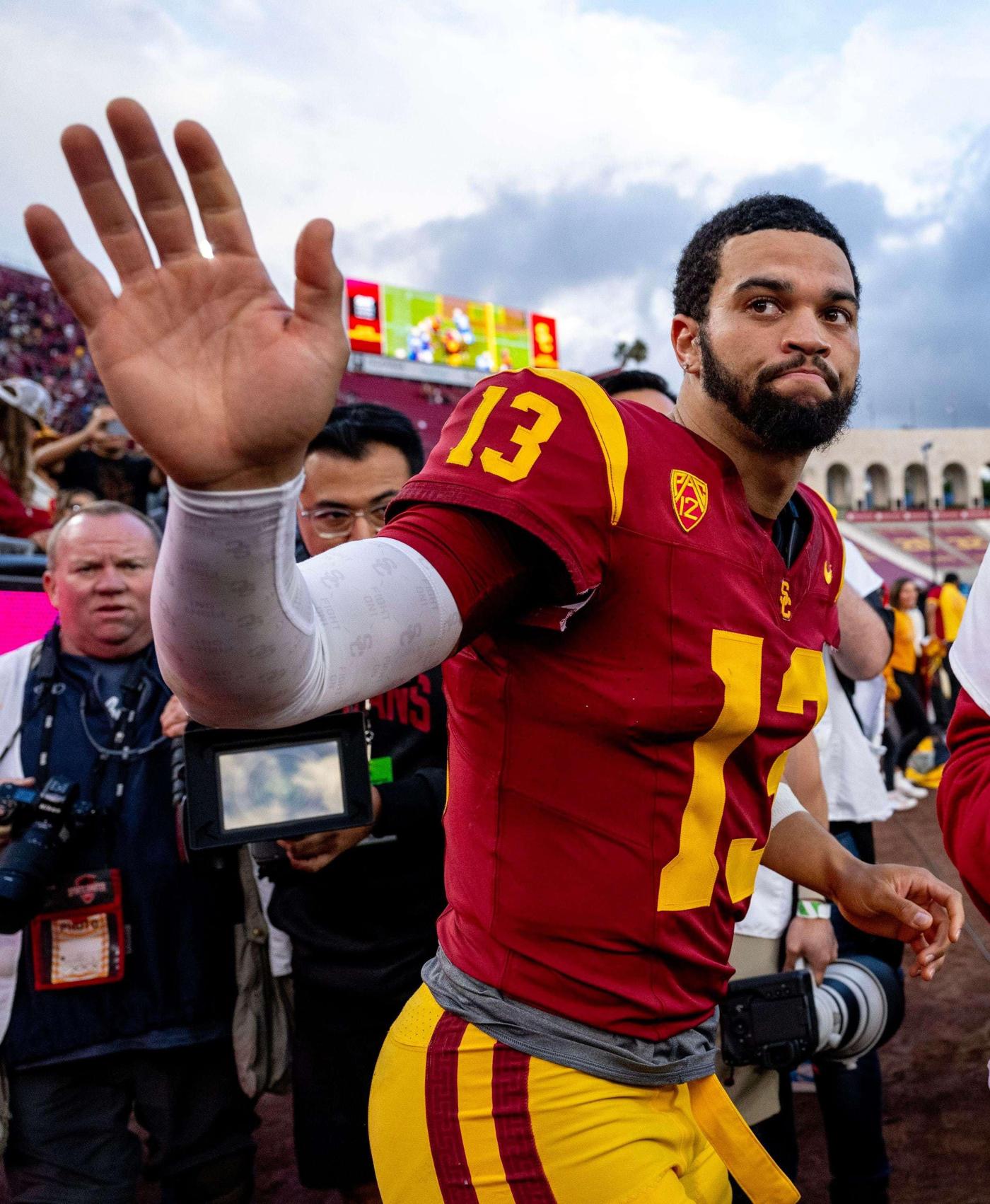
Williams was the presumptive No. 1 pick when the college season kicked off in August, and he still might wind up in that spot. He opted out of USC’s Holiday Bowl appearance, likely to begin preparing for the offseason with the combine, a pro day and private workouts.
If the draft were based on the current standings, the Bears would have the No. 1 pick (via the Panthers) and the No. 5 pick, meaning GM Ryan Poles would have control of the quarterback market if he desires. The Bears no doubt have been doing their homework on all of the quarterbacks, which means they surely have a pretty good feel as well for Oregon’s Bo Nix and Washington’s Michael Penix. I don’t see either of those guys in the mix at the very top of the draft, but it takes only one team to fall in love with a guy.
I think you can focus on Williams, Maye, McCarthy and Daniels with bowl season about to crank up. I went to see the first three play live and was glad to see McCarthy play in Michigan’s biggest game of the regular season against Ohio State because so much of the Wolverines’ schedule was against inferior competition. I wish I could have seen Daniels, who looks like the Heisman Trophy favorite, but there were only so many chances to get out and still see the Bears.
I was able to talk extensively with scouting personnel from a wide variety of organizations to help frame reports on all three. Here they are:
USC’s Caleb Williams
North Carolina’s Drake Maye
Michigan’s J.J. McCarthy
What is the hit rate for QBs taken at the top of the draft? If the Bears decide Justin Fields is slightly above average, would they forgo the risk of picking a QB and take a more surefire player(s)? — @chriscremer9
The hit rate isn’t great for the first two or three quarterbacks to come off the board, and there is always risk involved. The rate is similarly bad, however, for teams to become consistent contenders to make a deep run in the playoffs without a franchise quarterback. The Bears cannot plan on picking at the top of the draft every year — even if they traded one of their very high picks to a team in need of a quarterback — so eventually they have to fire on a quarterback if they’re not convinced Fields is the guy.
The timing here — Fields being in Year 3, the offense being underwhelming overall, the Bears positioned to have their pick of quarterbacks in a strong class and the fact they passed on a chance to draft C.J. Stroud this year — leads me to believe that’s the direction they’re headed in. Five games remain. That’s nearly one-third of a season. So there is more football to be evaluated, but that’s the scenario entering Week 14.
It looks like it could snow before Sunday’s game at Soldier Field and be windy during the game. Weather obviously impacts play calling. Regardless of the solution Kevin Warren and the Chicago Bears choose, do you expect it to have a roof? — @ajlight315
It’s my understanding the Bears’ plans for a new stadium involve a permanent roof. A retractable roof would cost significantly more money. Their goal is to have an indoor facility that can be used year-round for a variety of events.
()