Is my future all in the past? – “Tell Me Straight” by The Rolling Stones (2023)
The still-rocking Rolling Stones aside, should there be a required or suggested retirement age for concerts by over-the-hill music stars whose best days as live performers are years behind them?
The question is, admittedly, preposterous. Music is timeless. No one should have to retire unless their vocation poses a serious threat to others, or to themselves.
But what if a veteran rock star’s reluctance to retire from the stage poses a threat to their artistic legacy? Not their recorded legacy, but as once-dynamic live entertainers who could ignite and inspire on a nightly basis?
Specifically, what if the passing of time has led to an unmistakable decline in the quality of their performances, causing longtime fans to wince rather than cheer? And what if that decline means each successive concert and tour chips away at a performer’s previous accomplishments, simply because they are unable to rise to the same level that propelled them to stardom all those years ago?
As a lifelong music fan who cherishes attending concerts, these are questions I find myself pondering with increasing frequency. There are no easy answers. And there are multiple factors and distinctions to consider, including the love of performing at any age versus the risk of self-parody as one’s abilities audibly and visibly decline.
I pose these questions not because I no longer love much of the music I grew up with, but precisely because I still love so much of that music. This is why it becomes more and more difficult to reconcile the memories of what that music once sounded like in concert, when those performers were at the height of their powers — or even just 10 or 15 years ago, when they could still summon up a fair degree of magic on stage — as opposed to when they perform now.
This holds especially true after wincing through multiple performances over the past decade or more by such painfully diminished singers as Ian Anderson of Jethro Tull, Mike Love of the Beach Boys, Todd Rundgren and Elvis Costello, to cite just four discordant examples.
Their music has been vital to me at different stages of my life, even before the first concerts I attended by Jethro Tull and the Beach Boys as an eighth grader in 1969, and by Costello in 1978. I became a Rundgren fan in 1969 after buying a copy of “Nazz Nazz,” the second album by his band, Nazz. In 1970, I happily acquired his first solo album, “Runt.” As a music critic, I have happily done multiple interviews with Anderson, Rundgren, Costello and Love.
When, just a few months ago, I asked Anderson if there should be a mandatory retirement age for politicians and musicians, he offered an immediate response,
“For politicians, yes,” he said. “For musicians, no.” He then excused himself to do another interview.
In this photo from March 16, 2022, British singer Phil Collins performs onstage during “The last domino” tour of the British rock band Genesis at the Paris La Defense Arena, in Nanterre, northeastern France. (THOMAS COEX/AFP via Getty Images/TNS)
Living in the past?
For many casual concertgoers, the memory of what an artist sounded like in their heyday may supersede what they sound like now. Warm nostalgia may trump present-day reality. That disconnect can decrease in direct proportion to one’s desire to embrace the soundtrack of their younger days, when musicians and their fans shared a sense of boundless vitality, unlimited possibilities and feeling indestructible.
These colliding issues may be impossible to resolve, but they merit discussion.
Why would an artist who loves performing and lives for the roar of a crowd want to stop, even if they are a shadow of their former selves? Or does that question answer itself?
Why is it expected that jazz and blues artists grow better with age, while musicians who play rock — a genre created by young people for young people that is defined in part by its physicality — often face an uphill battle of steadily decreasing returns?
“It’s what I call the ‘Muhammad Ali syndrome’,” said Judas Priest singer Rob Halford.
“If you get in the ring too much, the whole thing can become really sad to look at and listen to. And you have to ensure that doesn’t happen as a musician, especially in the extreme world of heavy-metal, because it’s very demanding to carry these old bodies all over the place. You try to do the things you could easily do 30 years ago and it’s not so easy.”
Halford, now 72, made those comments in a 2010 San Diego Union-Tribune interview.
That was shortly before Judas Priest began its “Epitaph” farewell tour, which ended in 2012. Two years later, the band — like many rock and pop acts before it, including everyone from The Who to Cher — un-retired. The next world tour by Judas Priest, whose only original member now is bassist Ian Hill, runs from March 15 to July 10.
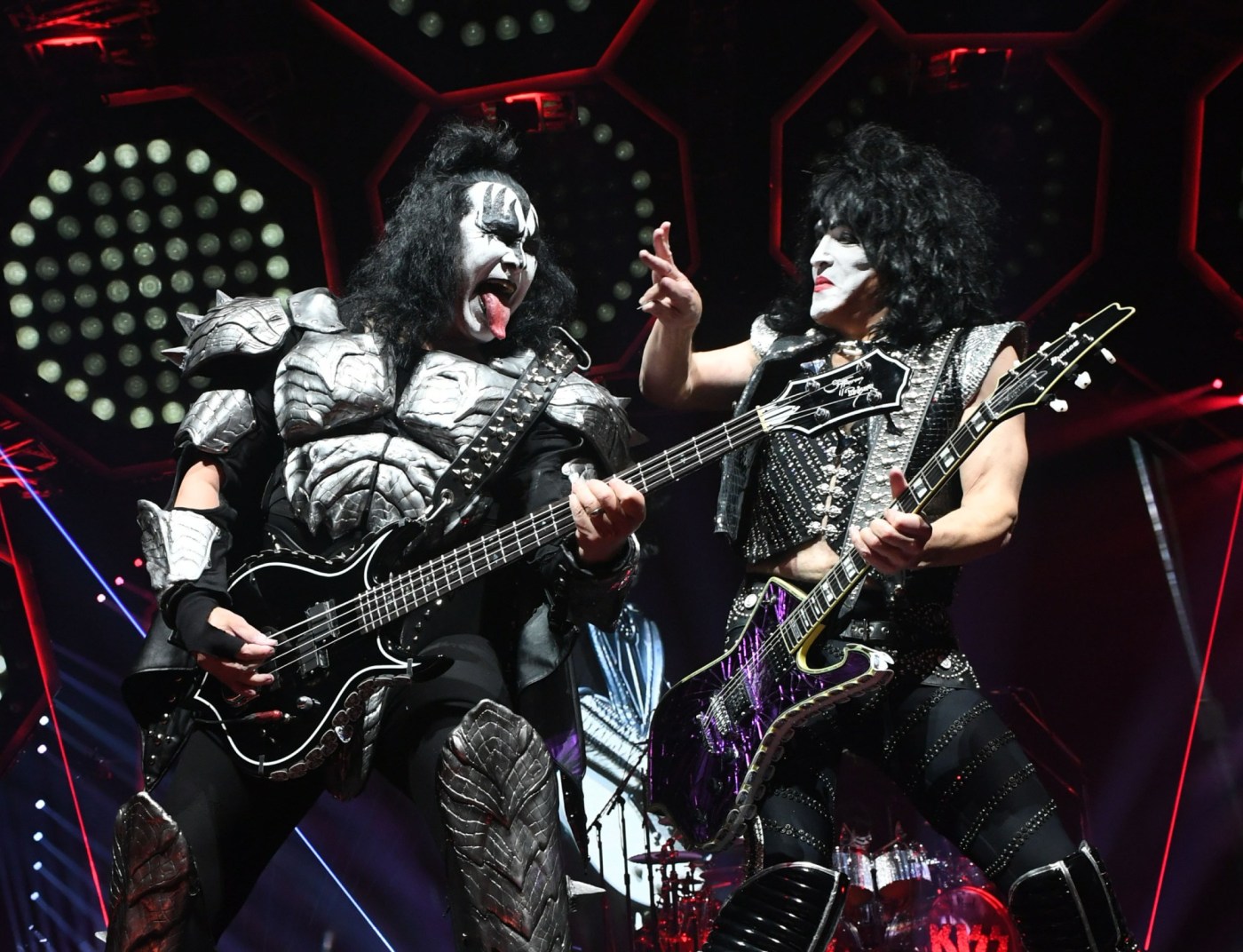
“I’m a big believer that it’s better to leave early than stay too late,” said Kiss singer and guitarist Paul Stanley. “We’re such big fans of the band that we don’t want to see it continue at any other level except prime. … It’s out of respect for Kiss, and our fans, that we have to stop.”
Stanley, now 71, shared those thoughts in a 2001 Union-Tribune interview during Kiss’ farewell tour. By 2003, the band was back on the road with a revamped lineup and has since done more than a dozen other tours. Its current “End of the Road” farewell trek, which the band vows will be its last, was set to conclude on Dec. 2.
Who, then, is ultimately qualified to determine when the time has come to no longer perform?
The artist, who has every right to change their mind and soldier on — even if their instincts to stop touring were correct in the first place? Concert promoters? Audiences? Certainly not a lone music critic.
And what about graying performers who might have happily retired years ago, but still tour out of financial necessity? The musicians who — to cite the name of Huey Lewis & The News’ 1982 hit — are still workin’ for a living?
Involuntary retirements
The aforementioned Lewis, the lead singer in The News, has not been able to tour since 2018 because of an inner-ear disorder called Ménière’s disease.
For Neil Diamond, the decision to cut short his 50th anniversary retirement tour in 2018 and retire was prompted by his Parkinson’s disease diagnosis.
For the now-deceased Glen Campbell, it was a 2010 Alzheimer’s diagnosis, although he subsequently embarked on a farewell tour that — like Diamond’s — was cut short.
For Slayer bassist and singer Tom Araya, whose band concluded its farewell tour in 2019, retirement was prompted by neck surgery that prevented him from continuing to engage in headbanging while he performed.
“It just gets harder and harder to come back out on the road; 35 years is a long time,” Araya, then 55, told the online magazine Loudwire in a 2016 interview.
Audiences are often more forgiving, and understandably so.
A concert is a shared experience. This holds true whether you are hearing a veteran act you grew up with perform for the fifth or 50th time. It holds true if you are hearing, for the first time, an artist whose music your family or friends introduced you to as a youngster.
Concerts, at their best, are a joyous communal event where performers and listeners bond over music that has become a shared fabric of their lives. The fraying of that fabric can sometimes make for a poignant evening, one that signifies the passing of time, the ties that still inextricably bind artist and listener, and the spark that a treasured piece of music can still trigger.
Alas, that fraying is sometimes so pronounced that the music becomes less poignant than jarring.
What happens when the fingers of a guitarist or keyboardist are no longer limber? When drummers struggle to maintain tempos or execute fills? When singers can no longer bound across the stage, stay on pitch or hit notes that once came easily (even after bringing the keys of a song down a half step or more)?
Sadly, the music begins to pale. So does the emotional resonance that can make a concert transcendent for artists and audiences alike.
Consider blues giant B.B. King, who died in 2015 at the age of 89 and battled Type 2 diabetes. A foundational musician of the 20th century, King was — decade after decade — one of the most consistently dynamic and impassioned performers I have ever seen.
“As long as people buy my records and come to my concerts, I don’t see anything else I’d like to do,” the then-80-year-old King told me in a 2005 interview.
But in the final years of his career, he was in consistent decline. King’s final San Diego concert, in late 2014 at Humphreys, found him singing erratically and struggling to find the right notes on his guitar. He started and ended his songs abruptly, prompting heckling from some dimwitted attendees.
No denial of aging
Like many fans, I want my musical heroes to endure. I want them to sustain their greatness, if not somehow defy the passing of time — at least sonically speaking — on stage and on record. Their continued vitality as performers is a victory for them and for their multi-generational fans.
Unlike some of my fellow baby-boomers, I am not in denial about aging. I know that with very few exceptions — take a bow, Mick Jagger! — it is unrealistic to expect a senior-citizen rock star to perform with the same youthful energy and athleticism as they did decades ago. I know we often see part of ourselves in the performers we watch, and that their mortality makes us ponder our own.
That Jagger can still sing and dance up a storm, at 80, is a triumph for him and should provide a vicarious thrill for anyone who attends a concert by the Rolling Stones next year. The 61-year-old band’s 2024 tour is being sponsored by AARP, which until 1999 was known as the American Association of Retired Persons.
Coincidentally, this year has seen a number of veteran acts embark on or conclude their farewell tours, including Elton John, Devo, the Eagles, Gladys Knight, Ted Nugent, Kenny Loggins, Foreigner, The B-52’s, Dead & Company, Manhattan Transfer, 50 Cent and Kiss. Aerosmith postponed the remaining dates on its “Peace Out: The Farewell Tour” until next year, after lead singer Steven Tyler, 75, suffered vocal cord damage and fractured his larynx at a Sept. 8 concert in New York.
This year may have witnessed more farewell tours since 2018, when Rock & Roll Hall of Famers Paul Simon, Joan Baez, George Clinton, Ozzy Osbourne and Lynyrd Skynyrd all announced their farewell tours. Lynyrd Skynyrd is still on the road, despite all its founding members now being deceased. Clinton, 82, also continues to tour and performed at UC San Diego in October. But he now spends most of his time sitting near the rear of the stage watching the latest iteration of his band, Parliament-Funkadelic, perform.
Of course, I welcome any opportunity to hear and celebrate pioneering musicians whose artistry and depth of emotional expression has grown with time.
That is exactly what I was fortunate enough to do at concerts over last year and this year by such varied artists as Bonnie Raitt, 74, Joe Walsh and Stevie Nicks, both 75, Neil Young, 78, Herbie Hancock, 83, Mavis Staples, 84, San Diego jazz dynamos Charles McPherson and Mike Wofford, who are 84 and 85, respectively, and the iconic Willie Nelson, 90, whose next tour starts in February.
But I cringe just thinking about concerts I have attended by veteran artists whose onstage abilities have decreased so much that it is disheartening to witness them perform. That these are artists whose music I grew up savoring — and whose songs I know, note for note and word for word — adds to that feeling of disappointment. Hearing classic music from decades ago performed in concert today should be more than an exercise in moldy nostalgia and reduced expectations.
At the same time, I have witnessed firsthand the power of music to transform and uplift, literally and figuratively.
Cab Calloway, music’s legendary “hi-de-ho” man, was 82 at his 1990 San Diego Civic Theatre performance. Knees buckling, he held on to the curtain at the side of the stage to steady himself before the lights came on. But once they did, he sang and danced, gliding across the stage like a young buck. When the lights when down, he again held on to the curtain for balance. The late Tony Bennett sang extremely well on stage into his nineties, even after his Alzheimer’s disease made his everyday life a major challenge and robbed him of his memory for everything but song lyrics.
The bottom line, ultimately, is not age on stage. It’s skill, tenacity, pacing and cultivation of greater emotional depth and finesse when the passing of time limits options once taken for granted. Adaptation, not retirement, should be the key.
Except, perhaps, in the case of Kiss, which last Saturday concluded its latest farewell tour by debuting its Kiss digital avatars. This not-so-fast-to-retire band envisions the avatars will enable the virtual Kiss to “perform” in three cities on three continents in one night.
“We can be forever young and forever iconic by taking us to places we’ve never dreamed of before,” Kiss bassist Gene Simmons said in an online interview with Kiss singer-guitarist Paul Stanley.
“What we’ve accomplished,” Stanley added, “has been amazing, but it’s not enough. The band deserves to live on because the band is bigger than we are.”
The odds add up
The aging process and the rigors of touring can prove doubly daunting for veteran musicians still on the road. Here are some examples.
Eric Clapton: The still-touring guitar legend suffers from peripheral neuropathy, severe eczema and tinnitus.
Phil Collins: The chart-topping vocal star has not been able to drum for years because of debilitating health issues. During the 2021-22 farewell tour by Genesis, the band he joined in 1970, Collins sang from a wheelchair.
Ozzy Osbourne: The former Black Sabbath singer and veteran solo artist has postponed his 2018 farewell tour — the third farewell trek of his career — multiple times because of his Parkinson’s diagnosis and multiple spinal surgeries. He now doubts he can ever tour again.
Dick Dale: Surf-rock guitar pioneer Dick Dale was 81 when he died in 2019. After being diagnosed with rectal cancer, he did his final tours while hooked up to a colostomy bag on stage. His $3,000 monthly medical bills, on top of his insurance, premiums necessitated his continuing to perform despite his ill health.
Jackie Wilson and Tiny Tim: Both died following on-stage heart attacks. Wilson’s 1975 heart attack resulted in a coma from which he never recovered, and he died in 1984. Tim died from congestive heart failure in 1996, three months after suffering an on-stage heart attack.
___________
©2023 The San Diego Union-Tribune. Visit sandiegouniontribune.com. Distributed by Tribune Content Agency, LLC.