“Finish.” Matt Eberflus has repeated the word so many times this year that his assistants and players have picked up on it. When the 2023 season concludes — three games remain for the Chicago Bears — the inability to finish perhaps will define it.
As we dive into the latest meltdown, a 20-17 loss Sunday to the Cleveland Browns, it’s important to use some perspective when framing the season. 10 thoughts on Sunday and beyond.
1. Coming off a 3-14 season and in the early stages of rebuilding, improved play was expected of the Bears this season.
In many ways they have made measurable steps forward, inching closer to a pivotal offseason as they hold the Carolina Panthers’ first-round pick — which projects to be No. 1 even after the Panthers’ win over the Atlanta Falcons — and will be armed with plenty of salary-cap space.
DJ Moore has brought a big-play element to an offense that had been without a No. 1 wide receiver. The offensive line is significantly improved and probably as good as the Bears have had since 2018, with youth and a chance to get better.
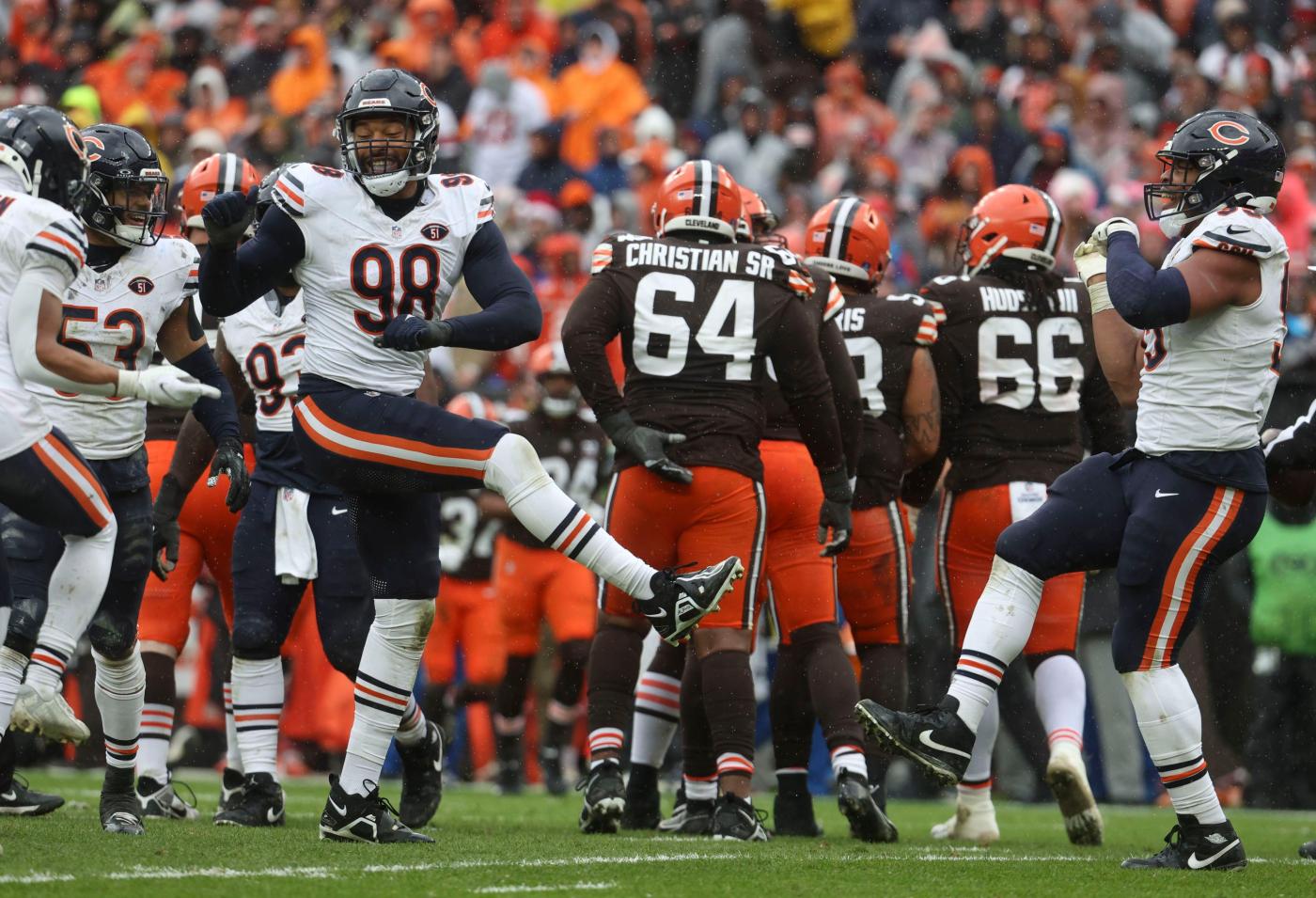
The defense has been stout against the run all season and has played with some teeth since the addition of edge rusher Montez Sweat, who had 2 1/2 sacks Sunday. The secondary has been taking the ball away. The high-priced linebackers have been making impact plays, such as T.J. Edwards leveling Cedric Tillman when Browns quarterback Joe Flacco committed the cardinal sin of being late across the middle and Tremaine Edmunds plucking the ball out of the air and racing 45 yards for a touchdown.
Yes, in a lot of ways the third-youngest roster in the NFL — according to snap-weighted age, per Bill Barnwell of ESPN — has been coming together. That’s significant to note because general manager Ryan Poles has been prioritizing youth with an eye toward the future.
Coming off three wins in their last four games — one an impressive thumping of the NFC North-leading Detroit Lions, the other two narrow victories over the Minnesota Vikings (12-10) and Panthers (16-13) — the Bears clung to hope they could win out and wiggle their way into a wild-card spot.
The Browns limped into Sunday’s game. Flacco is the fourth starting quarterback they have used this season, signed off his couch to help keep their season afloat. They’ve lost their top three offensive tackles for the season. Running back Nick Chubb has been on the shelf since the start of the season. They had two starting offensive linemen from Week 1 ready at kickoff, and that quickly became one when left guard Joel Bitonio went out early with a back injury. On defense, their top three safeties were out as well as a starting defensive tackle and third defensive end.
When Cairo Santos nailed a 41-yard field goal with 7:07 remaining in the third quarter, the Bears led 17-7 and it looked like the story would center around a robust defensive performance that prevented the Browns from running at all and closed windows on Flacco when he wasn’t flustered out of the pocket. The Bears looked like they could close out the Browns and turn their focus to home games against the Arizona Cardinals and Atlanta Falcons before a Week 18 showdown at Lambeau Field against the Green Bay Packers.
If they could only … finish.
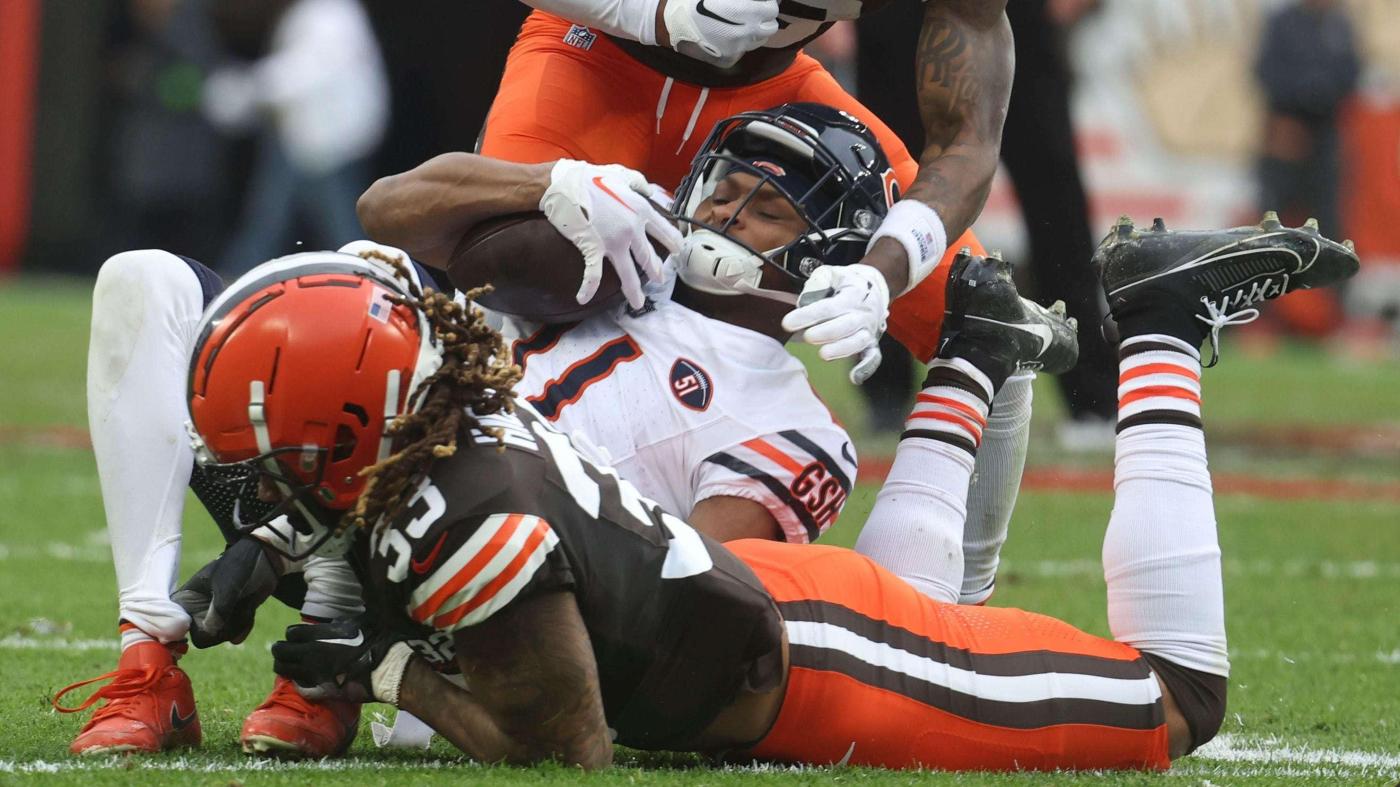
There are many reasons the Bears didn’t emerge with a victory and they’ll be analyzed all week. Tthe Browns tied the game on a 51-yard touchdown pass from Flacco to Amari Cooper with 3:08 remaining and then won on Dustin Hopkins’ 34-yard field goal with 32 seconds left. None of it was final until a Hail Mary by Justin Fields on the final play was in Darnell Mooney’s bread basket as he fell to the ground, only for the ball to pop into the air and be intercepted by safety D’Anthony Bell.
Just like that, the Browns (9-5) won for the fifth time this season with a score in the final two minutes, with locals comparing this team to Sam Rutigliano’s 1980 “Kardiac Kids,” a famed team in Cleveland history with a knack for pulling out games in odd fashion at the last moment.
“It’s the greatest team game there is, and what I love about it is it takes the offense, the defense and the special teams,” Browns coach Kevin Stefanski said. “In a moment like you’re describing, everybody has to come through, and that’s what we’ve done this season. The guys did a great job of understanding the situation, what we needed to do, but credit to the players for executing.”
The Bears are the antithesis of the “Kardiac Kids” for their way of bungling big leads late. It burned them in Week 4 against the Denver Broncos at Soldier Field. It was worse last month when they blew a late lead in Detroit. And it happened again in Cleveland.
“It’s just frustrating,” free safety Eddie Jackson said. “We’ve just got to finish. All around. On everybody. We’ve got to finish. We didn’t finish.”
Jackson sounded as if he were channeling his inner Eberflus. The message the coach has delivered to the media is the same one he hammers home with his players. Too often, they haven’t found a way to finish, and when you blow double-digit leads in the fourth quarter, it’s both sides of the ball, it’s across the roster and it’s coaching.
“The fourth quarter to me is all about finishing,” said Eberflus, who rambled his way through an opening statement in his postgame comments. “We’ve got to finish the right way.”
There are probably a dozen reasons the Bears didn’t finish. If Mooney catches the Hail Mary, it’s nearly as improbable as the 2001 win over the Browns at Soldier Field in which the Bears forced overtime with a Hail Mary pulled down by running back James Allen before winning on a Mike Brown interception return. If the Bears can run the ball and operate a four-minute offense, it never gets to that point.
If the defense, which allowed a high of 223 passing yards over the previous five games, doesn’t get torched for 212 yards by Flacco in the fourth quarter alone, it’s a win. If there’s a roughing-the-passer call on Za’Darius Smith on the final play of the first half — an incomplete Hail Mary by Fields — maybe the Bears get a field goal there and it’s a different game. As is usually the case when a team blows a 10-point lead in the closing minutes, it’s a total team effort.
I think the Bears are generally headed in the right direction, and that’s hard to write after such an ugly finish to what should have been a victory. If they find a way to seven or possibly even eight victories, that’s as good or better than a lot of people expected before the season. There are tough lessons in games like this, lessons that should have been learned against the Broncos and the first meeting against the Lions. As they tell you, it’s hard to win in the NFL and it’s also hard to stomach losses like this.
“Biggest takeaway so far this season is just that I am so proud of everybody in the locker room, proud of the coaches, the mentality that we have, the culture that we’ve set and the fight that we have as a total team,” Fields said. “Of course, there’s many games we want back, many plays we want back, but all in all, everyone is giving their best and their all. That is all you can ask for.
“I am just proud of everybody. Like I said, we have to be better in situations and this didn’t go our way today and we’ve got to bounce back next week.”
At 5-9, with playoff hopes minuscule, the Bears are running out of bounce-back opportunities. They will finish the season with a losing record, and since the franchise’s last playoff victory after the 2010 season, the Bears have had only two winning campaigns in 13 years. Finishing could be a project for the offseason ahead.
2. Justin Jones was floating in space on the back side of the play.
He was doing his job on third-and-15 with 56 seconds remaining and the game tied at 17. The Browns were on their 47-yard line, and if the Bears could force a punt, they had all three timeouts remaining to put together a field-goal drive.
Matt Eberflus dialed up pressure, rushing defensive linemen Montez Sweat, DeMarcus Walker and Gervon Dexter with middle linebacker Tremaine Edmunds in the pass rush along with strong safety Jaquan Brisker and nickel cornerback Kyler Gordon.
The goal was to force Joe Flacco to get the ball out immediately, and the Browns had six in to block with running back Jerome Ford and three in the pattern. It was Cover-0 with two robbers — one of them weak-side linebacker T.J. Edwards and the other Jones, the 309-pound defensive tackle.
The rush didn’t get there, and Flacco was able to back up and float the ball to the left side to tight end David Njoku with a lot of open field in front of him. Cornerback Tyrique Stevenson, who was in man coverage on Amari Cooper on that side, couldn’t make the tackle, and Njoku rumbled 34 yards to the Bears 19, putting the Browns in position for the winning field goal.
In a game in which so much went right for the Bears defense for 56 minutes, that was the defining moment.
“At that point in the game, I am just following the call,” Jones said.
“It ain’t on him, though,” Walker snapped from the next locker space.
That’s understood. Jones isn’t collecting paychecks to drop in coverage very often. Every scheme drops off linemen here and there in simulated pressures, and Eberflus got aggressive — really aggressive — in a moment that should be remembered by the crowd that regularly questions why the defense doesn’t pressure more and lean into more man coverage.
“Frustrating ain’t even a word for this,” Jones said. “I ain’t gonna lie. But, I mean, that’s what was called. That’s what we played. I don’t know what to tell you. I guess you hope the pressure gets there before (Njoku) runs the route he does. But, I mean, I am just doing what the call was. I don’t even know.”
Players throughout the locker room seemed peeved about the call in that situation, and I would imagine there are folks above Eberflus at Halas Hall who have wondered about it.
“Once I saw it,” Njoku told me, “I knew it was a mismatch. Me and Joe were on the same page. Joe threw a good ball and we executed.”
The Browns’ call was for Njoku to run a shallow, and the Bears figured Flacco would be targeting single coverage on the outside, a low-percentage throw to reach the line to gain.
“Normally when it’s zone, I am supposed to stop when I get past the hash,” Njoku said. “When I saw the tackle was out there covering me, me and Joe were on the same page. The chemistry was amazing. I ran an over. He threw the ball over my head and I executed.”
Said free safety Eddie Jackson: “It’s one of those pressures that if it don’t get home … it’s gonna hit big. And that’s what happened.
“I was backside. I just saw him lob the ball and Njoku catch it and I was just like — all the frustrations flying through your mind at that point.”
Does Jackson like an all-out pressure in a situation like that?
“Man,” he said after a sigh, “it’s Coach’s decision. As players we just go out there and execute. Whether we like it or not, you’ve got to go execute.”
I’m just spitballing here, but maybe Eberflus figured his tendencies were almost always some type of zone coverage in these situations. Perhaps he was seeking a tendency breaker against a quarterback who doesn’t move well.
“The thought process there is that it’s third-and-15 and you’re going to make them throw it and you’re going to tackle the catch,” Eberflus said. “Then they’re going to end up punting it, and they’re going to get maybe half the distance there, just to get the ball out of his hands fast.
“(Flacco) kind of retreated back a little bit. I have to look at the pressure and see where it was, but he ended up retreating and throwing it over the top. The tight end made a heck of a run and got it. That was the whole thought process.”
But Jones was one of the robbers. Less than ideal, right?
“Yeah, so it’s a sim pressure,” Eberflus continued. “He’s the one guy dropping back, but the thought is that the pressure is going to hit and the ball is going to be out a lot quicker than it was. Like I said, he retreated back a little bit, so that’s what I saw on the field.”
I don’t know that one call can doom a coach, but this one will sting for a while. I can’t remember the last time players in the locker room were stunned by a late-game decision. Sure, if the pressure had gotten home, it would have worked, but this one blew up on the Bears.
I imagine GM Ryan Poles could have some pointed questions for Eberflus about this call. I could envision President/CEO Kevin Warren having questions for Poles about the decision because the outcome was stunningly bad.
You can’t ignore the good Eberflus has done for the defense. The Bears became a legitimate defense at the midpoint of the season. They’re not all the way there yet but they’re dramatically improved over his first year and a half.
Yet the 38-year-old Flacco carved them up, rebounding from three interceptions — one a diving pick by Stevenson at the goal line, another that Jackson returned to the Browns 1-yard line and the pick-six by Edmunds — to complete 28 of 44 passes for 374 yards, the seventh-highest total of his long career.
The backbreaker was the floater to Njoku, who had a 31-yard reception at the beginning of the game-winning drive. I try to shy away from knee-jerk reactions, but there’s a chance Eberflus winds up really regretting the call in this situation.
Would it be enough on its own to cost a coach his job? No, not the way the Bears do business. Could it be a factor after a third game the team should have closed out in the fourth quarter? Possibly.
3. The disbelief and pain lingered on Darnell Mooney’s face longer than Justin Fields’ Hail Mary hung in the air on the final play.
It only seemed like that pass, a play that began at the Browns 45-yard line when the ball was snapped with three seconds remaining, hung in the air forever.
Fields floated left in the pocket, getting away from traffic and creating space to launch the ball from the Browns 47.
“Too good of a view,” Browns defensive end Myles Garrett said of his vantage point. “(Fields) kind of looked at me, just made sure I was far enough away and then tossed it up. I was like, please, Lord, don’t let us be one of these YouTube compilations.”
Tight end Cole Kmet was the big target among a flock of players in the end zone. When the ball arrived, Browns safety Ronnie Hickman leaped and batted the ball down with his right arm toward the front of the end zone. Mooney was falling as the ball headed right for his lap.
“I damn near (expletive) myself,” Browns tight end David Njoku said of his reaction as he watched the play from the sideline.
As Mooney hit the ground, cornerback Greg Newsome lunged forward to try to knock the ball loose, and just as Mooney appeared to have it, the ball squirted back into the air with D’Anthony Bell intercepting the pass to end the game.
“I tried to tip it and then hold on to it,” Mooney said. “It hit my chest (before I could pull it in). I was already falling, so it’s tough. It would have been crazy, but it’s tough. How many times do you see a Hail Mary working and actually fall to be able to make a catch?”
Mooney watched a replay on his phone in the locker room. Seeing it again probably didn’t make it any easier.
“It just ricocheted, and I happened to be the guy in the position right there to try to get the ball,” he said. “It’s a wild play. It could have been crazy. Shouldn’t have to come down to those things to just throw the ball up in the air and make some things work.”
“It just fell to him,” Newsome said. “Glad he didn’t catch it.”
It wasn’t the same as the play at the end of the 12-7 loss to the Washington Commanders last season at Soldier Field. The Bears had fourth-and-goal from the 4-yard line in the closing moments. Mooney went up over cornerback Benjamin St-Juste for the ball at the pylon but juggled it coming down, and before he could secure the catch he was just outside the end zone. Game over.
Hail Marys are, by definition, low-probability plays, and the degree of difficulty was raised with Mooney going to the ground. But the ball was right there for a miraculous finish, the kind Garrett said would last on the Internet for ages.
“You want to put some air on it to maybe get a tip,” Fields said. “Defensive backs are not the best at tracking the ball. The biggest thing is to give my guys a chance, and we almost came out with the catch and that’s all you can really do.”
Unfortunately, “almost” won’t live in Bears lore.
4. One play can turn the entire thing around, in the estimation of Browns wide receiver Amari Cooper.
A game can seem lost — and this one sure did for the Browns as the fourth quarter rolled on — but it only takes one play.
Everything was going the Bears’ way. They were harassing Joe Flacco. They had made some huge plays on the ball with Tremaine Edmunds scoring on an interception return and free safety Eddie Jackson setting up the only offensive score of the game for the Bears with an interception he returned to the 1-yard line.
“Just No. 2 (Cedric Tillman), I seen him bow out,” Jackson said, describing his first interception of the season. “Usually when somebody bows out, it’s a seam, so he was coming back in. I just stayed in my leverage. Tye (Stevenson) got a great reroute and the ball was there. Thought I was going to get in the end zone. Nobody blocked the big guy (guard Michael Dunn). I saw him at the last minute. I was going to cut outside, then I saw the hole open up, thought I was going to get through there and the big man came.”
That was in the second quarter. The Bears got another huge play from Stevenson in the third quarter after punt returner Trent Taylor muffed a catch, setting the Browns up in the red zone at the 20-yard line. Tight end David Njoku was open just short of the goal line when Stevenson came diving in front of him to intercept Flacco.
“We were in zone coverage,” Stevenson said. “I have to be able to split two and three. As I got my eyes to two, I saw (Njoku) bending inside. I’m like, ‘That’s where the ball is going if I’m a quarterback.’ I just trusted myself and trusted my instincts and went. Soon as I broke on it, (Flacco) literally let the ball go. As soon as I thought in my head to go, I went. I really wasn’t going for the interception. Just going for the pat down. Just how I broke on it allowed me to have a lot of momentum to be able to dive in front of it.
“It was a route to basically put the corner in a bind. I just chose correctly on that play.”
It turned into the first diving interception of Stevenson’s career, preventing the Browns from getting at least three points out of the Taylor muff.
That’s how things were going for Flacco. Even when there appeared to be a window, the Bears were slamming it shut, making plays, creating energy and feeding off one another.
“That’s exactly where the pain was,” Jackson said. “We had our destiny in our hands. Like, we had it. And we had it. We knew that it was going to be a tough game. Everybody knew, especially on defense, it was going to be a defensive game on both sides. They’ve got a good defense. We knew they were going to give our offense work. We knew it. And we have a good defense. So we knew that it was gonna be a defensive game. We knew that.
“It’s not like we came in, like, ‘Man, offense is going to put up points.’ We weren’t looking for offense to put up points. We were just looking to get turnovers, stop and score on defense, which we did. Just at the end, we couldn’t finish.”
Things turned when Flacco made a huge play on second-and-4 from the Browns 49-yard line. Cooper, the ninth-year pro, lined up to the left and ran a crossing route. Edmunds was in coverage and when Flacco cut the ball loose, Cooper was covered. It was the kind of anticipation throw into a tight window that veteran quarterbacks can make.
“I saw a couple guys in that area where I was supposed to catch the ball,” Cooper told me. “I wasn’t open when he threw it. It was incredible. It was a great throw and I couldn’t say that enough. It was a perfect throw. All I had to do was catch it and stay in bounds. That was all Joe.”
Cooper managed to scoot along the Bears’ sideline to the end zone, tying the game at 17 with 3:08 remaining.
Before that, it looked bleak for the Browns, though, right?
“I’m not going to lie to you, I was pretty concerned,” Cooper said. “At the same time, being an experienced player, I understand that it only takes one play sometimes to turn that tide, turn that momentum to your favor. You know, that was pretty much what happened out there.”
That propelled the Browns to … finishing.
5. This game would look significantly different for Justin Fields if a few plays went a little differently.
It’s easy to cherry-pick a couple of snaps every week for both quarterbacks but the Hail Mary to Darnell Mooney and a launched pass for tight end Robert Tonyan in the first quarter could have led to a different outcome.
The Mooney play has been described in detail. He feels bad. He knows the game was right there if he could clutch the ball. Tonyan was similarly dejected. The Bears had second-and-2 from the Browns’ 27-yard line on their third possession. Fields rolled right and Tonyan was streaking downfield with space between him and trailing linebacker Sione Takitaki. I don’t know if it goes for a touchdown if Tonyan hauls it in, but it easily could have and in a worst-case scenario, the Bears would have flipped the field in a huge way.
Tonyan just couldn’t complete the play.
“I can’t go anywhere without the ball,” he said. “That’s what happens. It was a great ball. That was a perfect throw, especially rolling out, off time and stuff like that, it was a great pass. It kind of turned into a scramble drill and he just took a shot. Made a great throw. I just have to execute.”
They are missed opportunities the Bears will wish had been made on a day Fields completed 19 of 40 passes for 166 yards with a 5-yard touchdown pass to tight end Cole Kmet and two interceptions — both on Hail Marys.
The Kmet touchdown pass was terrific after a series of calamities by both teams. The Bears had first-and-goal from the 1-yard line after the Eddie Jackson interception in the second quarter when all football hell broke loose.
First-and-goal from the 1 — D’Onta Foreman stuffed for a 3-yard loss
Second-and-goal from the 4 — Browns called for too many men on the field
Second-and-goal from the 2 — Pass interference on Browns cornerback Martin Emerson
First-and-goal from the 1 — Browns called for too many men on the field
First-and-goal from the 1 — Foreman run for no gain
Second-and-goal from the 1 — False start Kmet
Second-and-goal from the 5 — Incomplete pass for Mooney
Third-and-goal from the 5 — Fields’ touchdown pass to Kmet
Fields was able to avoid defensive end Myles Garrett on the play, create time and space to roll left and hit a streaking Kmet on a well-placed throw. It encapsulated what can make Fields’ rare talents special to extend and finish plays.
Another critical play came early in the fourth quarter when the Bears elected to go for it on fourth-and-1 at the Browns’ 33-yard line. Fields tried keeping it running around the right side and was tripped up by cornerback Cameron Mitchell for no gain. Mitchell was credited with a sack in press box statistics. I thought it was a run all the way but whatever the case, Fields couldn’t elude Mitchell and the Browns took over, turning their next possession into a field goal.
When reviewing a game and talking about missed opportunities, it cuts both ways. Emerson and Greg Newsome both dropped interceptions that were in their hands in the first half, plays that could have shifted the course of the game.
Jacksonville quarterback Trevor Lawrence threw for 257 yards and three touchdowns (also three interceptions) as the Jaguars put up 27 points against the Browns in Week 14. Matthew Stafford passed for 279 yards and three touchdowns in a 36-19 victory over the Browns in Week 13.
The Bears are not getting consistent high-caliber production from their passing offense and blame is to be spread around to Fields, the coaching staff and the rest of the roster. In a league where you see a backup like Jake Browning step in for the Cincinnati Bengals and light it up — he’s the first quarterback since at least 1950 to pass for more than 1,000 yards and complete more than 75% of his passes in his first four starts — it’s fair to want more from a quarterback being considered as a potential franchise piece for the future near the end of Year 3.
Yes, there are a ton of mitigating factors but the reality is nearly every quarterback selected near the top of Round 1 enters a situation that is far from hunky dory. C.J. Stroud was drafted onto a mess of a roster in Houston and the Texans look like they have a star to build around, a player who is out with a concussion right now but has produced huge numbers.
With three games remaining, it’s easy to get caught wondering where Fields (and the team) would be if a few plays went differently. There are always plays that could have swung against him too and the numbers as they are don’t paint a great picture.
6. Seemed like a pretty easy and correct decision for the Bears to go for a Hail Mary at the end of the first half.
With four seconds remaining, they were on the Browns’ 37-yard line and out of timeouts.
They could have asked Cairo Santos to attempt a 55-yard field goal but on the rain-soaked grass and after pregame warmups, the line wasn’t nearly that long. One kick, from 52 yards that Santos attempted in pregame warmups, fell well short to the same West end zone.
“I just felt like depending on the gust, maybe I could have made a 52 that way,” Santos said. “But it came up short that one time so we topped it at that. It was nasty. At the end of the half, could have taken a shot too (from 55) but I still think that it would have been short with what I saw in pregame.”
Kickoffs were traveling shorter in that direction too, and so it seemed like a clear-cut decision even as low-percentage as Hail Marys are.
What’s got to be unnerving for the Bears is Santos probably should have been put in position to try a 40-yard field goal. After Fields cut loose his Hail Mary attempt, Za’Darius Smith decked him. It looked like an easy roughing the passer call but referee Brad Allen, who was right there, didn’t act.
The Bears were hot and a penalty would have provided them with an untimed down for a field goal that would have been in range. Fields, after he got up, sought clarification from Allen.
“I really was just talking to him and asked him for an explanation,” Fields said. “He said something about a hit to the head and something about resetting. It was kind of confusing to me but the play is over and you can’t do anything about it.”
This will only fuel chatter that there are calls Fields and the Bears should be getting. This one was plain. I can’t imagine why Allen didn’t throw a flag. I do understand why the Bears opted against a 55-yard try for Santos.
7. Three teams are now in the market for a new head coach.
More will follow. The Los Angeles Chargers fired coach Brandon Staley (and GM Tom Telesco) after a disastrous loss at the Las Vegas Raiders on Thursday. The Raiders already cleaned house with their GM and coach earlier this season, and the Carolina Panthers fired coach Frank Reich previously. It will be interesting to see how many teams enter the hiring cycle. The Washington Commanders, under new owner Josh Harris, and New England Patriots also appear headed for changes. In aA lot of years, you find a surprise move or two.
Here are the new coach hires since 2020, with an asterisk noting those who have been replaced.
2020
*Matt Rhule — Carolina Panthers
Mike McCarthy — Dallas Cowboys
Kevin Stefanski — Cleveland Browns
*Joe Judge — New York Giants
Ron Rivera — Washington Football Team
2021
Arthur Smith — Atlanta Falcons
Dan Campbell — Detroit Lions
*David Culley — Houston Texans
*Urban Meyer — Jacksonville Jaguars
*Brandon Staley — Los Angeles Chargers
Robert Saleh — New York Jets
Nick Sirianni — Philadelphia Eagles
2022
Dennis Allen — New Orleans Saints
Todd Bowles — Tampa Bay Buccaneers
Brian Daboll — New York Giants
Matt Eberflus — Chicago Bears
*Nathaniel Hackett — Denver Broncos
Mike McDaniel — Miami Dolphins
*Josh McDaniels — Las Vegas Raiders
Kevin O’Connell — Minnesota Vikings
Doug Pederson — Jacksonville Jaguars
*Lovie Smith — Houston Texans
2023
Jonathan Gannon — Arizona Cardinals
Sean Payton — Denver Broncos
*Frank Reich — Carolina Panthers
DeMeco Ryans — Houston Texans
Shane Steichen — Indianapolis Colts
8. The perceived strength of the quarterback class is what could make top picks more valuable.
That could put teams that are set at the position or don’t see a fit for them in a spot to consider bold trades. If you look at the 13 teams currently below .500 and evaluate quarterback need, you can make a case that most of them have a need.
According to tankathon.com, the Bears are sitting at No. 1 (from Carolina) and No. 5 right now in the draft order.
So, the better the evaluations for Jayden Daniels, Drake Maye and Caleb Williams (listed alphabetically) and potentially J.J. McCarthy if he leaves Michigan early, the more possibilities there will be for movement in the top half of the round.
1. Bears (from Panthers, 2-12). It’s going to be a hotly debated topic whether or not the Bears seek a replacement for Justin Fields.
2. New England Patriots, 3-11. Whether it’s Bill Belichick or a new coach, it’s almost a guarantee they will be rebooting the offense with a new quarterback.
3. Arizona Cardinals, 3-11. My feeling is the Cardinals would be more inclined to consider a quarterback if they wouldn’t get hit with $46 million in dead cap space for trading Kyler Murray in 2024. That doesn’t strike me as how Arizona typically conducts business.
4. Washington Commanders, 4-10. Seems pretty apparent new owner Josh Harris will make some significant changes to football operations. The need here is real unless the next GM and coach want to address other areas while giving Sam Howell an extended leash. You can certainly make a case for a quarterback.
5. Bears, 5-9. See No. 1.
6. New York Jets, 5-9. If they’re going to make a run at things with 40-year-old Aaron Rodgers, they need the best, most impactful player they can get. That means hope there is an early run on quarterbacks and stay put.
7. New York Giants, 5-9. Daniel Jones isn’t the answer and it feels like this Tommy DeVito story will run its course soon. This is a QB-needy club.
8. Los Angeles Chargers, 5-9. Owner Dean Spanos is already seeking a replacement for ousted GM Tom Telesco and coach Brandon Staley. The Chargers have a ton of needs but one is not quarterback with Justin Herbert in place. This is the kind of team that could certainly trade down with a QB-needy club.
9. Tennessee Titans, 5-9. Rookie Will Levis has shown a little bit and the Titans will probably want to see how he fares after a full offseason.
10. Atlanta Falcons, 6-8. Eventually coach Arthur Smith is going to want a bright prospect at quarterback. Desmond Ridder is not that.
11. Green Bay Packers, 6-8. Jordan Love has had some strong moments this season. There have been bumps in the road, too, with a really inexperienced cast of players around him. They’re not in the quarterback market.
12. Las Vegas Raiders, 6-8. The Raiders can probably talk themselves into taking a shot with Aidan O’Connell next season. But that will be a decision made after the team decides on GM and coach hires.
13. Seattle Seahawks, 6-7. Geno Smith is a placeholder until the Seahawks look for their next Russell Wilson. They could be lurking for a quarterback.
9. The list of opponents for the 2024 season is beginning to come into focus with only three weeks remaining in the season.
Three games on the 2024 schedule will be determined by the 2023 standings with the Bears set to host the corresponding finisher in the NFC South and AFC East and play a road game at the corresponding finisher in the NFC East.
First, here is what we do know beyond the traditional home/road games against NFC North rivals. The Bears will play home games against the Jacksonville Jaguars, Los Angeles Rams, Seattle Seahawks and Tennessee Titans. They will have road games at the Arizona Cardinals, Houston Texans, Indianapolis Colts and San Francisco 49ers.
As far as the TBD opponents, the Bears are currently in fourth place in the NFC North, one game behind the Packers.
If the Bears finish in fourth place, it’s guaranteed they will host the Panthers, who are locked into a last-place finish in the NFC South. They would also likely host the Patriots, who are in fourth place in the AFC East, two games behind the Jets. The Commanders are a game back of the Giants in the NFC East, so it could mean a return trip to Washington in 2024, where the Bears played earlier this season.
If the Bears can make a move on Green Bay, things will shift. Third-place in the NFC South could be Atlanta, Tampa Bay or New Orleans. Something to keep in mind down the stretch besides just draft positioning.
10. Some of the wild plays and the meltdown overshadowed a huge game by Montez Sweat.
Sweat had 2 1/2 sacks, seven tackles, three QB hits and a forced fumble. He now has six sacks and 13 QB hits in six games with the Bears. The defense has 15 sacks in the last five games, much of the production fueled by the presence of Sweat.
10a. Left guard Teven Jenkins suffered a concussion in the second quarter. He left the game and did not return. That’s worth monitoring this week. He’s been playing at a high level since getting on the field after an injured reserve stint to start the season with a calf injury.
10b. Trenton Gill had 10 punts and eight came on three-and-outs by the offense.
10c. Weakside linebacker T.J. Edwards has filled a lot of statistical categories in games this season. He had six tackles, a half-sack, one QB hit and two pass breakups. That’s been par for the course this season. He’s playing at a high level.
10d. The Bears opened as a 4 1/2-point favorite over the Arizona Cardinals at Westgate SuperBook in Las Vegas for next Sunday’s game at Soldier Field.
()