Pew survey: YouTube tops teens’ social-media diet, with roughly a sixth using it almost constantly

posted in: News | 0

SAN FRANCISCO (AP) — Teen usage of social media hasn’t dropped much, despite rising concerns about its effects on the mental health of adolescents, a survey from the Pew Research Institute found.

But the data also found that roughly one in six teens describe their use of two platforms — YouTube and TikTok — as “almost constant.”

Seventy-one percent of teens said they visit YouTube at least daily; 16% described their usage as “almost constant” according to the survey. A slightly larger group — 17% — said they used TikTok almost constantly. Those figures for Snapchat and Instagram came in at 14% and 8% respectively.

YouTube remains by far the most popular social platform among teens, with 93% responding that they use the service. That number was down two percentage points from 2022. Runners-up included TikTok, Snapchat and Instagram, although all three trailed YouTube in this measure by 30 percentage points or more. Three of those four platforms showed slight drops in usage over the past year, according to the survey. The exception, Snapchat, rose a single percentage point.

Facebook, whose overall usage by teens has dropped to 33% in 2023 from 71% in 2014-15, gets about the respect from teens you’d expect. Only 19% of teens reported checking Facebook daily or more frequently. Just 3% describe their usage as almost constant.

Social media is increasingly taking fire over the algorithmic techniques that platforms use to drawn in and retain younger users. In October, a coalition of 33 states, including New York and California, sued Meta Platforms for contributing to the youth mental health crisis, alleging that the company knowingly and deliberately designed features on Instagram and Facebook that addict children to its platforms. Meta has denied the charges.

The Pew survey, which was published Monday, was conducted from Sept. 26 to Oct. 23 with 1,453 teens aged 13 to 17.

When Anthony Edwards returns, who’s in — and who’s out — of Timberwolves’ rotation?

posted in: News | 0

Injured Anthony Edwards could return to the Timberwolves’ lineup as soon as Thursday in Dallas. That’s good news for a team in the midst of a difficult portion of its schedule and that showed in Monday’s loss in New Orleans that if it is to compete with some of the NBA’s most-talented teams — particularly on the road — it likely will need its best player to do so.

Edwards’ return would fill Minnesota’s boat re: roster availability after Jordan McLaughlin and Jaden McDaniels also returned to action within the past few days.

So Timberwolves coach Chris Finch will have the option to reshuffle the deck and dial up the rotation however he sees fit.

As a reminder, when the Wolves were healthy at the start of the season, the core rotational pieces were Edwards, Karl-Anthony Towns, Rudy Gobert, Mike Conley, McDaniels, Nickeil Alexander-Walker, Naz Reid, Kyle Anderson and Shake Milton, while Jordan McLaughlin was used in short stints as a spark when needed.

But things have changed since then. Minnesota’s bench has been uninspiring at times, and the injuries to his fellow wings have given Troy Brown Jr. opportunities for playing time, which he has seized.

So, when everyone is available upon Edwards’ reinsertion into the starting lineup, Finch will have 11 players who have seen playing time this season at his disposal. Realistically, only nine of those guys can play legitimate minutes.

There are eight locks for rotational spots, with Towns, Edwards, Gobert, Conley and McDaniels set to start — McDaniels came off the bench Monday in his return to action, but that’s often a method used to reintegrate players who are on a minutes restriction — and Alexander-Walker, Reid and Anderson coming off the bench.

Assuming Finch doesn’t extend his rotation, that leaves three guys vying for one spot. It’s possible that ninth spot will go to any one of the three depending on situations and matchups. For instance, if the second unit’s offense stalls out in the first half, McLaughlin, a floor general, could be asked to attempt to jumpstart the engine in the second half of the third quarter.

But McLaughlin, who has played well this season after struggling to return from a calf injury last spring, lacks the shooting and size Finch seems to want to round out the rotation, even though the second-unit’s offense appears to be at its best when the point guard is in the game.

The Wolves like to lean into their identity as a “big” team, and no one would use that word to describe the reserve point guard.

That McLaughlin only played sparingly Monday in New Orleans seemed to provide further evidence that he’s not in Finch’s immediate rotational plans.

Milton, on the other hand, has size. It seems Minnesota signed Milton this offseason with the vision that he would run the second unit. But that hasn’t gone according to plan, as Milton has struggled to find any sort of offensive consistency in half-court sets. He’s a fast-break player on a team that, frankly, thrives with slow pace.

The Timberwolves have been patient amid Milton’s slow start, but it could be time for tough decisions to be made.

Then there’s Brown Jr., who seemingly earned the trust of the coaching staff via his strong play. He has started recent games in which Edwards and McDaniels were both sidelined, and has played 25-plus minutes in each of the Wolves’ past five games. Brown checks boxes as a competent defender who can also hit enough shots to not hinder the offense.

It’s difficult to imagine Brown Jr. going from such a big role to being entirely out of the rotation when Edwards returns. Assuming Brown Jr. stills sees minutes, Alexander-Walker, Anderson and even Edwards will share point guard duties when Conley isn’t in the game as Minnesota continues to shift further and further toward “positionless basketball” with its reserve unit.

“I’ve always been pretty comfortable with it. A lot of teams I’ve been involved in going way back have had it,” Finch said last week. “Playing with pace, like giving freedom for different guys to bring the ball (up court) and then it’s literally about, you play out of these actions and maybe another point guard or a guard is bringing the ball that better suited for these actions. It’s creating a bit of a menu for that. It gives you some variety too. It’s not like you come down, do the same thing all the time. For me, it’s been comfortable, but your team still has to get used to playing that way.”

Related Articles

Minnesota Timberwolves |


Timberwolves’ six-game winning streak snapped in New Orleans

Minnesota Timberwolves |


Jace Frederick: For the Timberwolves, the next month is one massive test

Minnesota Timberwolves |


Wolves rout Memphis, improve to NBA-best 17-4

Minnesota Timberwolves |


Is this the best Rudy Gobert has ever played? No, Timberwolves center is just back to his dominant self

Minnesota Timberwolves |


Jordan McLaughlin nearing his return to Timberwolves’ lineup, and confident he can hit the ground running

John Shipley: Wild coaching change has worked, but it’s still up to the players

posted in: News | 0

Back on Nov. 8, Bill Guerin had seen enough from Calen Addison, a young defenseman with a mostly offensive upside that the Wild GM had dragged his feet on, finally signing him to a one-year deal days before training camp started.

The Wild had played 12 games, and Guerin used the only real tool a salary-cap challenged team has at its disposal to replace him, trading Addison to San Jose for a low-end prospect and draft pick, then acquiring Zach Bogosian from Tampa Bay for a seventh-round draft pick.

The takeaway?

“I don’t need 70 games to figure out what we need,” Guerin said at the time.

So, when the Wild were staggering to the quarter pole — losers of seven straight, and 11 of 13 overall — Guerin made another, bigger move to improve his team, firing head coach Dean Evason and replacing him with John Hynes. And while the Wild remain buried in the Western Conference standings, it’s clear that Guerin’s move has worked.

Since Hynes became the coach Nov. 28, the Wild are 5-2-0 and, frankly, haven’t looked bad in any of those seven games. Even in a 2-0 loss at Vancouver last Thursday, they held the NHL’s best-scoring team to a pair of goals.

As the Wild return to practice Wednesday to prepare for Thursday’s 7 p.m. puck drop against the Calgary Flames at Xcel Energy Center, there is ample evidence to suggest that, quite simply, the Wild are a better team than they were during a 5-10-4 start.

It’s also clear that whether that lasts, and the Wild somehow dig out of the hole they have dug for themselves, it will be on the players. Evason’s dismissal was a cold glass of water to the face for players. There are plenty of stats to explain why the WIld are winning, but no one who has watched this team since its season opener on Oct. 12 needs numbers to explain how much more engaged the players have been since the change.

The eye test will do, and as the players have acknowledged, that’s on them.

They might have been tired of listening to Evason, maybe bored with playing the same system, or discouraged because they had won two straight games only once. But it was clear to anyone watching, the effort was rarely there. And if you want numbers, try these. When Evason was fired, the Wild had surrendered a league-high 27 first-period goals — outscored 27-15 — and had the NHL’s worst penalty kill (66.7 percent).

Hockey is a game of small competitions, from faceoffs to board battles, net-front presence and races for loose pucks. The Wild weren’t winning enough of them, because the effort wasn’t there — not consistently from every player.

After that loss in Detroit, an exasperated Evason told reporters, “Same mistakes and same guys not pulling their weight.” He was correct, but after defending his players for 17 games, it was as candid — or maybe just curt — as he had been about the team’s play.

Guerin has said the listlessness of the Detroit game wasn’t necessarily the catalyst for him to change coaches, but Evason’s demeanor might have been. Whatever was happening in the dressing room, Evason wasn’t able to solve it, perhaps because of his own ubiquity.

Too many players were done listening and, as a result, done playing. Guerin, unwilling to give up on a season fast slipping into the point of no return, gave the players a shock to the system. And it has worked. Hynes has made a series of welcome tweaks to get the team playing faster, and the players are working hard.

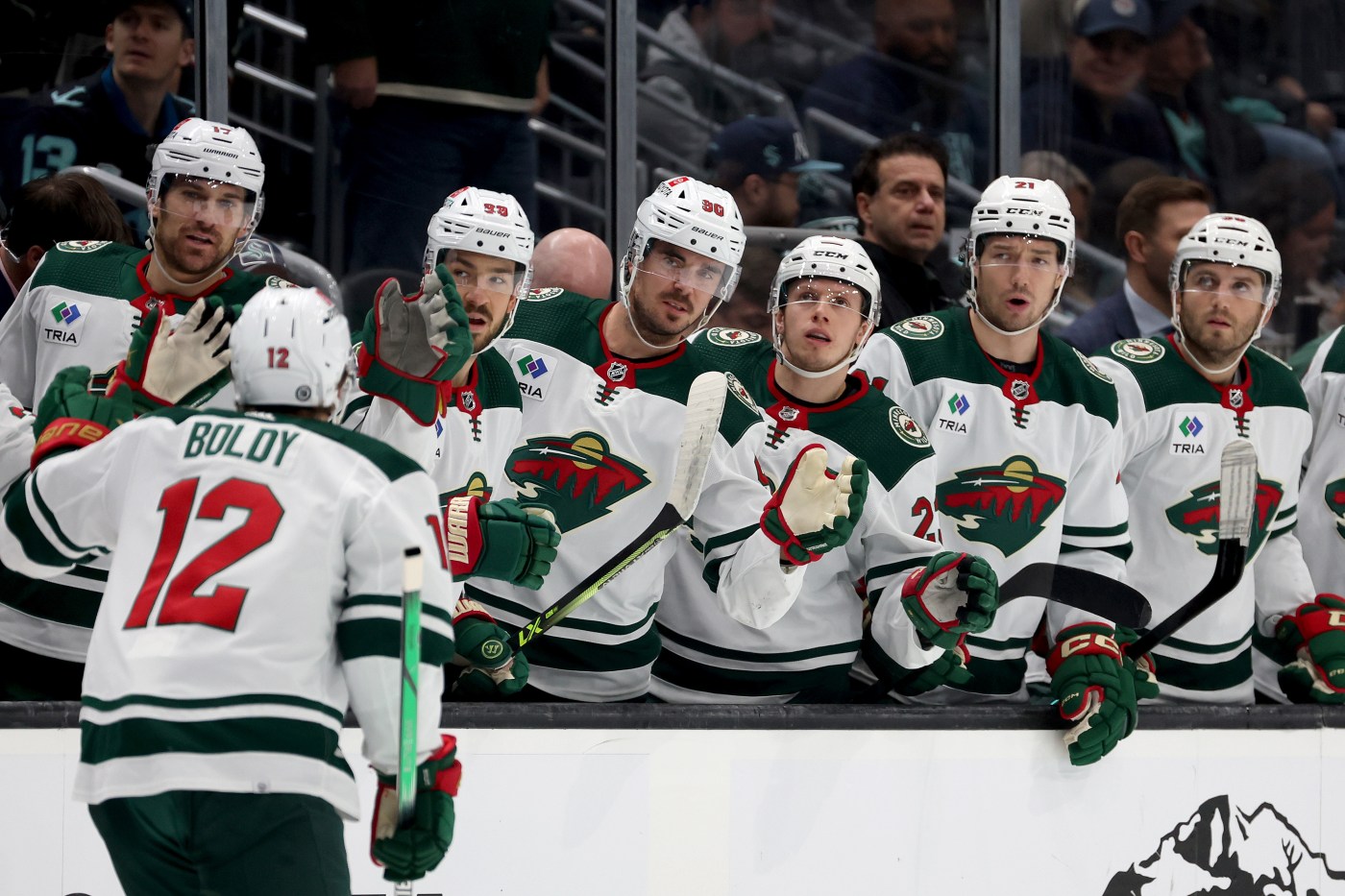
Since the change, the Wild lead the NHL in goals-against (1.57), and goaltender Filip Gustavsson is 4-1-0 with a 1.21 GAA and .951 save percentage. Forward Matt Boldy, who hadn’t scored a goal since Oct. 14 before the change, has six goals and eight points.

The team’s top offensive players, in fact, are all engaged and scoring points; since Hynes took over, Minnesota is outscoring opponents 24-11. The defense — notably a penalty kill that is 20 for 23 since the coaching change — has rarely been pinned in its end, getting pucks out fast and joining a rush that is taxing opposing defenses. Players are more decisive, their passes smarter and more accurate.

It’s a combination of coaching and effort, but in that equation, the latter is most important — by a long shot. No matter how many smart system changes Hynes employs, the players will have to work hard to turn them into wins.

A Magnificent Seven

Since John Hynes became head coach on Nov. 28, the Wild are 5-2-0, and their top players are producing:
G    G-A-P      P/M     SOG
Matt Boldy            7     6-2–8       +6       17
Mats Zuccarello   7     1-6–7        +3       15
Kirill Kaprizov       7     2-4–6       +6        16
Marco Rossi        7      3-2–5  +3    14
J. Erikkson Ek     7      4-0–4       +6        28
Ryan Hartman     5      0-2–2       +1        6

Related Articles

Minnesota Wild |


Matt Boldy stays hot, Wild end two-game skid with 3-0 victory at Seattle

Minnesota Wild |


Wild’s Jonas Brodin week to week after reckless hit by Evander Kane

Minnesota Wild |


Wild lose second straight game, and maybe a top defenseman

Minnesota Wild |


Nine years into pro career, Wild’s Dakota Mermis seeing his best results

Minnesota Wild |


Canucks end Wild winning streak with 2-0 victory

Vikings name Nick Mullens starting quarterback moving forward

posted in: News | 0

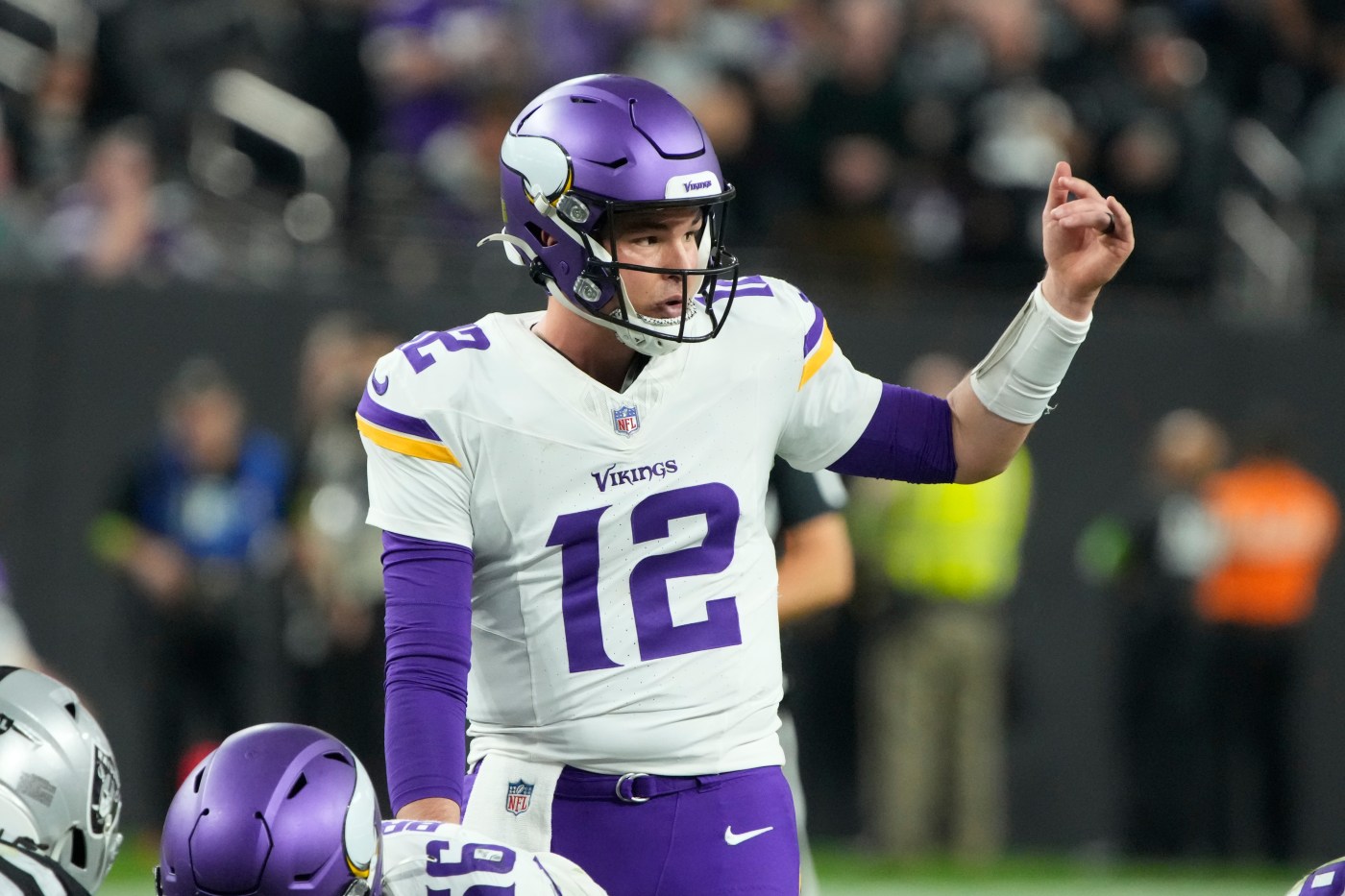
Nick Mullens will be the starting quarterback for the Vikings moving forward.

The official announcement came from head coach Kevin O’Connell on Tuesday before the Vikings held a walkthrough practice at TCO Performance Center. The decision makes sense considering Mullens replaced Josh Dobbs under center the past Sunday to lead the Vikings to a 3-0 road victory over the Las Vegas Raiders.

Though the offense struggled for most of the game, Mullens completed 9 of 13 passes for 83 yards, leading the Vikings down the field for their only points of the game.  Meanwhile, Dobbs was very inefficient, finishing 10 of 23 passing for 63 yards.

It’s still unclear if Dobbs or Jaren Hall will be the backup quarterback.

Related Articles

Minnesota Vikings |


Dane Mizutani: Josh Metellus is the queen on the chessboard for Vikings’ defense

Minnesota Vikings |


Vikings star receiver Justin Jefferson has ‘good chance’ to play Saturday in Cincinnati

Minnesota Vikings |


Vikings rookie linebacker Ivan Pace Jr. played the game of his life, then celebrated with a backflip

Minnesota Vikings |


Nick Mullens replaces Josh Dobbs at quarterback, leads Vikings to 3-0 win over Raiders

Minnesota Vikings |


Vikings receiver Justin Jefferson leaves game against Raiders, taken to local hospital out of precaution