Billionaire-backed plan for new California city gets its debut

posted in: News | 0

After enduring months of criticism, a company backed by billionaire tech moguls has pulled back the shroud of secrecy on their proposal to build a new California city — outlining a plan to transform farmland northeast of San Francisco into a pedestrian-friendly community that could grow to 400,000 in the coming decades.

California Forever, which quietly bought 60,000 rural acres in Solano County, says now it hopes to build on about a third of that land — with a mix of apartments and townhouses that would stand apart from traditional suburban developments.

“It’s medium density,” said Gabriel Metcalf, the group’s head of planning. “It’s not traditional suburbia, it’s not Manhattan, it’s in the middle.”

First, however, they need to get through the voters — and that may not be easy.

The project, which would be located on what is now largely windswept farmland just west of the small city of Rio Vista, violates the county’s decades-old Orderly Growth Initiative and General Plan and would require voter approval to go forward.

California Forever — which has not yet released a proposed name for its new city — is preparing a campaign for a November ballot initiative to secure that approval. At a series of town halls in recent weeks, the public reaction has been overwhelmingly negative, with many people insisting that new development stay within existing cities as the orderly growth initiative requires.

Documents shown by the company to POLITICO ahead of the launch aim to address some of the criticism levels at the town halls, with California Forever pledging to set aside thousands of acres around nearby Travis Air Force Base, the largest employer in the county, to ensure their project doesn’t interfere with operations there or raise concerns for the military.

The company also plans to offer what it says is a legally binding agreement that the project will create at least 15,000 jobs that pay at least 125 percent of the county average weekly wage by the time the new city reaches its first 50,000 residents.

California Forever also says it will be able to buy sufficient water for the project and pay its required share to widen the state highways that provide the only access to the area.

The city itself will feature dense, “walkable” streets. Homes will either be apartments or townhomes, most of which will be attached. There will be no large-lot single family homes.

Organizers estimate they’ll need to submit about 14,000 valid signatures by late April in order to put the measure on Solano County ballots in November.

They haven’t disclosed their campaign budget but it could be substantial. California Forever CEO Jan Sramek is a former Goldman Sachs trader who has created online social media and education companies. Project backers include uber-wealthy Silicon Valley investors, including Michael Moritz, chair of Sequoia Capital; Reid Hoffman, co-founder of LinkedIn; Laurene Powell Jobs, founder of the Emerson Collective and widow of the late Apple CEO Steve Jobs; Stripe co-founders Patrick and John Collison; and Marc Andreessen, an investor and co-founder of Netscape.

If voters approve the measure in November, organizers estimate they could start building basic infrastructure — like roads, sewers and gutters — by 2026.

Why Hochul’s budget won’t be an easy one

posted in: Politics | 0

ALBANY, N.Y. — The migrant crisis. Persistent voter concerns over public safety. Bolstering Mayor Eric Adams. Building more homes.

The $233 billion budget proposed by Gov. Kathy Hochul on Tuesday seeks to shore up the political fissures confronting her administration.

It also rewards areas of New York that were vital for her when she won a full term in 2022 and boosts the needs of Adams — who she has worked well with publicly — for migrant-related support and his desire to retain control of the city’s public school system.

“It seems like Hochul at this point in the budget negotiations is speaking to her base and has put in a lot of things that are important for Democratic base voters, particularly those in New York City,” Austin Shafran, a Democratic consultant, said.

But the budget negotiations will include plenty of friction for the governor and her fellow Democrats over the next three months.

Ahead of the April 1 deadline for an on-time deal, she faces calls from progressive lawmakers and advocates to raise taxes on rich New Yorkers — which she said she won’t do.

Suburbanites are fretting over her plan to reconfigure how school districts receive more than $35 billion in aid, a move that could create winners and losers.

Top Democratic lawmakers, meanwhile, are skeptical of her proposal to spend millions of dollars and boost penalties to combat shoplifting after the state has tried to limit the impact of low-level convictions.

Even some Republicans were more likely to compliment the broad strokes of Hochul’s budget plan than many Democrats.

“She’s talking about a lot of the issues Republicans are talking about: Talking about outmigration, talking about crime and talking about the cost of living,” Assembly Minority Leader Will Barclay said.

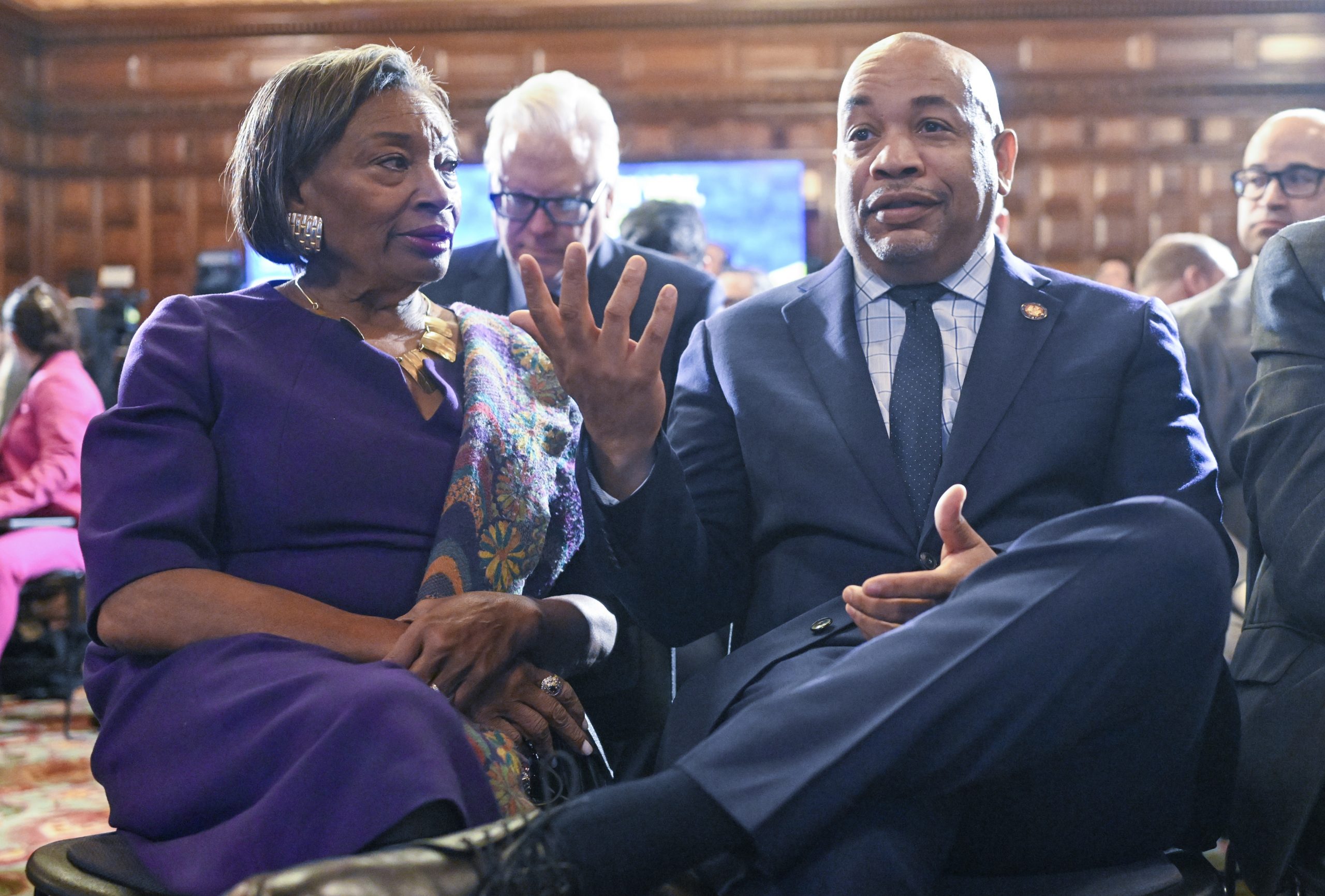
Negotiations at the Capitol often take place behind closed doors, with major items hashed out by a trio of people: The governor, the Senate majority leader and the Assembly speaker.

Often a governor’s budget proposal is a baseline, with lawmakers successfully winning some concessions for more aid to schools or spending for hospitals.

The budget talks are also playing out against the backdrop of an election year: All 213 seats in the Legislature are up for election this year; Hochul is not seeking another term until 2026.

That could give the governor more leverage. It could also set up political fights with her own party, which has supermajorities in both the state Senate and Assembly and want to keep them after November.

Hochul is already drawing what amounts to a red line with her fellow Democrats: No new tax increases for rich people.

“I will say ‘no’ on an income tax increase,” she told reporters.

Opposition to raising taxes on the richest New Yorkers puts her at odds with left-leaning Democrats and advocates.

Jasmine Gripper, the co-executive director of the progressive Working Families Party, said in an interview that the influential third party plans to make the tax-hike push a key priority this year.

Calls for increasing taxes on rich New Yorkers — typically people who earn more than $1 million a year — have long resonated with left-leaning lawmakers, but faced resistance from governors.

But the push is not without success: Three years ago, lawmakers and then-Gov. Andrew Cuomo agreed to increased tax rates on people who earn more than $1 million, generating billions of dollars that were ultimately funneled to schools.

“There is plenty to do, and there is plenty of money in New York state if we want to find it,” Sen. Jessica Ramos, a potential New York City mayoral candidate, told reporters after Hochul’s budget speech.

Still, New York has been flush with cash, a reflection in part of higher tax rates as well as federal pandemic-era aid that has since ended.

That has enabled the state to add billions of dollars to a “rainy day” fund — a savings that is typically tapped for emergencies.

On Tuesday, Hochul gave an indication the weather is turning sour: She is using $500 million in the fund to shore up resources for migrants, including emergency shelters for the thousands of people arriving weekly in New York City.

Hochul plans to further push the federal government, including President Joe Biden’s administration, for additional support to address the crisis along with stronger border security. She is set to visit Washington on Friday.

But there are also concerns the money New York will continue to spend for the migrant crisis will now become a regular feature of the state’s fiscal picture. If Hochul’s budget is approved as proposed, state taxpayers would be on the hook for more than $4 billion for migrants over the past two years.

State officials from both parties want a polarized Congress to do more. And Democrats acknowledge Republicans will use the migrant issue in the upcoming election season for state seats and critical House races in New York that could decide who controls the chamber in Washington next year.

“That’s something that really should be handled by the federal government,” Assembly Speaker Carl Heastie told reporters, adding the issue has by default fallen to the state to take up. “The problem is the House, but I don’t think the (Republican-led) House wants to solve this problem because it’s a great political issue in November.”

Heastie is not embracing Hochul’s push to combat shoplifting. The governor has proposed $40 million to curtail retail theft, including more money for law enforcement and district attorneys’ offices to create dedicated teams.

The push comes after lawmakers and Hochul were at odds over an effort to change New York’s law that limited when cash bail can be used for criminal defendants. Hochul, who was criticized by her Republican challenger over the bail issue in 2022, has successfully narrowed the bail law.

Still, Heastie has shown little desire to reignite discussions over public safety after years of progressive-endorsed efforts to overhaul the state’s criminal justice system.

“Retail crime is a problem everywhere in the country, and we keep trying to come up with a New York solution for a national problem,” Heastie said.

Hochul has endorsed some criminal justice changes favored by the left, and this year she wants to expand higher education programs in the state’s prison system. But she also wants to continue a decade-long trend of closing state-run prisons: Her budget backs closing up to five correctional facilities.

Additional crosscurrents remain over school aid. After a combined $7 billion boost to schools in the last two years, Hochul this year is calling for a smaller increase at 2.4 percent — which would be the lowest in recent history.

And perhaps even more controversially, Hochul wants to change how school districts are funded through the antiquated school-funding formula. It could mean less aid for wealthier districts in the electorally critical suburbs. Lawmakers always want to protect their school districts’ aid — one of the key pressure points back in their districts.

“There is a demographic change in the suburbs,” Assemblymember Michaelle Solages, a Queens Democrat, said. “People would assume the suburbs are homogenous when they’re actually diverse.”

Hochul, a relative moderate from Western New York, is also navigating a Legislature that is less willing to roll over due its ability to override any of her vetoes — though it’s something they haven’t done during her tenure.

Lawmakers and Hochul could not agree on a housing proposal last year that would have mandated communities to build new housing. Opposition was fueled in large part by suburban legislators.

Hochul is making a renewed effort this year to address the state’s housing shortage through a mix of incentives and action she can take on her own, minus the requirement to build.

Top Democrats insist they want to work with Hochul. But they also acknowledge the looming elections at the end of the year are a factor in the negotiations.

“We run every two years, so we’re always in that pattern,” Senate Majority Leader Andrea Stewart-Cousins said. “But more importantly, we’re in the pattern of trying to do more things for New Yorkers.”


Retired Chicago Cubs pitcher Kerry Wood and his wife list Winnetka mansion for $8.5M

posted in: News | 0

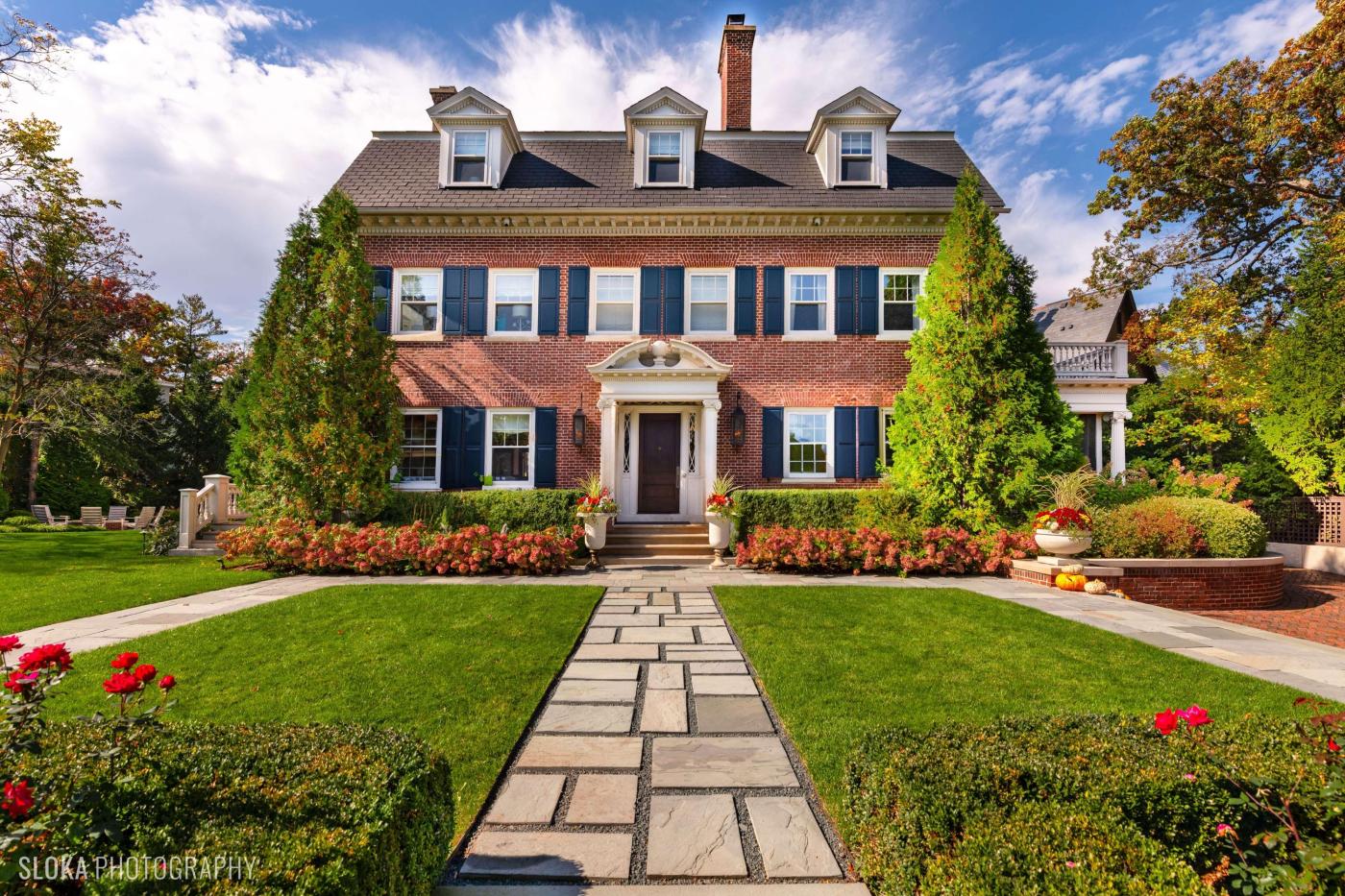
Retired Chicago Cubs pitcher Kerry Wood and his wife, Sarah, have placed their six-bedroom, 11,250-square-foot Georgian Revival-style mansion in Winnetka on the market for $8.49 million.

Wood, 46, first shot to prominence in 1998 when as a rookie he struck out 20 players in a shutout. He pitched for the team from 1998 until 2008, and he returned to the club for his final two seasons. Wood currently is a Cubs Ambassador, after previously serving as a special assistant to the Cubs’ president of baseball operations.

In addition, Wood and his wife founded the Pitch-In after-school mentoring program. And on Friday, the Cubs announced that Wood had been elected to the team’s Hall of Fame.

The Woods bought their three-story mansion in an off-market transaction in 2019 through an Illinois limited liability company. Built in 1902 for Chicago, Burlington and Quincy railroad executive Charles I. Sturgis and designed by architect William Otis, the mansion is encircled by a curved red brick perimeter wall and wrought iron gates.

Inside, the mansion has 5-1/2 bathrooms, five fireplaces, a grand staircase with extra-wide steps, wide-band hand rails and hand-carved balusters, along with millwork, wide-cased openings, restored windows, a walnut-paneled dining room and a living room with a fireplace and arched bookshelves.

The kitchen has white marble countertops, top-of-the-line appliances and a Farrow & Ball blue island. Other features include an eating area with curved bay picture windows, a second staircase, a mud room, a screened porch and a family room with original bookcases and a restored fireplace.

On the second floor, the mansion has a primary bedroom suite with a fireplace and two new walk-in closets, along with three more bedrooms. The third floor has two additional bedrooms, an office and a game room, while the mansion’s basement, which was refinished by the Woods, has an arts and crafts studio, a gym with a sauna, a wine room and a recreation room with a bar.

Outside on the 0.71-acre property are a swimming pool that was installed by the Woods, along with a new pool house that has a bathroom, a washer/dryer, a changing room, storage and a garden shed. The property also includes a new outdoor kitchen, a new pergola, a fire pit, working organic gardens, a brick driveway and a heated three-car garage with extra storage and a work bench.

“This east Winnetka in-town compound is simply out of this world,” listing agent Jena Radnay of @properties told Elite Street. “If you appreciate beautiful, distinguished architecture and understand the cost, the headache and the vision that is needed to restore to a glorious, high-end level of luxury, then this house is unmatched. We have yet to have a house in this kind of premier location in Winnetka, and I can even say in the North Shore. It’s a Mecca of beauty, every square inch.”

Radnay told Elite Street that the Woods are moving because they are “changing up things a bit.”

“They have a son graduating from high school, and Chicago will always be their home. That will never change,” she said.

Earlier, the Woods owned a newly built, six-bedroom, 11,000-square-foot mansion in Winnetka, which they bought in 2015 for $3.8 million and sold in early 2020 for $4.15 million. Prior to that, they paid $4.63 million in 2010 for an historic Tudor Revival-style mansion in Winnetka that they sought to raze but ultimately decided against doing so, instead selling that mansion at a loss in late 2013 for $4.18 million.

The Woods also have owned a four-bedroom, Beaux-Arts-style mansion in Lincoln Park, which they bought for $3.32 million in 2008 and sold in 2017 for $3 million; a vintage house in the Old Town Triangle, which they bought in 2004 for $1.3 million and sold in 2008 for $1.2 million; a River North condo that they bought in 2003 for $712,000 and sold in 2005 for $760,000; and a waterfront mansion in Fontana, Wis. that they bought in 2014 for $3.8 million and sold in 2017 for $4.7 million.

The Winnetka mansion that Kerry and Sarah Wood are selling had a $91,357 property tax bill in the 2022 tax year. The mansion is set to be publicly listed on Wednesday, Radnay said, with showings to begin that day.

Goldsborough is a freelance reporter.

Join our Chicago Dream Homes Facebook group for more luxury listings and real estate news.

()

Column: Thelma Krause’s viral moment during the Chicago Bulls Ring of Honor ceremony becomes a lesson for local sports fans

posted in: News | 0

One of the worst moments for Thelma Krause could have a happy ending.

It didn’t take long for social media to react to the booing of Thelma’s husband, late Chicago Bulls general manager Jerry Krause, during the Ring of Honor ceremony Friday at the United Center.

The loud and prolonged booing brought Thelma to tears. The scene was not only shown live on NBC Sports Chicago, but she suddenly appeared on the video boards at the United Center. The sight of Thelma crying apparently was too much to take for the crowd, and a smattering of cheers for Jerry was heard as she was being consoled by Ron Harper.

But it was too late.

The ceremony quickly moved on, though the booing is what will be remembered most on a night meant to honor the people who helped make the Bulls a successful, internationally known franchise.

Bulls TV analyst Stacey King and Golden State coach Steve Kerr were the first to publicly denounce the actions of fans, while Bulls president Michael Reinsdorf soon released a statement supporting Jerry and Thelma, though he failed to criticize the fans who participated in the booing.

Harper, the hero of the moment, had no such qualms.

“We don’t boo Jerry Krause,” Harper told NBC Sports Chicago after the game. “The man’s done a lot of great things here. He may not be your favorite person, but we cheer and we respect the man. I didn’t really appreciate that part.”

Within 24 hours, almost everyone had offered their opinion of the booing Bulls fans. Thelma received a massive dose of sympathy, something her husband rarely got when he was alive, and Chicago fans got a black eye.

KC Johnson, a longtime friend and currently the Bulls insider for NBC Sports Chicago, spoke to Thelma on Saturday and said on the pregame show that “she is in a remarkably good place because of the overwhelming support she has received today from people all around the league, around the franchise.

“The word she gave to me was ‘I’ve had so much support I can’t help but focus on the positive not the negative. Sometimes good things come from bad instances.’”

Hopefully, this is one of those instances and Thelma can move on.

Anyone who knew Jerry Krause knew of Thelma, even if they had never met her. Whenever I ran into Krause in spring training, when he returned to being a baseball scout after leaving the Bulls, he would go on and on about how happy he was in his post-Bulls life, getting to spend more time with Thelma and the grandkids. I’d never seen him so relaxed.

Krause died in March 2017 at age 77, only 10 days before the news that he would be inducted into the Basketball Hall of Fame. Three years later, during the COVID-19 pandemic, Krause was made out as a villain in “The Last Dance,” the documentary on the end of the Bulls’ dynasty.

He was not alive to defend himself, of course, and the narrative that he was responsible for the breakup of the team gained traction. Krause’s acquisitions of key players like Harper and Dennis Rodman and the drafting of Scottie Pippen and Horace Grant, were mostly overlooked.

That’s Hollywood. You need heroes and villains to make a story work.

But Krause was a two-time NBA Executive of the Year and a Hall of Famer. Obviously his peers understood his role in building two three-peat champions. And a baseball scout, he helped bring to the Sox Ozzie Guillén, Julio Cruz, Ed Farmer, Tom Seaver, Greg Luzinski, Ken Williams and Greg Walker, among other stars of the early ‘80s teams.

“He had a hand in seven championships, being that he scouted Ozzie and myself and counseled us in the early years of some of the things we had to go through in our general manager-player relationships,” Williams told me after Krause’s death. “He’s probably telling his friends up there right now he actually has seven (rings).”

Williams said if people knew Krause’s “softer side” and could hear some of his storytelling “maybe he would’ve gotten a break he probably deserved.”

Krause wasn’t warm and cuddly to outsiders, and didn’t get many breaks from fans, or his own players, including Pippen. He chalked it up as part of the job of being a general manager of a high-profile franchise in a sports-loving town.

Some have blamed the Friday booing on millennial fans who weren’t even around when Krause was building the Bulls. Others wondered whether Chicago was turning into Philadelphia, where booing is part of their fans’ repertoire.

But this episode was not really something new.

A similar incident happened 17 years ago at the United Center, when fans booed during a pregame memorial for former Blackhawks owner Bill Wirtz, who had just died. As soon as Hawks analyst Dale Tallon delivered the line “William Wirtz was a true Chicagoan,” the boos rained down from the third level and continued for well over a minute.

Even the moment of silence for Wirtz was disrupted by fans ripping him. Like Krause, Wirtz was vilified for decisions that led to some fan favorites leaving.

The Wirtz family members who sat through the rude display can no doubt empathize with Thelma, though at least their faces weren’t on the video board for everyone to see their pain.

Harper put it best when he said Krause “may not be your favorite person, but we cheer and we respect the man” when he’s being honored.

If you can’t find it within yourself to applaud someone’s accomplishments, at least do the right thing and remain silent. In the end, it’s just sports.

Thelma Krause’s viral moment can’t be erased. A week ago she was mostly anonymous, and now everyone in Chicago knows her name.

But now that the tears have dried, at least she can be consoled somewhat by the virtual group hug she’s received.

()