Canadian team wins 2026 World Snow Sculpting Championship in Stillwater

posted in: All news | 0

Team Fjordwitches, a team of three women from Quebec, Canada, is once again the winner of the World Snow Sculpting Championship, which was held Wednesday through Saturday in downtown Stillwater.

Team Fjordwitches — Fanny-Fay Tremblay-Girard, Joelle Gagnon and Marie-Claude-Paris-Tanguay — beat out 15 other teams from around the world to win this year’s competition and a $1,500 prize with their entry, “The Inosculation of Souls.” The team, which was also crowned champion in 2024, also won the Artists’ Choice Award, which had a $500 prize.

Team Falcon of Mongolia placed second and won $1,000, and Team Thailand took third and won $500.

The People’s Choice Award, which had a $500 prize, went to Team Kawsay of Peru.

Teams were judged on creativity, technical execution and overall visual impact, said Robin Anthony-Evenson, president of the Greater Stillwater Chamber of Commerce Foundation.

Related Articles


Appointments for free Valentine’s Day weddings available in 10 counties


VocalEssence and Sir John Rutter offer a balm for the wounded Twin Cities


Skywatch: There’s a giant on the rise


$7M youth sports complex coming to Apple Valley


Here’s your day-by-day guide to the 2026 St. Paul Winter Carnival

“These artists represent the very best of international snow sculpting,” Anthony-Evenson said. “The championship brings global talent to Stillwater while creating a shared winter experience that celebrates creativity, culture, and community.”

The championship, which brought more than 67,000 people to town Wednesday through Sunday, is considered the marquee event of the city’s World Snow Celebration, which continues through next Sunday, and includes live music, food and beverage events, a winter market, and family activities.

“Visitors are encouraged to experience the sculptures up close while enjoying the broader festival offerings,” Anthony-Evenson said.

The sculptures will remain up for viewing in Lowell Park as long as weather permits, she said.

For more information, go to www.worldsnowcelebration.com.

Related Articles


Appointments for free Valentine’s Day weddings available in 10 counties


VocalEssence and Sir John Rutter offer a balm for the wounded Twin Cities


Skywatch: There’s a giant on the rise


$7M youth sports complex coming to Apple Valley


Here’s your day-by-day guide to the 2026 St. Paul Winter Carnival

Analysts warn that Iran crisis carries potential nuclear risks

posted in: All news | 0

By STEPHANIE LIECHTENSTEIN, Associated Press

VIENNA (AP) — In the wake of spiraling tensions between the United States and Iran over Tehran’s violent crackdown on protests, analysts warn that the internal upheaval affecting the Iranian theocracy could carry nuclear proliferation risks.

While in recent days President Donald Trump seemed to have backed away from a military strike on Iran, he called Saturday for an end to Supreme Leader Ayatollah Ali Khamenei’s nearly 40-year reign in Iran. Trump’s comments came in response to Khamenei branding Trump a “criminal” for supporting protesters in Iran, and blamed demonstrators for causing thousands of deaths.

Meanwhile, a U.S. aircraft carrier, which days earlier had been in the South China Sea, passed Singapore overnight to enter the Strait of Malacca — putting it on a route that could bring it to the Middle East.

With those dangers, analysts warn Iran’s nuclear material could be at risk as well.

Nuclear material could fall into the wrong hands

David Albright, a former nuclear weapons inspector in Iraq and founder of the nonprofit Institute for Science and International Security in Washington, said that in a scenario of internal chaos in Iran, the government could “lose the ability to protect its nuclear assets.”

He said that Iran’s highly enriched uranium stockpile “would be the most worrisome,” adding that there is a possibility that someone could steal some of this material.

There are historical precedents for such a scenario.

Following the collapse of the Soviet Union in 1991, highly enriched uranium and plutonium suitable for building nuclear bombs went missing due to eroded security and weakened protection of these assets.

So far, Iran has maintained control of its sites, even after the U.S. bombed them in the 12-day war in June that Israel launched against the Islamic Republic.

Iran maintains a stockpile of 972 pounds of uranium enriched up to 60% purity — a short, technical step away from weapons-grade levels of 90%, according to the International Atomic Energy Agency, the Vienna-based U.N. nuclear watchdog.

The agency said in a report last November that it has not been able to verify the status and location of this highly enriched uranium stockpile since the war in June.

The agency said in November that therefore it had lost “continuity of knowledge in relation to the previously declared inventories of nuclear material in Iran” at facilities affected by the war.

A diplomat close to the IAEA confirmed Monday that the agency had still not received any information from Iran on the status or whereabouts of the highly enriched uranium stockpile. The diplomat spoke on condition of anonymity in line with diplomatic protocol.

Albright said that Iran’s stockpile of highly enriched uranium would fit in around 18 to 20 cylinders that are designed for transport, weighing around 55 pounds each. “Two people can easily carry it,” he said of each container.

Kelsey Davenport, director for nonproliferation policy at the Washington-based Arms Control Association, said that there is a risk that the stockpile “could be diverted either to a covert program or stolen by a faction of the government or the military that wanted to retain the option of weaponization.”

She said that this risk increases as the Iranian government feels threatened or gets destabilized.

Some of the nuclear material could get smuggled out of Iran or sold to non-state actors in the event of internal chaos or potential government collapse, Davenport said.

“The risk is real but it is difficult to assess, given the unknowns regarding the status of the materials and the whereabouts,” she stressed.

Related Articles


Chile fights wildfires that killed 19 and left 1,500 homeless


Fashion designer Valentino dies at home in Rome, aged 93


Prince Harry says Daily Mail scoops made him ‘paranoid beyond belief’


Inequality and unease are rising as elite Davos event opens with pro-business Trump set to attend


What to know about the annual World Economic Forum meeting in Davos

Possibility of Iran building a nuclear bomb

Both Davenport and Albright pointed out that there is also a theoretical possibility of making nuclear bombs with Iran’s 60% enriched uranium. Tehran has insisted for years its program is peaceful.

However, a weapon made directly from 60% enriched uranium rather than the usual 90% purity requires more nuclear material, which makes it “much bigger and bulkier and probably not well suited to delivery” on a missile, said Eric Brewer, a former U.S. intelligence analyst and now deputy vice president at the Nuclear Threat Initiative.

He added that such a device could still be “blown up in the desert,” for example.

Brewer said that the possibility that the current government in Iran goes down that road should not be “totally dismissed,” but he underlined that most information suggests that the highly enriched uranium “remains buried in a tunnel as a result of the U.S. strikes and is probably not easily accessible to the regime; at least not with some major risk of detection and another strike by the U.S. or Israel.”

He added that recent events “have also shown that the Supreme Leader has a very high bar for any decision to weaponize.”

Nuclear power reactor could be a target

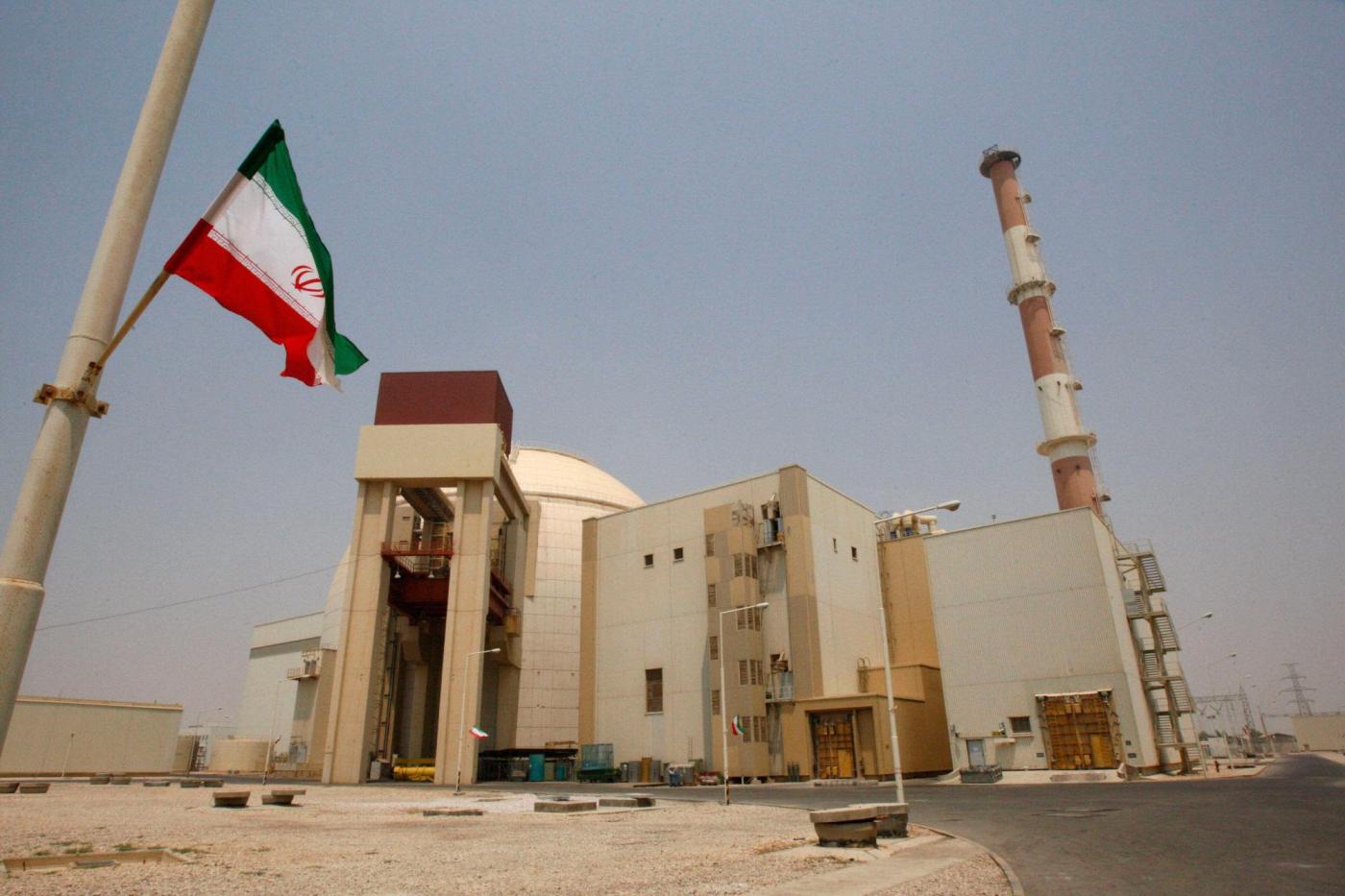
In the case of internal chaos, Iran’s nuclear power reactor in Bushehr — Iran’s only commercial nuclear power plant some 465 miles south of Tehran — could also get sabotaged or targeted with the aim of causing havoc or making a political point, Albright said. Bushehr is fueled by uranium produced in Russia, not Iran.

So far, there has been no sign of Iran losing command and control of its security forces.

Albright pointed to the attack by the African National Congress’s armed wing on South Africa’s Koeberg Nuclear Power Station near Cape Town, as the country went through increased anti-apartheid resistance in 1982. The act of sabotage caused significant damage but resulted in no nuclear fallout.

“If the Bushehr reactor has a major accident, the winds would carry the fallout within 12 to 15 hours to the United Arab Emirates, Saudi Arabia and Oman,” Albright said.

The Associated Press receives support for nuclear security coverage from the Carnegie Corporation of New York and Outrider Foundation. The AP is solely responsible for all content.

RFK Jr.’s MAHA movement has picked up steam in statehouses. Here’s what to expect in 2026

posted in: All news | 0

By Alan Greenblatt, KFF Health News

When one of Adam Burkhammer’s foster children struggled with hyperactivity, the West Virginia legislator and his wife decided to alter their diet and remove any foods that contained synthetic dyes.

“We saw a turnaround in his behavior, and our other children,” said Burkhammer, who has adopted or fostered 10 kids with his wife. “There are real impacts on real kids.”

The Republican turned his experience into legislation, sponsoring a bill to ban seven dyes from food sold in the state. It became law in March, making West Virginia the first state to institute such a ban from all food products.

The bill was among a slew of state efforts to regulate synthetic dyes. In 2025, roughly 75 bills aimed at food dyes were introduced in 37 states, according to the National Conference of State Legislatures.

Related Articles


Vance and Rubio set to attend Winter Olympics opening ceremony in Italy. Trump isn’t on the list


US Catholic cardinals urge Trump administration to embrace a moral compass in foreign policy


Hawaii’s strict gun law faces Supreme Court scrutiny in landmark case


AP Source: Fed Chair Powell to attend Supreme Court argument on Cook case


As faith in the US fades a year into Trump 2.0, Europe tries to end a reliance on American security

Chemical dyes and nutrition are just part of the broader “Make America Healthy Again” agenda. Promoted by Health and Human Services Secretary Robert F. Kennedy Jr., MAHA ideas have made their deepest inroads at the state level, with strong support from Republicans — and in some places, from Democrats. The $50 billion Rural Health Transformation Program — created last year as part of the GOP’s One Big Beautiful Bill Act to expand health care access in rural areas — offers incentives to states that implement MAHA policies.

Federal and state officials are seeking a broad swath of health policy changes, including rolling back routine vaccinations and expanding the use of drugs such as ivermectin for treatments beyond their approved use. State lawmakers have introduced dozens of bills targeting vaccines, fluoridated water, and PFAS, a group of compounds known as “forever chemicals” that have been linked to cancer and other health problems.

In addition to West Virginia, six other states have targeted food dyes with new laws or executive orders, requiring warning labels on food with certain dyes or banning the sale of such products in schools. California has had a law regulating food dyes since 2023.

Most synthetic dyes used to color food have been around for decades. Some clinical studies have found a link between their use and hyperactivity in children. And in early 2025, in the last days of President Joe Biden’s term, the Food and Drug Administration outlawed the use of a dye known as Red No. 3.

Major food companies including Nestle, Hershey, and PepsiCo have gotten on board, pledging to eliminate at least some color additives from food products over the next year or two.

“We anticipate that the momentum we saw in 2025 will continue into 2026, with a particular focus on ingredient safety and transparency,” said John Hewitt, the senior vice president of state affairs for the Consumer Brands Association, a trade group for food manufacturers.

This past summer, the group called on its members to voluntarily eliminate federally certified artificial dyes from their products by the end of 2027.

“The state laws are really what’s motivating companies to get rid of dyes,” said Jensen Jose, regulatory counsel for the Center for Science in the Public Interest, a nonprofit health advocacy group.

Andy Baker-White, the senior director of state health policy for the Association of State and Territorial Health Officials, said the bipartisan support for bills targeting food dyes and ultraprocessed food struck him as unusual. Several red states have proposed legislation modeled on California’s 2023 law, which bans four food additives.

“It’s not very often you see states like California and West Virginia at the forefront of an issue together,” Baker-White said.

Although Democrats have joined Republicans in some of these efforts, Kennedy continues to drive the agenda. He appeared with Texas officials when the state enacted a package of food-related laws, including one that bars individuals who participate in the Supplemental Nutrition Assistance Program — SNAP, or food stamps — from using their benefits to buy candy or sugary drinks. In December, the U.S. Department of Agriculture approved similar waivers sought by six states. Eighteen states will block SNAP purchases of those items in 2026.

There are bound to be more. The Rural Health Transformation Program also offers incentives to states that implemented restrictions on SNAP.

“There are real and concrete effects where the rural health money gives points for changes in SNAP eligibility or the SNAP definitions,” Baker-White said.

In October, California Gov. Gavin Newsom signed a bill that sets a legal definition for ultraprocessed foods and will phase them out of schools. It’s a move that may be copied in other states in 2026, while also providing fodder for legal battles. In December, San Francisco City Attorney David Chiu sued major food companies, accusing them of selling “harmful and addictive” products. The lawsuit names specific brands — including cereals, pizzas, sodas, and potato chips — linking them to serious health problems.

Kennedy has also blamed ultraprocessed foods for chronic diseases. But even proponents of the efforts to tackle nutrition concerns don’t agree on which foods to target. MAHA adherents on the right haven’t focused on sugar and sodium as much as policymakers on the left. The parties have also butted heads over some Republicans’ championing of raw milk, which can spread harmful germs, and the consumption of saturated fat, which contributes to heart disease.

Policymakers expect other flash points. Moves by the FDA and the Centers for Disease Control and Prevention that are making vaccine access more difficult have led blue states to find ways to set their own standards apart from federal recommendations, with 15 Democratic governors announcing a new public health alliance in October. Meanwhile, more red states may eliminate vaccine mandates for employees; Idaho made them illegal. And Florida Gov. Ron DeSantis is pushing to eliminate school vaccine mandates.

Even as Kennedy advocates eliminating artificial dyes, the Environmental Protection Agency has loosened restrictions on chemicals and pesticides, leading MAHA activists to circulate an online petition calling on President Donald Trump to fire EPA Administrator Lee Zeldin.

Congress has yet to act on most MAHA proposals. But state lawmakers are poised to tackle many of them.

“If we’re honest, the American people have lost faith in some of our federal institutions, whether FDA or CDC,” said Burkhammer, the West Virginia lawmaker. “We’re going to step up as states and do the right thing.”

©2026 KFF Health News. Distributed by Tribune Content Agency, LLC.

Fun-loving Kiwi Campbell Wright gives the US hope for its first biathlon Olympic medal

posted in: All news | 0

By MARTHA BELLISLE

The U.S. has never won an Olympic medal in biathlon, the only winter sport where that’s the case.

The drought could come to an end next month at the Winter Olympics.

The team brought on Campbell Wright, a rising star and dual citizen from New Zealand who combined fast skiing and precision shooting to win two world championship silver medals last year and has had strong results this season.

In addition, the team has a homecourt advantage, of sorts: Their Italian head coach, Armin Auchentaller, grew up in Antholz, the village that’s hosting the Olympic biathlon competitions. His assistant coach and support staff are also from the region, ensuring the team has the inside scoop on the ski trails, snow, climate, food and housing.

“We feel Antholz is almost a second home to us,” said U.S. Biathlon CEO Jack Gierhart. “Armin made it easy for us to operate there. That will enable our athletes to focus and feel relatively relaxed, which is really important in this level of competition.”

FILE – U.S. Coach Armin Auchentaller looks on at the shooting range of the World Cup of Biathlon in Oberhof, Germany, Thursday Jan. 8, 2026. (Jennifer Brückner/dpa via AP, File)

Winning athlete and coach

Wright said he trusts his fitness and training as he heads to the Games, where the pressure will be on him to perform.

“I think having success in the past just gives me confidence because I’ve already done more than I thought I could do in this sport, so the way I see it anything extra is just cream,” he told The Associated Press.

Related Articles


Vance and Rubio set to attend Winter Olympics opening ceremony in Italy. Trump isn’t on the list


Alpine skiing: Lindsey Vonn finishes third in latest World Cup downhill


How Olympians think about success and failure and what we can learn from them


Ukraine’s young skiers practice in a bombed-out Olympic training base


Has figure skating reached the limits of human performance?

Auchentaller said working with Wright has been one of the most rewarding experiences of his career.

“From the very start, you could tell he had something special — not just raw talent, but that spark of joy when he moved, competed, trained. That early talent was obvious,” Auchentaller said. “But what made working with him truly remarkable was how quickly he combined that talent with professionalism.”

Wright will be joined by Olympic newbie Maxime Germain and Paul Schommer, who is competing in his second Games, while Sean Doherty will race in his fourth. On the women’s side, Joanne Reid returns to competition after two years off and heads to her third Olympics. Teammate Deedra Irwin returns for her second and two new members, Margie Freed and Lucinda Anderson, will make their Olympic debut.

Who is Campbell Wright?

Wright, a 23-year-old from Wanaka, New Zealand, was born and raised Down Under by American parents who emigrated there in the 1990s. He spent his early years at the Snow Farm cross-country ski center, learned biathlon in Europe and raced for New Zealand at the Beijing Olympics. Seeking support from a seasoned team, his dual citizenship allowed him to join the U.S. in 2023.

That support has helped him to thrive.

In February 2025, he became the first U.S. biathlete to win two medals at one world championship event, taking home back-to-back silvers in the sprint and pursuit competitions in Lenzerheide, Switzerland. They were the first U.S. world medals since Susan Dunklee won silver in 2020. She also won silver and Lowell Bailey gold in 2017.

Auchentaller said he was proud but not surprised by Wright’s performance.

“I knew that beneath his talent lay a core of grit, a fearless heart, and a grounded, simple work ethic,” Auchentaller said. “His success didn’t feel like luck or a one-off; it felt like the natural outcome of years of hard, intelligent work, fueled by genuine love for what he does. Watching him step onto that podium, I saw a young man’s passion and dedication pay off — and I felt fortunate to have witnessed his growth from early promise to world-class performer.”

Keeping it fun

Wright’s Kiwi accent and light-hearted nature has endeared him to fans around the world. He often smiles and waves at adoring supporters who call his name from the stands, looking like his having the time of his life.

Wright’s multiple top-10 finishes on the World Cup circuit last season secured him the the U23 Globe for the best athlete 23 years old or younger, another first for a U.S. biathlete. He said his youth helps makes racing less stressful.

“I’m hopefully at the start of a long career and I think that also helps take the pressure off,” he said. “If this season goes poorly, there are a lot more years for me to try again.”

Training plan that works

Early in the World Cup season, Wright made his presence known by skiing to the front of the pack and consistently shooting well even in high-stress head-to-head battles. He said his training plan worked for him last season, so he has no intention of changing things, even though it’s an Olympic year.

“I think it’s a good one,” he said. “I think a lot of athletes tie themselves in knots trying to reinvent the wheel, but what we do isn’t complicated, it’s just hard.”

Auchentaller said what makes Wright special as a biathlete goes beyond a single skill. He has speed, focus, a positive attitude, sure, “but the real difference lies in his simplicity.” He doesn’t overthink things and maintains a calm confidence even when things don’t go as planned, which is inevitable in biathlon.

Suddenly the wind changes direction, you miss the first two shots, you drop your sunglasses, someone crashes in front of you, you drop a magazine. Every race has the potential for mishaps.

“Instead of panicking or doubting himself, he stays grounded, believes in the work he’s done, and keeps moving forward,” Auchentaller said. “That trust, combined with his simplicity and adaptability, is what makes him truly stand out in the sport.”

If Wright can keep it up, it could fulfill a dream that has eluded the U.S. for decades.

AP Winter Olympics: https://apnews.com/hub/milan-cortina-2026-winter-olympics