Virtual Mozart is almost as good as the classic analog option

posted in: All news | 0

This week, audiences have had a chance to hear the Berlin-based Mahler Chamber Orchestra — virtually.

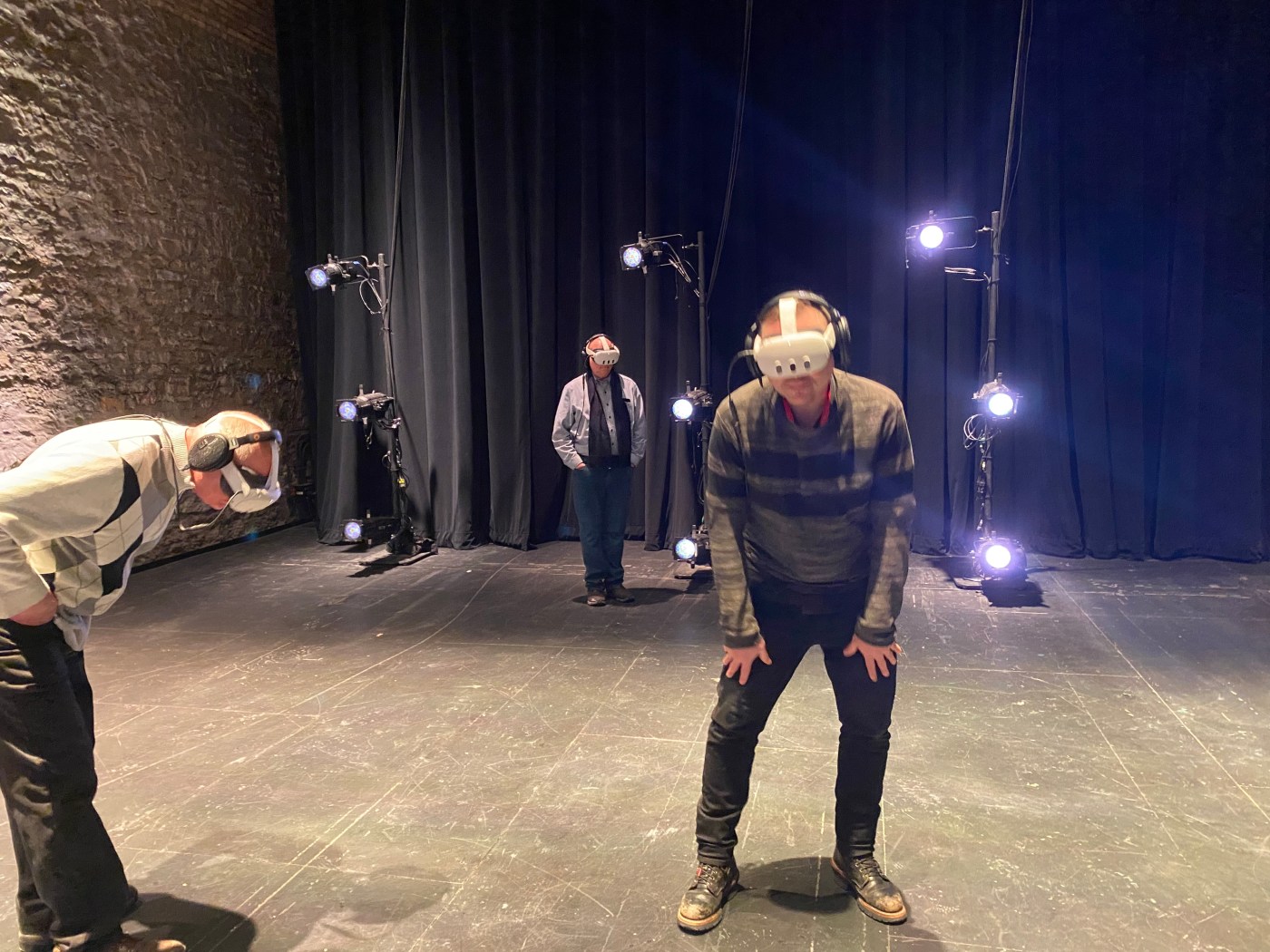
As part of an engagement presented by Schubert Club Mix at the Luminary Arts Center, six audience members at a time don headsets and walk around the Luminary stage, “seeing” musicians perform and hearing their music through headphones.

Designed by Henrik Oppermann of the company Schallgeber, in collaboration with MCO, the virtual program uses spatial audio to create a sense of moving through the musicians as they play. Get up close to the virtual version of violinist Timothy Summers and you can hear each bow stroke in sharp detail. Step further back, and you hear more of a blended sound of the different instruments playing together.

If you’ve ever wondered what a string bass sounds like up close, this is your chance. The instrument’s notes are so low, it’s often not easy to distinguish them from the brighter, higher-note instruments like a flute or a violin when it is not playing solo. Like a bay leaf in a savory sauce, the bass provides essential tone and depth, even if its flavor isn’t distinguishable at first. Only in its absence does its essential role become clear. MCO’s virtual concert allows you to lean in close and take a good listen.

With object-based audio and distance modeling, the mix of hardware and software technology creates a way to hear the music in three dimensions. “I’m basically having all musicians miked up, and then also the room, and then I recreate it in 3-D space,” Oppermann said on the event’s opening day on Thursday.

The program features three pieces of music, beginning with Wolfgang Amadeus Mozart’s Quintet in G minor, followed by the Overture from “A Midsummer Night’s Dream” by Felix Mendelssohn and lastly “Siegfried Idyll” by Richard Wagner. Because each work features a different number of musicians and varies slightly in the way it was designed, each has a different feeling.

Mozart’s quintet in some ways provides the most visceral experience. Fewer instruments make every one all the more distinctive. Standing between a cello and a violin, you can hear both instruments in different ears.

The Mendelssohn work features almost five times as many instruments, and uses 99 microphones as opposed to 12 for the Mozart recording. As a result, it has a very full and nuanced sound, and there’s more space to walk through as you virtually experience the piece. The last piece by Wagner features 13 musicians, with the trumpet only performing at the very end.

Normally, audience members aren’t allowed to get so close to real musicians playing, so in a way it’s a way of listening to music that’s altogether different than a regular concert. It also doesn’t quite compare physically with hearing live music, which has the added allure of the physical resonances of the music, not just the sound coming through headphones.

According to Oppermann, the idea is to ultimately supplement, not replace, live music concerts. Much like orchestra, opera or theater events that are both performed live and simultaneous screened to multiple locations, he said MCO hopes to eventually offer live virtual experiences for audiences at home.

In the meantime, MCO’s virtual concert is enough of a novelty to explore, even if it’s not quite as fulfilling as the real thing.

IF YOU GO

Who: The Schubert Club
What: The Mahler Chamber Orchestra — In Virtual Reality
When: 10 a.m.-6 p.m. Jan. 24 & Jan. 25
Where: Luminary Arts Center, 700 N. First St., Minneapolis
Tickets: $25 at schubert.org.
Capsule: Walk amid virtual musicians in this virtual experience.


TikTok finalizes deal to form new American version of the app

posted in: All news | 0

By KAITLYN HUAMANI, AP Technology Reporter

TikTok has finalized a deal to create a new American version of the app, avoiding the looming threat of a ban in the U.S. that has been in discussion for years.

Related Articles


FAA is making the rules imposed after an airliner collided with an Army helicopter permanent


NASA and families of fallen astronauts mark 40th anniversary of space shuttle Challenger accident


Immigration officials allow suspect in $100M jewelry heist to self deport, avoiding trial


A Kentucky cathedral called ‘America’s Notre Dame’ gets a rehab, gargoyles and all


Uvalde officer’s acquittal shifts focus to the next case over police response to attack

The social video platform company signed agreements with major investors including Oracle, Silver Lake and MGX to form the new TikTok U.S. joint venture. The new app will operate under “defined safeguards that protect national security through comprehensive data protections, algorithm security, content moderation and software assurances for U.S. users,” the company said in a statement Thursday.

Adam Presser, who previously worked as TikTok’s head of operations and trust and safety, will lead the new venture as its CEO. He will work alongside a seven-member, majority-American board of directors that includes TikTok’s CEO Shou Chew.

The deal marks the end of years of uncertainty about the fate of the popular video-sharing platform in the United States. After wide bipartisan majorities in Congress passed — and President Joe Biden signed — a law that would ban TikTok in the U.S. if it did not find a new owner in the place of China’s ByteDance, the platform was set to go dark on the law’s January 2025 deadline. For a several hours, it did. But on his first day in office, President Donald Trump signed an executive order to keep it running while his administration sought an agreement for the sale of the company.

FAA is making the rules imposed after an airliner collided with an Army helicopter permanent

posted in: All news | 0

By JOSH FUNK, Associated Press

The temporary rules imposed after last year’s collision of an airliner and an Army helicopter to improve the safety of the crowded airspace around Washington D.C. are being made permanent, the government announced Thursday.

The Federal Aviation Administration took steps to make sure that helicopters and airplanes would no longer share the same airspace around Reagan National Airport shortly after the investigation into the Jan. 29 crash began. The rules also prohibit air traffic controllers from relying on visual separation and require all military aircraft to broadcast their locations.

The National Transportation Safety Board plans to hold a hearing next Tuesday to detail everything that contributed to the deadliest plane crash on American soil since 2001.

“After that horrific night in January, this administration made a promise to do whatever it takes to secure the skies over our nation’s capital and ensure such a tragedy would never happen again. Today’s announcement reaffirms that commitment,” Transportation Secretary Sean Duffy said.

Related Articles


NASA and families of fallen astronauts mark 40th anniversary of space shuttle Challenger accident


Immigration officials allow suspect in $100M jewelry heist to self deport, avoiding trial


A Kentucky cathedral called ‘America’s Notre Dame’ gets a rehab, gargoyles and all


Uvalde officer’s acquittal shifts focus to the next case over police response to attack


Under Armour looking into data breach affecting customers’ email addresses

The families of the 67 people who died after an Army Black Hawk helicopter struck an American Airlines jet that was preparing to land hope Duffy and Congress will act on the recommendations NTSB is expected to make next week to help prevent a similar tragedy from ever happening again.

Matt Collins, who lost his younger brother Chris in the disaster, said he and many of the other families plan to keep going to Washington so often that lawmakers will get sick of seeing them until changes are made.

“I hope to have some hearings done in the Senate and Congress, and I hope results come out of these hearings that they have,” said Collins who lives in Dighton, Massachusetts. “I hope we’re not just placated and it falls off into the background until another big news story comes up.”

The FAA said the new final rule will take effect on Friday. It will continue to require military aircraft to broadcast their locations using their ADS-B Out systems, which was routinely not done before the crash. And air traffic controllers are not allowed to rely on pilots to ensure visual separation between aircraft within 5 miles of Reagan airport.

The NTSB has said that the Black Hawk helicopter in the crash was flying 78 feet higher than the 200-foot limit on the route and likely had a faulty altimeter. But even if the helicopter had been adhering to that limit, the NTSB has said the route design didn’t provide nearly enough separation to ensure safety.

Air traffic controllers had warned the FAA years beforehand about the dangers of all the helicopters around the nation’s capital, and the agency failed to recognize an alarming pattern of 85 near misses in the three years before the crash.

Collins said he still flies often for work and pleasure, but his parents haven’t boarded a plane since the crash.

“I still think flying is probably the safest mode of transportation, but I think it could be a heck of a lot safer,” he said.

Many of the people who died on the flight were young figure skaters and their parents and coaches who had just attended a development camp in Wichita, Kansas, after the U.S. figure skating championships were held there.

Opinion: A Safer New York Starts With Community, Not Incarceration

posted in: All news | 0

“Not only should the administration strive to make New York City a place where all people can meet their basic needs, but Mamdani’s team must also work to bring alternatives to incarceration to scale, so they are the new default while jail becomes a last resort.”

Mayor Bill de Blasio signs an executive order to reduce the City’s vehicle fleet in the parking lot of Citi Field in Queens on Thursday, March 28, 2019. Michael Appleton/Mayoral Photography Office

As Mayor Zohran Mamdani takes office, New York City stands at a crossroads. For decades, “public safety” in this city has been synonymous with policing, punishment, and incarceration. But New Yorkers know better: real safety isn’t achieved through handcuffs or jail cells—it’s built through stable access to affordable housing, food, health care, transportation, and other life essentials.  

Mamdani’s campaign centered on affordability, rightly arguing that when people can meet their basic needs, the entire city becomes safer. But the incoming mayor cannot avoid inheriting a public safety infrastructure that, for several years now, has doubled down on punitive responses that have devastated Black, Latine, and other working class neighborhoods across the city. 

The number of people incarcerated on Rikers Island still hovers over 7,000 while NYPD arrests continue to climb under current NYPD Commissioner Jessica Tisch. In the first two months of last year alone, for example, the number of people put through the system for minor drug possession spiked by 59 percent, while the number of people held to arraignment on noncriminal violations jumped by 188 percent. This reflects how “public safety” has been used to justify the criminalization of poverty, mental illness, and addiction—especially in neighborhoods where state neglect and law enforcement presence have long gone hand in hand.

And this is exactly why Mamdani’s proposal to create a Department of Community Safety (DCS) is so critical. Even the framing—community safety—signals a shift from punishment to prevention, and from surveillance to support. For far too long, New York’s jails have functioned as warehouses for chronically unhoused people and those living with mental and substance use disorders. The DCS has the potential to redefine safety as something built through care, housing, health, and stability—not through cycles of arrest and incarceration that have harmed marginalized communities. 

And alternatives to incarceration (ATIs) will play a critical role in this shift. As leaders in the NYC ATI and Reentry Coalition, a network of 12 community-based providers that already serves more than 30,000 New Yorkers each year, we at the Coalition have seen firsthand the transformative impact such an approach yields. Moreover, decades of research confirms that ATIs not only increase overall desistance from crime, reduce homelessness, improve health outcomes, and boost employment rates, but they save taxpayers millions. For every $1 invested in community-based alternatives, savings between $3.46 and $5.54 are generated. Despite these proven benefits, ATI and reentry services remain chronically under-resourced and undervalued. 

This is where DCS must step in. ATIs and reentry services must be adequately funded to truly ensure safe communities across the five boroughs. Not only should the administration strive to make New York City a place where all people can meet their basic needs, but Mamdani’s team must also work to bring ATIs to scale, so they are the new default while jail becomes a last resort. 

As the nation’s largest city, New York is uniquely positioned to lead in building a holistic, human-centered approach to public safety. By coordinating resources across city agencies and committing to long-term investments that go to prevention and community wellbeing rather than policing and incarceration, the new administration can truly realize its vision of community safety—and begin to rectify the decades of disinvestment and over-policing that has decimated neighborhoods primarily home to Black and brown New Yorkers.  

We have an opportunity now to make real the simple promise that our neighborhoods will care for, not criminalize, one another—as long as Mayor Mamdani pairs his affordability agenda with a hard shift away from punishment and incarceration and towards compassion and support. Doing so will make New York City a national model—proving that investing in people and repairing past harm is how we build lasting safety. 

Jonathan McLean is CEO at The Center for Alternative Sentencing & Employment Services (CASES), and Megan French-Marcelin is the senior director of New York State policy at the Legal Action Center (LAC).

The post Opinion: A Safer New York Starts With Community, Not Incarceration appeared first on City Limits.