Editor’s Note: This story is the second part of a two-part series supported by the Law & Justice Journalism Project. See part one in the January/February issue.
D’Mitri Davis, 36, met his younger brother Dominique Judge for the first time in 2024, when they were both in prison. The two were living at the French Robertson Unit in Abilene when they were coincidentally enrolled in the same adult education course. They were unaware of the family connection until a chance conversation in class.
“Whose last name is Davis?” Judge asked, after glancing at classwork stacked at the front of the room. Judge had been adopted, but he’d met his biological dad in 2018. His dad told him that Judge had a half-brother in prison, so every time the 24-year-old met someone with that surname, he wondered if they were related.
Davis was skeptical. He’d grown up in Galveston with his mom and his sister, the only sibling he knew. He took a harder look at Judge only when the younger man mentioned being from Beaumont. As an adult, Davis, too, had finally connected with his dad, who had fathered “a whole football team” somewhere in southeast Texas.
Though Davis had a darker complexion and more facial hair than Judge, Davis noticed a nebulous family resemblance. “When I looked in his face, I saw my dad,” he recalled in a June interview.
Davis offered up his ID badge, which showed the full name he shared with his father. Judge, already convinced, began jumping up and down, saying: “That’s my brother! That’s my brother!”
After their lucky meeting, the two grew close. Judge had been struggling, feeling overwhelmed by the weight of his 25-year sentence. No one on the outside would take his calls. Feeling unmoored, he’d started using drugs, which were seemingly everywhere in prison.
“I lost hope, and I didn’t have a family at the time,” Judge told the Texas Observer. Meeting his brother gave him something to hold onto and helped him ease off on the drugs.
Their encounters made Davis think about his own choices. He’d been dealing in Galveston when he was busted and sent to prison. He wasn’t using inside, but he’d stayed in the game.
Prisons are full of people like Judge, who are vulnerable to addiction, and Davis, who have backgrounds as dealers. The rate of substance-use disorders is nearly six times higher among prisoners than in the free world, according to data from the Bureau of Justice Statistics and the Texas Department of State Health Services.
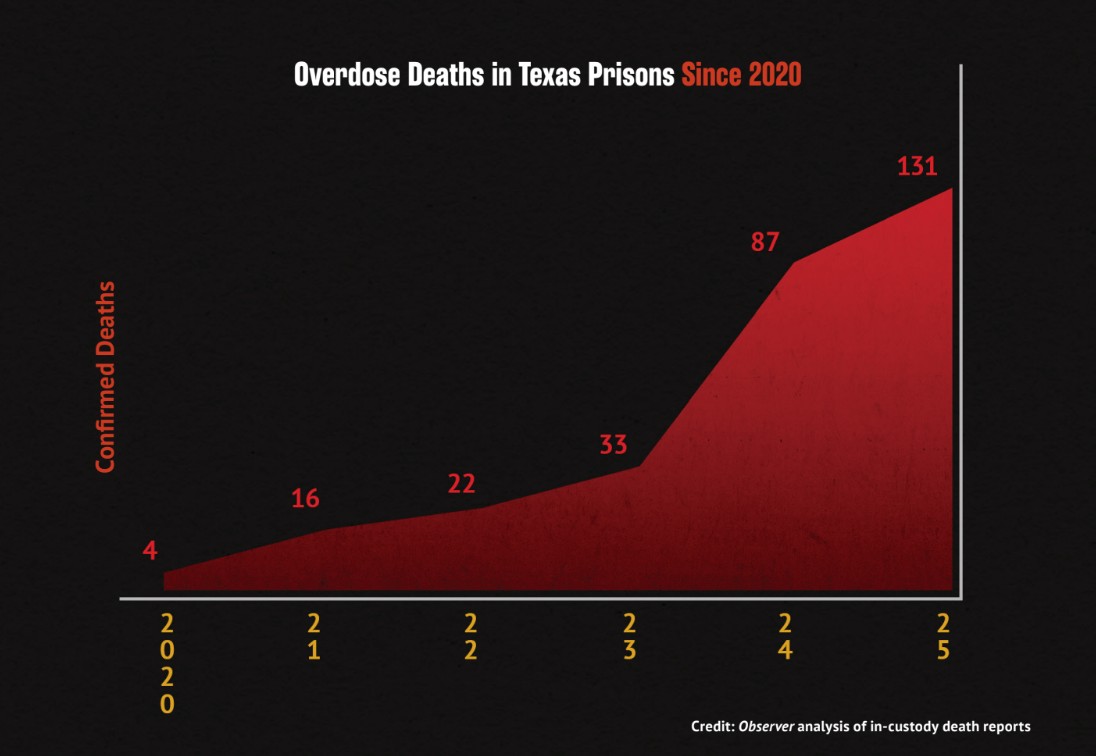
Texas prisons have seen an explosion of drugs. It’s a hard place to get clean, an easy place to get high, and an increasingly common place to die of an overdose, an investigation by the Observer shows. Confirmed drug-related deaths in Texas prisons and state jails have steadily risen from just four in 2020 to at least 131 in 2025.
But access to agency-led treatment programs in Texas prisons has been historically limited to those already approved for parole. The Texas Department of Criminal Justice (TDCJ) says it implemented more ways this year for people to voluntarily seek treatment, but the rollout is incomplete. TDCJ did not respond to repeated requests for information about what programs were available at each unit as of July.
At the unit where Judge and Davis were incarcerated, the only option was a volunteer-led group.
Davis found it hard to watch his brother struggle with addiction. To Davis, dealing had always been a means to an end: Prisoners don’t get paid for their labor in Texas, so if they don’t have someone depositing money in their account, they have no way to purchase items from the commissary, to pay the fees to see a doctor or dentist, or to buy extra stamps to communicate with people outside. Davis also wanted to be able to support his kids.
“I was still standing on business through the walls,” Davis said. “Like, OK, we have school coming up. I’m taking care of that. What’s wrong with the car? I’m fixing that.”
Inside Texas prisons, smuggling methods are evolving, and digital economies are cropping up to facilitate the trade. The players are both prisoners and guards.
Since 2020, at least 220 TDCJ employees have been arrested on contraband-related charges, including drug possession, having a prohibited substance in a correctional facility, engaging in organized criminal activity, and bribery. In the past five years, 321 prisoners have gotten new charges related to contraband, which can include drugs or cell phones. The department has about 34,000 employees and around 145,000 incarcerated individuals.
The harms of this drug supply are stark. In May, the agency reported that nearly one in five in-custody deaths was attributed to an overdose, even though since 2022, Narcan has been stocked in prisons. Narcan can reverse the effects of an overdose from opioids like fentanyl or hydrocodone, but it’s ineffective against K2—extremely potent and often-adulterated synthetic cannabinoids that can be distributed on paper and have run rampant through the system since at least 2017. In 2023, 16 prison deaths were attributed at least in part to K2; in 2025, that number was at least 113.
The response to this growing issue has mostly centered on targeting dealers like Davis, rather than offering ongoing treatment to those like Judge. In 2025, it became a felony to possess or bring prohibited substances onto TDCJ property; the law also applies to contraband cell phones, which are often used to orchestrate smuggling and deals.
Davis got tangled in the enforcement dragnet. He’d been caught with an illegal cell phone in 2023, and a year later, he was criminally charged for it.
He’d profited from dealing inside, where so many people relied on drugs to tamp down their isolation and grief. He’d seen plenty of people so desperate for
a fix that they’d traded their food trays and neglected their hygiene. “Smoke, smoke, smoke,” he said. “You just go down that rabbit hole.” Now he knew that one of the people using was family.
After getting in trouble and meeting his brother, he decided to stop dealing.
Davis knows, though, that the problem is complex—and cracking down on people inside won’t solve it. Drugs enter prison units concealed on visitors or staff, hidden in packages, dropped over barbed wire fences by drones, and tossed across by people with strong arms in the dead of night. It’s gotten harder for officials to track drug transactions because little cash exchanges hands. Most deals are done via digital payments on contraband phones, which themselves sell for between $1,000 and $3,500.
OUT OF 30 UNITS WITH THREE OR MORE CONFIRMED DRUG-RELATED DEATHS, ONLY THREE HAVE
TDCJ-LED DRUG AND ALCOHOL REHABILITATION.
It’s difficult to quantify how much TDCJ has spent to curb contraband, since the efforts are spread across various budget categories: increasing staff pay, implementing body cameras for guards, and updating unit surveillance systems. But the agency does maintain a specific budget category for its agency-led rehabilitation programs. This funding has effectively fallen in recent years: For example, the budget for TDCJ’s Substance Abuse Felony Punishment program increased from $99 million in fiscal years 2018-19 to only $110 million in fiscal years 2026-27, lagging far behind inflation. Over the same time frame, the agency did not ask the Legislature for any significant budget increases to expand substance abuse programming, even as the agency acknowledged in its appropriations requests that lower rehabilitation funding levels correlate with greater substance abuse in prisons.
Out of the 30 units with three or more confirmed drug-related deaths from January 2020 through April 2026, only three have TDCJ-led drug and alcohol rehabilitation programs, according to the agency’s website. Just a quarter of the state’s 102 units offer this treatment. And these agency-led programs are typically available only to people who are mandated to do them as a condition of release. Space constraints mean waiting lists can be long, and those programs have had massive staffing shortages in recent years. In 2023, the vacancy rate for the rehabilitation division was 31 percent.
“It is not for lack of thinking it’s a priority,” said Amanda Hernandez, TDCJ’s director of communications, of the fact that programming isn’t available at every unit. “If you were to ask our leadership right now what the biggest thing plaguing our agency is, it’s going to be contraband and substance use issues.”
Hernandez separately told the Observer: “Despite staffing challenges, TDCJ is able to run substance use programming,” later saying that the agency is using technology like Zoom to give its limited number of counselors greater reach.
Merci Wood, deputy director of the agency’s Rehabilitation and Reentry Division, said that the agency is working to support volunteer- and peer-led groups that help fill the treatment gap. TDCJ also offers online modules on topics like substance abuse that prisoners can access on their tablets.
In other words, despite some urgency from the department, prisoners seeking help must often turn to outside organizations or to one another.
Julian Alejo first tried drugs when he was 13 years old. He knew what addiction looked like—his father was an alcoholic who had gotten locked up four years earlier—but that didn’t stop Alejo. Recreational drugs became a part of his youth, then his marriage. For a while, he and his wife got sober together. Alejo had become a father and a licensed plumber. But then, he started using again, and soon he failed a drug test. Child services took his daughter away, Alejo and his wife separated, and the addiction took over.
By 2013, Alejo was drinking two cases of beer a day and smoking “as much meth [as he] could get.” He began shoplifting and selling the products to support his habit. One of his trips to Walmart turned ugly. He was arrested, charged with aggravated robbery, and given 30 years in prison.
While he was in county jail before being transferred to the prison, his mother died of cirrhosis of the liver. At that point, he promised himself he’d get clean for good—a tall order in prison. But Alejo has kept his word.
In 2019, he started taking classes on sobriety and life skills, many of which were not overseen by the rehabilitation division but led by either volunteers or the Windham School District, an independent body that runs educational courses in TDCJ. He trained for seven months to become a certified recovery specialist. Now he runs his unit’s peer-led program. More than 150 “recovery peers” today serve about 50 units, according to TDCJ, to supplement the agency’s limited parole-mandated programs.
Wood said the agency is shifting its focus to getting people treatment earlier, not just through peer mentoring but by evaluating individuals when they’re booked, increasing access to educational resources on their tablets, and offering a no-questions-asked help line, available in 16 units as of July, where prisoners are told they can self-report drug use without fear of disciplinary action. “[This] is essentially turning a ship,” she said.
This purported pivot comes following a 2025 Sunset Advisory Commission audit, in which the legislative committee found that TDCJ had failed to “monitor volunteer- or peer-led programs, going so far as to say these programs are impossible to track or control.”
The Sunset report further found that TDCJ’s agency-led rehab programming was both difficult to access and, in some cases, ineffective for those able to enroll.
TDCJ had also failed to evaluate the outcomes of its programming and “[could] not demonstrate programs are effective in reducing recidivism and improving reentry outcomes,” the audit stated. The commission found that one program, the Pre-Release Substance Abuse Program (PRSAP), even led to higher rates of recidivism, “meaning participation in the program is at best ineffective and at worst may be so harmful as to increase the likelihood of recidivism.” More than 20,000 people have been required to complete PRSAP over the past 10 years.
Some participants echo the committee’s findings, saying this treatment included orchestrated interactions that may have done more harm than good. Substance-use education training materials provided to the Observer by TDCJ in 2025 describe confrontational “encounter groups” in which participants in group therapy sessions are encouraged to publicly call out the others’ flaws or misdeeds. “The encounter process is designed to confront a client’s negative behavior and reinforce that responsibility to community,” the lesson plan states.
Ashley Long, who worked from 2017 to 2021 for Management & Training Corporation, a private contractor that operates some TDCJ rehabilitation programs, helped run encounter groups and told the Observer that they often turned hostile.
Jennifer Toon, now a criminal justice reform advocate, went through a parole-mandated treatment program at the Henley State Jail in 2018. Feedback and some criticism is common in group therapy, but Toon said requiring people to tell on one another in a prison environment was problematic: “This would go on for about an hour with the supervision of the counselor. People dreaded that group.”
Officials confirmed those materials and techniques are still used.
The backlogs and quality of the rehabilitation programs were worse from 2020 to 2022, starting at the height of COVID-19 restrictions but continuing well after. Required prerelease programs were more likely to be delayed—until June 2020, prisoners weren’t being transferred for anything nonurgent, so some people couldn’t physically get to the units where these programs were held—and classes were significantly truncated. In affidavits and interviews, some people who participated in prison programs during this time reported a complete lack of instruction and even pressures to falsify time sheets.
Joshua Ladd was approved for parole in October 2019, but he waited an interminable five months to be transferred to the Gist Unit in Beaumont to go through his mandated six-month program. He said he was the “last bus out” of his unit before transfers effectively halted.
“I don’t know if I’d rather it had been stopped so I didn’t have to go through the crap,” Ladd said. “It was a joke from day one to me. I was really mad about waiting for five months. Like, I guess they don’t want me to recover too bad.”
Six years later, despite the grim reality of widespread drug use and increasing overdose deaths in units, prisoners like Alejo said they believe current peer-led efforts have promise.
“Trying to get clean has to be from us men in white,” he said, referring to the prison-issued white uniform. “There is hope, there is success, and there are men here like myself who have made that change to become successful men of society and spend their time in prison to guide men to their pathway to recovery and be there for them when nobody else will.”
In March, Lieutenant Governor Dan Patrick declared eliminating contraband in prisons a top priority, tasking the Senate Committee on Criminal Justice with analyzing trends and agency response before the next legislative session.
On May 4, Texas’ top prison officials faced that committee in a subterranean hearing room in the Capitol in Austin. In some ways, the men—TDCJ Executive Director Bobby Lumpkin, Inspector General Lance Coleman, Texas Board of Criminal Justice Chair Eric Nichols, and Jack Choate, the director of the Special Prosecution Unit—seemed indistinguishable from the politicians questioning them. All wore well-pressed gray or dark-colored suits, no-nonsense ties, and glistening state-seal lapel pins.
Lumpkin, the newly appointed head of the prison system, spoke first, and he painted a dire picture, saying that Texas prisons are “continuously under attack” as smuggling efforts become more sophisticated. The overarching issue of drugs in prison is nothing new, he said. What has changed is the “scale and the potency [and] level of coordination.” He highlighted enforcement efforts and new treatment initiatives.
After hearing over an hour of testimony, committee members told the Observer that the system must do more to address the problem—and to reduce the unacceptable number of overdose deaths.
“The State is responsible for the well-being of those in the TDCJ system,” said Houston Democratic Senator Borris Miles in a statement to the Observer. “We must do a better job of keeping drugs out of our prison system while also expanding treatment and support for those struggling with addiction once they are inside.”
Republican Committee Chair Pete Flores said he “support[s] both initiatives [punishment and treatment] and additional funding that will eliminate contraband in our prisons.”
The Legislature has funded TDCJ’s requests for enforcement, including modernized video surveillance and drug-sniffing dogs. And lawmakers also have thrown tens of millions of dollars at another underlying problem: the high turnover, limited vetting, and underpayment of prison guards, who have been a major source of drugs in Texas prisons and been implicated in smuggling rings.
In the pandemic’s wake, TDCJ officials were so desperate to fill jobs that, in 2022, almost half of all applicants were hired (compared with around one in six now). Those making hiring decisions may not have properly considered applicants’ histories of addiction or involvement with drugs in the rush to address a yearslong staffing shortage. (TDCJ hires correctional officers with misdemeanor records if three or 10 years have elapsed, depending on the class of offense.)
The shortages have now abated: Prison officials report that they have more than 20,000 correctional staffers for the first time since 2021, and retention rates are improving. This is in part because legislative funding enabled TDCJ to raise all correctional staff salaries by over 40 percent since 2022. Still, even the most senior correctional officer, someone with more than six years of experience and who works at a maximum security unit, makes about $65,000 a year.
For some, the massive payouts from drug smuggling seem worth the risk. Others, like former prison guard Anival Porras, were also motivated by their own addictions.
Porras’ imposing stature was an asset in his job as a prison guard at the James V. Allred Unit near the Oklahoma border. Standing over 6 feet tall, some prisoners referred to him by the nickname “Tall Guy.” In February 2023, he was pulled over by Wichita Falls police for having an expired registration.
Porras told the officers he worked for TDCJ as a guard at the nearby unit, which houses about 4,500 men. The seven-year employee wasn’t necessarily a standout among the prison’s nearly 700 workers. He’d never had a disciplinary violation, but he’d also received middling performance reviews. At the time of his arrest, his salary was around $51,000.
The guard gave officers permission to search his car. By then, another officer had arrived with a K-9 named Lock trained to detect marijuana, meth, cocaine, and heroin. Lock sniffed around the car, then paused at the driver’s-side door. The Belgian Malinois sat, indicating that he smelled drugs.
Porras admitted he had a pipe in the car, which officers quickly spotted. They then found a box of paper—stationery and tattoo transfer papers—on the passenger-side floor. Officer Dylan Dilbeck lifted the lid and found the top sheet covered in tiny brown dots. It wasn’t hard for officers to connect dots of their own. Dilbeck already knew from speaking with other TDCJ employees “that they often find paper laced with different narcotic substances getting smuggled into the prisons,” as he later wrote in his report.
There were just over two pounds of what officers suspected were fentanyl-laced papers in the car. It’s unclear how much was on those pages, since soaking or spraying papers results in varying dosages, but ingesting just two milligrams of fentanyl can be fatal.
Porras cooperated with police and the TDCJ Office of the Inspector General (OIG). The federal Drug Enforcement Administration later took over the case. He admitted it wasn’t his first time. He’d smuggled or attempted to smuggle drug-soaked papers into the unit twice before. A drug user himself, he’d been paid in the same product he snuck in.
Federal prosecutors would later argue that Porras was a bit player in a larger conspiracy. In 2023, a federal grand jury indicted 13 people, including incarcerated and non-incarcerated people and two more TDCJ employees. The defendants each faced varying charges, including conspiracy to possess with intent to distribute fentanyl and methamphetamine, conspiracy to commit money laundering, and identity theft.
According to the indictment, the group trafficked fentanyl, meth, K2, and other contraband like cell phones into multiple prisons throughout the state. Their main points of entry: corrections officers and the mail.
Inside, prisoners allegedly used contraband cell phones to coordinate with suppliers who provided fentanyl and meth in bulk, some in liquid form, and with other contacts who saturated papers with the drugs. Then, the papers were handed off to the indicted guards, who would bring them inside and were “often paid thousands of dollars for their smuggling services,” according to court documents.
Porras ultimately pleaded guilty to his role in the scheme. He admitted he, too, had become addicted to fentanyl and methamphetamines after trying drugs he’d confiscated from prisoners.
Currently sentenced and serving time in a federal prison, Porras didn’t respond to the Observer’s interview request. His federal defense attorney, Thomas McHugh, said that Porras, surrounded by so much drug use each day, had a “genuine curiosity.” But, McHugh said, his client soon learned: “You don’t control it. It controls you.”
The first time McHugh met Porras, he learned his client’s main concern was about how his family would be affected. Porras begged for the sentencing to be put off long enough to attend his son’s high school graduation.
McHugh, who worked as a federal prosecutor on cases, including drug crimes, before becoming a defense attorney, said he’s sympathetic to men like Porras, who have jobs and families but end up losing control. “They have no idea what’s around the turn on this journey that they have just put themselves on,” he said.
Records show at least 30 other TDCJ employees were arrested for contraband-related crimes, including bribery, in 2023, the year Porras was charged. Most involved isolated incidents that tend to receive far less attention than multiagency busts, but large-scale drug enforcement efforts seem to be increasing. In the 2025 fiscal year, the OIG created a statewide, 14-person Strike Force Team to focus on stopping contraband and reported the team arrested 87 people.
In April 2025, seven correctional officers and nine prisoners at the Barry B. Telford Unit in far northeast Texas were arrested for allegedly working together to smuggle in contraband. In April of this year, TDCJ announced the arrests of two former correctional officers and five others for allegedly using drones to bring drugs and cell phones into the Mark W. Michael Unit in East Texas. In May, another “large-scale operation” involving drones used to ferry contraband over prison walls at the southeastern Memorial Unit ended with the arrests of one former guard and eight others.
“We have heightened efforts to deter, detect and disrupt the flow of contraband and illegal narcotics from entering TDCJ facilities,” Coleman, the inspector general, said in a press release after one of those busts.
In 2025, TDCJ officials detected more than two dozen drone smuggling attempts, compared with just three in 2023. Coleman denied the Observer’s request for an interview.
Drone-related smuggling isn’t limited to Texas. TDCJ officials say prison security efforts have been hampered by federal rules that have until recently prohibited them from intercepting or interfering with drones. In July, a new interim federal rule expanded that authority to state prisons and jails.
D’Mitri Davis remembers being called to the unit’s front building on a summer day in 2024. He thought he’d be getting a new photo taken for his ID.
In reality, he was being summoned because a grand jury had handed down a criminal charge for his having a contraband cell phone a year prior. He’d already spent time in solitary confinement and wasn’t expecting things to escalate.
“It’s like everything stopped, slowed down,” Davis said. “I thought I was just doing good.”
Instead, he became one of the suspected smugglers caught up in TDCJ’s attempts to curb drug use.
Being caught with drugs ranks as one of the highest-level offenses in TDCJ, on par with escape, rioting, and sexual abuse. Prisoners can get bumped to a more restrictive security level, lose visitation privileges, and forfeit “good time” that they’ve accrued to reduce their sentences, among other sanctions.
In 2020, TDCJ recorded 3,939 disciplinary cases related to drugs. In 2025, that number rose to 9,232. Less common are cases, like Davis’, that involve new criminal charges and years added onto prisoners’ sentences.
Davis didn’t fight the new charge against him, even though more time behind bars certainly wasn’t what he wanted.
He has an 8-year-old son he’s never hugged. His girlfriend was pregnant when he got arrested, and he’s been considered too high-risk for a contact visit since then. At one point, his son said that he didn’t think Davis loved him, since Davis had pictures with his other kids but none with him.
Davis spent his own childhood in a Galveston housing project called Cedar Terrace. As a kid, he said, he used to try to get on camera when the news crews came by to do a story on violence, robberies, or drugs. Every now and then, he’d sleep on the floor to avoid stray bullets that might come through the walls.
“I always despised drugs because my mom was once addicted, but I turned around and started dealing what I despised,” he wrote to the Observer. He never wanted to be like his own father, who wasn’t around to guide him or his siblings, including his half-brother Judge.
Not long after meeting, Davis and Judge were separated. TDCJ moved them to different units across the state. They’re not able to communicate anymore, and Judge feels the loss. “I love him and miss him to the bottom of my heart,” he wrote the Observer in a recent message.
Judge feels more alone now and continues to use sporadically.
“I am still hurt because I left the person I really felt loved by. … I am doing my best to shake [the drug habit], it is really hard,” he wrote. “But I am going to do it.”
The post Texas Is Trying to Punish Its Way Out of a Prison Overdose Crisis appeared first on The Texas Observer.
Leave a Reply