Clarence Page: Joe Biden’s campaign could use some star power. Paging Taylor Swift?

posted in: News | 0

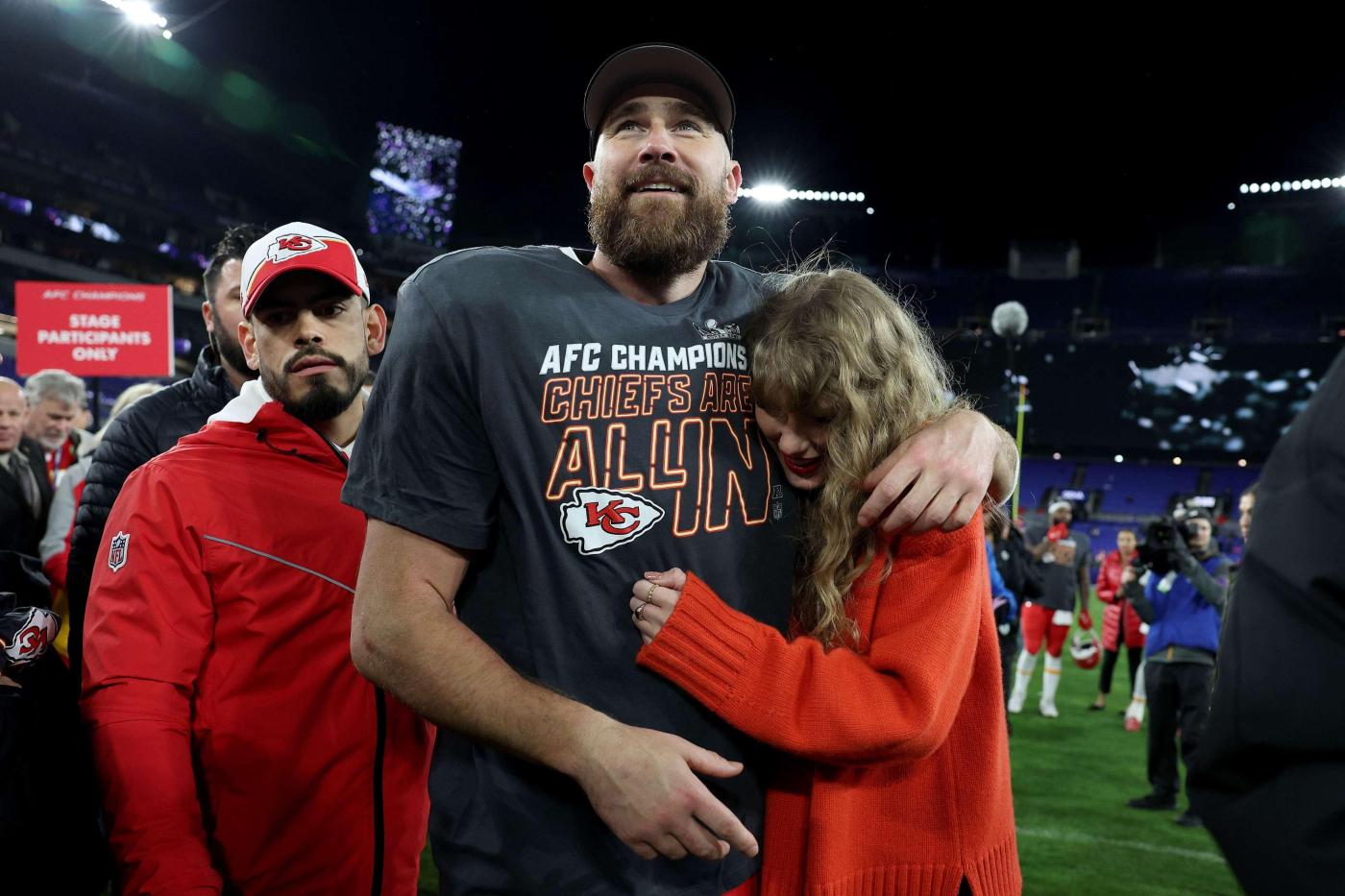
President Joe Biden’s team looks to Taylor Swift for a touchdown. Considering the obvious ability that pop star Taylor Swift and her NFL star boyfriend, Travis Kelce, have shown for stealing the limelight, it comes as little surprise that, without even trying, they have generated their own conspiracy theory, too.

Long-standing conspiracy theories about the NFL and the “deep state” and other far reaches of the fever swamps produced a photo on the Twitter account @NFL_Memes that claimed a connection between Super Bowl logo colors and the teams playing in the big game itself. In response, faster than you could say “touchdown,” right-wing conspiracy theorists were claiming Swift’s involvement with Kelce of the Kansas City Chiefs is really part of a plot to gin up support for Biden in the 2024 election.

Considering the lackluster state of Biden’s campaign, the president needs all the help he can get. Besides, the success of Swift and her record-breaking Eras Tour have made this such a successful time for the pop star that it is not surprising to see the Biden campaign dream of sharing some of the glory and good fortune.

After all, it didn’t hurt Biden to have Swift’s endorsement in 2020. Last year a single Instagram post from her led to 35,000 new voter registrations. Even if old-timer football personalities disparage the couple’s star appeal as a big distraction, as retired coach Tony Dungy did recently, the entertainment industry known as the NFL has to be delighted with the publicity, merch sales and other revenue that the fun couple has brought to the sport.

Just as John F. Kennedy enlivened the White House with Frank Sinatra and his “Rat Pack” of pals and began a long-running tradition of Hollywood hobnobbing with presidents — mostly Democrats, as it turned out — today’s campaigns seek their own stars and welcome those who come along. As it struggles to hang onto such core constituencies as young liberals and people of color, at least according to polls, the Biden campaign has begun discussions with celebrities and social media stars about promoting Biden on Instagram and TikTok.

Old-school pols made good use of TV ads. Given today’s sensibilities, Biden’s campaign has enlisted “influencers” with a following on Instagram and TikTok — which I’m going to figure out one of these days.

Biden’s plan, insiders say, leans toward direct assaults on Trump and a big emphasis on abortion rights — an easy issue to contrast with sound bites of Trump boasting about picking Supreme Court justices who overturned Roe v. Wade. Democratic success at restoring abortion rights in red states that have put the issue to a referendum justifiably encourages the Biden campaign, but it’s likely not enough by itself to defeat Trump.

Biden’s campaign reportedly believes that the more the public sees and hears Trump brag about wanting to be “a dictator on day one,” the more voters will be brought to their side on issues like abortion and health care. Such a reversal won’t come easily. No one seems to thrive as much off of criminal indictments as Trump does.

But it’s still early in the campaign calendar and there’s still hope, according to longtime supporters. One who knows how that works is Rep. James Clyburn, a South Carolina Democrat and key Biden ally, who was credited with Biden’s crucial turnaround in 2020. He told The New York Times that Democrats needed to make an affirmative case and remind voters of tangible changes to their lives — like capping insulin costs, infrastructure cash for roads and bridges and other important promisesBiden kept.

But those “promises kept” have not mattered enough to younger and more progressive voters who have not given the administration much credit for itsaccomplishments — or harbor, in many cases, resentment toward Team Biden’s support for Israel’s war against Hamas. Complex issues like that are not easily debated in the midst of a presidential campaign, but campaigns are, after all, a nation’s sometimes ungainly debate over issues determining its future.

Politics often look like a game, but now it’s time to get serious.

cpage@chicagotribune.com

Twitter @cptime

()

Europe’s world-first AI rules get final approval from lawmakers. Here’s what happens next

posted in: Society | 0

By Kelvin Chan, Associated Press 

LONDON (AP) — European Union lawmakers gave final approval to the 27-nation bloc’s artificial intelligence law Wednesday, putting the world-leading rules on track to take effect later this year.

Lawmakers in the European Parliament voted overwhelmingly in favor of the Artificial Intelligence Act, five years after regulations were first proposed. The AI Act is expected to act as a global signpost for other governments grappling with how to regulate the fast-developing technology.

“The AI Act has nudged the future of AI in a human-centric direction, in a direction where humans are in control of the technology and where it — the technology — helps us leverage new discoveries, economic growth, societal progress and unlock human potential,” Dragos Tudorache, a Romanian lawmaker who was a co-leader of the Parliament negotiations on the draft law, said before the vote.

Big tech companies generally have supported the need to regulate AI while lobbying to ensure any rules work in their favor. OpenAI CEO Sam Altman caused a minor stir last year when he suggested the ChatGPT maker could pull out of Europe if it can’t comply with the AI Act — before backtracking to say there were no plans to leave.

Here’s a look at the world’s first comprehensive set of AI rules:

HOW DOES THE AI ACT WORK?

Like many EU regulations, the AI Act was initially intended to act as consumer safety legislation, taking a “risk-based approach” to products or services that use artificial intelligence.

The riskier an AI application, the more scrutiny it faces. The vast majority of AI systems are expected to be low risk, such as content recommendation systems or spam filters. Companies can choose to follow voluntary requirements and codes of conduct.

High-risk uses of AI, such as in medical devices or critical infrastructure like water or electrical networks, face tougher requirements like using high-quality data and providing clear information to users.

Some AI uses are banned because they’re deemed to pose an unacceptable risk, like social scoring systems that govern how people behave, some types of predictive policing and emotion recognition systems in school and workplaces.

Other banned uses include police scanning faces in public using AI-powered remote “biometric identification” systems, except for serious crimes like kidnapping or terrorism.

WHAT ABOUT GENERATIVE AI?

The law’s early drafts focused on AI systems carrying out narrowly limited tasks, like scanning resumes and job applications. The astonishing rise of general purpose AI models, exemplified by OpenAI’s ChatGPT, sent EU policymakers scrambling to keep up.

They added provisions for so-called generative AI models, the technology underpinning AI chatbot systems that can produce unique and seemingly lifelike responses, images and more.

Developers of general purpose AI models — from European startups to OpenAI and Google — will have to provide a detailed summary of the text, pictures, video and other data on the internet that is used to train the systems as well as follow EU copyright law.

AI-generated deepfake pictures, video or audio of existing people, places or events must be labeled as artificially manipulated.

There’s extra scrutiny for the biggest and most powerful AI models that pose “systemic risks,” which include OpenAI’s GPT4 — its most advanced system — and Google’s Gemini.

The EU says it’s worried that these powerful AI systems could “cause serious accidents or be misused for far-reaching cyberattacks.” They also fear generative AI could spread “harmful biases” across many applications, affecting many people.

Companies that provide these systems will have to assess and mitigate the risks; report any serious incidents, such as malfunctions that cause someone’s death or serious harm to health or property; put cybersecurity measures in place; and disclose how much energy their models use.

DO EUROPE’S RULES INFLUENCE THE REST OF THE WORLD?

Brussels first suggested AI regulations in 2019, taking a familiar global role in ratcheting up scrutiny of emerging industries, while other governments scramble to keep up.

In the U.S., President Joe Biden signed a sweeping executive order on AI in October that’s expected to be backed up by legislation and global agreements. In the meantime, lawmakers in at least seven U.S. states are working on their own AI legislation.

Chinese President Xi Jinping has proposed his Global AI Governance Initiative for fair and safe use of AI, and authorities have issued “ interim measures ” for managing generative AI, which applies to text, pictures, audio, video and other content generated for people inside China.

Other countries, from Brazil to Japan, as well as global groupings like the United Nations and Group of Seven industrialized nations, are moving to draw up AI guardrails.

WHAT HAPPENS NEXT?

The AI Act is expected to officially become law by May or June, after a few final formalities, including a blessing from EU member countries. Provisions will start taking effect in stages, with countries required to ban prohibited AI systems six months after the rules enter the lawbooks.

Rules for general purpose AI systems like chatbots will start applying a year after the law takes effect. By mid-2026, the complete set of regulations, including requirements for high-risk systems, will be in force.

When it comes to enforcement, each EU country will set up their own AI watchdog, where citizens can file a complaint if they think they’ve been the victim of a violation of the rules. Meanwhile, Brussels will create an AI Office tasked with enforcing and supervising the law for general purpose AI systems.

Violations of the AI Act could draw fines of up to 35 million euros ($38 million), or 7% of a company’s global revenue.

This isn’t Brussels’ last word on AI rules, said Italian lawmaker Brando Benifei, co-leader of Parliament’s work on the law. More AI-related legislation could be ahead after summer elections, including in areas like AI in the workplace that the new law partly covers, he said.

Second Time’s the Charm? NY Legislature Angles For Broad Housing Deal

posted in: Politics | 0

With the state’s annual spending plan due in less than three weeks, the Senate and Assembly are calling for a housing plan that both incentivizes development and protects tenants from eviction. 

NYS Senate Media Services

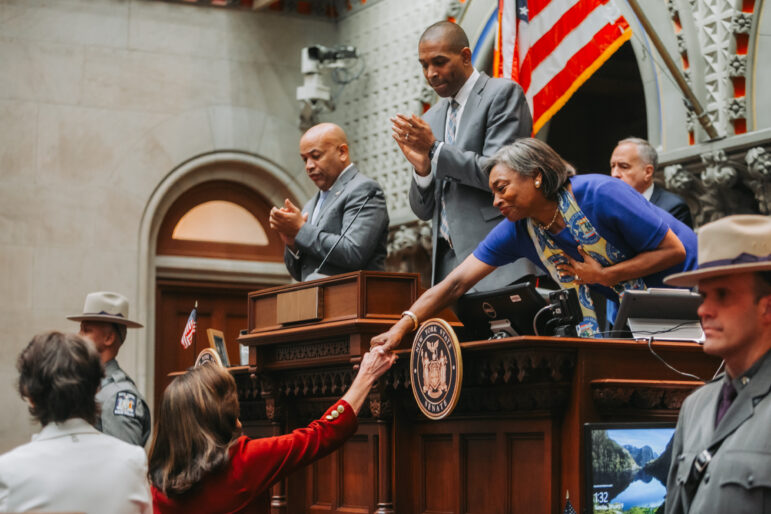
Majority Leader Andrea Stewart-Cousins greats Governor Kathy Hochul ahead of her State of the State address in January. Assembly Speaker Carl Heastie, far left, applauds.

Second time’s the charm? 

Last June, as the legislative session was coming to an end, Senate Majority Leader Andrea Stewart-Cousins and Assembly Speaker Carl Heastie released a laundry list of policies to expand the state’s housing supply and keep renters in place—endorsing them even as they kicked the can down the road.

“Unfortunately, it was clear that we could not come to an agreement with the governor on this plan,” the state legislative leaders wrote. Though details were thin, the list included a plan to boost affordable housing production, a statewide rental voucher program, a path to repair “dilapidated” apartments, and good cause eviction protections.

By this point, Gov. Kathy Hochul’s signature 2023 proposal to double New York’s housing supply over the coming decade under threat of local zoning overrides had fizzled.

Fast forward a year, and the governor has not tried to revive her “stick” approach to housing production, which hit a wall with legislators from New York City’s outer boroughs and the near-city suburbs. But Hochul’s priorities still veer from the Legislature’s, as demonstrated by the latters’ newly-released budget proposals. 

With the state’s annual spending plan due in less than three weeks, the Senate and Assembly called this week for a housing deal that both incentivizes development and protects tenants. But Hochul, who has substantial leverage in budget negotiations, has insisted that these topics should be addressed separately. 

“I’ve always talked about the need to protect our tenants,” Hochul told reporters in February. “However, they should not be conflated. I’m talking about supply. Regulations related to tenants do not get me more supply; they don’t build more housing in every corner of the state. So, they’re two different conversations.” 

Good Cause clash 

Hochul has yet to entertain Brooklyn Sen. Julia Salazar’s good cause legislation, a third-rail for the real estate industry that would give tenants across the state a defense against eviction so long as they keep up with their rent, as well as leverage to challenge steep rent increases. Landlords claim it would discourage development. 

But the Senate said this week that it supports “advancing tenant protections that align with the core principles of Good Cause Eviction,” as a condition for other proposals, like a new tax incentive in New York City

“The core principle of good cause is that people should not be evicted from their home for no good reason,” Senate Housing Committee Chair Brian Kavanagh told City Limits Tuesday. 

And while the Assembly doesn’t reference the bill explicitly, a summary of its budget priorities states the body is “committed to addressing the state’s affordable housing shortage by enacting statewide policies that protect tenants from arbitrary and capricious rent increases and unreasonable evictions of paying tenants.” 

Chris Janaro

State Sen. Julia Salazar at a rally outside 63 Tiffany Place in Brooklyn, calling for passage of good cause eviction legislation on Feb. 22, 2024.

The Assembly went on to endorse “strong labor standards” in any housing deal, along with development incentives and funding for existing Mitchell-Lama programs: subsidized apartments and co-ops developed in New York City between 1955 and 1981. 

Good cause is “just two words,” Assemblymember Linda Rosenthal, chair of her body’s housing committee, told City Limits Tuesday, arguing that the language “captures the essence” of the proposal. 

Rosenthal went on to express optimism about the possibility of a broader deal, despite last year’s impasse. “I think the need is more urgent on all fronts,” she said. “I would not assume anything negative this year, because all sides want to accomplish something.” 

Spending priorities 

Other overlapping proposals from the Senate and Assembly include $250 million to launch the Housing Access Voucher Program, a statewide rental subsidy modeled after the federal Section 8 program, and $40 million for the Homeowner Protection Program, an anti-foreclosure project that tends to be left out of executive budget proposals. 

The Senate also put forward $5 million for an Office of Civil Representation to expand tenants’ access to lawyers in eviction cases, while the Assembly proposed $10 million. Both bodies declined to endorse a path to legalization for basement and cellar apartments, a priority for New York City Mayor Eric Adams that Hochul backs. 

The Senate and Assembly also put forward ideas for building housing on state-owned land. The former proposed $250 million for a New York Housing Opportunity Corporation, billed as Mitchell-Lama 2.0, while the Assembly pitched $500 million for Foundations for Futures, a limited-equity co-op plan it tried for last year. 

Hochul’s plan includes $500 million for housing development on state-owned land, which she estimates could produce 15,000 housing units. “I’m obviously entertaining what they put forth,” she said Tuesday, of the Senate proposal. “My job is to assess and analyze this, and how this fits into the overall objective, which is to start building again.” 

Unique to the Senate’s budget plan are amendments to the state’s social services law, expanding eligibility for emergency rent payments known as one-shot deals. The language increases the eligibility threshold from 125 percent to 200 percent of the federal poverty line and, significantly, removes a requirement to repay the grant. 

The Senate also included $50 million to fund one-shots statewide. “We think that will dramatically decrease the rate of evictions across the state,” Kavanagh said. Deborah Berkman, supervising attorney of the Shelter Advocacy Initiative at New York Legal Assistance Group, called the proposal “huge.” 

“In general, paying back one-shot deals is a crushing hurdle that people can’t get through,” she said. 

Vacancy debate 

Earlier this session, landlord trade organizations began pushing for various proposals to increase rents on regulated apartments—which benefit from annual lease renewals and limited rent adjustments—arguing that some share of empty units won’t be rentable without a boost. 

But neither the Senate or the Assembly endorsed a bill to increase rents on vacant units following a tenancy of at least 10 years. 

There were about 26,300 rent stabilized apartments both vacant and unavailable for rent in 2023, according to the latest Housing Vacancy Survey (HVS). Yet Rosenthal and Kavanagh both said Tuesday that a much smaller universe of apartments are both low-cost and in such poor shape that landlords cannot fix them without raising rents. 

A new HVS analysis by Comptroller Brad Lander noted that north of 3,000 rent stabilized apartments were deemed dilapidated or uninhabitable in 2023. And at a recent City Council hearing, the New York City Department of Housing Preservation and Development estimated that about 1,730 apartments renting for $1,500 or less had been held off the market for a year or more. 

In June 2019, New York passed the Housing Stability and Tenant Protection Act (HSTPA), multi-part legislation that eliminated most avenues for landlords of stabilized buildings to increase rents between tenancies.

“I worked very hard to negotiate the HSTPA in 2019 and I am not supportive of anything that’s going to undermine that work that we did,” Kavanagh told City Limits Tuesday. 

But the Senate did signal that it is open to increasing the cost of renovations, known as Individual Apartment Improvements (IAIs), that can go toward a rent increase. The current cap is $15,000 over 15 years, and rents can increase 1/168th or 1/180th of the cost, depending on the building size.  

“For starters there’s been some inflation since 2019, so certainly if you want to have something that’s functionally equivalent you’d raise [it] a little bit,” Kavanagh said. The Senate also proposed a $40 million fund to bring apartments in small stabilized buildings up to code.

Ellen Davidson, a staff attorney with the Legal Aid Society who lobbies for her organization’s priorities in Albany, said she was open to an adjustment for IAIs. “I do think that maybe it should have been tied to inflation,” she said. 

But Jay Martin of the Community Housing Improvement Program, which has pushed for a rent reset following tenancies of at least a decade, dismissed the IAI language and repairs fund in a statement as “insufficient.” 

Sherwin Belkin, a partner with Belkin Burden Goldman LLP who represents landlords, said increasing the IAI cap without allowing a larger share to go toward rent increases would be like “giving ice in the winter.” 

Weeks ahead 

Cea Weaver, campaign coordinator for the statewide tenant coalition Housing Justice for All, took a harder line on IAIs, pointing to the small number of low-cost apartments held offline for a year or more identified in the HVS. 

“There’s no reason to change wholesale policy for hundreds of thousands of apartments for such a small problem,” she said. 

Looking ahead, Weaver added, her coalition is focused on a housing deal that includes statewide good cause eviction protections. Allowing localities outside of New York City to opt into the program would not be acceptable, she said. Nor would a version of good cause with exclusions beyond owner-occupied buildings with less than four units. 

The Senate budget proposal includes the words “good cause,” albeit linked to a New York City tax incentive. The Assembly proposal doesn’t use those exact words, but Weaver said she was heartened by their use of the word “statewide.”

“Given the pressure to make a New York City-only version of the policy, the word ‘statewide’ is pretty important,” she said.

To reach the reporter behind this story, contact Emma@citylimits.org. To reach the editor, contact Jeanmarie@citylimits.org

US lawmakers say TikTok won’t be banned if it finds a new owner. But that’s easier said than done

posted in: Society | 0

By Matt O’Brien, Associated Press

U.S. lawmakers are threatening to ban TikTok but also say they are giving its Chinese parent company a chance to keep it running.

The premise of a bipartisan bill passed by the U.S. House of Representatives on Wednesday is that TikTok fans in the U.S. can keep scrolling through their favorite social media app so long as Beijing-based ByteDance gives up on owning it.

“It doesn’t have to be this painful for ByteDance,” U.S. Rep. Raja Krishnamoorthi, an Illinois Democrat and bill co-sponsor, recently posted on X. “They could make it a lot easier on themselves by simply divesting @tiktok_us. It’s their choice.”

But it’s not going to be as simple as lawmakers are making it sound, according to experts.

WHO WOULD BUY TIKTOK?

While some people have voiced an interest in buying TikTok’s U.S. business — among them “Shark Tank” star Kevin O’Leary — there are a number of challenges including a 6-month deadline to get it done.

Related Articles

National Politics |


House passes bill that would lead to a TikTok ban if Chinese owner doesn’t sell. Senate path unclear

National Politics |


Washington County has new fire-suppression devices, and one already helped save a St. Paul Park home

National Politics |


TikTok bill heads to House floor as Trump backs away from ban

National Politics |


Most teens report feeling happy or peaceful when they go without smartphones, Pew survey finds

National Politics |


How Netflix survived the streaming wars to stay the subscription video king

“Somebody would have to actually be ready to shell out the large amount of money that this product and system is worth,” said Stanford University researcher Graham Webster, who studies Chinese technology policy and U.S.-China relations. “But even if somebody has deep enough pockets and is ready to go into negotiating to purchase, this sort of matchmaking on acquisitions is not quick.”

Big tech companies could afford it but would likely face intense scrutiny from antitrust regulators in both the U.S. and China. Then again, if the bill actually becomes law and survives First Amendment court challenges, it could make TikTok cheaper to buy.

“One of the main effects of the legislation would be to decrease the sale price,” said Matt Perault, director of the University of North Carolina’s Center on Technology Policy, which gets funding from TikTok and other tech companies. “As you approach that 180-day clock, the pressure on the company to sell or risk being banned entirely would be high, which would mean probably the acquirers could get it at a lower price.”

HOW WOULD IT WORK?

The bill — which now moves to the U.S. Senate — calls for prohibiting TikTok in the U.S. but makes an exception if there’s a “qualified divestiture.”

That could only happen if the U.S. president determines “through an interagency process” that TikTok is “no longer being controlled by a foreign adversary,” according to the bill. Not only that, but the new U.S.-based TikTok would have to completely cut ties with ByteDance. That includes no more “cooperation with respect to the operation of a content recommendation algorithm or an agreement with respect to data sharing.”

It reflects longstanding concerns that Chinese authorities could force ByteDance to hand over data on the 170 million Americans who use TikTok. The worry stems from a set of Chinese national security laws that compel organizations to assist with intelligence gathering.

It’s an unusual bill in the way that it targets a single company. Typically, a government group led by the Treasury secretary called the Committee on Foreign Investment in the United States, or CFIUS, will review whether such a sale would pose any national security threats.

HASN’T THIS HAPPENED BEFORE?

Yes. The Trump administration brokered a deal in 2020 that would have had U.S. corporations Oracle and Walmart take a large stake in TikTok on national security grounds.

The deal would have also made Oracle responsible for hosting all TikTok’s U.S. user data and securing computer systems to ensure national security requirements are satisfied. Microsoft also made a failed bid for TikTok that its CEO Satya Nadella later described as the “strangest thing I’ve ever worked on.”

Instead of congressional action, the 2020 arrangement was in response to then-President Donald Trump’s series of executive actions targeting TikTok.

But the sale never went through for a number of reasons. Trump’s executive orders got held up in court as the 2020 presidential election loomed. China also had imposed stricter export controls on its technology providers.

Incoming President Joe Biden in 2021 reversed course and dropped the legal proceedings. Now Biden says he’s in favor a bill that would ban TikTok if ByteDance won’t divest, and Trump is not.