Autopsy: Willmar man died of head injury after being shocked with Taser during eviction attempt

posted in: Society | 0

WILLMAR, Minn. — The death of a Willmar man after a sheriff’s deputy shocked him with a Taser during an attempted eviction in January has been ruled a homicide by the Midwest Medical Examiner’s Office.

According to medical examiners, 75-year-old Michael Yanacheak’s death was caused by blunt-force head injuries suffered when he fell after being shocked with the stun gun.

The Minnesota Bureau of Criminal Apprehension is investigating the matter. The BCA previously identified Yanacheak and Kandiyohi County Sheriff’s Deputy Riley Kampsen as the officer who deployed his Taser.

The BCA previously stated two Kandiyohi County sheriff’s deputies and two Willmar police officers went to Yanacheak’s apartment on the morning of Jan. 29 to perform a court-ordered eviction. Law enforcement tried to persuade Yanacheak to open his door, but he did not respond.

After about an hour, the property manager pried open the door and officers entered to find Yanacheak in a bedroom, where law enforcement agencies stated he picked up a kitchen knife and began to walk toward the officers.

According to the BCA, officers attempted to retreat, but at one point, Kampsen deployed his Taser. Sheriff Eric Tollefson stated in an initial news release that officers provided lifesaving medical care at the scene until Yanacheak could be taken to a hospital.

Kampsen and the two Willmar police officers involved were wearing body cameras. The BCA previously said all available video would be reviewed as part of the investigation. Upon completion, the BCA will present its findings to the Kandiyohi County Attorney’s Office for review.

Yanacheak grew up in Willmar and graduated in 1968 from Willmar High School. He served in the Army during the Vietnam War, according to his obituary. He later worked as a security officer at the Minnesota State Capitol in St. Paul and returned to Willmar following his retirement.

Related Articles

Crime & Public Safety |


In a first, goat in west-central Minnesota tests positive for avian influenza virus

Crime & Public Safety |


Homelessness down 7% in Minnesota since 2018, study says

Crime & Public Safety |


Minnesota court rules pharmacist discriminated against woman in denying emergency contraception

Crime & Public Safety |


Walz seeks $16 million to support struggling EMS providers in greater Minnesota

Crime & Public Safety |


MacKenzie Scott donates $18 million to 9 Twin Cities nonprofits

F.D. Flam: Not even Antarctica could stop COVID. It’s a crucial lesson.

posted in: Society | 0

COVID-19 wasn’t supposed to get to Antarctica. If any place had a hope of keeping the virus out, it would be a continent with no permanent residents and an annual visiting population of only 5,000. And every control measure was in place — testing, a strict quarantine of everyone visiting, as well as lots of deep sanitation, masks and social distancing.

And yet the virus got there in December 2020, less than a year into the pandemic. It arrived at the Chilean base first, spreading to at least 36 people. It later reached the Belgian base, and the Argentinian base, as well as French and British outposts. In 2022, there was a big outbreak at the U.S. McMurdo station, one at New Zealand’s Scott base and even a few cases at the South Pole.

Four years after the start of the pandemic, the frozen continent holds a lesson for the world in how much control we ever had over COVID. Back in March 2020, leaders worldwide talked about getting things under control, without thinking through what this entailed.

COVID in Antarctica “tells us a lot about human arrogance in terms of being above nature and being able to manage all that happens in nature,” said Daniela Liggett, a social scientist at the University of Canterbury who studies Antarctic politics and environmental management. “We couldn’t even lock away this one piece of the planet where nobody lives and protect it from the virus.” She explored the situation and its implications in a paper earlier this month in the journal Science Advances.

Humanity can control what we dump into the environment and emit into the atmosphere. We can exert some control over activities that might transfer animal viruses to humans. But after the fact, it’s nearly impossible to hoover up plastic pollution or cool our artificially warmed planet or control a virus that’s already spread far and wide.

By the end of March 2020, COVID had reached every continent on the planet except for Antarctica, where the summer research season was underway. Before that season was over, most research and tourism to the continent was paused. Scientists scheduled to continue experiments or collect field data were kept out. As months went by, Antarctica went into its dark, cold winter season, and its small skeleton crews remained isolated.

When the next summer research season began in late 2020, however, some researchers and support staff were allowed to return following a strict quarantine. To get to the New Zealand base, people had to be tested and then hole up alone in a hotel room for two weeks, Liggett said, while continuing to undergo daily testing. Once vaccines became available to the general public, the US programs and others required everyone to be up to date on their shots.

Despite all this, disease found a way to sneak in and spread.

That doesn’t mean that Antarctica’s policy was a failure. (I couldn’t find a record of any deaths.) It showed the futility of going for total containment or elimination by cancelling activities and then using quarantines, testing and masks. But rejecting all those measures would have increased the number of cases and the odds that people would die. Before the vaccines became available, it wasn’t all that rare for seemingly healthy people to get a severe case. Such cases would be more likely to turn deadly in a remote outpost far from a hospital.

The decision to resume Antarctic research activity struck a balance between the risks of disease and the benefits of conducting research that can’t be done elsewhere. The few Antarctic regions not covered in ice are full of lakes where scientists have found improbable life forms, giving them clues to the way life might survive on other worlds. Some scientists are monitoring the effects of global warming on the ice sheets, and others are monitoring the accumulation of microplastics and PFAS (forever chemicals) on the Antarctic ice and in the surrounding seas. Others study ghostly particles or astrophysical phenomena.

Shutting down everything even for part of one season had consequences. Careers were derailed, said Liggett, because researchers couldn’t get to the continent to finish field studies or experiments. For young investigators in competitive fields, that could make the difference between getting established and starting over.

Now, she said, researchers in Antarctica don’t spend all that much time worrying about COVID. They’ve moved on — because that’s what everyone is doing worldwide. And doing research in such extreme conditions has always required some appetite for balancing risk and reward.

Today, fact checkers, ignoring the complexity of the real world, try to argue that the virus is “under control” in the U.S. despite a continued weekly death toll in the hundreds. But what counts as “under control” is inherently subjective and often politically malleable.

We can’t control what’s already unleashed. Perhaps the best we can hope for is finding a balance, imposing some precautions but also accepting some risk.

F.D. Flam is a Bloomberg Opinion columnist covering science. She is host of the “Follow the Science” podcast.

Related Articles

Opinion |


Jay Ambrose: The test Biden can’t pass

Opinion |


Thomas Friedman: What Schumer and Biden got right about Netanyahu

Opinion |


F.D. Flam: Do you really want to find out if you’ll get Alzheimer’s?

Opinion |


Stephen L. Carter: What leash laws for dogs tell us about humans

Opinion |


Andreas Kluth: Don’t fear AI in war, fear autonomous weapons

Developing St. Paul’s Midway: A new hotel, office building, 90-foot-wide loon …

posted in: News | 0

The primary structures of a sizable new playground are now in the ground by Allianz Field, the professional soccer stadium in St. Paul’s Midway.

A sculpted loon measuring some 35 feet in height, with a wing span 90 feet across, will roll in from Los Angeles this summer and land, permanently, at the southeast corner of Snelling and University avenues, arriving in as many as 40 pieces and four truckloads.

On April 1, the St. Paul Board of Zoning Appeals will host a public hearing on a series of variance requests related to two single-story food pavilions proposed along the eastern edges of United Village’s “Great Lawn.” The pavilions, with covered outdoor dining terraces, will host both a full-service restaurant and more casual dining between extensions of Asbury, Simpson and Spruce Tree streets, just south of an eight-story, 160-unit hotel and adjoining parking ramp planned along University Avenue.

As for the longstanding McDonald’s on University Avenue, its lease ends in December. Demolition could follow.

A rendering depicting the pedestrian plaza that would connect two single-story food pavilions along the east end of the Great Lawn, the greenery at the center of the United Village area surrounding Allianz Field in St. Paul’s Midway. (Courtesy of Snelling-Midway Redevelopment)

‘Superblock’

After years of waiting for real estate development to fill in the empty lots of the 35-acre Snelling-Midway “superblock,” neighborhood advocates are cautiously optimistic that United Village will become reality.

On the horizon, at least in concept drawings, is some $200 million in private real investment, on top of upwards of $6 million in contributions from Dr. Bill McGuire’s family foundation for the new all-abilities playground and the acre-sized sculpture garden.

“Allianz Field has many great features,” said McGuire, owner of the Minnesota United soccer team, addressing neighborhood residents last week during a community forum at Allianz Field. “One of them is its architecture … but its greatest feature is how it works for people. That’s the reason it was voted the No. 1 experience in any stadium in North America, and I think this represents an opportunity to do very similar things in the community.”

McGuire, who recently paid $54 million to buy 10 parcels of land from former property owner RK Midway, has now taken the lead in redeveloping the 35 acres once associated with the former Midway Shopping Center and a blighted bus storage lot.

More than ever, it’s put him front and center in discussions about the future of not just the stadium, but the well-being of the surrounding Midway neighborhood, which has lost a series of anchor restaurants and retailers over the past four years.

A rendering showing the future layout of the United Village area surrounding Allianz Field in St. Paul’s Midway. (Courtesy of Snelling-Midway Redevelopment)

A chain-link fence that separated the empty lots near Snelling and University avenues from the community was not his idea, said McGuire, responding last week to a question from the audience. He pinned blame squarely on the city and the Minnesota Department of Transportation.

“We should get our facts straight,” he said. “Bill McGuire had nothing to do with that fence. I neither asked for it nor condoned it.”

He hopes to turn the perception of blight around, but even if financing comes through this summer, construction of four new buildings will take 14 to 16 months, he said.

“Our intent is to do them all together,” he said.

Goodbye, McDonald’s — unknowns ahead

Creation requires destruction, and the lease held by the superblock’s last remaining commercial tenant — the drive-through McDonald’s — ends at the end of December, setting the stage for demolition and then hotel construction about a year from now. Asbury Street will be extended through the center of what had been the fast food restaurant, completing the street grid.

An architectural rendering of a proposed eight-story hotel to be built by the Allianz Field soccer stadium in St. Paul, with a south wall entrance facing the “Great Lawn” and a north wall entrance set back several dozen feet from University Avenue to accommodate a passenger drop-off loop running the length of the building.(Courtesy of Snelling-Midway Redevelopment)

McGuire informed residents that the proposed parking structure adjoining the hotel will feature a public restroom with outside access from the Great Lawn, an amenity that many see as important toward elevating the green space into a true community asset.

There are still many unknowns. If McGuire has a hotel partner in mind, he’s staying mum. For the two food pavilions, “exact operators have not been selected,” reads the supporting materials behind the variance requests, which mostly center on ground-floor windows and door openings.

It’s unclear if the management behind Minnesota United will relocate from Golden Valley and move into an airy, four-story office building, depicted in conceptual renderings with large glass windows and wide-open work areas.

Ground-level restaurants and retailers also are expected in the hotel and office building, but those partners haven’t been chosen, either. McGuire said he had no interest in big-box retail or national chains and was courting smaller, locally-driven ventures. He said he was excited about “the opportunity (United Village) represents for the community and for the city to express itself and bring new and interesting things to the area. … I think it remains up in the air what the retail will ultimately be. You all can look around and see that retail has a lot of empty space.”

Other challenges ahead

There are other challenges ahead. Finding financing for the hotel, office building and two food pavilions has been a difficult slog, in part due to interest rates that have risen to “8 1/2% or 9% if they like you,” McGuire said. “This a terrible market … globally for financing, getting debt and finding investors in particular projects. That is a full-time occupation and a half, and not easy.”

Nevertheless, “I remain confident that we have the people in this that will step forward,” he added. “They have committed to that, and I expect them to be there. Hopefully, we can be shoveling, at least moving some dirt around in a few areas, specifically the office building and the restaurants in late summer.”

Some residents have expressed concern that the proposed buildings will be situated to present their back doors to the surrounding neighborhood. McGuire said the goal is to form a ring around the Great Lawn, elevating the space as a center of activity while promoting foot traffic, almost like the quad of a college green.

“Virtually every street (will be) bounded by sidewalks in a world where there was once no sidewalks,” McGuire said. “These are 12- and 15-foot sidewalks, which are very large, I suspect larger than any sidewalks you could find in the Twin Cities almost.”

As the four buildings come online, street improvements and other public amenities will be paid for in large part through property tax incentives known as tax increment financing, which the St. Paul City Council approved in 2021. The $209 million “TIF” district effectively redirects payments that would otherwise flow to city, county and school district tax coffers over the course of 26 years, focusing them instead on on-site land improvements.

“The city is making a real commitment in TIF, but it is spread out for years to come,” McGuire said. “If the buildings don’t happen, TIF doesn’t happen.”

The March 14 community discussion was hosted by the Hamline Midway Coalition and Union Park District Council.

Related Articles

Local News |


Ooey, gooey, delicious: Six of the best hot cheese dishes on Twin Cities restaurant menus

Local News |


St. Catherine University appoints veteran college administrator as new president

Local News |


Prosecutors: St. Paul officer’s fatal shooting of man, 65, was legally justified

Local News |


Mother of 23-year-old fatally shot in St. Paul: ‘There will be justice for Devon’

Local News |


St. Paul man pleads guilty to stabbing wife to death during Bible study

Ooey, gooey, delicious: Six of the best hot cheese dishes on Twin Cities restaurant menus

posted in: News | 0

Typically, when it’s chilly and dreary outside, there’s nothing like hot, melty cheese to warm up your body and spirit.

The weather this winter, of course, was anything but typical — though that hasn’t exactly slowed down my cheese consumption. Maybe this year, I’m turning toward comforting, cheesy foods less to power through the cold months and more to cope with the deterioration of our climate. But hey, either way, melty cheese is still very much on the menu in my life.

And as a former cheesemonger, I’m always delighted by dishes that make cheese the star in engaging, delicious ways. Sometimes this means sticking with tradition, as the Lowell Inn in Stillwater does with its multi-course fondue dinners, and sometimes it calls for a little experimentation.

Here are six of the melty-cheese dishes I’ve enjoyed at restaurants around St. Paul and the Twin Cities this winter.

Aligot at Maison Margaux

“It’s mashed potatoes!” … “It’s cheese fondue!” … No, it’s aligot! (Cue the “Superman” intro music.)

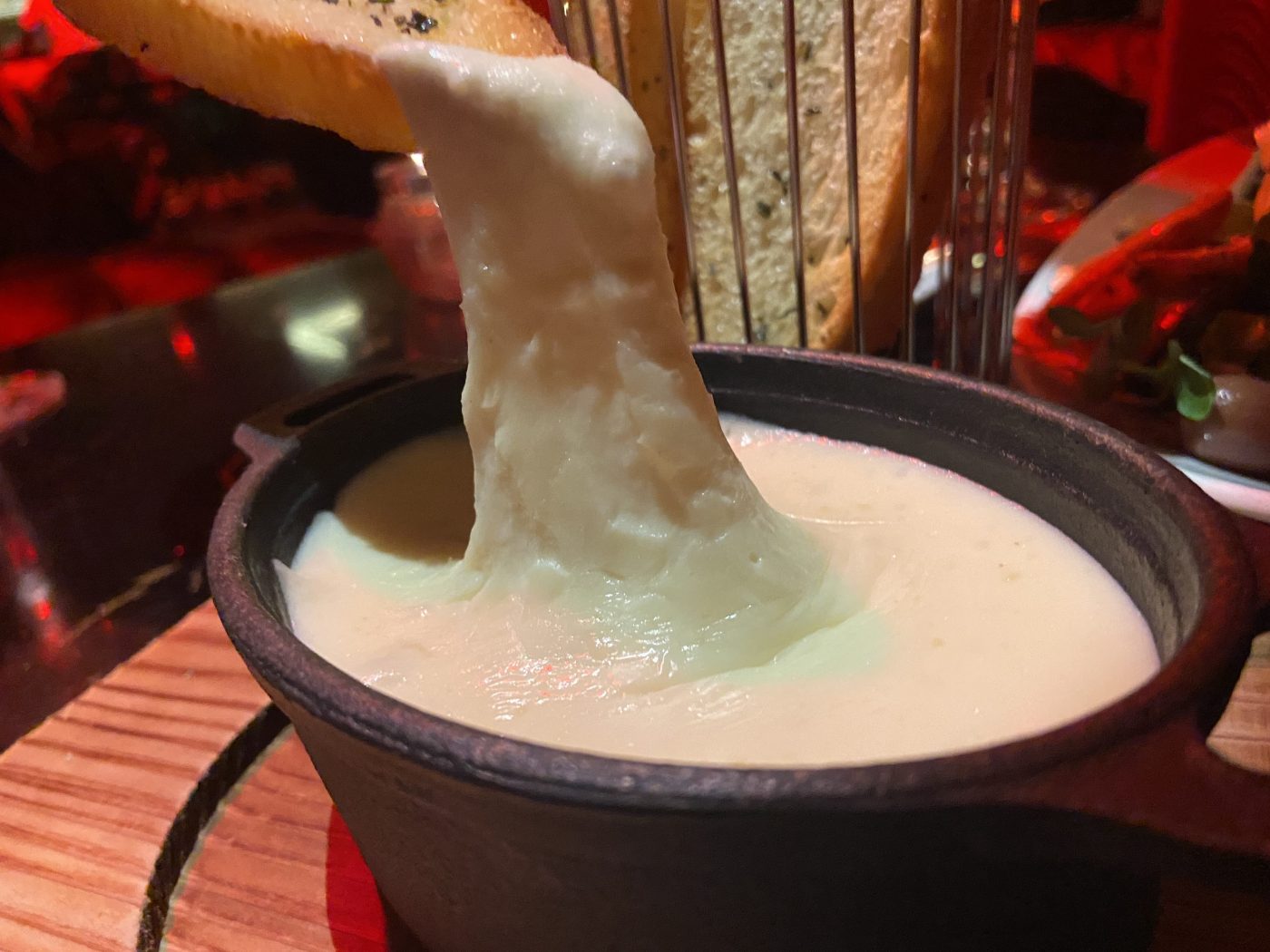
I don’t think it’s an exaggeration to say aligot deserves superhero status. The dish comes from south-central France and involves slowly adding plenty of cheese into mashed or riced potatoes, over low heat, until it’s all melted together into a silky dip that’s stretchy enough to go viral on Instagram.

It’s worth the trek to the North Loop to find aligot at Maison Margaux, the French restaurant chef David Fhima opened last year. The dish arrives at your table in a fairly anonymous way, ungarnished in a metal crock, alongside bread for dipping. As you dig in, you’ll find it’s indulgent, but hearty. On second thought, maybe it would be more accurate to say aligot is my kryptonite.

Maison Margaux: 224 1st St. N, Minneapolis; 612-900-1800; maisonmargauxmpls.com

Formaggio di Capra at DeGidio’s

The formaggio di capra appetizer at DeGidio’s, on West Seventh, consists simply of red sauce and goat cheese, as shown here Feb. 16, 2024. The dish, delightfully rich and tangy, is served with toast. (Jared Kaufman / Pioneer Press)

This appetizer is simple DeGidio’s glory at its best: a bowl of the restaurant’s unmatched red sauce with chunks of creamy, tangy goat cheese plopped in. It’s served with grilled toast. Done and done.

Against the rich and herbaceous marinara, the sweet acidity of the goat cheese really helps lighten and brighten the dish — probably more so than other, more mild cheeses like ricotta would. I am a goat cheese fan and I respect that some people are not, but I personally find the chèvre here to be more fresh and lemony than “goat-y,” per se.

This dish is basically red sauce, cheese, carb. Is your entree also going to be red sauce, cheese, carb? Probably. Embrace it. It’s delicious. You’ll grow big and strong, I promise.

DeGidio’s: 425 7th Street W.; 651-571-4928; degidios.com

Queso Fundido at Pajarito

Unlike the queso dips more commonly found at Mexican restaurants, the queso fundido at Pajarito on West Seventh, as shown Feb. 13, 2024, is simply a crock of melted cheese topped with chorizo. And rather than chips, it’s served with soft tortillas for dipping. (Jared Kaufman / Pioneer Press)

We have no shortage of excellent Mexican restaurants here in St. Paul that serve excellent queso dip with tortilla chips. Pajarito, on West Seventh, is playing a different game.

At Pajarito, the queso is a cast-iron crock of melted Monterey Jack cheese, topped with chorizo, tossed under the broiler, and trotted out to your table with soft tortillas. Not so much what a different local taco spot cheekily calls “gringo dip;” more DIY quesadilla.

“Queso fundido” literally translates to melted cheese — molten, like lava. (The Spanish verb “fundir” comes from the same Latin word that gives us the term foundry.) The dish looks volcanic. The smoky and savory and velvety-soft cheese slips from your tortilla like a pyroclastic flow. It’s amazing.

(Speaking of amazing: On the entree menu at Pajarito, the woodfired chicken is brilliant. Perfectly cooked chicken thighs with Middle Eastern-spiced — and unbelievably crispy — skin and a chipotle sauce, plus cucumber and labneh. Just out of this world.)

Pajarito: 605 W 7th St.; 651-340-9545; pajaritorestaurant.com

Khachapuri at Moscow on the Hill

The interior of khachapuri is shown Feb. 4, 2024, at the Cathedral Hill restaurant Moscow on the Hill. Khachapuri, a type of cheese-stuffed or filled bread, is a common food in the country of Georgia, between Europe and Asia. (Jared Kaufman / Pioneer Press)

Khachapuri is sometimes called the national dish of Georgia, a small country tucked between Europe and Asia, just south of Russia. Its most popular form resembles a sort of open-top bread boat, with melty cheese and sometimes an egg inside.

The khachapuri at Moscow on the Hill, the Russian restaurant in Cathedral Hill, is a bit different, though — here, it’s more of a stuffed cheesy bread, folded in on itself and topped with some parsley.

Less visually dramatic, perhaps, but still tasty. The bread was soft and puffy; the cheese had the savoriness of your everyday cheddar-jack situation, but there was plenty of it. That’s enough to keep me happy.

Moscow on the Hill: 371 Selby Ave.; 651-291-1236; moscowonthehill.com

Baked Brie at Churchill Street

At Churchill Street, a restaurant in Shoreview, the baked brie is no ordinary dough-wrapped appetizer: As shown March 2, 2024, it’s a plate of broiled soft cheese topped with charred cheese rind, pickled raisins, rosemary and honey. (Jared Kaufman / Pioneer Press)

I have admittedly complex feelings about dinner-party baked brie, a wheel of cheese entombed with jam inside crescent rolls or puff pastry. I wasn’t sure what to expect at Churchill Street, a classy and unstuffy spot in suburban Shoreview — and I was genuinely pleasantly surprised by how they reimagined the dish.

Churchill Street’s baked brie is, well, a plate of cheese, toasted under the broiler till it’s bubbly and oily, with charred strips of cheese rind laid across the top like rib bones.

The whole shebang is topped with pickled golden raisins, toasted pistachios, rosemary and honey. The light sourness of the pickled raisins is refreshing in such a rich dish, and rosemary and honey are always classic flavor pairings with soft French-style cheeses. And including the rind (which is perfectly edible!) reintroduces the natural earthiness that high-quality bries and camemberts should have.

The crostini served for dipping were a little too crusty for my personal liking, but that’s neither here nor there. This, I think, is what baked brie should be.

Churchill Street: 4606 Churchill St, Shoreview; 612-466-2596; churchillst.com

Potatoes at Dario

Crispy shredded-then-fried potatoes are topped with a cheese foam on March 3, 2024, at Dario, a buzzy new restaurant in Minneapolis. The restaurant, which focuses on fresh pasta and creative fine dining, was launched by two longtime Minneapolis food service vets. (Jared Kaufman / Pioneer Press)

The buzzy new North Loop restaurant is the talk of the town among my industry friends for its fresh pasta and cocktails, courtesy of local restaurant and bar vets Joe Rolle and Stephen Rowe. But hey, I’m a simple guy: I was most intrigued by their potato and cheese appetizer.

The menu description — “potatoes: crispy and creamy with Comté, caramelized onion, Tabasco” — humbly understates just how clever the dish actually is.

The potatoes, for starters, are shredded and formed into four perfectly thick logs, then fried, becoming what one server described to me as “the sexiest hash brown of your life.”

And it’s no ordinary melted cheese on top. They already had me hooked by using comté, France’s slightly more savory and fruity answer to gruyère — and a cheese that’s massively underrated. But then, they combined the cheese with some dried hot sauce and other goodness in a gas canister to turn it into an airy, sticky, dense foam that’s pillowed on top of the potatoes.

It’s not cheap. The appetizer itself runs $16, as does every cocktail on the menu. A potato snack and the Bad Apple cocktail — an excellent negroni-ish drink made with apple brandy — ended up becoming a $50 excursion, all told.

But when it comes to melty cheese? I’ll splurge.

Dario: 323 Washington Ave. N., Minneapolis; 612-614-2560; dariorestaurant.com

Related Articles

Restaurants, Food and Drink |


St. Paddy’s approaches: Here’s where to find corned beef and cabbage

Restaurants, Food and Drink |


Check out Allianz Field’s new food items

Restaurants, Food and Drink |


Detroit-style, Sicilian, Roman: Thick-crust pizza is here to stay. Here’s where to find it.

Restaurants, Food and Drink |


Our 2024 guide to Twin Cities fish fries

Restaurants, Food and Drink |


Locally made nonalcoholic options are better than ever