Trump’s social media company approved to go public, potentially netting former president billions

posted in: Politics | 0

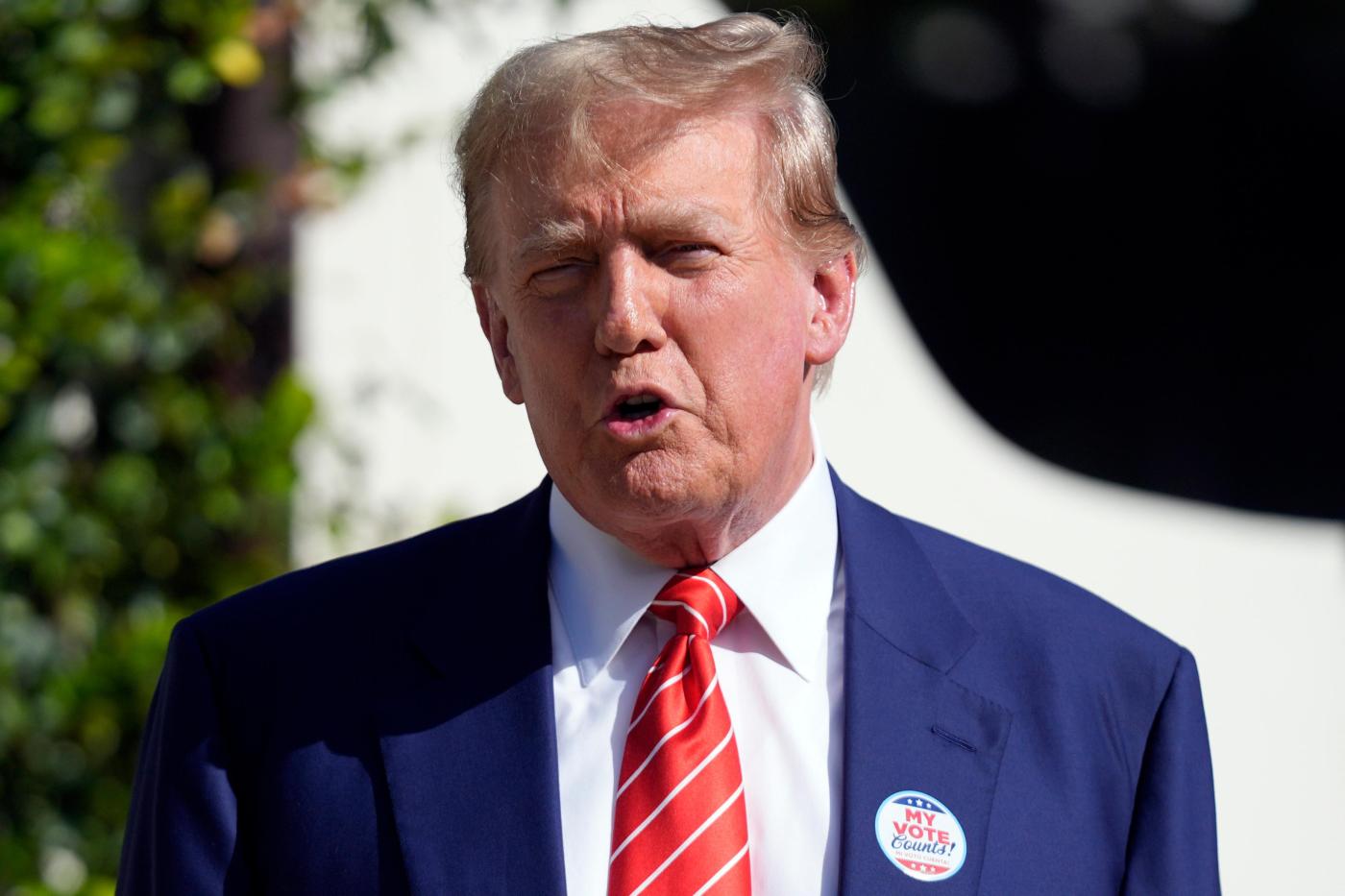
NEW YORK (AP) — Donald Trump is returning to the stock market, and the former president stands to reap a sizeable payout in the process.

Shareholders of Digital World Acquisition Corp., a publicly traded shell company, approved a deal to merge with the Trump’s media business in a Friday vote. That means Trump Media & Technology Group, whose flagship product is social networking site Truth Social, will soon begin trading on the Nasdaq stock market.

Trump is set to own most of the combined company — or nearly 79 million shares. Multiply that by Digital World’s closing stock price Thursday of $42.81, and the total value of his stake could surpass $3 billion.

The greenlight arrives at a time the presumptive Republican presidential nominee is facing his most costly legal battle to date: a $454 million judgment in a fraud lawsuit.

But Trump won’t be able to cash out the deal’s windfall immediately, unless the company’s board makes changes to a “lock-up” provision that prevents company insiders from selling newly issued shares for six months.

Trump’s presidential campaign did not immediately respond to request for comment.

When a publicly traded shell company agrees to buy a private company, the target company takes its place on a stock exchange once the combination is approved by shareholders. If recent activity in Digital World’s stock is any indication, shareholders of Trump Media could be in for a bumpy ride.

Many of Digital World’s investors are small-time investors who are either fans of Trump or trying to cash in on the mania, instead of big institutional and professional investors. Those shareholders helped the stock more than double this year in anticipation of the merger going through. After the deal was cleared Friday, shares fell as much as 12% before bouncing back to be down about 2.5% around midday,

Trump’s earlier foray into the stock market didn’t end well. Trump Hotels and Casino Resorts went public in 1995 under the symbol DJT — the same symbol Trump Media will trade under. By 2004, Trump’s casino company had filed for bankruptcy protection and was delisted from the New York Stock Exchange.

Ahead of Friday’s approval, Digital World’s regulatory filings listed many of the risks its investors face, as well as those of the Truth Social owner once Trump Media also goes public.

One risk, the company said, is that Trump would be entitled to vote in his own interest as a controlling stockholder — which may not always be in the interests of all shareholders. Digital World also cited the high rate of failure for new social media platforms, as well as Trump Media’s expectation that it would lose money on its operations “for the foreseeable future.”

Trump Media lost $49 million in the first nine months of last year, when it brought in just $3.4 million in revenue and had to pay $37.7 million in interest expenses.

Trump Media and Digital World first announced their merger plans back in October 2021. In addition to a federal probe, the deal faced a series of lawsuits leading up to Friday’s vote.

Truth Social launched in February 2022, one year after Trump was banned from major social platforms including Facebook and Twitter, the platform now known as X, following the Jan. 6 insurrection at the U.S. Capitol. He’s since been reinstated to both, but has stuck with Truth Social as a megaphone for his message.

Trump promoted Truth Social in a post on the social media network Thursday evening, saying: “TRUTH SOCIAL IS MY VOICE, AND THE REAL VOICE OF AMERICA!!! MAGA2024!!!”

Trump Media hasn’t so far disclosed Truth Social’s user numbers. But research firm Similarweb estimates that it had roughly 5 million active mobile and web users in February. That’s far below TikTok’s more than 2 billion and Facebook’s 3 billion — but still higher than other “alt-tech” rivals like Parler, which has been offline for nearly a year but is planning a comeback, or Gettr, which had less than 2 million visitors in February.

Related Articles

National Politics |


Biden and Trump ask voters if they’re ‘better off’ than they were 4 years ago. It’s complicated

National Politics |


Wall Street debut of Trump’s Truth Social network could net him stock worth billions on paper

National Politics |


9 takeaways from California, Illinois and Ohio elections

National Politics |


National poll finds Biden-Trump tie. State of the Union didn’t help president.

National Politics |


US Jews upset with Trump’s latest rhetoric say he doesn’t get to tell them how to be Jewish

A plunge into the public market means Trump’s social media business will soon have to disclose more details.

Private companies are accountable to their owners, while public ones are accountable to the shareholders who own the company’s stock. Once public, Trump Media will be required to report its quarterly finances as well as other material news to federal regulators.

In this sense, Truth Social faces some of the same problems that X has been contending with — mainstream advertisers who don’t want to be associated with hate speech and other controversial content.

AP Reporters Stan Choe and Barbara Ortutay contributed to this report from New York and San Franciso.
Sugarbeet companies sued over antitrust violation allegations

posted in: Society | 0

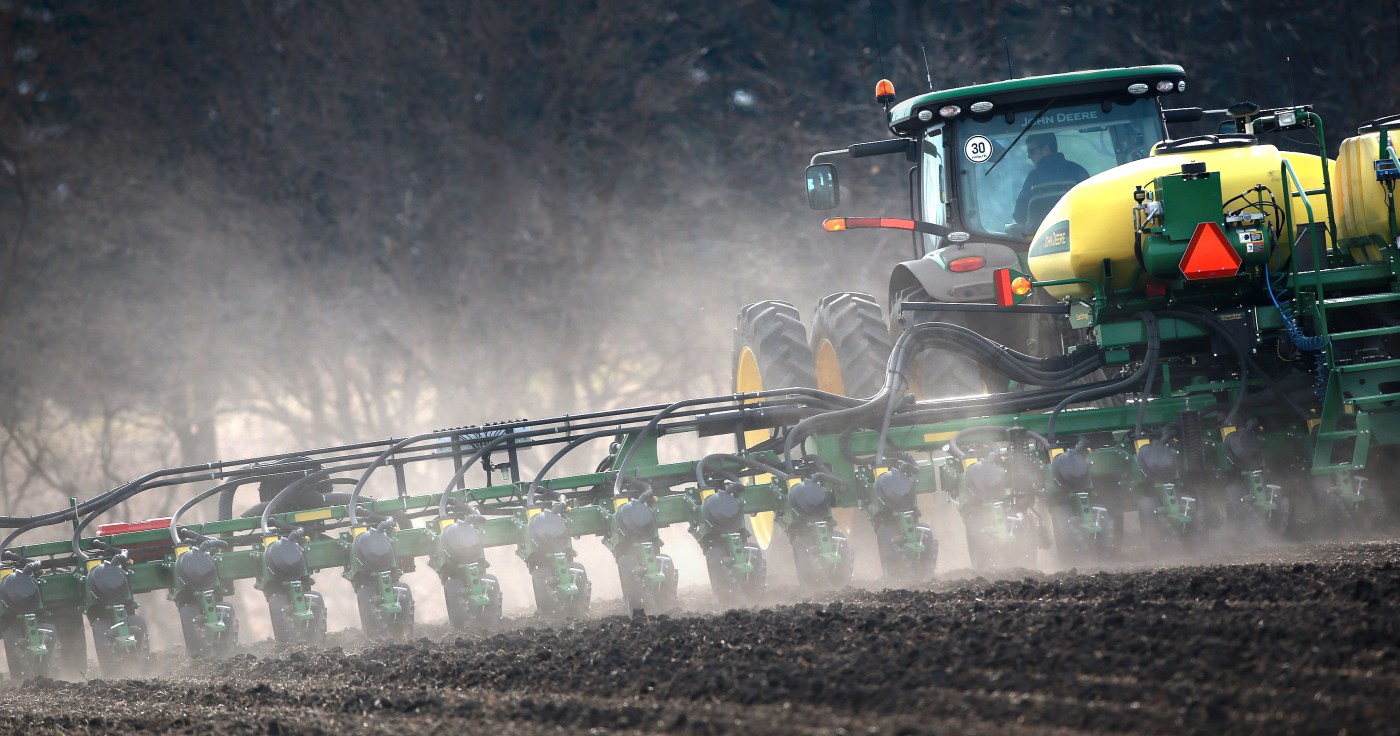
Three companies that use granulated sugar have filed antitrust lawsuits against U.S. companies, including United Sugar Producers and Refiners, which markets the commodity for American Crystal Sugar Co., Minn-Dak Farmers Co-op and other companies.

The lawsuits claim that sugarbeet and sugar cane companies have joined together to raise the price of sugar to end-users such as bakeries and restaurants.

Morelos Bakery LLC, St. Paul, Minnesota; Great Harvest Bread Co., Duluth, Minnesota; and Connecticut restaurants WNT LLC and WNT Farmington LLC argue that for more than 80 years the sugar industry has been involved in unfair business practices that have resulted in high prices.

American Crystal Sugar, based in Moorhead, Minnesota, is owned by about 2,800 farmers in eastern North Dakota and western Minnesota. The company has factories in Moorhead, Crookston and East Grand Forks in Minnesota and in the North Dakota towns of Hillsboro and Drayton. About 500 farmers own Minn-Dak Farmers Co-op in Wahpeton, North Dakota.

Besides American Crystal Sugar Co. and Minn-Dak Farmers Co-op, Wyoming Sugar Co., of Worland, Wyoming, and U.S. Sugar, based in Florida, are also members of United Sugar Producers and Refiners, also known as United Sugar Corp., and are named in the lawsuit.

The defendants in the lawsuits filed the week of March 17 also include Cargill Inc. based in Wayzata, Minnesota, and Michigan Sugar, a farmer-owned cooperative based in Bay City, Michigan; and Domino Foods Inc., the marketing and sales subsidiary for American Sugar Refining, which markets cane sugar.

Leaders of American Crystal Sugar Co., United Sugar Producers and Refiners, Michigan Sugar Co. and American Sugarbeet Growers Association did not immediately return messages seeking comment on the case.

The lawsuits list a history of unfairly setting prices, beginning with a lower court ruling in 1936 that found that major refined sugar producers unreasonably restrained trade by practices including creating the Sugar Institute, a trade association that enabled them to promulgate rules.

Under the rules, “defendants agreed to sell, and in general did sell sugar only upon open prices, terms and conditions publicly announced in advance of sales, and they agreed to adhere and in general did adhere without deviation, to such prices, terms and conditions until they publicly announced changes,” the lawsuit filed this week said.

The granulated sugar industry’s interference in the market continues today, the lawsuits claim.

Since at least 2019, the defendants have had an ongoing agreement to artificially raise, fix, stabilize or maintain U.S. granulated sugar prices, the lawsuit said.

The methods the sugar companies used included emailing one another about prices, the lawsuits allege. They also allege that the defendants engage in such conversations in other gatherings.

“For example, the American Sugar Alliance holds an annual symposium sponsored and attended by the Producing Defendant where attendees not only participate in industry discussions, but also informal activities such as golf outings,” the lawsuits said.

The sugar industry lends itself to price manipulation in part because it is highly concentrated and is nearly vertically integrated because the defendants and other sugar producers control most aspects of producing, processing, refining and marketing their commodities, the lawsuit said.

The U.S. Department of Agriculture sugar program, which long has been a source of contention with end-users, is also noted in the lawsuits. The lawsuits repeat the end-users argument that the sugar program, which limits the amount of sugar that can be imported into the United States, protects domestic sugar companies from competition, which results in them setting higher prices.

Related Articles

News |


Dave Thune: We need to support our public-safety people every day

News |


Letters: Why would we think a zoning sledgehammer is the right tool for Minnesota?

News |


Spring snowfall, in two parts for the Twin Cities, follows a mild winter

News |


State sanctions western Minnesota jail after unruly inmate deprived of food and water

News |


Minnesota private sector loses 1,600 jobs in February, unemployment steady at 2.7%

Russia and China veto US resolution calling for immediate cease-fire in Gaza

posted in: News | 0

By EDITH M. LEDERER (Associated Press)

UNITED NATIONS (AP) — Russia and China on Friday vetoed a U.S.-sponsored U.N. resolution calling for “an immediate and sustained cease-fire” in the Israel-Hamas war in Gaza to protect civilians and enable humanitarian aid to be delivered to more than 2 million hungry Palestinians.

The vote in the 15-member Security Council was 11 members in favor and three against, including Algeria, the Arab representative on the council. There was one abstention, from Guyana.

Before the vote, Russian U.N. Ambassador Vassily Nebenzia said Moscow supports an immediate cease-fire, but he criticized diluted language that referred to moral imperatives, which he called philosophical wording that does not belong in a U.N. resolution.

He accused U.S. Secretary of State Antony Blinken and U.S. Ambassador Linda Thomas-Greenfield of “deliberately misleading the international community.”

“This was some kind of an empty rhetorical exercise,” Nebenzia said. “The American product is exceedingly politicized, the sole purpose of which is to help to play to the voters, to throw them a bone in the form of some kind of a mention of a cease-fire in Gaza … and to ensure the impunity of Israel, whose crimes in the draft are not even assessed.”

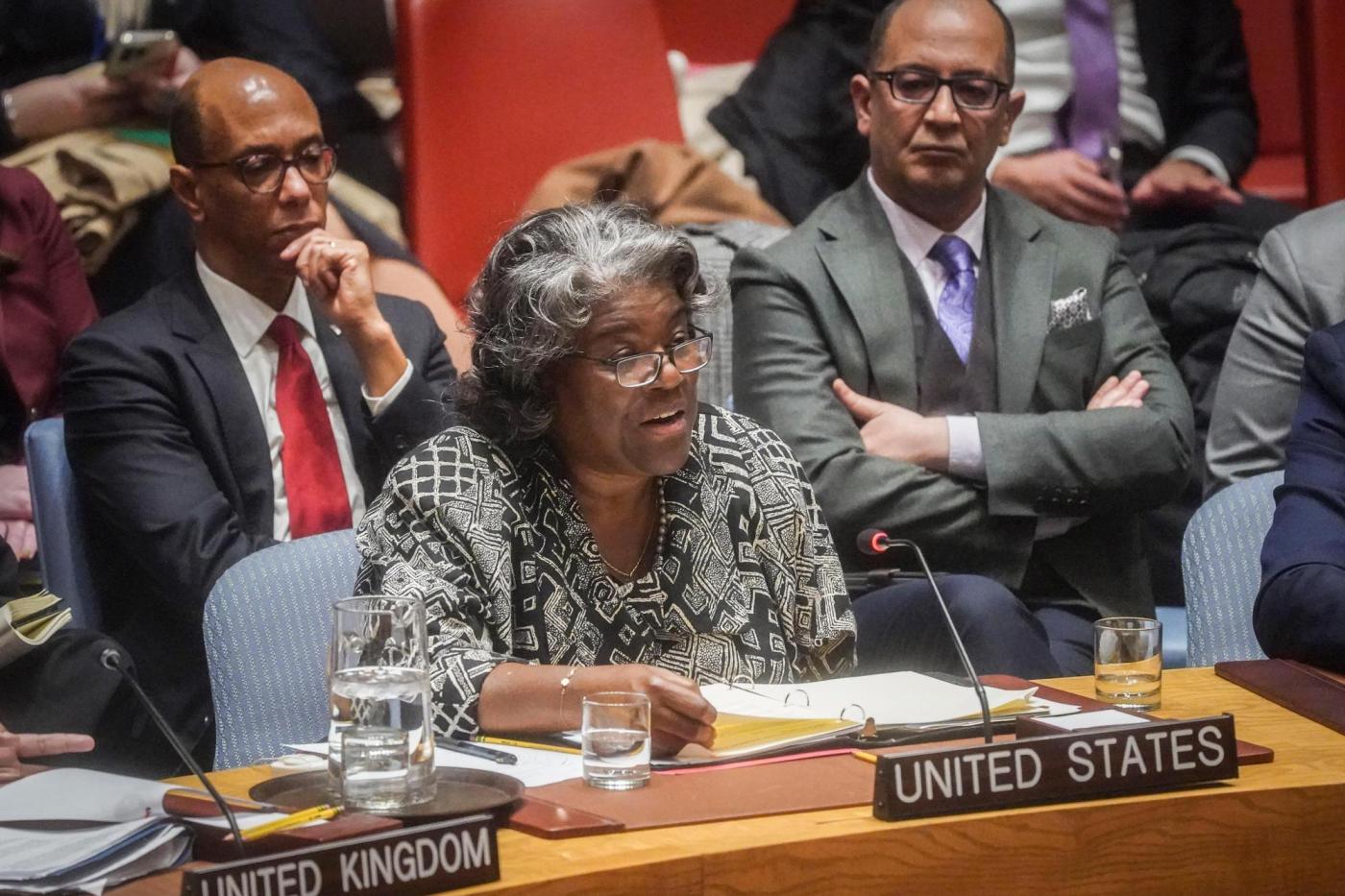
Thomas-Greenfield urged the council to adopt the resolution to press for an immediate cease-fire and the release of the hostages, as well as to address Gaza’s humanitarian crisis and support ongoing diplomacy by the United States, Egypt and Qatar.

After the vote, Thomas-Greenfield accused Russia and China of voting for “deeply cynical reasons,” saying they could not bring themselves to condemn Hamas’ terrorist attacks in southern Israel on Oct. 7, which the resolution would have done for the first time. Hamas has been designated as a terrorist organization by the United States, Canada and the European Union.

A key issue in the vote was the unusual language related to a cease-fire. It said the Security Council “determines the imperative of an immediate and sustained cease-fire,” — not a straight-forward “demand” or “call.”

The resolution did reflect a shift by the United States, which has found itself at odds with much of the world as even close allies push for an unconditional end to fighting.

In previous resolutions, the U.S. has closely intertwined calls for a cease-fire with demands for the release of Israeli hostages in Gaza. This resolution, through awkward wording that’s open to interpretation, continued to link the two issues, but not as firmly.

While the resolution would have been officially binding under international law, it would not have ended the fighting or led to the release of hostages. But it would have added to the pressure on Israel as its closest ally falls more in line with global demands for a cease-fire at a time of rising tensions between the U.S. and Israeli governments.

Meanwhile, the 10 elected members of the Security Council have put their own resolution in a final form to be voted on. It demands an immediate humanitarian cease-fire for the Muslim holy month of Ramadan that began March 10 to be “respected by all parties leading to a permanent sustainable cease-fire.” Riyad Mansour, the Palestinian U.N. ambassador, told reporters the vote would take place either late Friday or Saturday morning.

The resolution also demands “the immediate and unconditional release of all hostages ” and emphasizes the urgent need to protect civilians and deliver humanitarian aid throughout the Gaza Strip.

Nebenzia urged council members to support it, but Thomas-Greenfield said the text’s current form “fails to support sensitive diplomacy in the region. Worse, it could actually give Hamas an excuse to walk away from the deal on the table.”

The Security Council had already adopted two resolutions on the worsening humanitarian situation in Gaza, but none has called for a cease-fire.

Russia and China vetoed a U.S.-sponsored resolution in late October calling for pauses in the fighting to deliver aid, protection of civilians and a halt to arming Hamas. They said it did not reflect global calls for a cease-fire.

The U.S. has vetoed three resolutions demanding a cease-fire, the most recent an Arab-backed measure supported by 13 council members with one abstention on Feb. 20.

A day earlier, the U.S. circulated a rival resolution, which went through major changes during negotiations before Friday’s vote. It initially would have supported a temporary cease-fire linked to the release of all hostages, and the previous draft would have supported international efforts for a cease-fire as part of a hostage deal.

The vote took place as Blinken, America’s top diplomat, is on his sixth urgent mission to the Middle East since the Israel-Hamas war, discussing a deal for a cease-fire and hostage release, as well as post-war scenarios.

Related Articles


Why Israel is so determined to launch an offensive in Rafah


During the Israel-Hamas war, Jews will soon celebrate Purim — one of their most joyous holidays


Jared Kushner, Trump’s son-in-law, praises ‘very valuable’ potential of Gaza’s ‘waterfront property’


Thomas Friedman: What Schumer and Biden got right about Netanyahu


Heavy fighting rages around Gaza’s biggest hospital as Israel raids it for a second day

Palestinian terrorists killed some 1,200 people in the surprise Oct. 7 attack into southern Israel that triggered the war, and abducted another 250 people. Hamas is still believed to be holding some 100 people hostage, as well as the remains of 30 others.

In Gaza, the Health Ministry raised the death toll in the territory Thursday to nearly 32,000 Palestinians. The agency does not differentiate between civilians and combatants in its count but says women and children make up two-thirds of the dead.

The international community’s authority on determining the severity of hunger crises warned this week that “famine is imminent” in northern Gaza, where 70% of people are experiencing catastrophic hunger. The report from the Integrated Food Security Phase Classification initiative, or IPC, warned that escalation of the war could push half of Gaza’s total population to the brink of starvation.

The U.S. draft expressed “deep concern about the threat of conflict-induced famine and epidemics presently facing the civilian population in Gaza as well as the number of undernourished people, and also that hunger in Gaza has reached catastrophic levels.”

It emphasized “the urgent need to expand the flow of humanitarian assistance to civilians in the entire Gaza Strip” and lift all barriers to getting aid to civilians “at scale.”

Israel faces mounting pressure to streamline the entry of aid into the Gaza Strip, to open more land crossings and to come to a cease-fire agreement. But Prime Minister Benjamin Netanyahu has vowed to move the military offensive to the southern city of Rafah, where some 1.3 million displaced Palestinians have sought safety. Netanyahu says it’s a Hamas stronghold.

The final U.S. draft eliminated language in the initial draft that said Israel’s offensive in Rafah “should not proceed under current circumstances.” Instead, in an introductory paragraph, the council emphasized its concern that a ground offensive into Rafah “would result in further harm to civilians and their further displacement, potentially into neighboring countries, and would have serious implications for regional peace and security.”

Dave Thune: We need to support our public-safety people every day

posted in: News | 0

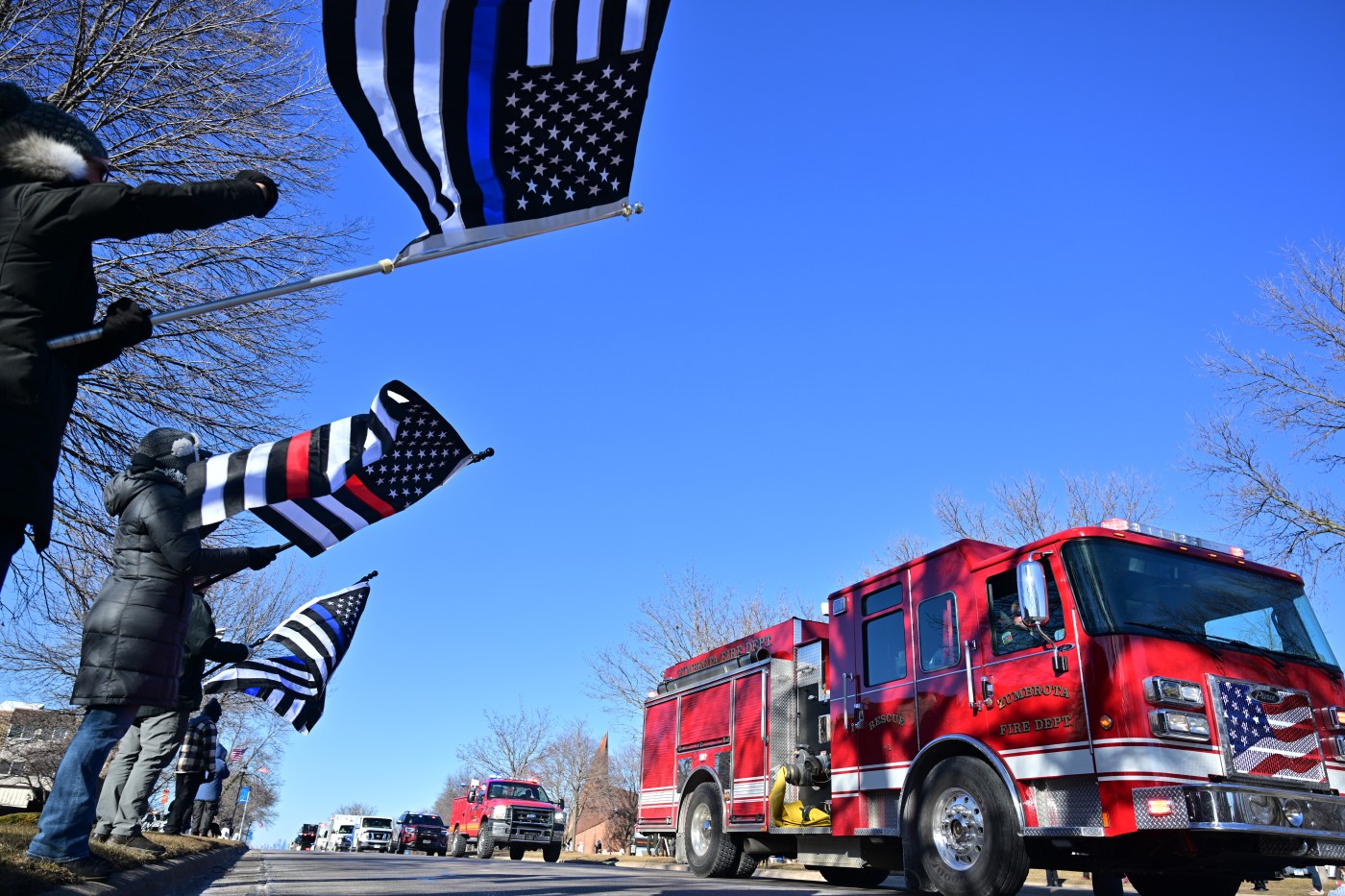
On a recent evening, I took down our two American flags — one with a blue stripe and one with red.

The time of mourning for three brave, dead first responders had ended, but in taking the flags down it struck me that remembering those lives should never be finished.

Last month, the state showed heart-aching grief. Tears were shed at the deaths of three brave heroes. By their deaths, the lives of eight others — including seven children — were saved. Let this solidarity in support of our public safety ranks carry over as tears dry and the memories of two police officers and a firefighter-paramedic grow fainter.

Photos of Burnsville police officers, from left, Paul Elmstrand, Matthew Ruge and firefighter/paramedic Adam Finseth are displayed during a community vigil Feb. 20, 2024, at the Burnsville Police Department/City Hall. (Mara H. Gottfried / Pioneer Press)

During the past 10 years increasing criticism of law enforcement has reached a point where a small minority of opinion-makers seems to have taken the position that the public fears our uniformed protectors — that the presence of peace officers in our schools and on our streets presents a danger to innocent citizens.

Nothing could be further from the truth.

From our peace-keeping citizen soldiers to our police officers and sheriff’s deputies, to our safety inspectors and radio dispatchers, to our firefighters and paramedics, we in Minnesota need to hold them all close to our hearts and support them and their families. We need to show our public support every day for the men and women who willingly stand between us and the actions of those with evil intent.

A wave of public support should overwhelm the bumper-sticker bleating of apologists and supporters of the criminals who in fact make us fear the shadier corners of our streets. While continuing insistence on fair and just enforcement must always be present, this blanket criticism of law enforcement is wrong-headed and is simply an insult to the memories of our fallen heroes.

While I served on the City Council here in St. Paul I attended too many funerals for officers, I also spoke with officers and firefighters wounded or injured in the line of duty. I could see the pain on their faces and the injuries on their bodies that they willingly endured to protect the public. At funerals I saw the agony on the faces of friends, spouses and parents who asked why but to a person were proud that their loved one had served.

Now that I’ve replaced my flags of mourning with an American and rainbow flag, I would call on my friends and fellow St. Paulites to challenge the critics of public servants and the vilification of our police and soldiers. If not for them. who would we call? If not for them, who would stand between us, our families, and our children in times of danger?

Remember the fallen, and remember their colleagues who went back to work when the funerals came to an end.

Dave Thune of St. Paul retired from the St. Paul City Council in 2016.

Related Articles

Opinion |


Real World Economics: Why a coup at the Fed is highly unlikely

Opinion |


Letters: Words and their varied meanings matter in Minnesota’s End of Life debate

Opinion |


Skywatch: Celestial signs of spring

Opinion |


Your Money: Timely milestones on your retirement journey

Opinion |


Working Strategies: A spring reading list for all seasons