Bodies of 6 foreign aid workers slain in Israeli strikes are transported out of Gaza

posted in: News | 0

By MOHAMMAD JAHJOUH and SAMY MAGDY (Associated Press)

RAFAH, Gaza Strip (AP) — The bodies of six foreign aid workers killed in a series of Israeli strikes were transported out of the Gaza Strip and into Egypt on Wednesday ahead of their repatriation, Egypt’s state-run Qahera TV reported.

The deadly strikes have renewed criticism of Israel’s conduct in the nearly six-monthlong war with Hamas, and highlighted the perilous conditions aid workers face in trying to deliver food to the besieged enclave, where experts say nearly a third of the population is on the brink of starvation.

The three British citizens, a Polish citizen, an Australian and a Canadian American dual citizen worked for World Central Kitchen, an international charity founded by celebrity chef José Andrés. Their Palestinian driver was also killed, and his remains were handed over to his family for burial in Gaza.

The other bodies were driven into Egypt through the Rafah crossing.

The seven were distributing food that had been brought into Gaza through a newly established maritime corridor late Monday when Israeli airstrikes targeted their three vehicles, killing everyone inside.

Israel said it carried out the strikes by mistake and that it has launched an independent investigation into how it happened.

Some of Israel’s closest allies, including the United States, condemned the deaths, which led the World Central Kitchen and other charities to suspend food deliveries, citing the dire security situation.

Cyprus, which has played a key role in setting up the maritime corridor, said the ships that had arrived Monday were returning to the Mediterranean island nation with some 240 tons of undelivered aid. But it also said the sea deliveries would continue.

Israel faces growing isolation as international criticism of its Gaza assault has mounted. On the same day as the deadly airstrikes, Israel stirred more fears by apparently striking Iran’s consulate in Damascus, killing two Iranian generals. The government also moved to shut down a foreign media outlet — Qatari-owned Al Jazeera television.

The hit on the charity’s convoy highlighted what critics have called Israel’s indiscriminate bombing and lack of regard for civilian casualties in Gaza.

In an op-ed published by Israel’s mass-circulation Yediot Ahronot newspaper on Wednesday, Andrés wrote that “the Israeli government needs to open land routes to food and medicine today. It needs to stop killing civilians and aid workers today.”

Andrés, whose organization has provided aid in war and disaster zones all over the world, including to Israelis after Hamas’ Oct. 7 attack that triggered the war, said the strikes “were not just some unfortunate mistake in the fog of war.”

“It was a direct attack on clearly marked vehicles whose movements were known by the (Israeli military). It was also the direct result of (the Israeli) government’s policy to squeeze humanitarian aid to desperate levels,” Andrés wrote.

Israel has severely restricted access to northern Gaza, where experts say famine is imminent.

The deaths of the World Central Kitchen workers threatened to set back efforts by the U.S. and other countries to open a maritime corridor for aid from Cyprus to help ease the desperate conditions in northern Gaza.

U.S. President Joe Biden issued an unusually blunt criticism of Israel by its closest ally, suggesting that the incident demonstrated that Israel was not doing enough to protect civilians.

“Incidents like yesterday’s simply should not happen,” he said. “The United States has repeatedly urged Israel to deconflict their military operations against Hamas with humanitarian operations, in order to avoid civilian casualties.”

Israel’s military chief, Lt. Gen. Herzi Halevi, announced the results of a preliminary investigation early Wednesday.

“It was a mistake that followed a misidentification -– at night during a war in very complex conditions. It shouldn’t have happened,” he said. He gave no further details. He said an independent body would conduct a “thorough investigation” that would be completed in the coming days.

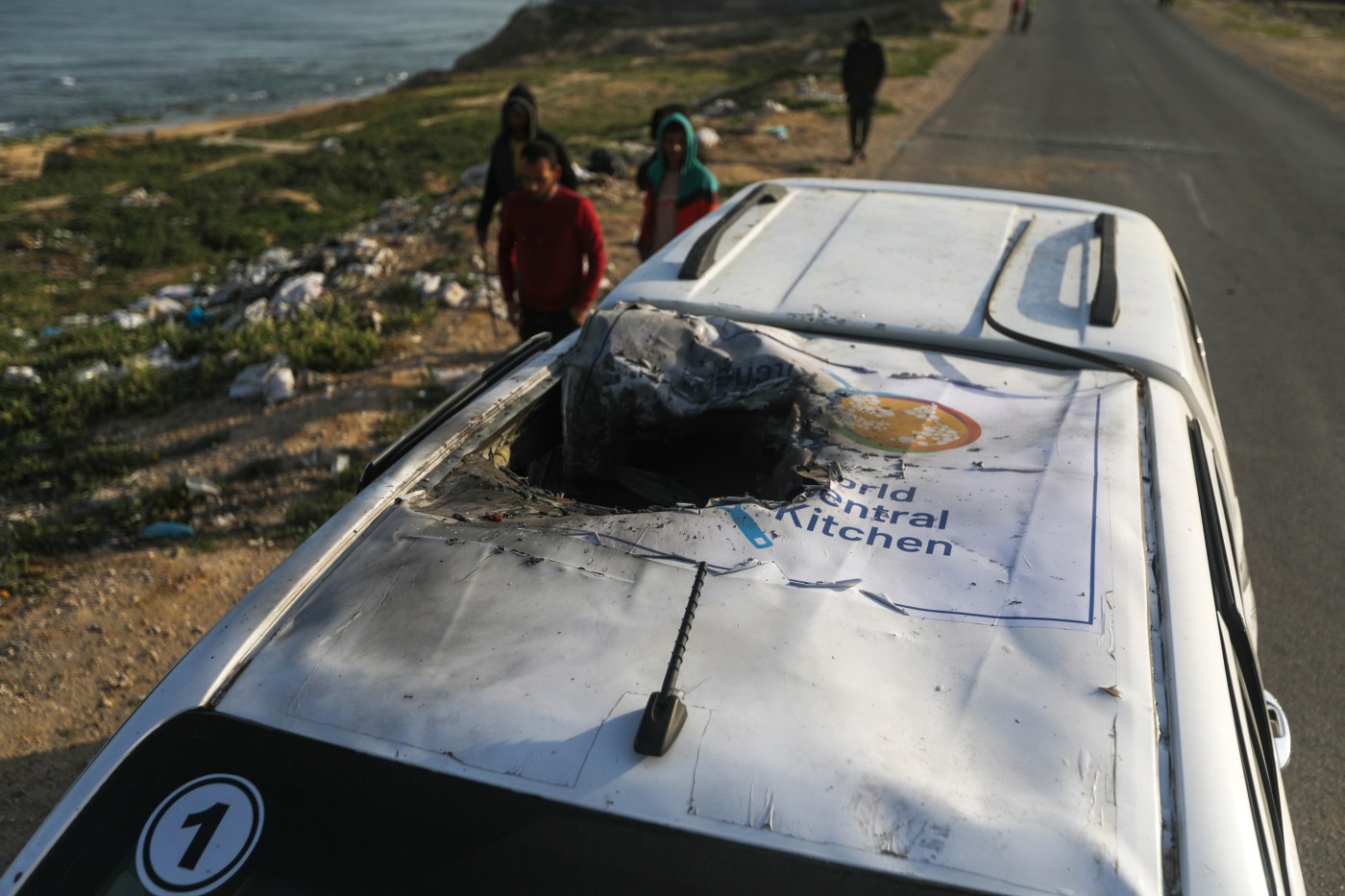
World Central Kitchen said it had coordinated with the Israeli military over the movement of its cars. Three vehicles moving at large distances apart were hit in succession. They were left incinerated and mangled, indicating multiple targeted strikes.

At least one of the vehicles had the charity’s logo printed across its roof to make it identifiable from the air, and the ordnance punched a large hole through the roof. A video showed the bodies at a hospital in the central Gaza town of Deir al-Balah, several of them wearing protective gear with the charity’s logo.

Nearly 33,000 Palestinians have been killed in the war, around two-thirds of them women and children, according to Gaza’s Health Ministry, which does not distinguish between civilians and combatants in its count.

The war began when Hamas-led militants stormed into southern Israel in a surprise attack on Oct. 7, killing some 1,200 people and taking around 250 hostage. Israel responded with one of the deadliest and most destructive offensives in recent history.

Hamas is still holding an estimated 100 hostages and the remains of around 30 others, after most of the rest were freed last year in exchange for Palestinians imprisoned in Israel. The United States, Qatar and Egypt have spent months trying to broker another truce and hostage release.

___

Magdy reported from Cairo.

Related Articles

World News |


What is World Central Kitchen and how has it helped people in Gaza?

World News |


With famine looming, aid group halts food delivery in Gaza after Israeli strike kills 7 workers

World News |


Israelis stage largest protest since war began to increase pressure on Netanyahu

World News |


Israeli troops withdraw from Shifa Hospital, Gaza’s largest, after 2-week raid

World News |


Doctors visiting a Gaza hospital are stunned by the war’s toll on Palestinian children

Tyler Cowen: Indiana can’t make universities more conservative with a law

posted in: News | 0

Indiana’s Republican governor has just signed new law that introduces “intellectual diversity” as a standard for tenure decisions in state universities. Under the law, campus boards of trustees will determine what intellectual diversity consists of, and lack of such diversity can be grounds for denying tenure. Intellectual diversity also must be considered in the post-tenure review process.

The background context here, in case you don’t already know, is that professors largely support the Democratic Party, or they are left-wing rather than conservative. The data are overwhelming. For instance, one study of top universities found that out of 7,243 faculty only 314 registered as Republican. In my personal experience, I have found that libertarians are scarce as well.

As a libertarian-leaning professor, I am unhappy about this state of affairs. That said, I fear the Indiana law will make matters worse rather than better.

Keep in mind that academic hiring is a highly idiosyncratic process. There is a tiny selection of open jobs and a very large number of applicants. A hired assistant professor then labors for years, trying to publish articles and receive high teaching evaluations to — perhaps — one day receive tenure through departmental and university committee votes, ultimately ratified by a Board of Trustees.

The first and perhaps most important point is that university processes, especially for state universities, operate at a large scale. For instance, Indiana University claims over 89,000 degree-seeking students and 21,000 faculty and staff. Review methods, including for tenure, are based on measurable publications, citations and letters of recommendation. The process is standardized in such a way that any interference, for instance by the overseeing Board of Trustees, comes as a kind of shock, replete with concomitant controversy and also publicity.

If we add an intellectual diversity requirement, we likely will have more professors publishing articles on John Locke, Adam Smith, Rene Girard, or whatever will count as a relevant marker of intellectual diversity. Yet it is unlikely that such publications will change what professors say in the classroom, what their politics are, or the main conclusions from their most influential pieces of research.

You might think that universities will be more likely to hire people who really do count as right-wing thinkers. I am skeptical, as I expect that over time the monitoring will shift toward what can be shown on paper, namely nominal markers of “diversity obedience,” if only to forestall employment-related lawsuits. In the third year of a professor’s career, he may publish an article on Milton Friedman, critical in the footnotes, but sufficiently vague in broad presentation that it can count as contributing to intellectual diversity. Who exactly is to step up and say this shouldn’t count?

Under some scenarios, right-wing and conservative professors could easily end up worse off under this new system. For purposes of argument, let’s assume the worst of a left-leaning academic department, namely that they intentionally prevent conservative professors from getting tenure. Under the new law, there is a chance that a Board of Trustees might grant tenure to a conservative voted down by the department. How would a department of committed lefties address that problem? They’d avoid hiring conservative professors at all, for fear of having their tenure decisions overturned.

Even if you think a Board of Trustees can intervene in tenure decisions in a meaningful and informed manner, they cannot run a job search, which involves going through hundreds or even thousands of applications. The bias merely will be shifted to some other part of the process.

Another danger is that this law will entrench the view that academic life is and should be politicized. You might think that already has happened, but I assure you matters always can get worse. It would become virtually mandatory to discuss the politics, or at least the nominal political slant, of intended hires and tenure decisions. That might scare even more conservative and libertarian scholars away from academia, because many on the right believe that politicization of a sphere of activity benefits the left.

Further issues arise from how the law creates a channel that students and university employees can use to complain about the political orientations of faculty members. The net effect will be to shift power to students, which means easier classes and more grade inflation. Are those trends likely in the longer run to support conservative or classical education values in our universities? As a long-time teacher for almost 40 years, I suspect not.

If we are looking to shift the political orientation of universities, I suggest a simple first step. Let the pressures of higher salaries and undergraduate enrollments shift more slots toward STEM (science, technology, engineering and math) and also business-related majors, including economics (my own field). In those latter fields, faculty lean less toward left-wing political views. For a more radical change, let us also try creating some new universities based on different, experimental principles. (Disclosure: I am on the advisory board of one of these, the University of Austin).

Conservative legal scholars often have criticized race-based affirmative action, claiming it will create a marked class of lower-performing individuals, who received their jobs only because of the law. Here is not the place to evaluate such a charge, but surely it would be ironic — and likely mistaken — if conservatives sought out that mantle for themselves.

Tyler Cowen is a Bloomberg Opinion columnist, a professor of economics at George Mason University and host of the Marginal Revolution blog.

Related Articles

Opinion |


Zeynep Tufekci: You don’t need to freak out about Boeing planes (but Boeing does)

Opinion |


Karl W. Smith: Raising Social Security’s retirement age is the least bad option

Opinion |


Ludwig, Miller: We are seeing a lethal shift in America’s shooting crisis

Opinion |


Allison Schrager: What are the odds of enjoying March Madness now?

Opinion |


Lisa Jarvis: Parents alone can’t protect kids from social media

Zeynep Tufekci: You don’t need to freak out about Boeing planes (but Boeing does)

posted in: Society | 0

“Ah, it’s a Boeing Max,” I exclaimed to my travel companions after we boarded our plane a few weeks ago. I looked to see if we were seated next to a hidden door plug panel like the one that blew out on Alaska Airlines Flight 1282 in January. We weren’t, but joining a trend on social media, we cracked a few jokes at Boeing’s expense: “Maybe they can charge extra, saying it’s potentially an even bigger window seat.”

The Federal Aviation Administration recently informed the passengers on that ill-fated Alaska Airlines flight that they may have been crime victims. The agency hasn’t explained why, but Boeing has told the Senate that it cannot find documentation of exactly how the door plug was removed and reinstalled, even though the company acknowledged it is supposed to have kept such records. Facing all this, the company announced last week that it was replacing its CEO. But the bad news wasn’t over: On Thursday, a New York Times investigation reported a disturbing pattern of sloppy safety procedures and dangerous cost-cutting. One expert who had spent more than a decade at Boeing told the Times, “The theme is shortcuts everywhere — not doing the job right.”

Is it any wonder that some travelers are trying to avoid Boeing planes? Kayak, a travel booking site, noticed an uptick in the number of people trying to weed them out; it recently made that search filter more prominent and even added an option to specifically avoid certain models.

Boeing’s problems, great as they are, are just one reason that consumers might be wary of taking flight. United Airlines now also faces scrutiny for a series of safety incidents, although many experts say the issues there do not appear to be systemic. The biggest danger of all may be understaffed air traffic controllers and overstuffed runways, which lead to far too many near misses.

Personally, I am not worried about flying, and other than cracking some ill-advised jokes, I have not changed my behavior. That’s why I hadn’t bothered to check whether I’d be flying on a Boeing Max, or any type of Boeing plane, until after I boarded.

Checks and redundancies

The trajectory of Boeing as a corporation, however, is another matter. It’s going to take a lot more than a shuffle at the top to fix that company’s problems. But the fact that Boeing managed to cut as many corners as it did is testament to the layers and layers of checks, redundancies and training that have been built into the aviation industry. Aviation safety is so robust because we made it so.

Two seemingly contradictory things are both true: U.S. commercial passenger airlines have gone an astonishing 15 years without a single death from a crash. And there is a huge safety crisis in commercial aviation that we urgently need to fix.

Commercial aviation is a complex system involving many dynamics: technology, engineering, corporate culture, regulation, weather, human factors, politics and more.

It’s extremely hard to predict what will emerge from so many different things interacting all at once — an example of the so-called butterfly effect, in which a tiny insect flapping its wings leads to major weather on the other side of the world. And although testing every part of the system on its own is necessary, it’s insufficient, since it’s the interaction of many moving parts that creates those hard-to-foresee problems. Solving equations won’t be enough to manage it all because such systems defy easy calculations.

Layers of precaution

We do, however, have methods to manage complex and safety-critical systems, and if done right, they can work very well.

Perhaps the most important measure is redundancy, the layering of precautions. Since even a minor failure could set off a catastrophic chain of events, it’s important to shore up everything. That’s why many plane parts have duplicates or backups, and much of planes’ production and maintenance is subject to inspections by multiple people.

Redundancy, however, while great for safety, is expensive.

The first Boeing 737 Max crash occurred in Indonesia in 2018. Everyone on board was killed. The next was in 2019, in Ethiopia. There were no survivors of that flight, either. After that, the planes — which had been flying globally for more than a year — were grounded by the FAA. (About 387 of them had been delivered at that time, and 400 or so more were in production.)

The public later learned Boeing had added a new software system to the planes to help keep them stable. Because the system made the planes behave more like older Boeing models that pilots were already familiar with, the company got permission from the FAA to avoid retraining pilots on the new planes (a cost savings for the airlines that bought them) or even telling pilots about it.

Those two flights proved the danger of that approach. The new system relied on a single sensor, even though the planes were equipped with two. When that sensor failed, pilots lacked the information to diagnose the problem and avoid disaster. Boeing’s actions were a violation of those core tenets of aviation of building in redundancy and understanding how complicated interactions can create problems that no one predicted.

Check everything

Given the impossibility of testing for every outcome, keeping complex systems safe also depends on another crucial signal: near misses. If something goes wrong but disaster is averted, the correct response should not be a “whew” and back to normal. It should be caution and investigation.

The Times investigation shows how alarmingly different Boeing’s approach was.

The Boeing plane that crashed in Indonesia had, the day before, experienced the exact same problem with the new stabilization system. But on that flight happened to be a third pilot, riding off-duty in the back of the cockpit. When things went haywire, he was able to suggest the correct sequence of actions and saved the day. Had Boeing updated pilots about the system, would the passengers on the airplane’s next flight have landed safely? We’ll never know.

That third pilot — in that case, present purely by luck — was an example of how redundancy can save lives. So is a co-pilot. Planes fly on autopilot all the time, and can even land on their own. Still, regulations require a second person in the cockpit for many types of passenger flights, not just to handle things in the extremely rare event that the primary pilot gets sick or dies midflight, but to help manage emergencies and equipment failures. It’s the same reason that planes have more engines, more tires and more ways to extend the landing gear than they need for any individual flight, just in case one of those things fails, as has happened many times.

An extra layer of safety helped avert the Alaska Airlines blowout from turning into a catastrophe: Because the incident occurred so soon after takeoff, all the passengers were still required to wear their seat belt.

Pilots even do a “walk-around” of their plane just before takeoff to conduct a final visual inspection. Commercial aviation works because of the principle of trust nothing and check everything.

It’s hard to escape the conclusion that those at the company who took all those shortcuts figured the system, with all its redundancies, would save them. But that’s a gamble. Eventually, two or three or four rare mishaps will align.

A Boeing representative told me that the company was taking responsibility and working to improve quality. But we need to see action, not promises.

Still, safe. Let’s keep it that way

So, why should anyone still fly on Boeing’s planes? Or fly at all? Because the statistics still show that commercial aviation is miraculously safe, far more so than all the alternative ways of traveling.

Although I don’t check for who manufactured the planes I fly, I do keep my seat belt on even when the captain says I don’t have to. Other than that, I’m as comfortable as possible while flying. I know that, on balance, air travel is a well-regulated system staffed by highly trained crews with layers and layers of safety precautions and a dedication to learning from past accidents. Let’s keep it that way.

Zeynep Tufekci writes a column for the New York Times.

Related Articles

Opinion |


Karl W. Smith: Raising Social Security’s retirement age is the least bad option

Opinion |


Ludwig, Miller: We are seeing a lethal shift in America’s shooting crisis

Opinion |


Allison Schrager: What are the odds of enjoying March Madness now?

Opinion |


Lisa Jarvis: Parents alone can’t protect kids from social media

Opinion |


David Brooks: The great struggle for liberalism

Three festive main dishes for any spring party

posted in: News | 0

After the quiet winter months, spring heralds the return of longer days and gathering over leisurely meals. The best dishes for those get-togethers are the ones that feel celebratory enough to serve to guests, but are simple enough to ensure you’re not spending all day in the kitchen.

These three cheery mains — a salad that can be prepared in advance, a one-pot seafood stunner and a versatile grilled chicken — remind us that with the right recipes, hosting doesn’t have to be stressful. These recipes can be served alone for low-key occasions, but for a particularly memorable meal, make all three. The clams are a lovely yet rustic first course, to be followed by the chicken as a hearty centerpiece and the salad as a refreshing side dish.

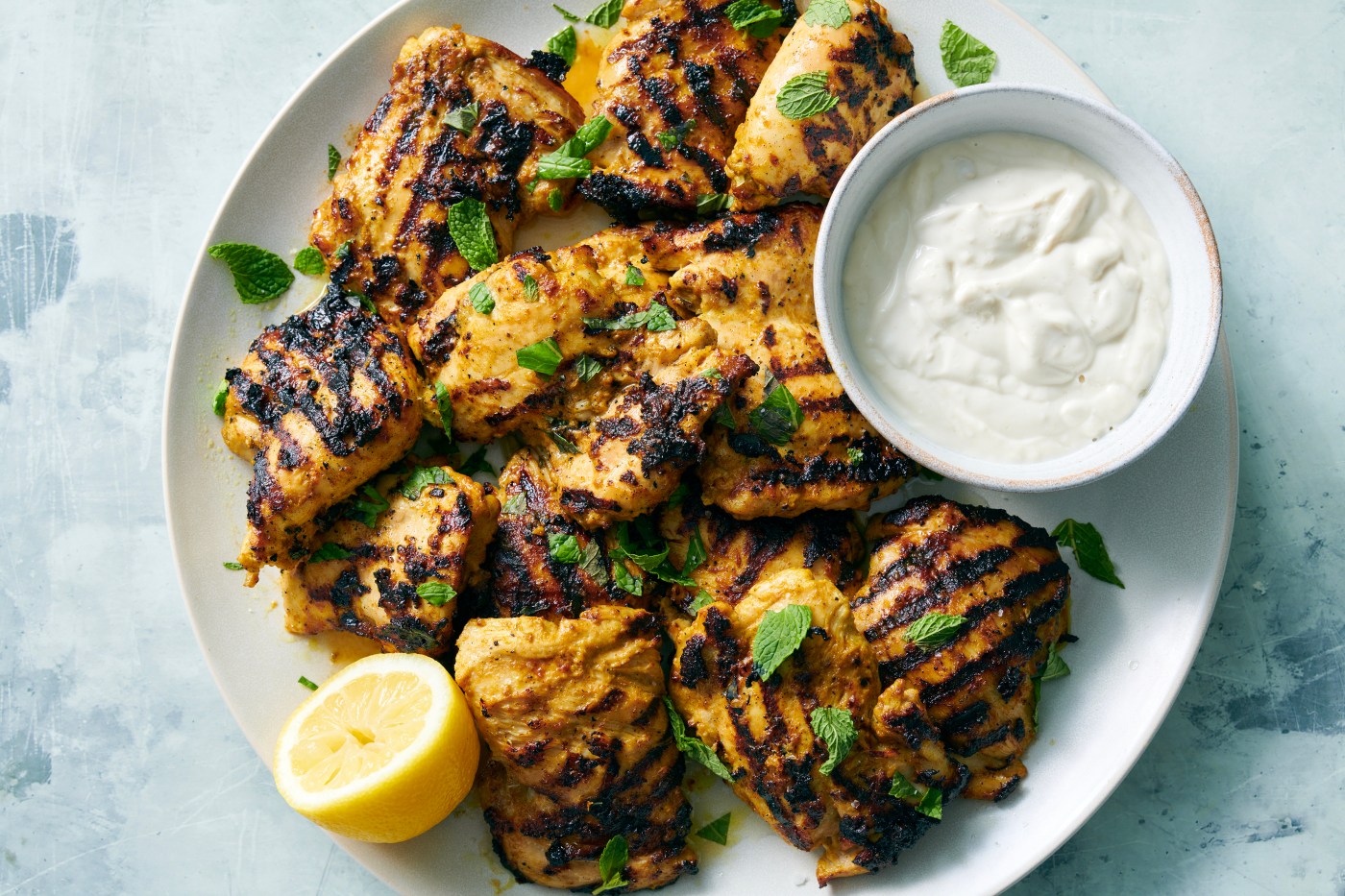
Shawarma-Spiced Grilled Chicken With Tahini-Yogurt Sauce

Marinated with whole-milk yogurt and shawarma-inspired spices, both white and dark meat end up tender and flavorful. Serve right off the grill or at room temperature.

Perfect for: A backyard barbecue on a warm spring day.

Prepare ahead: Marinating the meat a day in advance yields the best results and makes this dish even easier to prepare for guests. The sauce also can be made ahead and refrigerated for up to three days.

Serve with: Steamed rice and roasted or grilled vegetables or the salad below turn this into a hearty spread.

Taverna Salad

This colorful vegetarian main dish borrows elements from horiatiki, the classic Greek salad, and fattoush, the Lebanese salad studded with pieces of toasted pita. Seared cubes of halloumi make this salad substantial enough to stand on its own.

Perfect for: A brunch or lunch or a lighter dinner.

Prepare ahead: The dressing can be made in advance. The vegetables, aside from the tomatoes, can be sliced and stored in the refrigerator until you’re ready to serve the salad.

Serve with: More pita and dips such as hummus or tzatziki. For a heartier meal, it works well served alongside the grilled chicken above.

Littleneck Clams With Cherry Tomatoes and Pearl Couscous

This one-pot recipe capitalizes on the clams’ liquor (that briny juice inside their shells), white wine, a fresh red chile, garlic and shallots to make a broth that’s rich and nuanced with very little effort. It’s an impressive first course or standout meal on its own.

Perfect for: An intimate dinner party or lunch.

Prepare ahead: The vegetables can be chopped in advance. If you’re new to cooking clams, remember to give them a nice soak in salt water to remove any impurities, and to discard any that are open before you cook them, as well as any that haven’t opened after you cook them.

Serve with: A simple green salad and plenty of crusty bread for dipping.

Shawarma-Spiced Grilled Chicken With Tahini-Yogurt Sauce

By Lidey Heuck

Yield: 6 servings

Total time: About 4 1/4 hours

INGREDIENTS

For the chicken:

1 teaspoon sweet paprika
1 teaspoon ground cumin
1/2 teaspoon ground coriander
1/2 teaspoon ground ginger
1/2 teaspoon ground turmeric
1/4 teaspoon ground allspice
1/4 teaspoon ground cinnamon
Salt and pepper
1 1/2 cups plain yogurt
1/4 cup minced yellow onion
3 tablespoons extra-virgin olive oil, plus more for the grill
2 garlic cloves, minced
3 pounds boneless, skinless chicken breasts or thighs (or a combination)
1/2 lemon, for serving
Fresh parsley or mint leaves (optional), for serving
For the tahini-yogurt sauce:
1 cup plain yogurt
2 tablespoons tahini
1 tablespoon freshly squeezed lemon juice
1/2 garlic clove, finely grated or minced
Salt

DIRECTIONS

Make the marinade: In a large bowl, combine the paprika, cumin, coriander, ginger, turmeric, allspice and cinnamon with 1 1/2 teaspoons salt and 1/2 teaspoon pepper. Add the yogurt, onion, olive oil and garlic; mix well, then set aside.
Pat the chicken pieces dry with a paper towel. If using breasts, cut the breasts in half crosswise, so you have one thicker, rounded piece and one thinner, triangular piece. Working in batches, place the chicken pieces on a large cutting board and cover them with a sheet of parchment paper. Using a meat mallet or rolling pin, pound the chicken until each piece is about the same thickness as the others, between 1/2-inch and 3/4-inch. (Be careful not to pound so hard that you tear the chicken.)
Add the chicken to the marinade and toss well. Cover and refrigerate for at least 3 hours or up to 24 hours.
Meanwhile, make the tahini-yogurt sauce: In a small bowl, combine the yogurt, tahini, lemon juice and garlic; season to taste with salt. Refrigerate for at least 30 minutes or up to 3 days.
Before grilling, let the chicken come to room temperature for 30 minutes. If using a charcoal or gas grill, clean the grates and brush them with oil. Set the grill to medium-high or heat a grill pan slicked with olive oil on the stovetop over medium-high.
Lift the chicken from the marinade (no need to brush off excess marinade) and grill until cooked through, 6 to 8 minutes on each side, covering the grill halfway through, if necessary, to retain the heat.
Transfer the chicken to a plate, sprinkle generously with salt and squeeze the lemon half over the pieces. Allow the chicken to rest for at least 10 minutes before serving. Garnish with chopped fresh parsley or mint (if using) and serve the tahini-yogurt sauce on the side.

Taverna Salad

Taverna salad. Pan-fried halloumi adds richness and heft, but you can skip the searing process and use fresh feta instead. Food styled by Simon Andrews. (David Malosh/The New York Times)

By Lidey Heuck

Yield: 4 to 6 servings

Total time: 45 minutes

INGREDIENTS

1/3 cup plus 2 tablespoons extra-virgin olive oil
2 tablespoons red wine vinegar
1 teaspoon minced garlic (1 small clove)
1/2 teaspoon dried oregano
Salt and pepper
3 medium tomatoes, cored, seeded and diced into 1/2-inch pieces (or 1 cup halved cherry tomatoes)
1 (15-ounce) can chickpeas, rinsed
1 orange or yellow bell pepper, halved, seeded and diced into 1/2-inch pieces
1/2 large English cucumber, halved, seeded and diced into 1/2-inch pieces
1/2 cup pitted Kalamata olives
1/4 cup chopped fresh parsley
1/4 cup minced red onion or shallot
2 tablespoons (drained) capers, coarsely chopped
2 scallions, thinly sliced
1 (6-inch) pita
1 (8-ounce) block halloumi cheese, patted dry and cut into 3/4-inch slices

DIRECTIONS

In a small bowl, combine 1/3 cup olive oil with the vinegar, garlic and oregano. Whisk vigorously to combine then season to taste with salt and pepper.
In a large bowl, combine the tomatoes, chickpeas, bell pepper, cucumber, olives, parsley, red onion, capers and scallions. Pour the dressing over the salad and toss well.
Chop the pita into 1-inch pieces and place them in a small bowl. Drizzle with 1 tablespoon olive oil, sprinkle with salt and toss to coat. Heat an 8-inch skillet over medium. Add the pita pieces and cook, tossing often, until toasted and golden brown, about 5 minutes. Return to the small bowl to cool, reserving the skillet.
Place the halloumi slices on a small plate and drizzle with 1 tablespoon olive oil. Heat the same skillet over medium-high heat, and cook the halloumi until golden brown, 2 to 3 minutes per side. Transfer to a cutting board and cut the slices into bite-size cubes.
Add the pita and halloumi to the salad, toss well and serve.

Littleneck Clams With Cherry Tomatoes and Pearl Couscous

Littleneck clams with cherry tomatoes and pearl couscous. Fresh clams cook with garlic, white wine, shallots and tomatoes to form a deliciously fragrant sauce that’s perfect for mopping up with bread. Food styled by Simon Andrews. (David Malosh/The New York Times)

By Lidey Heuck

Yield: 4 servings

Total time: 45 minutes

INGREDIENTS

3 pounds littleneck clams
Salt and pepper
3 tablespoons extra-virgin olive oil
2 large shallots, chopped
4 garlic cloves, minced
1 small red chile (such as Fresno or red jalapeño), seeded and minced (about 1 tablespoon)
3 cups cherry tomatoes (preferably a combination of Sungold and red cherry tomatoes)
1/2 cup dry white wine (such as sauvignon blanc)
1/2 cup pearl couscous or fregola
2 tablespoons chopped fresh parsley
Crusty bread, for serving

DIRECTIONS

Place the clams in a large bowl along with 1 tablespoon salt, and fill the bowl with cold water. Set aside to let the clams release any grit.
While the clams soak, prepare the sauce: In a large Dutch oven (or a deep 12-inch skillet with a lid), heat the olive oil over medium. Add the shallots and cook, stirring occasionally, until tender but not browned, 3 to 5 minutes. Add the garlic and chile and stir until fragrant, 30 seconds to 1 minute.
Add the cherry tomatoes, 1/2 teaspoon salt and a few grinds of pepper and cook over medium heat, stirring occasionally, until the tomatoes begin to collapse, 6 to 8 minutes.
Stir in the wine and bring to a boil.
While the wine comes to a simmer, lift the clams from the water and rinse well under running water, scrubbing if necessary.
Reduce the heat to medium-low and add the clams to the pot, evenly nestling them into the sauce. Cover and cook until the clams open, 8 to 12 minutes, checking every few minutes and removing clams and placing them in a large serving bowl as they open. (This will prevent the clams from overcooking.) Discard any clams that do not open.
Bring the liquid in the pot back to a boil over medium-high heat and add the couscous. Reduce the heat and simmer, uncovered, until the couscous is tender and the liquid in the pan has reduced, 10 to 15 minutes.
Off the heat, season the couscous mixture with salt and pepper to taste, then carefully pour it over the clams. Garnish with the parsley and serve immediately, with crusty bread on the side.

Related Articles

Restaurants, Food and Drink |


Five weeknight dishes: The rice bowl you need for dinner and more

Restaurants, Food and Drink |


Quick Fix: Sweet and Tangy Sauced Pork Tenderloin with Green Beans and Barley

Restaurants, Food and Drink |


Minnesota Twins’ 2024 new food lineup: Baked potato bar, banh mi brat, chicken tinga arepas and more from local chefs

Restaurants, Food and Drink |


Kickoff to Summer at the Fair returns May 23-26

Restaurants, Food and Drink |


At new St. Paul Andiamo, fresh, comforting Italian is on the menu