3 ways AI could transform your insurance policy

posted in: News | 0

By Robin Hartill | Nerdwallet

Your insurance company may know more about you than you realize.

The technology that saturates today’s world — smart-home devices, drone images, fitness trackers, social media posts and telematics programs that monitor your driving habits — can help insurers piece together a detailed picture of your behavior.

Your permission isn’t always required. Many facts about your house, car and neighborhood are public records. Data brokers also gather and sell details about your activity, like which stores you visit, what you click online and the whereabouts of your mobile phone.

For a human, all that data is too much to process. But the ability of artificial intelligence to interpret data could upend the process of buying an insurance policy and filing a claim. As insurers face questions about fairness and privacy, some people may find it’s harder to get coverage. Others will benefit from cheaper rates, quicker applications and easier claims.

Faster insurance applications

Customers could see a shortened application process as insurance companies embrace AI.

Insurers may drastically cut the number of questions they ask in a home insurance application, says Peter Flynn, head of personal lines for the Americas at insurance consulting firm Xceedance.

“In the future, they might only ask five questions,” Flynn says. “But they might gather 5,000 additional data points, and they might interpret those 5,000 things in addition to the five answers they get from the applicant.”

Related Articles

Business |


5 ways to calm financial stress

Business |


How to successfully negotiate real estate commissions

Business |


Egg and chocolate prices are hopping — just in time for Easter

Business |


Selling your home could boost your nest egg — but is it worth it?

Business |


Sold a home recently? Here’s what you’ll get from the $418 million Realtor settlement

Chicago-based Kin Insurance, for example, collects thousands of data points and “prefills” home insurance applications with property details like square footage, foundation type and number of bathrooms.

A similar shift is happening in life insurance underwriting, which traditionally requires a medical exam plus a health and lifestyle questionnaire. As AI models improve, more carriers offer accelerated underwriting — quickly issuing policies to low-risk customers based on digital medical records and other data, while flagging higher-risk applicants for conventional underwriting.

“You can put a little bit of information and they can return a rate that’s not based on somebody coming to your house and taking blood,” says David Embry, CEO of online insurance broker Mylo.

To get the most accurate rate, make sure your records are correct and up to date before starting a life insurance application. You might also want to have supporting documents — like a summary from your doctor about any medical conditions — ready to go.

More personalized insurance rates

Low-risk customers stand to save money as insurers use data to create increasingly personalized profiles of their users.

The auto insurance industry is leading the charge with telematics programs that monitor things like your speed, braking patterns and mileage, enabling insurers to base pricing on driver behavior.

“In an AI-enabled or machine-learning-enabled environment, they can take that to an infinite degree and gather and collect as much data as available and interpret it in real time,” making predictions based on an individual’s habits, Flynn says.

While low-risk buyers reap the benefits of a constantly fine-tuned prediction model, a 2020 report by the Organization for Economic Cooperation and Development warns of the potential downside of this approach. Slicing and dicing customers into smaller risk pools could effectively price some applicants out of insurance, the OECD report says.

For drivers, the smart approach is to compare car insurance quotes from several companies. Insurers don’t all use the same sources of data, and they weigh each factor differently.

Simpler claims, and maybe fewer of them

Filing an insurance claim can be a stressful experience. Insurers’ use of AI could make the process smoother for customers and get them a decision — and their payout — much more quickly.

AI can help insurers identify the most urgent claims, reconstruct accident scenes, analyze medical records and flag cases for signs of fraud, according to a 2023 report by research firm Everest Group and professional services company Ernst & Young. Making claims more efficient is a priority for more than half of the property and casualty insurers surveyed, the report says.

New York-based insurer Lemonade says AI-based insurance fraud detection allows about 40% of its claims to be resolved within moments.

AI could even help prevent losses before the need for a claim arises — known as a “predict and prevent” model instead of the current “detect and repair” approach. For example, data relayed by smart-home devices could automatically trigger intervention if, say, a sensor catches early warning signs of a leak or a frozen pipe.

AI can also deliver feedback to drivers, helping them adjust their behavior. Programs like Allstate’s Drivewise reward those who avoid risky habits like speeding, hard braking or using a phone while driving.

But as the insurance industry integrates AI, there are concerns about cybersecurity, privacy and the potential for AI models to discriminate based on characteristics like race or gender.

The National Association of Insurance Commissioners issued guidelines in December 2023, encouraging insurers to correct errors in AI models and avoid bias. But each state creates its own rules, and regulation remains in its infancy stages.

Oversight will evolve, Flynn says. “But I’ll bet you the technology evolves faster than the regulation.”


Robin Hartill, CFP® writes for NerdWallet. Email: articles@nerdwallet.com.

Minnesota Twins’ 2024 new food lineup: Baked potato bar, banh mi brat, chicken tinga arepas and more from local chefs

posted in: News | 0

As baseball season gets underway, the Minnesota Twins are continuing to partner with local restaurants for the new food lineup at Target Field.

This year, Kamal Mohamed is bringing dishes from several of his Minneapolis restaurants, including StepChld and the new Parcelle Organics. The team from Two Mixed Up, in the Graze food hall in the North Loop, is taking the field, as are East Coast BBQ in Hopkins, Lord Fletcher’s Old Lake Lodge in Spring Park and Bussin Birria Tacos at the Mall of America.

The Twins’ home opener is Thursday, April 4, when they’ll face the Cleveland Guardians at Target Field. The team began its season on the road last week, first in Kansas City then Milwaukee.

Read more: Sign up for our free baseball newsletter at twincities.com/newsletters by following the prompts to select “Twins Report.”

Last season, notable additions to the ballpark’s food roster included Union Hmong Kitchen and Official Fried Chicken, both of which are returning.

Union Hmong Kitchen is subbing out last year’s noodle dish for a banh mi brat with Hmong sausage, which chef Yia Vang said is a dish he’s been playing around with behind the scenes after it was created almost by accident for a post-shift meal. Sausage and baseball are already a classic match, he said, and it’s especially impactful for Hmong families at ballgames to see their cuisine represented as Minnesota food, too.

“One of the things I really love is the fact that the Twins go, how do we reflect our community in our stadium?” Vang said on Monday at Target Field. “Not just, hey, we’re going to take your name and put it up there — no, we want you involved. I think that’s super beautiful.”

The Family Value concession stands, with ballpark classics under $5, are returning for this season in sections 120, 133 and 311. Prices for the rest of the new food lineup were not available as of April 1.

Here’s the official list of new foods and drinks:

The banh mi brat, from chef Yia Vang’s Union Hmong Kitchen, is prepared for sampling on April 1, 2024. The dish is new this year at Target Field, one of several offerings from local chefs available at the Minnesota Twins ballpark. (Jared Kaufman / Pioneer Press)

In the stands

Union Hmong Kitchen: They’re serving a banh mi brat this year — Hmong sausage, pickled vegetables, caramelized garlic aioli. Available in Section 127.

Official Fried Chicken: This year, they’re serving Mighty Buffalo Dry Rub Wings, marinated and pressure-fried. They’re good, folks. Available in Section 134.

Smashed Baked Potato: Yep, a baked potato cart! Butter, sour cream, beer cheese, green onions, bacon bits, chopped brisket, chili. Available in Section 117

Parcelle: C.R.E.A.M. smoothie (strawberry, banana, coconut milk, collagen peptides, and more) and a BluePrint smoothie (blueberry, avocado, banana, blue spirulina, and more) are on offer from the brand founded by StepChld and Nashville Coop chef Kamal Mohamed. Available in Section 126.

Mac and cheese topped with choice of chicken, rib tips or pulled pork, from East Coast BBQ in St. Louis Park, shown on April 1, 2024, is one of the new foods at Target Field for this Minnesota Twins season. (Jared Kaufman / Pioneer Press)

East Coast BBQ Mac N’ Meat: Mac and cheese topped with choice of chicken, rib tips or pulled pork. Available in Section 131.

Curds & Cakes: Deep fried Oreos, baby. Featuring a variety of toppings. Available in Section 232.

Red Cow: The Ultimate Burger, a double patty with cheddar, lettuce, tomato, onion, Red Cow sauce. Available in Section 233.

Papa Pete’s Mini Donuts: Keeping it simple — cinnamon and sugar. Available in Section 136.

Lord Fletcher’s: The Lake Minnetonka institution is serving a walleye burger with smoked tartar sauce. Find it at Land of 10,000 Lakes Bar at Gate 34.

S’mores Boozy Ice Cream: Chocolate soft serve mixed with vodka and toasted marshmallow syrup, topped with marshmallow and graham crackers. Available at Gate 34.

S’mores boozy ice cream — chocolate soft serve mixed with vodka and toasted marshmallow syrup — is topped with marshmallow and graham crackers on April 1, 2024. The treat, available at Gate 34, is a new food offering for this season at Target Field. (Jared Kaufman / Pioneer Press)

Restaurants & bars

At Truly On Deck: S’more Cookies from Two Mixed Up; chicken tinga arepas from Q’bo Latin Food (crispy arepa, chicken tinga, cheese, sour cream, pico de gallo, pickled onion); and Sweet Potato Fritters from StepChld. Club level, right field.

At Keeper’s Heart Town Ball Tavern: Just A Burger from Two Mixed Up (double smashie with lettuce, tomato, onion, cheese, special sauce). Plus, cocktails: vanilla creamed whiskey, cherry smashed whiskey and Irish mojito. Section 229.

At Hrbek’s: Bussin Birria Tacos: braised beef and cheese in a corn tortilla with consomme dipping sauce. Section 114.

At the Thrivent Club: If you have access to the field’s snazzy club level (renamed this year from its past identity as a Delta-sponsored spot), you can find burger fries from Two Mixed Up (battered fries, Philly cheesesteak, cheese, caramelized onion, jalapeño, sauces)

Legends Landing: An all-inclusive game ticket with all-you-can-eat hot dogs, burgers, chicken tenders, chips, peanuts, drinks and desserts. Located in sections S, T, U and V and starts at $42.

Related Articles

MLB |


From USA Baseball to the Twins, Royce Lewis and Austin Martin reunite as teammates a decade later

MLB |


Twins switch up day game preparations in hopes of better results

MLB |


Bailey Ober rocked as Twins fall in series finale to Royals

MLB |


Christian Vázquez comes through on both sides of the ball in Twins’ win

MLB |


Royce Lewis sidelined for more than a month with “severe” quad strain

Wild’s Ryan Hartman on throwing stick on ice: ‘I was over-the-top frustrated’

posted in: News | 0

In the wake of a three-game suspension, Ryan Hartman promised Tuesday he wasn’t throwing his stick at anything but the Xcel Energy Center ice after the Wild’s 2-1 overtime loss to the Vegas Knights on Saturday.

“Pure frustration,” he told reporters after Tuesday’s morning skate at the X. “But it wasn’t directed toward an official or player. That’s not something I’ve ever done or will ever do.”

The frustration stemmed from a no-call on what Hartman and coach John Hynes considered an obvious high stick to the face during the 3-on-3 overtime on Saturday. But the veteran wing was contrite on Tuesday.

“I understand it’s a fast game; calls are gonna be missed. They don’t have an easy job, the refs. The game happens fast,” he said. “But, in the moment, with the importance of the game, you know, with a minute-40 left we have a chance to be on the power play to get two points, I was over-the-top frustrated.

“I care a lot about this team, and a lot about winning, and it came out.”

After a meeting Monday with NHL director of player safety George Parros, Hartman was handed down a three-game, unpaid suspension supplemental to the game misconduct he earned on Saturday.

It will cost Hartman more than $63,000 — payable to the NHL’s Players Emergency Assistance Fund — and he will miss the rest of the Wild’s homestand, games against the Senators Tuesday, Colorado Avalanche on Thursday and Winnipeg Jets on Saturday.

Hynes expressed sympathy for Hartman but added, “Like everything, you have to be able to handle it the right way. What happened, and the end result, is disappointing.”

Hartman said he didn’t so much as plead his case during Monday’s meeting as accept responsibility for his actions.

“I didn’t even really have a side,” he said. “I went on there to apologize and to own up to throwing a stick on the ice in frustration. It wasn’t me trying to make an excuse for why I did it.”

Hartman, 29, has been suspended three times and fined seven times in 10 NHL seasons. He missed Hynes’ first two games this season because he was suspended for slew-footing Detroit’s Alex DeBrincat on Nov. 26, and was fined $4,427.08 for high-sticking Winnipeg’s Alex Perfetti in the faceoff circle on Jan. 1.

“It’s more information, from seeing him in those situations, and you wonder if there’s something you can do differently as a coach in that situation, as well,” Hynes said. “I think it’s a dual responsibility.”

Adam Beckman will step into the lineup in Hartman’s absence Tuesday night, and Hynes said the coaching staff was still tinkering with line combinations after the morning skate.

Foligno pushing

The Wild also will be without veteran wing Marcus Foligno, who missed the morning skate because of a groin injury that has been bothering him for most of the second half of the season.

Tuesday’s game will be the 16th he has missed in the Wild past 23 games. With nine regular-season games left, the Wild are trying to make up a seven-point deficit in the race for a Western Conference playoff spot.

“Credit to Marcus, he wants to try to push and play and do everything that he can,” Hynes said. “But there are some medical things that he’s getting evaluated on that we may know whether he’s even going to be able to come back, or whether he is going to be shut down for the year.”

Related Articles

Minnesota Wild |


Wild’s Ryan Hartman suspended three games for throwing stick on ice

Minnesota Wild |


Wild’s Ryan Hartman scoring big points down the stretch

A million simulations, one verdict for US economy: Debt danger ahead

posted in: News | 0

By Bhargavi Sakthivel, Maeva Cousin and David Wilcox, Bloomberg News

The Congressional Budget Office warned in its latest projections that U.S. federal government debt is on a path from 97% of GDP last year to 116% by 2034 — higher even than in World War II. The actual outlook is likely worse.

From tax revenue to defense spending and interest rates, the CBO forecasts released earlier this year are underpinned by rosy assumptions. Plug in the market’s current view on interest rates, and the debt-to-GDP ratio rises to 123% in 2034. Then assume — as most in Washington do — that ex-President Donald Trump’s tax cuts mainly stay in place, and the burden gets even higher.

With uncertainty about so many of the variables, Bloomberg Economics has run a million simulations to assess the fragility of the debt outlook. In 88% of the simulations, the results show the debt-to-GDP ratio is on an unsustainable path — defined as an increase over the next decade.

Related Articles

Business |


Real World Economics: Ripple effects of a falling bridge

Business |


Your Money: Squaring values with your investments

Business |


Real World Economics: How Haiti now reflects age-old economic teachings

Business |


Immigration is fueling US economic growth while politicians rage

Business |


Minnesota private sector loses 1,600 jobs in February, unemployment steady at 2.7%

The Biden administration says its budget, featuring a slew of tax hikes on corporations and wealthy Americans, will ensure fiscal sustainability and manageable debt-servicing costs.

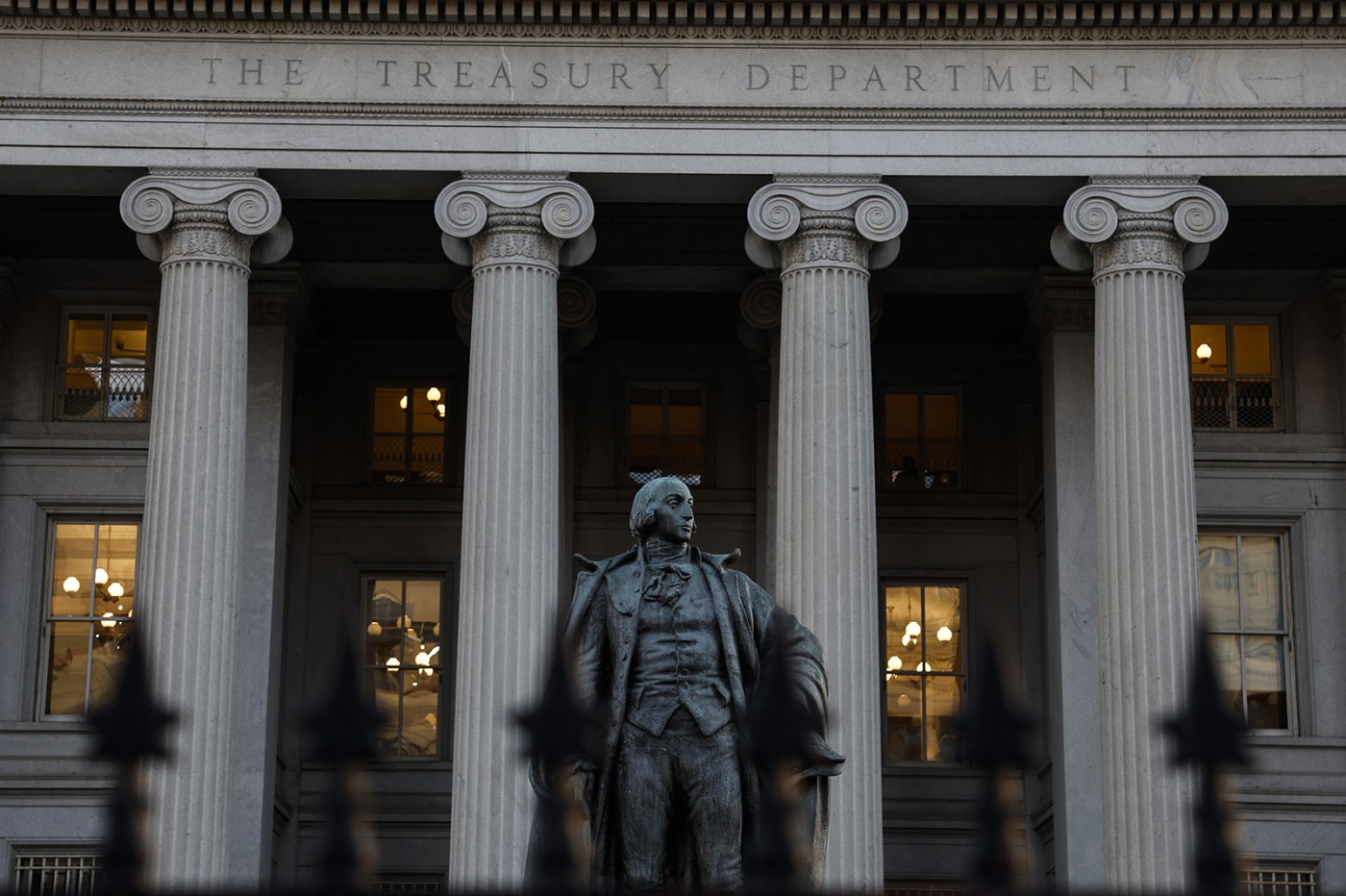
“I do believe we need to reduce deficits and to stay on a fiscally sustainable path,” Treasury Secretary Janet Yellen told lawmakers in February. Biden administration proposals offer “substantial deficit reduction that would continue to hold the level of interest expense at comfortable levels. But we would need to work together to try to achieve those savings,” she said.

Trouble is, delivering on such a plan will require action from a Congress that’s bitterly divided on partisan lines.Republicans, who control the House, want deep spending cuts to bring down the ballooning deficit, without specifying exactly what they’d slash. Democrats, who oversee the Senate, argue that spending is less of a contributor to any deterioration in debt sustainability, with interest rates and tax revenues the key factors. Neither party favors squeezing the benefits provided by major entitlement programs.

In the end, it may take a crisis — perhaps a disorderly rout in the Treasuries market triggered by sovereign U.S. credit-rating downgrades, or a panic over the depletion of the Medicare or Social Security trust funds — to force action. That’s playing with fire.

Last summer provided a foretaste, in miniature, of how a crisis might begin. Over two days in August, a Fitch Ratings downgrade of the U.S. credit rating and an increase of long-term Treasury debt issuance focused investor attention on the risks. Benchmark 10-year yields climbed by a percentage point, hitting 5% in October — the highest level in more than one and a half decades.

As for how things might end, Britain’s experience in fall 2022 provides a glimpse into the abyss. Then-Prime Minister Liz Truss’s plan for unfunded tax cuts sent the gilt market into a tailspin. Yields soared so quickly that the central bank had to step in to snuff out the risk of an outright financial crisis. The bond vigilantes’ actions forced the government to call off the plan and Truss out of office.

For the U.S., the dollar’s central role in international finance and status as the dominant reserve currency lowers the odds of a similar meltdown. It would take a lot to shake investor confidence in U.S. Treasury debt as the ultimate safe asset. If it did evaporate, though, the erosion of the dollar’s standing would be a watershed moment, with the U.S. losing not just access to cheap financing but also global power and prestige.

Variable variables

How does the CBO, Washington’s official budget watchdog, arrive at its debt forecast? The CBO’s assumptions for crucial variables — GDP growth around 2%, inflation returning to 2%, interest rates drifting down from the current levels — are squarely in the ballpark of plausibility. They’re also not far from numbers in the Federal Reserve Bank of Philadelphia’s Survey of Professional Forecasters. Indeed, the CBO’s view on rates is a little higher than the most recent consensus.

Examine them closely, though, and key assumptions underpinning the CBO forecast appear optimistic:

By law, the CBO is compelled to rely on existing legislation. That means it assumes the 2017 Trump tax cuts will expire as scheduled in 2025. But even President Joe Biden wants some of them extended. According to the Penn Wharton Budget Model, permanently extending the legislation’s revenue provisions would cost about 1.2% of GDP each year starting in the late 2020s.
The CBO also must assume that discretionary spending, which is set by Congress each year, will increase with inflation, not keep pace with GDP. As a result, defense spending falls from around 3% of GDP now to about 2.5% in the mid-2030s — a tall order given the wars currently raging and the geopolitical threats that loom. Former Treasury Secretary Lawrence Summers says a more realistic forecast would add at least 1% of GDP to the CBO’s outlook.
Market participants aren’t buying the benign rates outlook, with forward markets pointing to borrowing costs markedly higher than the CBO assumes.

Bloomberg Economics has built a forecast model using market pricing for future interest rates and data on the maturity profile of bonds. Keeping all the CBO’s other assumptions in place, that shows debt equaling 123% of GDP for 2034. Debt at that level would mean servicing costs reach close to 5.4% of GDP — more than 1.5 times as much as what the federal government spent on national defense in 2023, and comparable to the entire Social Security budget.

Heavyweights from across the political spectrum agree the long-term outlook is unsettling. Fed Chair Jerome Powell said earlier this year it was “probably time — or past time” for politicians to get going in addressing the “unsustainable” path for borrowing. Former Treasury Secretary Robert Rubin said in January the nation is in a “terrible place” with regard to deficits. From the realm of finance, Citadel founder Ken Griffin told investors in a letter to the hedge fund’s investors Monday that U.S. national debt is a “growing concern that cannot be overlooked.” Days earlier, BlackRock Inc. Chief Executive Officer Larry Fink said the U.S. public debt situation “is more urgent than I can ever remember.” Ex-IMF chief economist Kenneth Rogoff says while an exact “upper limit” for debt is unknowable, there will be challenges as the level keeps going up.

Rogoff’s broader point is well taken: forecasts are uncertain. To put some parameters around the uncertainty, Bloomberg Economics has run a million simulations on the CBO’s baseline view — an approach economists call stochastic debt sustainability analysis. Each simulation forecasts the debt-to-GDP ratio with a different combination of GDP growth, inflation, budget deficits, and interest rates, with variations based on patterns seen in the historical data.

In the worst 5% of outcomes, the debt-to-GDP ratio ends 2034 above 139%, which means that the U.S. would have a higher debt ratio in 2034 than crisis-prone Italy did last year.

Yellen has another way of thinking about debt sustainability: inflation-adjusted interest expense, which she’s indicated she’d prefer to see below 2% of GDP. On that basis, the results are more hopeful — finding that the metric averaged over the next 10 years violates the threshold in less than a third — 30% — of simulations. The Treasury chief herself acknowledged in a Feb. 8 hearing that “in an extreme case” there could be a possibility of borrowing reaching levels that buyers wouldn’t be willing to purchase everything the government sought to sell. She added that she saw no signs of that now.

Partisan politics

Getting to a sustainable path will require action from Congress. Precedent isn’t promising. Disagreements over government spending came to a head last summer, when a standoff over the debt ceiling brought the U.S. to the brink of a default. The deal to halt the havoc suspended the debt ceiling until Jan. 1, 2025, postponing yet another clash over borrowing until after the presidential election.

It’s hard to imagine a U.S. debt crisis. The dollar remains the global reserve currency. The annual and unseemly spectacle of government-shutdown brinksmanship typically leaves barely a ripple on the Treasury market.

Still, the world is changing. China and other emerging markets are eroding the dollar’s role in trade invoicing, cross-border financing and foreign exchange reserves. Foreign buyers make up a steadily shrinking share of the U.S. Treasuries market, testing domestic buyers’ appetite for ever-increasing volumes of federal debt. And while demand for those securities has lately been supported by expectations for the Fed to lower interest rates, that dynamic won’t always be in play.

Herbert Stein — head of the Council of Economic Advisers in the 1970s — observed that “if something cannot go on forever, it will stop.” If the U.S. doesn’t get its fiscal house in order, a future U.S. president will have the truth of that maxim confirmed. And if confidence in the world’s safe asset evaporates, everyone will suffer the consequences.

Methodology

As a starting point for the analysis, Bloomberg Economics uses the baseline fiscal and economic outlook — including the effective interest rate, primary budget balance as a percent of GDP, inflation as measured by the GDP deflator, and real GDP growth rate — from the latest long-term CBO projections.

For the calculation of the debt-to-GDP ratio using market forecasts for rates, we substitute in forward rates as of March 25, 2024, and project future effective rates on federal debt based on a detailed bond-by-bond analysis.

To forecast the distribution of probabilities around the CBO’s baseline debt-to-GDP view, we conduct a stochastic debt-sustainability analysis:

We estimate a VAR model of short- and long-term interest rates, primary balance-to-GDP ratio, real GDP growth rate, and GDP deflator growth using annual data from 1990 to 2023. The covariance matrix of the estimated residuals is then used to draw one million sequences of shocks.
We use data on the maturities of individual bonds to map short- and long-term interest-rate shocks to the effective rate of interest paid on U.S. federal debt.
Using this model, Bloomberg Economics considers two definitions of sustainability. First, we check if the debt-to-GDP ratio increases from 2024 to 2034. Second, we examine if the average inflation-adjusted interest expense, scaled by nominal GDP, over the 10 years from 2025-2034 is less than 2%.

With assistance from Jamie Rush, Phil Kuntz and Viktoria Dendrinou.

©2024 Bloomberg L.P. Visit bloomberg.com. Distributed by Tribune Content Agency, LLC.