Lauren Peace, Tampa Bay Times | (TNS) KFF Health News
OCALA, Fla. — Fire Capt. Jesse Blaire steered his SUV through the mobile home park until he spotted the little beige house with white trim and radioed to let dispatchers know he’d arrived.
There, Shawnice Slaughter waited on the steps, wiping sleep from her eyes.
“Good morning, Shawnice,” Blaire said. “How are you feeling today?”
“I’ve been good, I’ve been good,” Slaughter said. “Much better.”
Three days earlier, Blaire — a paramedic who leads the fire department’s emergency medical team — met Slaughter at a nearby hospital. She had overdosed on opioids. It took four vials of an overdose reversal medication and dozens of chest compressions to get her breathing again.
At the hospital, Blaire told Slaughter about a free program that could help. It wouldn’t just connect her with a recovery center but would also get her doctors’ appointments, plus rides there. More important, she would get medicine to alleviate withdrawal symptoms so she wouldn’t search for drugs to ease the sickness. Blaire would bring that medication, daily, to her home.
“I have a son,” Slaughter, 31, told Blaire. “I need to be alive for him.”
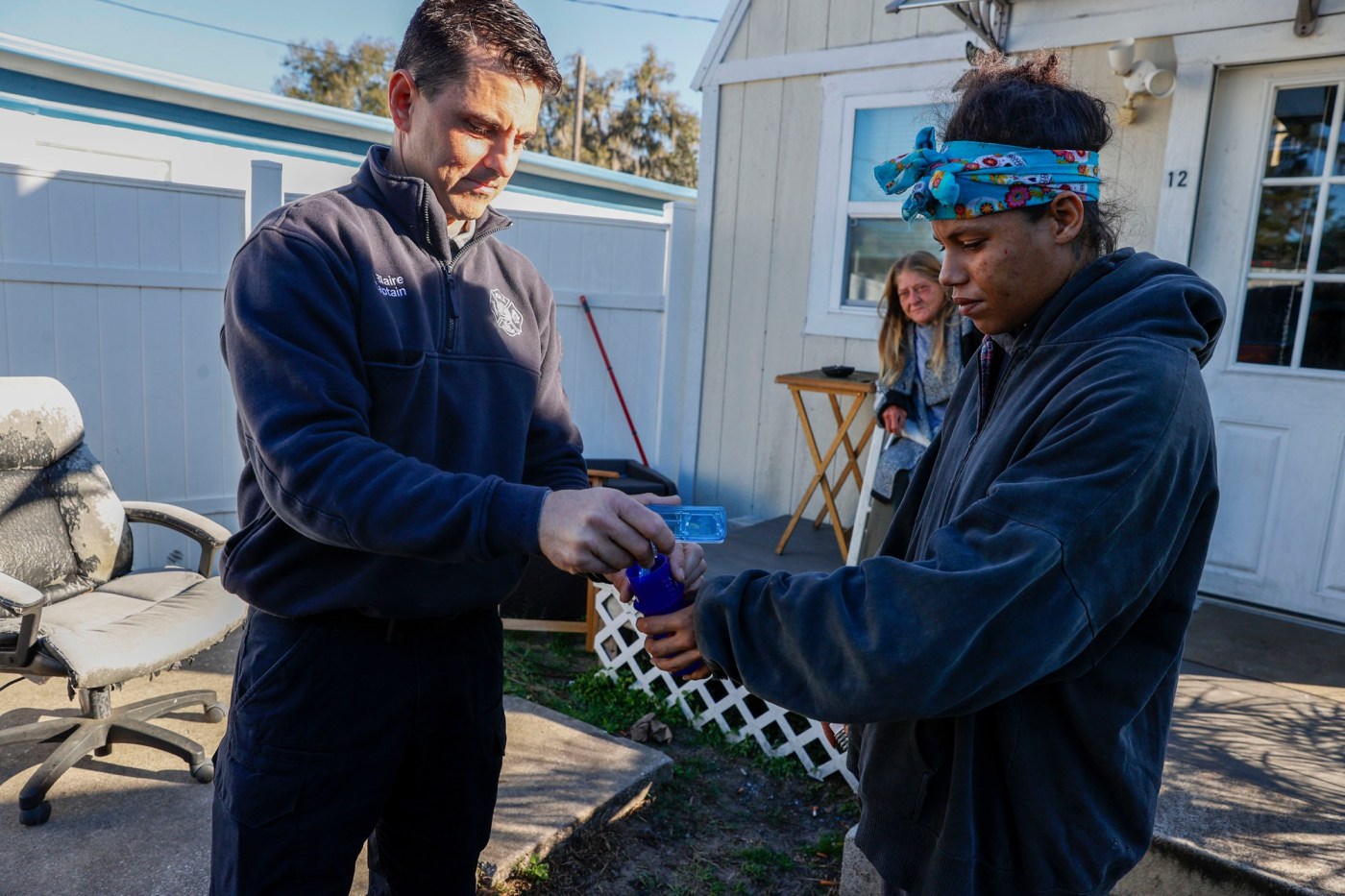
Every morning since, Blaire had driven over for a check-in. He reminded Slaughter of appointments and took note of what she needed: clothes, food, help with bills.
And at the end of each visit, from a lockbox in the back of his car, he dispensed to her a couple of tiny, lifesaving tablets.
Buprenorphine is displayed inside an Ocala Fire Rescue truck parked at Beacon Point, an integrated care center for substance use recovery, in Ocala, Florida. (Ivy Ceballo/Tampa Bay Times/TNS)
Those tablets — a medicine called buprenorphine — represent a tidal change in the way counties in Florida and other states are addressing the opioid crisis. The idea: Get addiction medication to people who need it by meeting them where they are. Sometimes, that’s on the street. Sometimes, it’s in the driveway of a big house with a swimming pool. Sometimes on the steps of a modest home like Slaughter’s.
********
For a long time, many people who could benefit from buprenorphine, commonly known by the brand name Subutex, couldn’t get it.
Until recently, doctors needed a federal waiver to prescribe it to treat opioid use disorder. Amid misconceptions about treating opioid use disorder with medication, only about 5% of doctors nationally underwent the training to qualify. And in 2021, only 1 in 5 people who could have benefited from opioid addiction medication were receiving buprenorphine or another drug therapy.
But as evidence supporting the drug’s efficacy grew and the urgency mounted to curb opioid deaths, Congress axed the waiver requirement in late 2022, clearing the way for greater availability.
And in rare cases, such as in Ocala, medics on the front lines began bringing treatment to patients’ front doors.
In Florida, the state-run Coordinated Opioid Recovery Network, known as the CORE Network, provides guidelines on medicine distribution to areas hit hard by overdoses. Services through the network are free for patients, funded by money from the state’s opioid settlement.
The network looks different in each of its 13 counties. Not all hand-deliver buprenorphine. But the common goal is to create a single entry point for services that have typically been siloed and difficult for patients to navigate, such as mental health care and housing support.
In a recovery landscape rife with shoddy facilities and prohibitive price tags, simplifying the path for patients stands to make a meaningful difference.
“We know that the more people are in contact with services, the more they’re treated with respect, the more likely they are to reduce or cease drug use,” said Susan Sherman, a public health professor at Johns Hopkins University.
As opioid settlement dollars continue to come in, state officials have said they hope to expand to more counties.
********
Becoming a firefighter and paramedic satisfied Blaire’s craving for adrenaline and his conviction, informed in part by his Christian background, that he was put on this Earth to help others.
At 20, he imagined responding to car crashes and heart attacks, broken bones and punctured flesh. But after years on the job with Ocala Fire Rescue, the calls began to change.
At first, Blaire felt some resentment toward the people overdosing. His team was suddenly responding to hundreds of such calls a year. He viewed drug use as a moral failure. What if a grandmother had a heart attack or a kid drowned while his team was on an overdose call?
Unlike with other emergencies, he never really felt he was saving a life when responding to an overdose. It was more like delaying death.
Over and over, he’d pump a patient full of naloxone, an overdose reversal medication often known by one of its brand names, Narcan, and drop them at the hospital, only to find they’d overdosed again after being discharged. One Christmas, he said, he responded to the same person overdosing five times on a single shift.
“I didn’t understand it. I thought that they wanted to die,” said Blaire, 47. “I’m embarrassed to say that now.”
About a decade ago, the scope of the epidemic had already come into full view to Blaire’s crew. It seemed the team was responding to overdoses at big houses in wealthy neighborhoods nearly as often as they were in the park and under the bridge.
One week, his team went to a home on a cul-de-sac with two kids and a swing set — the kind of place families take their children trick-or-treating.
The dad had overdosed. The next week, it was the mom.
“Money can mask any problem, but we’ve seen it from the top to the bottom,” Blaire said.
Over time, Blaire began to understand addiction as the disease it is: a physiological change to someone’s brain that traps them in a dangerous cycle. Maybe it started with a prescription painkiller after surgery, or an indulgence at a party, but the majority of people weren’t using drugs to get high, he realized. They were using them to avoid being sick.
“Imagine the worst flu you’ve ever had, then make it a lot worse,” Blaire said.
When a person dependent on opioids stops taking them, their body goes into withdrawal, often accompanied by shakes, nausea, fever, sweating, and chills. Though rare, people can die from opioid withdrawal syndrome. Still, historically, the emergency health care system has focused on reversing overdoses, rather than treating the withdrawal side effects that keep people returning to drugs.
In the past, Blaire said, he saw patients released from the hospital with little more than a phone number for a recovery center. Getting an appointment could be challenging, not only because of wait times or insurance complications, but because the patients weren’t stable — they were in withdrawal. To make it through the day, Blaire said, they’d often use again.
“‘Good luck, you’re on your own,’” Blaire said. “That’s how it was. And that doesn’t work for somebody who is sick.”
Under Blaire’s leadership, Ocala Fire Rescue sought to stop the revolving door by launching its Community Paramedicine program and the Ocala Recovery Project in 2020.
They modeled it after overdose quick-response teams around the country, which vary in makeup. These mobile teams, typically helmed by paramedics like Blaire, connect people who have overdosed with services aimed at stabilizing them long-term. On some, a registered nurse embeds with paramedics in an ambulance or SUV. Others have a therapist or peer recovery coach on board. Some are bare-bones: a single responder with a phone on 24 hours a day. Some get in touch with patients through a call or a home visit after a reported overdose.
Others, like Blaire’s team, intercept patients at the hospital.
Blaire likens the system to that of a trauma alert — a message sent to medical centers to ready a response to near-fatal car wrecks or shootings. When a trauma alert goes out, operating tables are cleared, CT scanners are prepped, and responders stand by for arrival.
“We set the same system up for overdoses,” Blaire said.
Now, when somebody in Ocala overdoses, whether it’s on opioids, alcohol, meth, or cocaine, an alert goes out, notifying Blaire and his team, a peer recovery coach, a behavioral health specialist, and a local recovery center.
His team usually beats the ambulance to the hospital.
The next day, team members follow up at the patient’s home.
Then, last May, under the guidance of the EMS medical director, Blaire’s team started offering addiction medication to opioid users, too.
Since then, Blaire said, his team has connected 149 patients with treatment. Only 28 of them have needed additional intervention, he said.
********
When Blaire first heard about buprenorphine, he was skeptical.
How could giving somebody with an addiction more narcotics help?
That common response misunderstands the reality of addiction, said Nora Volkow, director of the National Institute on Drug Abuse.
People perceive that one drug is being substituted for another, Volkow said. Instead, the use of medications like buprenorphine is more akin to those that treat other psychiatric conditions, like mood disorders or depression.
Research shows that opioid addiction medication — including drugs like methadone — can greatly reduce the risk of overdose deaths, and increase a person’s retention in treatment. But a study out of the New York University Grossman School of Medicine found that nearly 87% of people with opioid use disorders don’t receive any.
Such addiction medications work by stimulating opioid receptors in the brain.
Opioids — like oxycodone or fentanyl — are what experts refer to as “full agonists.” Imagine an opioid receptor as a rounded bowl. A full agonist — like fentanyl — fits perfectly in that bowl and latches tightly to the receptor.
Buprenorphine is a “partial agonist.” It fits in the bowl — and satiates a craving — but doesn’t completely bind like a full agonist. Instead, it eliminates withdrawal symptoms so people won’t get sick or crave illicit drugs, without producing a high. Second, it counteracts the effects of other drugs, so a person can’t overdose on other opioids like fentanyl or heroin while taking it.
And for somebody who already uses opioids, overdosing from buprenorphine is nearly impossible.
“They help a person regain control of their everyday life,” Volkow said.
********
On this Monday in January, Blaire pulled into Beacon Point, a local treatment center, just past 2 p.m.
He’d spent his morning calling on people like Slaughter, but now he was meeting paramedics from his team. After nearly three weeks of home visits, a man in the recovery network program was set to have his first appointment with a doctor.
Blaire has found that once people are stable on buprenorphine, more often than not they want to get into a treatment program.
While Blaire waited, a woman walking out of the center approached, smiling.
“I just got my first clean urine analysis,” she said. “I’m doing great, I’m so excited.”
“That’s awesome news,” Blaire said, a smile stretched across his face. He’s often stoic, straight-laced, with combed hair and aviators. But when he lights up, his all-business exterior gives way to gentleness.
Jacqueline Luciano is sober for the first time in 30 years. She’s proud, glowing, and Blaire is proud, too.
Jacqueline Luciano, who received care through Florida’s CORE program, becomes emotional while speaking about the help she’s received. Luciano, who started using drugs at age 9, says she has hope for the first time. (Ivy Ceballo/Tampa Bay Times/TNS)
Luciano first came to Blaire through a referral when she was living at a women’s shelter. She said she had $20 in her pocket and wanted to get high — needed to.
Fentanyl withdrawal had left her shaky and cold. Her stomach was seizing, her muscles spasming. To quell the agony that day in early January, she went on the hunt.
Luciano said she had first used drugs when she was 9. Her family had been torn apart by pills and powders, she said, a sickness she’d inherited.
But this time, a woman — “like an angel” — passed her a number for someone who she promised could guide her into a brighter future, blame-free. Luciano, 39, paused, skeptical.
Then she gave Blaire a call.
For about a week, Blaire delivered her a daily dose of buprenorphine using a Safe RX bottle — essentially a trackable pill bottle with a lock code to limit who can open it. He helped connect her with food and clothing donations.
And as Luciano started to feel more like herself, absent of cravings, she began to hope.
Blaire got her an appointment with doctors at Beacon Point, then drove her to her first screening. Now, in the parking lot, she thanked him for everything.
“It made all the difference in the world,” Luciano told Blaire. “I really didn’t think that I could get better. I didn’t. But I am.”
As a tear rolled down Luciano’s face, Blaire’s phone rang.
********
The call came from the health department. A man in his 40s or 50s had come some 40 miles from Gainesville, Florida, for help, steered through word of mouth.
He’d tried to get into a recovery center there but said he was turned away. Something about insurance and a criminal record had stood in the way.
It’s a pattern that drives Blaire crazy. He’d seen it a lot before his team was formed. People would get a moment of courage or clarity, only to be told “not yet.”
“Your first answer has to be ‘yes,’” he said. “‘Yes, I can help you.’”
He knew about a woman who had come from 25 miles out of town, then was told to come back days later. She didn’t have a car or a home to return to.
“They didn’t even offer her a ride,” Blaire said. “Sometimes you only have one shot.”
Blaire has learned that building trust starts with a small offering. A car ride. A sandwich. Help getting a government ID. Anything to show that you care, that you’re useful. That you see someone trying.
Outside the health department, a man in muddied jeans and a frayed T-shirt stood waiting on the curb. He introduced himself as Jetson and didn’t give a last name. Blaire shook his hand before they loaded into the car.
“So what brings you this way?” Blaire asked, once both were buckled in.
“I heard there were services here,” Jetson said, his voice gruff, quivering. “I’ve tried to stop using so many times, but I keep messing it up.”
Jetson shook his head.
“Well, I’m glad you found us,” Blaire said. He asked the man if he wanted to go to the recovery center for a screening. He did.
Over the 10-minute drive to Beacon Point, Blaire and Jetson talked, not about drugs or meds, but life. Baseball. Cabbage (good when fried).
When they pulled up, Blaire handed Jetson a card.
“Please call me,” Blaire said. “If you need anything. We can get you help.”
For a moment, the men sat there. Jetson pulling at his fingers. Taking deep breaths.
Then, he got out of the car — Blaire’s card in hand — and walked through the glass door.
____
This article was produced in partnership with the Tampa Bay Times.
___
(KFF Health News is a national newsroom that produces in-depth journalism about health issues and is one of the core operating programs of KFF — the independent source for health policy research, polling and journalism.)
©2024 KFF Health News. Distributed by Tribune Content Agency, LLC.