US government warns it will take action if Haitian politicians destabilize country

posted in: All news | 0

By DÁNICA COTO, Associated Press

SAN JUAN, Puerto Rico (AP) — The U.S. warned the transitional council in charge of Haiti against making changes to the troubled country’s government late Wednesday, as pressure mounts for the unelected body to move toward elections for the first time in a decade.

Related Articles


What to know about Greenland’s role in nuclear defense and Trump’s ‘Golden Dome’


House moves to finish government funding as Democrats decry Homeland Security bill


Denmark says its sovereignty is not negotiable after Trump’s Greenland about-turn


Jack Smith is set to testify at a public hearing about his Trump investigations


Trump rolls out his Board of Peace at Davos, but many top US allies aren’t participating

In a statement posted on X, the U.S. Embassy in Haiti wrote that “The United States would consider that any person who supports such a destabilizing initiative, which favors the gangs, would be acting against the interests of the United States, the region, and the Haitian people, and will take appropriate measures accordingly.”

The U.S. Embassy added that such a maneuver would undermine efforts to establish “a minimal level of security and stability” in Haiti, where gang violence is surging and poverty deepening.

The statement came as some members of the council are at odds with Haitian Prime Minister Alix Didier Fils-Aimé, although it wasn’t immediately clear why. The council met behind closed doors earlier Wednesday.

A spokesman for the prime minister’s office said he could not comment on the situation. The council’s seven members with voting powers did not return messages asking for comment.

Meanwhile, Laurent Saint-Cyr, the council’s leader, said in a statement that he opposes any push to undermine government stability ahead of Feb. 7, when the council is provisionally scheduled to step down.

“As major institutional deadlines for the Nation approach, any initiative likely to fuel instability, confusion or a breakdown of trust carries serious risks for the country,” he wrote. “Haiti cannot afford to make unilateral decisions or engage in short-sighted political calculations that would compromise the stability and continuity of the State, as well as the well-being of the already sorely tested population.”

Unelected council was put in charge to quell chaos

It’s the latest episode in years of political chaos that erupted after Haiti’s last elected president, Jovenel Moïse, was slain at his home in July 2021.

The council has been one of the country’s top authorities since April 2024. It was created with the help of Caribbean leaders after powerful gangs forced the closure of Haiti’s main international airport and targeted key state infrastructure in a series of unprecedented attacks that eventually led former Prime Minister Ariel Henry to resign.

The council was charged with selecting Haiti’s prime minister in a bid to quickly bring some stability to the beleaguered country.

Fils-Aimé is the third person chosen by the council. A businessman and former head of Haiti’s Chamber of Commerce and Industry, he was appointed in November 2025 after the council fired previous leader Garry Conille.

The council is supposed to step down by Feb. 7, but it’s unclear if that will happen. Critics say some council members are trying to stay in power longer, and many fear the move could unleash a fresh round of violent protests.

The Feb. 7 deadline was approved in early 2024 on the assumption that Haiti would have held general elections to elect a new president. Gang violence has prevented officials from holding elections so far, although they are tentatively set for August, with a runoff to be held in December.

UN Security Council meets to discuss Haiti

A new U.N. report released Wednesday noted that “national stakeholders remain divided over the transitional governance architecture that is to lead the country to elections.”

Earlier on Wednesday, the U.N. Security Council met to discuss the unraveling situation in Haiti.

“Haiti has entered a critical phase in its process of restoring democratic institutions,” said Carlos Ruiz-Massieu, special representative of the U.N. Secretary General in Haiti. “Let’s be clear: the time for political maneuvering is over.”

Panamanian Ambassador Eloy Alfaro de Alba noted at the meeting that Haiti is at a “critical juncture,” with only 18 days left for the transitional presidential council’s mandate to end.

“The persistent nature of violence … remains of utmost concern,” he said.

Several U.N. Security Council members noted that Haiti needs to quickly move toward a democratic transition as gangs continue to seize control of more territory.

“There’s a need to approach this deadline with a sense of responsibility … to sustain continuity of state and avoid any disruptions that may undermine the operation of national institutions,” said Ericq Pierre, permanent representative of Haiti to the United Nations.

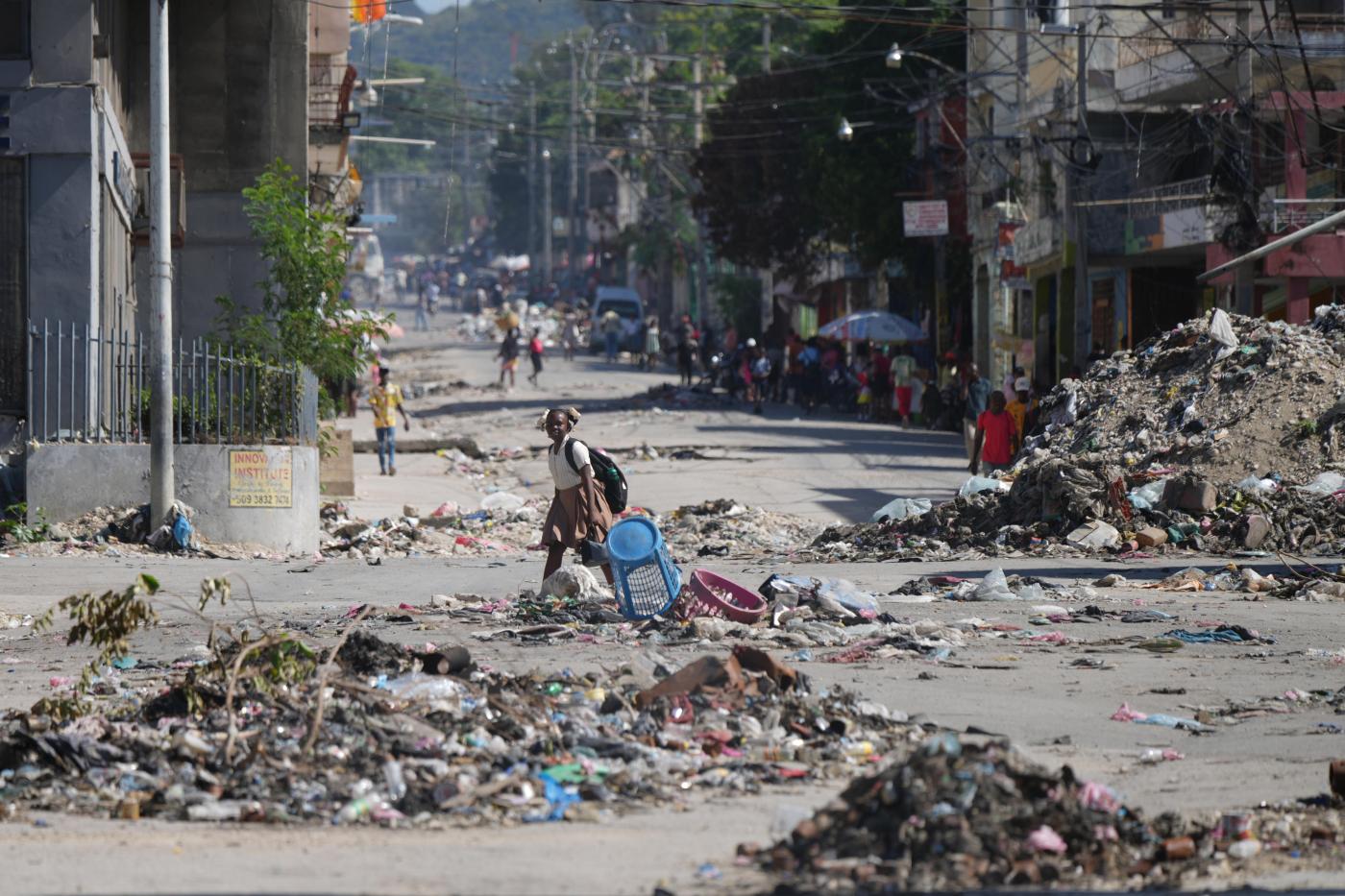
Gangs control an estimated 90% of Port-au-Prince, Haiti’s capital, and they have seized swaths of land in the country’s central region.

More than 8,100 killings were reported across Haiti from January to November last year, “with figures likely underreported owing to limited access to gang-controlled areas,” according to the U.N. report.

Haiti’s National Police has been trying to quell gang violence with help from a U.N.-backed mission led by Kenyan police that remains understaffed and underfunded.

The mission is transitioning into a so-called “gang suppression force” that would have the power to arrest suspected gang members.

Haiti’s government also has been working with a private military contractor to launch drone strikes targeting suspected gang members, but which have also killed civilians. The strikes killed more than 970 people from March to December last year, including 39 civilians, 16 of them children, according to the Office of the United Nations High Commissioner for Human Rights.

Associated Press reporter Evens Sanon in Port-au-Prince, Haiti contributed to this report.

EU leaders gather to chart a new course for transatlantic ties after Trump threats over Greenland

posted in: All news | 0

By LORNE COOK and SAM McNEIL, Associated Press

BRUSSELS (AP) — European Union leaders are gathering for emergency talks on Thursday to chart a new course in transatlantic relations after a tumultuous two weeks dominated by U.S. President Donald Trump’s renewed threats to take control of Greenland.

Related Articles


Denmark says its sovereignty is not negotiable after Trump’s Greenland about-turn


Today in History: January 22, ‘Unabomber’ Ted Kaczynski pleads guilty


Trump’s Argentine ally welcomes a shipload of Chinese EVs for the first time


Man who assassinated former Japanese prime minister gets life in prison


Israeli fire kills 11 Palestinians in Gaza, including 2 children, local hospital officials say

On the eve of their summit, Trump dramatically backed away from his insistence on “acquiring” Greenland, a semiautonomous territory of Denmark. For the first time, he said that he would not use force to seize the island. Trump also dropped his threat of slapping tariffs on eight European nations supporting Denmark.

Yet nothing suggests that the unpredictable U.S. leader won’t change his mind again. European Commission President Ursula von der Leyen this week cast doubts over his reliability after he appeared ready to renege on an EU-U.S. trade deal sealed in July that was meant to end further tariffs.

“In politics as in business – a deal is a deal. And when friends shake hands, it must mean something,” von der Leyen told EU lawmakers on Tuesday.

No details of the hastily agreed “framework” deal that sparked Trump’s extraordinary reversal have been made public, and doubts about it persist. Danish Prime Minister Mette Frederiksen insists that her country will not negotiate away its sovereignty.

European leaders are also expected to agree on a joint approach to Trump’s proposed “Board of Peace,” which was initially envisioned as a small group of world leaders overseeing the Gaza ceasefire but has grown into something far more ambitious.

French President Emmanuel Macron is seen during the Annual Meeting of the World Economic Forum in Davos, Switzerland, Tuesday, Jan. 20, 2026. (AP Photo/Markus Schreiber)

On Thursday, days after telling the prime minister of Norway in a text message that he no longer felt “an obligation to think purely of Peace,” Trump put the spotlight on the proposed board at Davos.

Trump has spoken about the board replacing some of the functions of the United Nations.

Some European countries have declined invitations to join. Norway, Slovenia and Sweden said they won’t take part. Told that President Emmanuel Macron was unlikely to join, Trump said: “I’ll put a 200% tariff on his wines and champagnes and he’ll join.”

Germany has offered a guarded and noncommittal response to Trump’s invitation, but Hungary has accepted.

On the eve of the meeting, the man who will chair it, European Council President António Costa, said that the Trump administration poses a challenge to Europe’s security, principles and prosperity.

“All these three dimensions are being tested in the current moment of transatlantic relations,” Costa said.

After consulting the leaders, Costa said they are united on “the principles of international law, territorial integrity and national sovereignty,” something the EU insists on as it defends Ukraine against Russia, and which Trump has threatened in Greenland.

In a speech to EU lawmakers in Strasbourg, France, he also insisted that “further tariffs would undermine transatlantic relations and are incompatible with the EU-US trade agreement.” EU lawmakers must endorse that deal but on Wednesday they put a hold on their vote over Trump’s threats.

EU leaders have been galvanized by Trump’s bullying over Greenland, and are rethinking their relations with an unpredictable America, their long-time ally and the most powerful member of NATO.

German Chancellor Friedrich Merz sits on the podium during the Annual Meeting of the World Economic Forum in Davos, Switzerland, Thursday, Jan. 22, 2026. (AP Photo/Markus Schreiber)

“Appeasement is always a sign of weakness. Europe cannot afford to be weak — neither against its enemies, nor ally,” Polish Prime Minister Donald Tusk, a staunch supporter of strong transatlantic ties, posted on social media on Tuesday.

Von der Leyen, who manages trade on behalf of EU countries, warned that the bloc is “at a crossroads.” Should tariffs come, she said, “we are fully prepared to act, if necessary, with unity, urgency and determination.”

She also told the lawmakers that the commission is working on “a massive European investment surge in Greenland” to beef up its economy and infrastructure, as well as a new European security strategy.

What to know about Greenland’s role in nuclear defense and Trump’s ‘Golden Dome’

posted in: All news | 0

By JOHN LEICESTER, Associated Press

PARIS (AP) — In a hypothetical nuclear war involving Russia, China and the United States, the island of Greenland would be in the middle of Armageddon.

Related Articles


House moves to finish government funding as Democrats decry Homeland Security bill


Denmark says its sovereignty is not negotiable after Trump’s Greenland about-turn


Jack Smith is set to testify at a public hearing about his Trump investigations


Trump rolls out his Board of Peace at Davos, but many top US allies aren’t participating


Conservative group says Los Angeles school policy hurts white students in federal lawsuit

The strategic importance of the Arctic territory — under the flight paths that nuclear-armed missiles from China and Russia could take on their way to incinerating targets in the United States, and vice versa — is one of the reasons U.S. President Donald Trump has cited in his disruptive campaign to wrest control of Greenland from Denmark, alarming Greenlanders and longtime allies in Europe alike.

Trump has argued that U.S. ownership of Greenland is vital for his “Golden Dome” — a multibillion dollar missile defense system that he says will be operational before his term ends in 2029.

“Because of The Golden Dome, and Modern Day Weapons Systems, both Offensive and Defensive, the need to ACQUIRE is especially important,” Trump said in a Truth Social post on Saturday.

That ushered in another roller-coaster week involving the semiautonomous Danish territory, where Trump again pushed for U.S. ownership before seemingly backing off, announcing Wednesday the “framework of a future deal” on Arctic security that’s unlikely to be the final word.

Here’s a closer look at Greenland’s position at a crossroads for nuclear defense.

ICBM flight paths

Intercontinental Ballistic Missiles, or ICBMs, that nuclear adversaries would fire at each other — if it ever came to that — tend to take the shortest direct route, on a ballistic trajectory into space and down again, from their silos or launchers to targets. The shortest flight paths from China or Russia to the United States — and the other way — would take many of them over the Arctic region.

Russian Topol-M missiles fired, for example, from the Tatishchevo silo complex southeast of Moscow would fly high over Greenland, if targeted at the U.S. ICBM force of 400 Minuteman III missiles, housed at the Minot Air Force Base in North Dakota, the Malmstrom Air Force Base in Montana and the Warren Air Force Base in Wyoming.

Chinese Dong Feng-31 missiles, if fired from new silo fields that the U.S. Defense Department says have been built in China, also could overfly Greenland should they be targeted at the U.S. Eastern Seaboard.

“If there is a war, much of the action will take place on that piece of ice. Think of it: those missiles would be flying right over the center,” Trump said Wednesday at the World Economic Forum in Davos, Switzerland.

Pituffik Space Base

An array of farseeing early warning radars act as the Pentagon’s eyes against any missile attack. The northernmost of them is in Greenland, at the Pituffik Space Base. Pronounced “bee-doo-FEEK,” it used to be called Thule Air Base, but was renamed in 2023 using the remote location’s Greenlandic name, recognizing the Indigenous community that was forcibly displaced by the U.S. outpost’s construction in 1951.

Its location above the Arctic Circle, and roughly halfway between Washington and Moscow, enables it to peer with its radar over the Arctic region, into Russia and at potential flight paths of U.S.-targeted Chinese missiles.

“That gives the United States more time to think about what to do,” said Pavel Podvig, a Geneva-based analyst who specializes in Russia’s nuclear arsenal. “Greenland is a good location for that.”

The two-sided, solid-state AN/FPS-132 radar is designed to quickly detect and track ballistic missile launches, including from submarines, to help inform the U.S. commander in chief’s response and provide data for interceptors to try and destroy warheads.

The radar beams out for nearly 5,550 kilometers (3,450 miles) in a 240-degree arc and, even at its furthest range, can detect objects no larger than a small car, the U.S. Air Force says.

Expert sees holes in Trump’s arguments

Pitching the “Golden Dome” in Davos, Trump said that the U.S. needs ownership of Greenland to defend it.

“You can’t defend it on a lease,” he said.

But defense specialists struggle to comprehend that logic given that the U.S. has operated at Pituffik for decades without owning Greenland.

French nuclear defense specialist Etienne Marcuz points out that Trump has never spoken of also needing to take control of the United Kingdom — even though it, like Greenland, also plays an important role in U.S. missile defense.

An early warning radar operated by the U.K.’s Royal Air Force at Fylingdales, in northern England, serves both the U.K. and U.S governments, scanning for missiles from Russia and elsewhere and northward to the polar region. The unit’s motto is “Vigilamus” — Latin for “We are watching.”

Trump’s envisioned multilayered “Golden Dome” could include space-based sensors to detect missiles. They could reduce the U.S. need for its Greenland-based radar station, said Marcuz, a former nuclear defense worker for France’s Defense Ministry, now with the Foundation for Strategic Research think tank in Paris.

“Trump’s argument that Greenland is vital for the Golden Dome — and therefore that it has to be invaded, well, acquired — is false for several reasons,” Marcuz said.

“One of them is that there is, for example, a radar in the United Kingdom, and to my knowledge there is no question of invading the U.K. And, above all, there are new sensors that are already being tested, in the process of being deployed, which will in fact reduce Greenland’s importance.”

‘Golden Dome’ interceptors

Because of its location, Greenland could be a useful place to station “Golden Dome” interceptors to try to destroy warheads before they reach the continental U.S.

The “highly complex system can only work at its maximum potential and efficiency … if this Land is included in it,” Trump wrote in his post last weekend.

But the U.S. already has access to Greenland under a 1951 defense agreement. Before Trump ratcheted up the heat on the territory and Denmark, its owner, their governments likely would have readily accepted any American military request for an expanded footprint there, experts say. It used to have multiple bases and installations, but later abandoned them, leaving just Pituffik.

“Denmark was the most compliant ally of the United States,” Marcuz said. “Now, it’s very different. I don’t know whether authorization would be granted, but in any case, before, the answer was ‘Yes.’”

House moves to finish government funding as Democrats decry Homeland Security bill

posted in: All news | 0

By KEVIN FREKING and LISA MASCARO, Associated Press

WASHINGTON (AP) — The House will look to pass this year’s final tranche of spending bills on Thursday, an effort that is being complicated by Democratic lawmakers’ concerns that the measure funding the Department of Homeland Security inadequately addresses President Donald Trump’s mass deportation efforts.

Related Articles


What to know about Greenland’s role in nuclear defense and Trump’s ‘Golden Dome’


Denmark says its sovereignty is not negotiable after Trump’s Greenland about-turn


Jack Smith is set to testify at a public hearing about his Trump investigations


Trump rolls out his Board of Peace at Davos, but many top US allies aren’t participating


Conservative group says Los Angeles school policy hurts white students in federal lawsuit

The House has already passed eight of the 12 annual appropriations bills that fund federal agencies and programs. If the final four bills pass on Thursday, action would then move to the Senate, with final passage needed before a Jan. 30 deadline to avoid a partial government shutdown.

House Democratic leaders Rep. Hakeem Jeffries of New York, Rep. Katherine Clark of Massachusetts and Rep. Pete Aguilar of California announced in a closed-door meeting that they would oppose the Homeland Security bill. Their members are demanding a forceful stand in response to the Republican president’s immigration crackdown, most recently centered in the Minneapolis area, where more than 2,000 officers are stationed and where a U.S. Immigration and Customs Enforcement officer fatally shot Renee Good, a mother of three.

“There’s a very big concern about ICE being out of control,” said Rep. Rosa DeLauro, the ranking Democratic lawmaker on the House Appropriations Committee.

But Democrats have few good options to express their opposition. DeLauro said that passing a continuing resolution to fund Homeland Security at current levels for the remainder of the budget year would cede spending decisions to Trump. There’s also little appetite for another shutdown, even if it would affect only a portion of the federal government.

“There is much more we must do to rein in DHS, which I will continue to press for. But the hard truth is that Democrats must win political power to enact the kind of accountability we need,” said Sen. Patty Murray, the top Democrat on the Senate Appropriations Committee.

This year’s Homeland Security bill holds spending for ICE roughly flat from the prior year. It also restricts the ability of Homeland Security Secretary Kristi Noem to unilaterally shift funding and allocate federal dollars as she sees fit.

“It’s not everything we wanted. We wanted more oversight. But, look, Democrats don’t control the House. We don’t control the Senate or the White House. But we were able to add some oversight over Homeland,” said Rep. Henry Cuellar, D-Texas, a member of the Appropriations panel. He said he intends to vote for the bill.

Democrats voice their concerns privately and publicly

But most Democrats who emerged from the closed-door caucus meeting on Wednesday had a different view.

“I never support lawless operations,” said Rep. Marcy Kaptur, D-Ohio.

“If it’s the status quo, I’m a no,” said Rep. Brad Schneider, D-Ill.

DeLauro, along with Cuellar, made a presentation about the bill to House Democrats during their closed-door meeting. Rep. Pramila Jayapal, D-Wash., said she told her colleagues why she thought it was a mistake. Others who spoke up agreed, she said.

“I think this is just a really horrific time, and people understand what’s at stake,” Jayapal said. “We can’t treat this like it’s anything else. Our eyes are not lying to us.”

She explained that extra money for body cameras and other changes was insufficient. The bill provides $20 million that must be used for ICE and Customs and Border Protection officers when conducting enforcement actions.

She said she told her colleagues, “Nobody should try to sell this as an improvement. It’s not an improvement.”

But some Democrats in key swing districts will likely be seeing campaign ads targeting them if they vote against the Homeland Security funding bill. The campaign arm for House Republicans issued press releases on Wednesday targeting some 20 Democrats, saying they “will do anything to appease the ‘defund ICE’ crowd even if it means risking national security.”

Meanwhile, liberal advocacy groups are also applying pressure, saying Congress must take clear, immediate action to rein in the department.

“The DHS bill that was released clearly falls far short, and should be roundly rejected. Every Democrat should be voting against this funding bill, and Democratic leadership in both chambers should be actively whipping their caucus in opposition,” said Andrew O’Neill, national advocacy director for the group Indivisible.

Republicans are confident the bill will pass

Speaker Mike Johnson, R-La., was optimistic that the funding bills would pass, including the Homeland Security measure. He can afford a few defections given the GOP’s razor-thin majority.

“All we do is win,” Johnson said.

The overall funding package before the House on Thursday contains roughly $1.2 trillion in spending. About two-thirds of that will go to the Defense Department.

Other departments that are funded through the package include Health and Human Services, Education, Transportation and Housing and Urban Development. Most federal spending is unaffected by the yearly battles in Congress, most notably Social Security and Medicare.