US applications for jobless benefits inch up last week to a still-low 200,000

posted in: All news | 0

By MATT OTT, Associated Press Business Writer

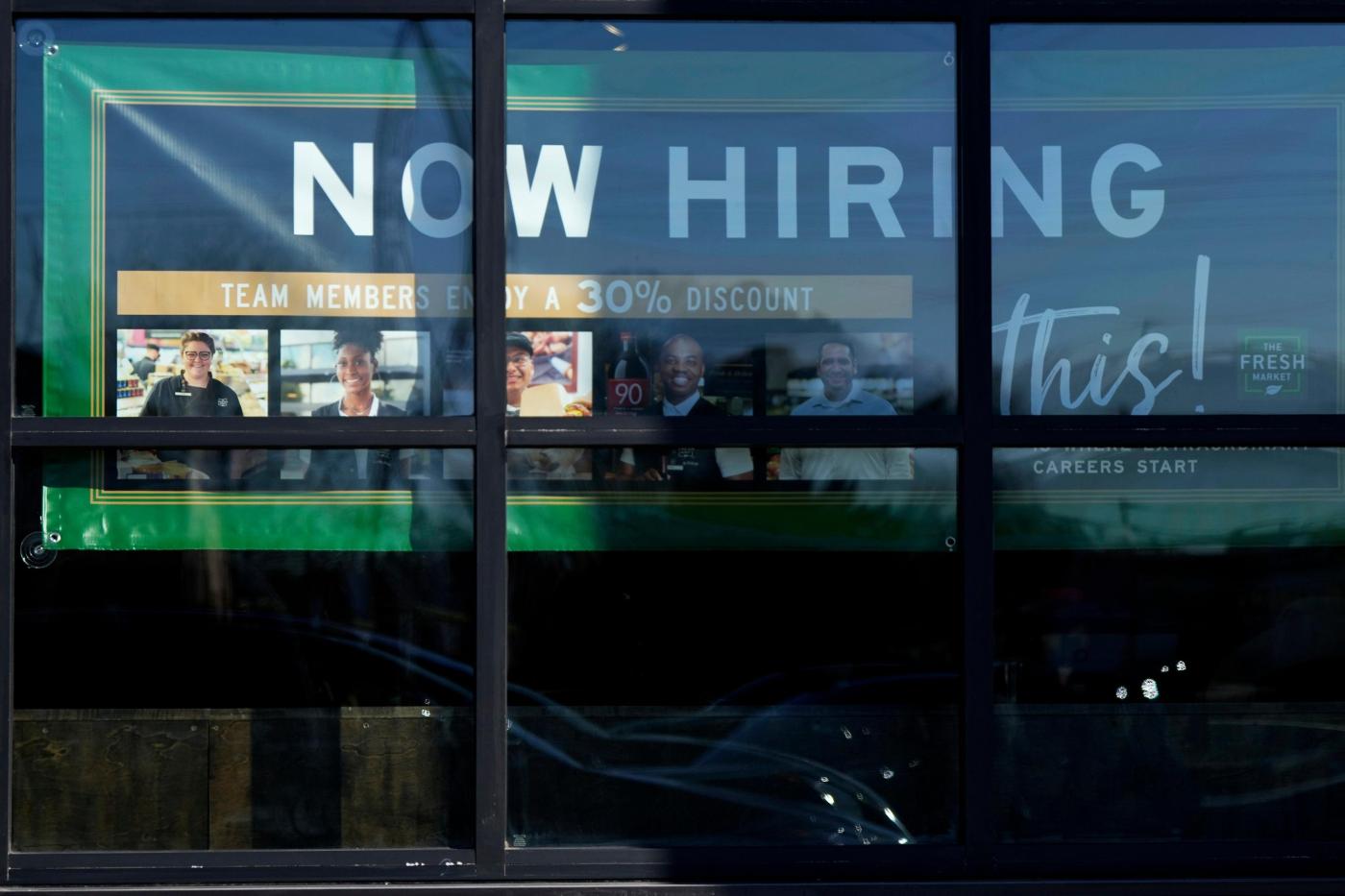
WASHINGTON (AP) — The number of Americans who applied for unemployment benefits inched up last week but U.S. layoffs remain historically low despite signs of a softening labor market.

Related Articles


Consumer spending pushes US economy up 4.4% in third quarter, fastest in two years


Wall Street claws for more gains in wake of Greenland de-escalation


Trump’s Argentine ally welcomes a shipload of Chinese EVs for the first time


Food costs spiked while gas prices cooled. Here’s the latest look at consumer expenses.


Iconic Coney Island hot dog hawker Nathan’s Famous is sold for $450 million

U.S. filings for jobless aid for the week ending Jan. 17 rose by 1,000 to 200,000, up from 199,000 the previous week, the Labor Department reported Thursday. That’s fewer than the 207,000 new applications that analysts surveyed by the data firm FactSet were expecting.

Applications for unemployment benefits are viewed as a proxy for layoffs and are close to a real-time indicator of the health of the job market.

Earlier this month, the government reported that hiring remained sluggish in December, capping a year of weak employment gains that have frustrated job seekers even though layoffs and unemployment remained low.

Employers added just 50,000 jobs last month, nearly unchanged from a downwardly revised figure of 56,000 in November, the Labor Department said. The unemployment rate slipped to 4.4%, its first decline since June, from 4.5% in November, a figure also revised lower.

The Labor Department also recently reported that businesses posted far fewer jobs in November than the previous month, a sign that employers aren’t yet ramping up hiring even as growth has picked up.

Businesses and government agencies posted 7.1 million open jobs at the end of November, down from 7.4 million in October. Layoffs also dropped as companies seem to be retaining workers even as they are reluctant to add staff, a trend economists refer to as “low hire, low fire.”

Recent government data has revealed a labor market in which hiring has clearly lost momentum, hobbled by uncertainty raised by President Donald Trump’s tariffs and the lingering effects of the high interest rates the Fed engineered in 2022 and 2023 to rein in a spike of pandemic-induced inflation.

In an attempt to stabilize a softening labor market, the Federal Reserve last month trimmed its benchmark lending rate by a quarter-point, its third straight cut. Fed officials meet again next week, with most analysts and traders expecting central bank officials to keep the benchmark lending rate where it is.

Fed Chair Jerome Powell said members of the committee are increasingly concerned that the job market is even weaker than it appears. Powell suggested that recent job figures could be revised lower by as much as 60,000, which would mean employers have actually been shedding an average of about 25,000 jobs a month since the spring, when the Trump administration rolled out its sweeping import taxes.

Companies that have recently announced job cuts include UPS, General Motors, Amazon and Verizon.

Thursday’s report from the Labor Department also showed that the four-week average of jobless claims, which softens some of the week-to-week volatility, fell by 3,750 to 201,500.

The total number of Americans filing for jobless benefits for the previous week ending Jan. 10 declined by 26,000 to 1.85 million, the government said.


Consumer spending pushes US economy up 4.4% in third quarter, fastest in two years

posted in: All news | 0

By PAUL WISEMAN, Associated Press Economics Writer

WASHINGTON (AP) — Powered by strong consumer spending, the U.S. economy grew at the fastest pace in two years from July through September, the government said Thursday in a slight upgrade of its first estimate.

Related Articles


US applications for jobless benefits inch up last week to a still-low 200,000


Wall Street claws for more gains in wake of Greenland de-escalation


Trump’s Argentine ally welcomes a shipload of Chinese EVs for the first time


Food costs spiked while gas prices cooled. Here’s the latest look at consumer expenses.


Iconic Coney Island hot dog hawker Nathan’s Famous is sold for $450 million

America’s gross domestic product — the nation’s output of goods and services — rose at a 4.4% annual pace in the third quarter, the Commerce Department reported Thursday, up from 3.8% in the April-June quarter and from the 4.3% growth the department initially estimated. The economy hasn’t grown faster since third-quarter 2023.

Consumer spending, which accounts for 70% of U.S. GDP, grew at a healthy 3.5% pace. Spending on services such as healthcare rose 3.6% versus a 3% uptick on goods spending, including an increase of just 1.6% on so-called durable goods such as cars that are meant to last at least three years. A surge in exports and a drop in imports also contributed to robust third-quarter growth.

Business investment (excluding homebuilding) rose at a 3.2% clip, partly reflecting bets on artificial intelligence.

The economy has remained resilient despite uncertainty caused by President Donald Trump’s economic policies, particularly his double-digit taxes on imports from almost every country on Earth.

Despite the strong growth numbers, many Americans are dissatisfied with the state of the economy and especially the high cost of living.

The gap between how consumers say they feel and the strong spending numbers might reflect what is known as a “ K-shaped economy.” Wealthier Americans are spending more, their incomes boosted by market gains and growing investments, while lower-income households struggle with stagnant pay and high prices.

The job market also looks a lot weaker than the overall economy. Employers have added a lackluster 28,000 jobs a month since March. In the 2021-2023 hiring boom that followed COVID-19 lockdowns, by contrast, they were creating 400,000 jobs a month. Still, the unemployment rate remains low at 4.4%, suggesting a no-hire, no-fire labor market with companies hesitant to bring on new employees but reluctant to let go of the ones they have.

“The United States is experiencing a jobless boom where strong growth is powered by AI investments and consumption by wealthier families, but there is almost no hiring,” said Heather Long, chief economist at Navy Federal Credit Union. “It’s an uneasy situation for many middle-class families. One of the big questions for 2026 is whether the middle class will start to feel the uplift from the boom.”

Wall Street claws for more gains in wake of Greenland de-escalation

posted in: All news | 0

By CHAN HO-HIM and MATT OTT, Associated Press Business Writers

Wall Street was poised to open with gains Thursday, adding to the rally from a day earlier when U.S. President Donald Trump walked back his tariff threats on eight European countries over Greenland and ruled out using military force to take control of the territory.

Related Articles


US applications for jobless benefits inch up last week to a still-low 200,000


Consumer spending pushes US economy up 4.4% in third quarter, fastest in two years


Trump’s Argentine ally welcomes a shipload of Chinese EVs for the first time


Food costs spiked while gas prices cooled. Here’s the latest look at consumer expenses.


Iconic Coney Island hot dog hawker Nathan’s Famous is sold for $450 million

Futures for the S&P 500 gained 0.5% before the bell Thursday while futures for the Dow Jones Industrial Average inched up 0.3%. Nasdaq futures jumped 0.8%. All three rallied to 1.2% gains on Wednesday but are still down for the week.

Shares of the power generator maker Generac are up 3% with a potentially catastrophic ice storm about to slam into a large swath of the U.S.

Procter & Gamble slipped 1.2% after it barely nudged past Wall Street’s second-quarter profit targets and came up just short of revenue projections. The company, which owns a bevy of home and personal care brands such as Pampers and Crest, lowered the range on one measure of its full-year profit guidance.

Spice maker McCormick & Co. slumped 6.8% after it missed profit targets and issued disappointing guidance as it continues to face higher commodity prices.

Railroad operator CSX reports after the closing bell Thursday.

The U.S. will release new data on jobless claims, as well as an updated estimate of third-quarter U.S. gross domestic product. A delayed inflation report for November and December is also landing Thursday.

U.S. markets logged t heir biggest losses since October on Tuesday as investors reacted to Trump’s threat over the weekend to slap tariffs of 10% on Denmark, Norway, Sweden, Germany, France, the United Kingdom, the Netherlands and Finland for opposing U.S. control of Greenland, sparking concerns over worsening relationships between the U.S. and its European allies.

But Trump, attending the World Economic Forum in Davos, Switzerland, backed down on Wednesday and said he would not use force to acquire Greenland. The U.S. president also said in a post on his social media site that he had agreed with the head of NATO on a “framework of a future deal” on Greenland and on Arctic security.

At midday in Europe, Germany’s DAX and France’s CAC 40 each added 1.2%. Britain’s FTSE 100 picked up 0.4%.

Tokyo’s Nikkei 225 climbed 1.7% to 53,688.89, with technology stocks leading gains. SoftBank Group jumped 11.6% and equipment maker Disco Corp. soared 17.1%. Advantest, which makes testing equipment for computer chips, surged 5%.

South Korea’s Kospi closed 0.9% higher at 4,952.44 after crossing the 5,000 mark for the first time, as traders cheered. Technology-related stocks drove the rally. Shares of chipmaker SK Hynix picked up 2%, while Samsung Electronics rose 1.9%.

Hong Kong’s Hang Seng edged less than 0.1% higher to 26,600.68. The Shanghai Composite index edged 0.1% higher to 4,122.58.

In Australia, the S&P/ASX 200 gained nearly 0.8% to 8,848.70.

Taiwan’s Taiex rose 1.6%, while India’s Sensex added 0.2%.

The price of gold fell 0.2% to $4,829.80 per ounce, reflecting investors’ reduced worries, after passing the $4,800 mark ahead of Trump’s reversal of stance on Greenland as many flocked to safe-haven assets.

In the bond market, U.S. Treasury yields also eased following lessened fear among investors as well as a calming of Japan’s bond market turmoil. The yield on the 10-year Treasury eased to 4.25% from 4.29% late Wednesday.

Japan’s long-term bond yields surged to records earlier this week after Prime Minister Sanae Takaichi’s decision to call a snap election in February. That sparked concerns over her pledges to cut taxes and increase spending, which could hinder efforts to rein in government debt.

The U.S. dollar rose to 158.78 Japanese yen from 158.27 yen, prompting analysts to speculate that authorities might intervene if the yen falls any further.

U.S. benchmark crude oil shed 89 cents to $59.73 per barrel. Brent crude, the international standard, fell 92 cents to $64.32 per barrel.

Millions of Americans prepare for potentially catastrophic ice storm. Here’s what the numbers show

posted in: All news | 0

By JEFF MARTIN, Associated Press

ATLANTA (AP) — Millions of Americans from New Mexico to the Carolinas are bracing for a potentially catastrophic ice storm that could crush trees and power lines and knock out power for days, while many northern states all the way to New England could see enough snow to make travel nearly impossible, forecasters say.

Related Articles


Wall Street claws for more gains in wake of Greenland de-escalation


Watch: Oscar nominations are getting underway. ‘Sinners’ could make history


Auction marking the United States’ 250th birthday features some of its most iconic documents


Today in History: January 22, ‘Unabomber’ Ted Kaczynski pleads guilty


Army orders military police to get ready for a possible Minneapolis deployment, AP source says

An estimated 100 million people were under some type of winter weather watch, warning or advisory on Wednesday ahead of the storm, the National Weather Service said.

The storm, expected to begin Friday and continue through the weekend, is also projected to bring heavy snow and all types of wintry precipitation, including freezing rain and sleet. An atmospheric river of moisture could be in place by the weekend, pulling precipitation across Texas and other states along the Gulf Coast and continuing across Georgia and the Carolinas, forecasters said.

Here’s a look at the approaching storm and how people are preparing for it, by the numbers:

0

The number of snowplows owned by the city of Jackson, Mississippi, where a mix of ice and sleet is possible this weekend. The city uses other heavy machinery like skid steers and small excavators to clear roads, said James Caldwell, deputy director of public works. Jackson also has three trucks that carry salt and sand to spread across roads before freezing weather.

0.5

The amount of ice — half an inch, or 1.27 centimeters — that can lead to a crippling ice storm, toppling trees and power lines to create widespread and long-lasting power outages. The latest forecasts from the National Weather Service warn of the potential for a half-inch of ice or more for many areas, including parts of Arkansas, Louisiana, Alabama, and Tennessee.

1

The number of Nashville snowplows named after country music legend and Tennessee native Dolly Parton (Dolly Plowton). Another snowplow in East Tennessee was named Snowlene after her classic hit song “Jolene” as part of a 2022 naming contest.

3

The number of layers needed to keep warm in extreme cold. AP video journalist Mark Vancleave in Minnesota explains the benefits of all three — a base layer, a middle layer and an outer shell — in this video.

4

The number of major U.S. hub airports in the path of the southern storm this weekend, when ice, sleet and snow could delay passengers and cargo: Dallas-Fort Worth; Atlanta; Memphis, Tennessee, and Charlotte, North Carolina. Still more major airports on the East Coast could see delays later, as the storm barrels east.

12

The number of inches of snow that could fall in parts of Oklahoma.

“You’ve got to be very weather aware, and real smart about what you’re doing,” said Charles Daniel, who drives a semitrailer across western Oklahoma.

“One mistake can literally kill somebody, so you have to use your head,” he added.

15

The number of snow and ice removal trucks operated by Memphis, Tennessee’s Division of Public Works. The city also has six trucks that spread brine, a mixture designed to melt wintry precipitation. Statewide, the Tennessee Department of Transportation has 851 salt trucks and 634 brine trucks, and most of the salt trucks double as plows.

19

Parts of at least 19 states in the storm’s path were under winter storm watches by late Wednesday, with more watches and warnings expected as the system approaches. They include Texas, New Mexico, Oklahoma, Kansas, Missouri, Arkansas, Louisiana, Mississippi, Alabama, Georgia, Tennessee, North Carolina, South Carolina, Kentucky, Indiana, Illinois, Ohio, Virginia and West Virginia. An estimated 55 million people are included in these winter storm watches, the weather service said.

32

The degree in Fahrenheit when water freezes, equivalent to 0 Celsius. This is a magic number when it comes to winter weather, said Eric Guillot, a scientist at the National Weather Service. If the temperature is slightly above 32, it will be mostly liquid. But the colder it is below the mark, the more efficiently precipitation will freeze.

45

The number of snowplow trucks at the ready in Nashville, Tennessee, according to the Nashville Department of Transportation and Multimodal Infrastructure.

50 below zero

The windchill value — how cold it feels to a person when winds are factored in — that is expected in parts of the Northern Plains, the weather service projects. That equates to minus 45.6 Celsius and is forecast for parts of northern Minnesota and North Dakota.

“When the weather forecast says, ‘feels like negative 34,’ it’s just a matter of covering skin and being prepared for it,” said Nils Anderson, who owns Duluth Gear Exchange, an outdoor equipment store in Duluth, Minnesota.

330

The number of snowplows in the city of Chicago, where annual snowfall averages 37 to 39 inches (0.94 to 0.99 meters). The city also has 40 4×4 vehicles, and about 12 beet juice-dispensing trucks, according to Cole Stallard, Chicago’s commissioner of Streets and Sanitation. The natural sugars of beet juice lower the freezing point of water, allowing salt mixtures to work at much lower temperatures and preventing refreezing, while also helping salt stick to the road longer.

600

The number of miles added last year to snowplow routes in Nashville, Tennessee. That was done “to get deeper into our neighborhoods — roads that had never been plowed before,” said Alex Apple, a spokesperson for Nashville Mayor Freddie O’Connell.

1,000-plus

Texas has this number of pieces of winter weather equipment, including snowplows, motor graders and brine tankers, Texas Department of Transportation spokesperson Adam Hammons said. He said the agency also works with state partners and contractors to get more equipment when needed. In the Dallas area, “right now our main focus is treating our roadways in advance of the storm,” agency spokesperson Tony Hartzel said Wednesday.

78,000

The number of cubic yards of salt on hand at the Arkansas Department of Transportation. The state has 121 salt houses around the Arkansas, plus 600 salt spreaders and 700 snowplows, said Dave Parker, an agency spokesperson.

Associated Press writers Jamie Stengle in Dallas; Sophie Bates in Jackson, Mississippi; Adrian Sainz in Memphis, Tennessee; Travis Loller and Kristin M. Hall in Nashville, Tennessee; Sean Murphy in Oklahoma City; John O’Connor in Springfield, Illinois; and Rebecca Boone in Boise, Idaho, contributed.