Trump trial: Why can’t Americans see or hear what is going on inside the courtroom?

posted in: Politics | 0

By David Bauder, Associated Press

NEW YORK (AP) — It’s a moment in history — the first U.S. president facing criminal charges in an American courtroom. Yet only a handful of observers are able to see or even hear what is going on.

Instead, most of the nation is getting news of former President Donald Trump’s hush money trial secondhand. Starting with preliminary motions and jury selection Monday, reporters in a Manhattan courtroom must convey what is being said to the outside world after the fact.

That’s all because New York state law regarding media coverage of court proceedings is one of the most restrictive in the country. Last week’s death of O.J. Simpson, whose murder trial beamed live from a California courtroom captivated a nation three decades ago, was a telling reminder of how New York is behind the times — or, at least, a holdout.

WHY WON’T NEW YORK LET ME SEE IT?

Regulations limiting media coverage in courtrooms date back nearly a century, when the spectacle of bright flashbulbs and camera operators standing on witness tables during the 1935 trial of the man accused of kidnapping and killing Charles Lindbergh’s baby son horrified the legal community, according to a 2022 report by the New York-based Fund for Modern Courts.

Former President Donald Trump, left, with his attorney Todd Blanche, speaks to reporters outside of the courtroom following the first day of jury selection for his trial at the Manhattan criminal court in New York, on Monday, April 15, 2024. (Jabin Botsford/The Washington Post via AP, Pool)

Rules to enforce decorum spread nationally, amended to account for the invention of television, as defense lawyers worried that video coverage would harm their cases, the report said.

Yet an interest in open government chipped away at these laws and — slowly, carefully — video cameras began to be permitted in courts across the country, often at the discretion of judges presiding in individual cases.

New York allowed them, too, on an experimental basis between 1987 and 1997, but they were shut down. Lobbyists for defense lawyers remain strong in New York and hold particular sway among lawyers in the state Assembly, said Victor Kovner, a former New York City corporation counsel who advocates for open courtrooms.

New York and Louisiana are the only states remaining that completely restrict video coverage, the Fund for Modern Courts said.

To Kovner and others, that’s outrageous.

“We’re the media capital of the world, we like to think, and the fact that cameras aren’t permitted in one of our three branches of government is unacceptable,” said New York State Sen. Brad Hoylman-Sigal, who has sponsored a bill to try to change that.

“It’s one of the most consequential trials of our modern age,” the senator said. “I think the public has a right to see exactly what happens in that courtroom.”

WAIT — I SAW A PICTURE OF TRUMP IN COURT AT THE TRIAL’S START

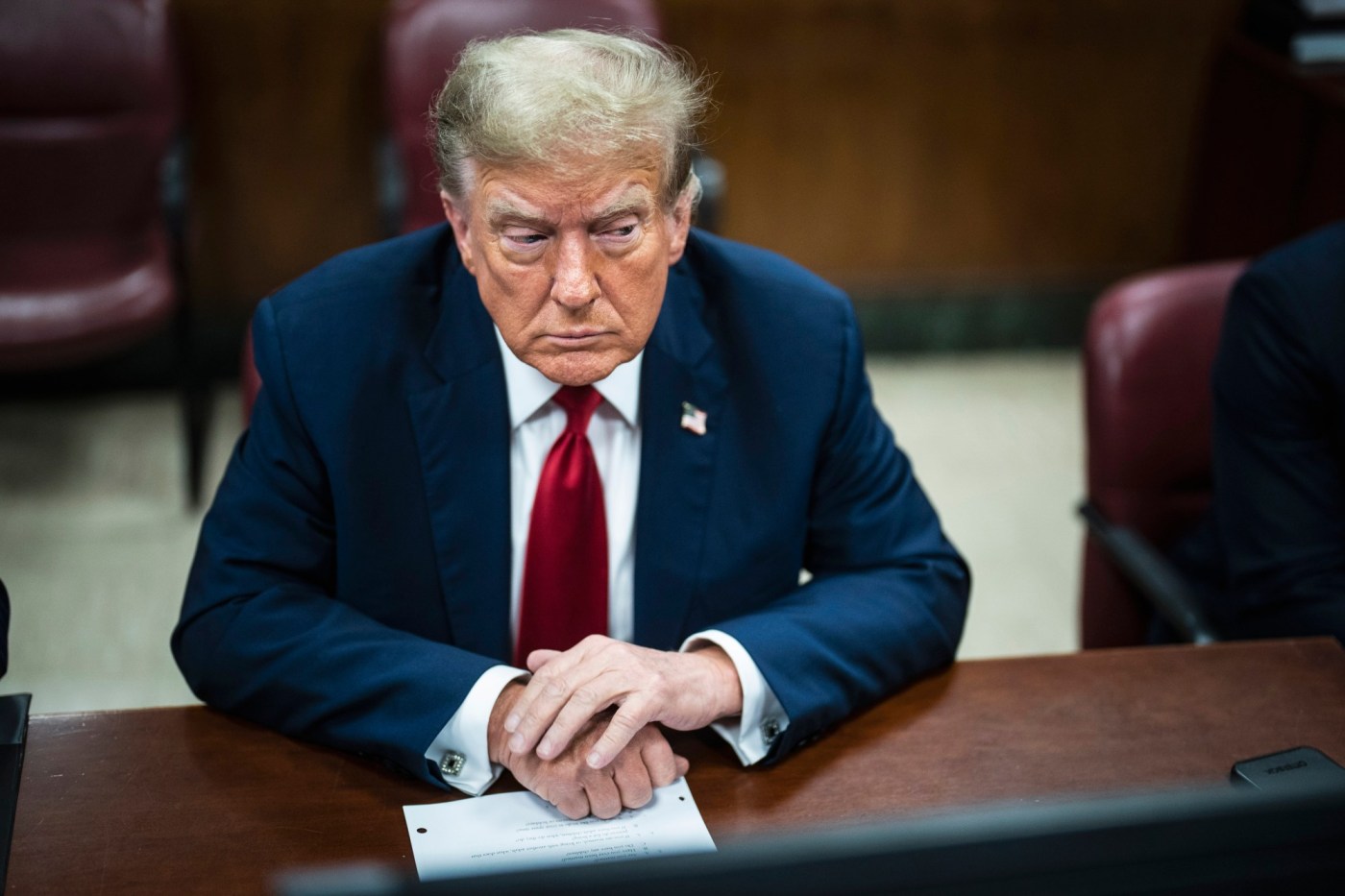
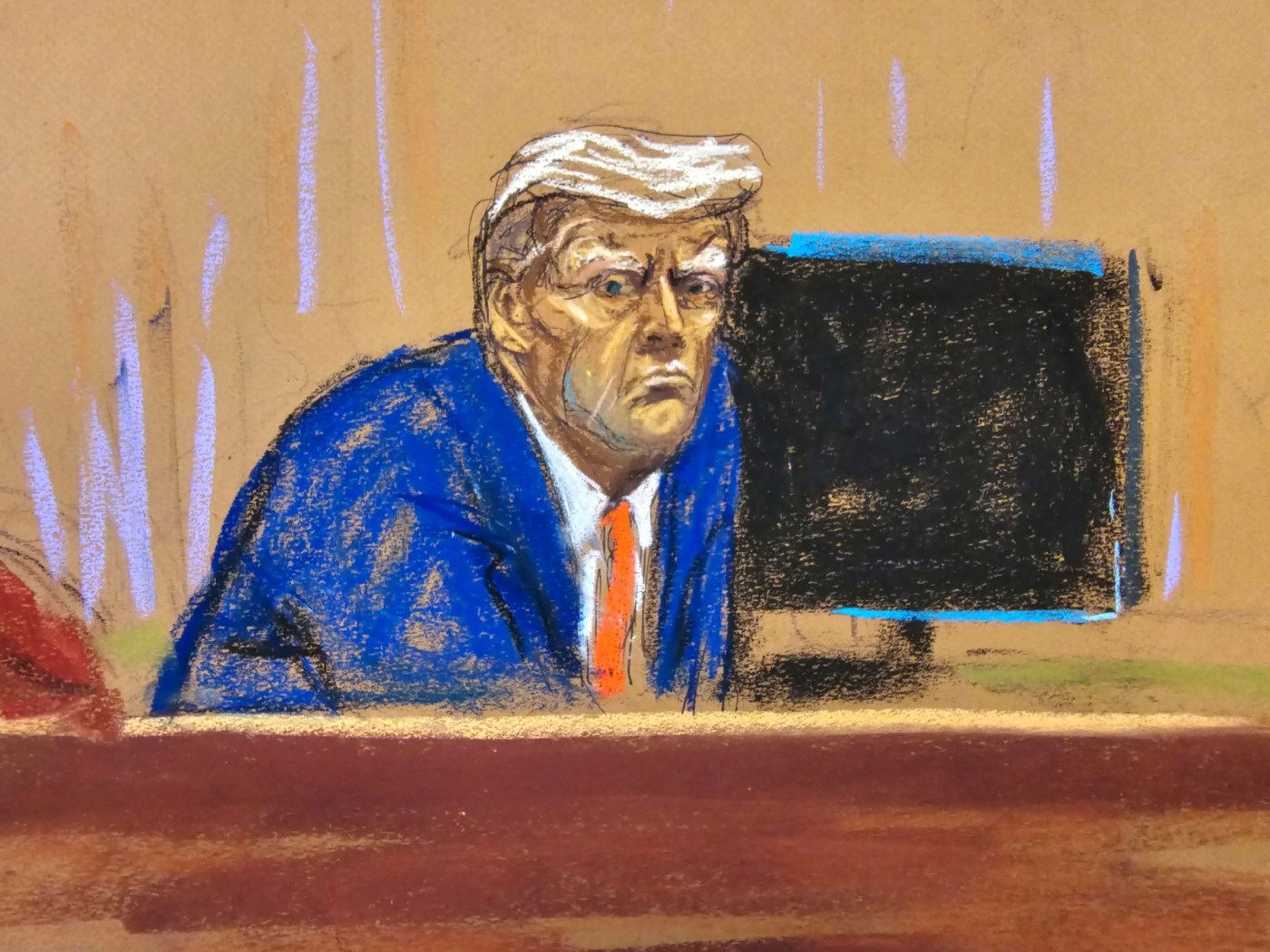
That’s because the presiding judge, Juan M. Merchan, permitted a handful of still photographers to shoot photos of Trump before the day’s proceedings started. Once court was called into session, courtroom sketch artists — a dying communications form — hold sway.

Republican presidential candidate, former President Donald Trump speaks to the media on the first day of jury selection during his trial at Manhattan Criminal Court Monday, April 15, 2024, in New York. (Michael Nagle/New York Post via AP, Pool)

There is actually some video coverage of the trial, available on monitors in an overflow room adjacent to the main courtroom. It was packed Monday with reporters, court officers and a few members of the public, including Ron Sinibaldi, a former accountant from Long Island who lined up outside the courthouse before midnight for a seat.

“I read presidential biographies,” Sinibaldi said. “I go to presidential libraries. I’m here for the history.”

HOW CAN THOSE INVOLVED GET AROUND THE RESTRICTIONS?

In a hallway outside of the courtroom, a limited number of cameras and a small pool of reporters are positioned to capture remarks of anyone involved in the trial who want to address the outside world. That included Trump, even before the proceedings started.

Absent live coverage of the trial, how often the former president chooses to take advantage of those cameras and whether news organizations carry his remarks either live, taped or not at all will play a big role in how the case is perceived publicly.

MSNBC carried his remarks live on Monday morning. “They’re trying to grab the narrative regardless of the outcome,” CNN reporter Phil Mattingly said of the Trump defense team.

HOW ARE JOURNALISTS COVERING THE TRIAL HANDLING IT?

With some difficulty. CNN stationed a team on the streets of Manhattan outside the courtroom, where a truck festooned with pro-Trump flags frequently drove by, blaring horns and music from loudspeakers. Reporters sometimes struggled to be heard. “It is kind of a circus down here,” CNN’s Kaitlan Collins said.

Related Articles


Trump will return to court after first day of hush money criminal trial ends with no jurors picked


Trump’s historic hush-money trial gets underway; 1st day ends without any jurors being picked


Jamelle Bouie: When politicians invoke the Founding Fathers, remember this


Other voices: Criminal justice reform is alive. Thank conservatives


Trump pushes Arizona lawmakers to ‘remedy’ state abortion ruling that he says ‘went too far’

Commentators and experts, many of them with experience in jury selection, offered opinions from outside the courtroom or from studios. Fox News analyst Jonathan Turley said “most cities, at least those outside of New York,” will see the case as a weaponization of criminal justice.

With estimates that jury selection could take two weeks, and no way of showing it, journalists will have a lot of time to fill unless they turn their attention elsewhere.

WILL OTHER TRUMP CASES BE TELEVISED?

Georgia, where Trump faces charges of election meddling, gives judges discretion over whether to allow television cameras. Superior Court of Fulton County Judge Scott McAfee has said he will make all hearings and trials in that case available for broadcast. That has already included hearings on whether Fulton County District Attorney Fani Willis would be allowed to argue the case.

Federal courts do not allow cameras in criminal cases. Trump is facing separate federal cases for election interference and mishandling classified documents, although it is not clear when, or if, trials will take place.

The feds offer one glimmer of hope: The U.S. Supreme Court permits audio of oral arguments to be broadcast outside of the courtroom. But there’s no indication that this would apply to Trump’s case. New York’s law does not allow audio coverage of his hush money trial.

Proponents of legislation to open up New York courts to electronic media coverage are hoping the attention paid to the Trump case may boost their proposals. The idea is being considered as part of current negotiations over the New York state budget so, theoretically, a new law could even affect the Trump trial if it is passed and goes into effect immediately.

Given New York state’s history, it’s best not to count on it.

Associated Press correspondent Jennifer Peltz and Jake Offenhartz in New York, and Anthony Izaguirre and Maysoon Khan in Albany, N.Y., contributed to this report. David Bauder writes about media for The Associated Press. Follow him at http://twitter.com/dbauder.
Only 1 in 3 US adults think Trump acted illegally in New York hush money case, poll shows

posted in: Politics | 0

By Thomas Beaumont and Amelia Thomson-Dexeaux, Associated Press

WASHINGTON (AP) — The first criminal trial facing former President Donald Trump is also the one in which Americans are least convinced he committed a crime, a new AP-NORC Center for Public Affairs Research poll finds.

Only about one-third of U.S. adults say Trump did something illegal in the hush money case for which jury selection began Monday, while close to half think he did something illegal in the other three criminal cases pending against him. And they’re fairly skeptical that Trump is getting a fair shake from the prosecutors in the case — or that the judge and jurors can be impartial in cases involving him.

Still, half of Americans would consider Trump unfit to serve as president if he is convicted of falsifying business documents to cover up hush money payments to a woman who said he had an affair with her.

Related Articles


Trump will return to court after first day of hush money criminal trial ends with no jurors picked


Trump’s historic hush-money trial gets underway; 1st day ends without any jurors being picked


Jamelle Bouie: When politicians invoke the Founding Fathers, remember this


Other voices: Criminal justice reform is alive. Thank conservatives


Trump pushes Arizona lawmakers to ‘remedy’ state abortion ruling that he says ‘went too far’

While a New York jury will decide whether to convict Trump of felony charges, public opinion of the trial proceedings could hurt him politically. The poll suggests a conviction could hurt Trump’s campaign. Trump enters a rematch with President Joe Biden as the first presumptive nominee of a major party — and the first former president — to be under indictment. A verdict is expected in roughly six weeks, well before the Republican National Convention where he will accept the GOP nomination.

Trump has made the prosecutions against him a centerpiece of his campaign and argued without evidence that Biden engineered the cases. That argument helped him consolidate GOP support during the Republican primary, but a conviction might influence how many Americans — including independent voters and people long skeptical of Trump — perceive his candidacy.

“Any conviction should disqualify him,” said Callum Schlumpf, a 31-year-old engineering student and political independent from Clifton, Texas. “It sets a bad example to the rest of the world. I think it misrepresents us, as a country, as to what we believe is important and virtuous.”

Yet, a cloud of doubt hangs over all the proceedings. Only about 3 in 10 Americans feel that any of the prosecutors who have brought charges against Trump are treating the former president fairly. And only about 2 in 10 Americans are extremely or very confident that the judges and jurors in the cases against him can be fair and impartial.

“It’s very obvious political persecution,” said Christopher Ruff, a 46-year-old political independent and museum curator from Sanford, North Carolina. “I’m no fan of Trump in any way, shape or form. Didn’t vote for him, never will. But it’s obviously all political.”

Republican presidential candidate, former President Donald Trump speaks to the media on the first day of jury selection during his trial at Manhattan Criminal Court Monday, April 15, 2024, in New York. (Michael Nagle/New York Post via AP, Pool)

Former President Donald Trump, left, with his attorney Todd Blanche, speaks to reporters outside of the courtroom following the first day of jury selection for his trial at the Manhattan criminal court in New York, on Monday, April 15, 2024. (Jabin Botsford/The Washington Post via AP, Pool)

In this courtroom sketch, former President Donald Trump turns to face the audience at the beginning of his trial over charges that he falsified business records to conceal money paid to silence porn star Stormy Daniels in 2016, in Manhattan state court in New York, Monday, April 15, 2024. (Jane Rosenberg/Pool Photo via AP)

FILE – Former President Donald Trump is pictured in a Manhattan criminal court ahead of the start of jury selection in New York on April 15, 2024. The first day of Trump’s history-making trial in Manhattan ended Monday with no one yet chosen to be among the panel of 12 jurors and six alternates. Dozens of people were dismissed after saying they didn’t believe they could be fair, though dozens of other prospective jurors have yet to be questioned. (Photo by Jabin Botsford/Washington Post via AP, Pool, File)

Former President Donald Trump returns from a break at Manhattan criminal court in New York, on Monday, April 15, 2024. The hush money trial of Trump begun Monday with jury selection. (Jeenah Moon/Pool Photo via AP)

Former President Donald Trump attends the first day of his criminal trial, at Manhattan Criminal Court in New York City on April 15, 2024. (Angela Weiss/AFP via AP Pool)

of

Expand

Consistent with AP-NORC polls conducted over the past year, the new poll found that about half of Americans say Trump did something illegal regarding the classified documents found at his Florida home, and a similar share think he did something illegal regarding his alleged attempt to interfere in Georgia’s vote count in the 2020 presidential election. The poll also found that nearly half of Americans believe he did something illegal related to his effort to overturn the results of the 2020 election.

Prosecutors in New York will argue that Trump falsified his company’s internal records to hide the true nature of a payment to his former lawyer, Michael Cohen. Cohen alleges he was directed by Trump to pay adult film actress Stormy Daniels $130,000 one month before the 2016 election to silence her claims about an extramarital affair with Trump.

Trump has pleaded not guilty to the 34-count indictment and denied any affair with Daniels.

The poll found that 35% of Americans say Trump has done something illegal with regard to the hush money allegations. Slightly fewer, about 3 in 10, think he did something unethical without breaking the law. Fourteen percent think he did nothing wrong at all. Those numbers haven’t shifted meaningfully in the year since he was first charged in the case.

Republicans are much less likely than Democrats and independents to say Trump committed a crime in the hush money case.

“He’s done nothing wrong,” said Louie Tsonos, a 43-year-old sales representative and Republican from Carleton, Michigan, a suburb of Detroit. “Because Trump has a lot of money and fame, they want to destroy his reputation. Or at least they are trying to.”

Fewer than one in 10 Republicans say Trump did something illegal in the case, while 4 in 10 Republicans think he did something unethical but did not break the law. About 3 in 10 Republicans, like Tsonos, say he did nothing wrong.

By contrast, about 6 in 10 Democrats and roughly 3 in 10 independents believe he did something illegal.

Monica Brown, a Democrat from Knoxville, Tennessee, thinks Trump did something unethical, though not illegal, in the New York criminal case under way. But a conviction would ruin his credibility to serve as president, she said.

“I don’t believe any president – whether it’s Donald Trump or anyone else – should have a criminal conviction on his record,” said Brown, a 60-year-old veterinary technician and social worker. “Even if it’s related to something like hush money, what respect are they going to get from anyone? Citizens of the country or world leaders, they aren’t going to respect you.”

Nearly 6 in 10 Republicans say they would consider Trump fit to be president even if he were to be convicted of falsifying business documents in the hush money case. About 8 in 10 Democrats say Trump would not be fit to serve in the event of a conviction. About half of independents think he would be unfit to serve, with 22% saying he would be fit and 30% saying they didn’t know enough to say.

“I don’t think any of that stuff has any relevance to his ability to lead this country,” said Jennifer Solich, a Republican from York, Pennsylvania, and retired nuclear engineer who believes Trump would be fit to serve if convicted in the New York case. “There may be some unethical aspects to it. I just think it’s more trivial than what we’re facing as a nation.”

Beaumont reported from Des Moines, Iowa.

The poll of 1,204 adults was conducted April 4-8, 2024, using a sample drawn from NORC’s probability-based AmeriSpeak Panel, which is designed to be representative of the U.S. population. The margin of sampling error for all respondents is plus or minus 3.9 percentage points.

Trump will return to court after first day of hush money criminal trial ends with no jurors picked

posted in: Politics | 0

By Michael R. Sisak, Jennifer Peltz, Jake Offenhartz and Alanna Durkin Richer, Associated Press

NEW YORK (AP) — Donald Trump will return to a New York courtroom Tuesday as a judge works to find a panel of jurors who will decide whether the former president is guilty of criminal charges alleging he falsified business records to cover up a sex scandal during the 2016 campaign.

The first day of Trump’s history-making trial in Manhattan ended with no one yet chosen to be on the panel of 12 jurors and six alternates. Dozens of people were dismissed after saying they didn’t believe they could be fair, though dozens of other prospective jurors have yet to be questioned.

It’s the first of Trump’s four criminal cases to go to trial and may be the only one that could reach a verdict before voters decide in November whether the presumptive Republican presidential nominee should return to the White House. It puts Trump’s legal problems at the center of the closely contested race against President Joe Biden, with Trump painting himself as the victim of a politically motivated justice system working to deprive him of another term.

Related Articles


Trump’s historic hush-money trial gets underway; 1st day ends without any jurors being picked


Jamelle Bouie: When politicians invoke the Founding Fathers, remember this


Other voices: Criminal justice reform is alive. Thank conservatives


Trump pushes Arizona lawmakers to ‘remedy’ state abortion ruling that he says ‘went too far’


Many say Biden and Trump did more harm than good, but for different reasons, AP-NORC poll shows

Trump has pleaded not guilty to 34 felony counts of falsifying business records as part of an alleged effort to keep salacious — and, he says, bogus — stories about his sex life from emerging during his 2016 campaign. On Monday, Trump called the case brought by Manhattan District Attorney Alvin Bragg a “scam” and “witch hunt.”

The charges center on $130,000 in payments that Trump’s company made to his then-lawyer, Michael Cohen. He paid that sum on Trump’s behalf to keep porn actor Stormy Daniels from going public with her claims of a sexual encounter with Trump a decade earlier. Trump has denied the sexual encounter ever happened.

Prosecutors say the payments to Cohen were falsely logged as legal fees. Prosecutors have described it as part of a scheme to bury damaging stories Trump feared could help his opponent in the 2016 race, particularly as Trump’s reputation was suffering at the time from comments he had made about women.

Trump has acknowledged reimbursing Cohen for the payment and that it was designed to stop Daniels from going public about the alleged encounter. But Trump has previously said it had nothing to do with the campaign.

Former President Donald Trump attends the first day of his criminal trial, at Manhattan Criminal Court in New York City on April 15, 2024. (Angela Weiss/AFP via AP Pool)

Former President Donald Trump returns from a break at Manhattan criminal court in New York, on Monday, April 15, 2024. The hush money trial of Trump begun Monday with jury selection. (Jeenah Moon/Pool Photo via AP)

Former President Donald Trump arrives at court for the start of jury selection in his historic hush money trial, Monday, April 15, 2024 in New York. (Angela Weiss/Pool via AP)

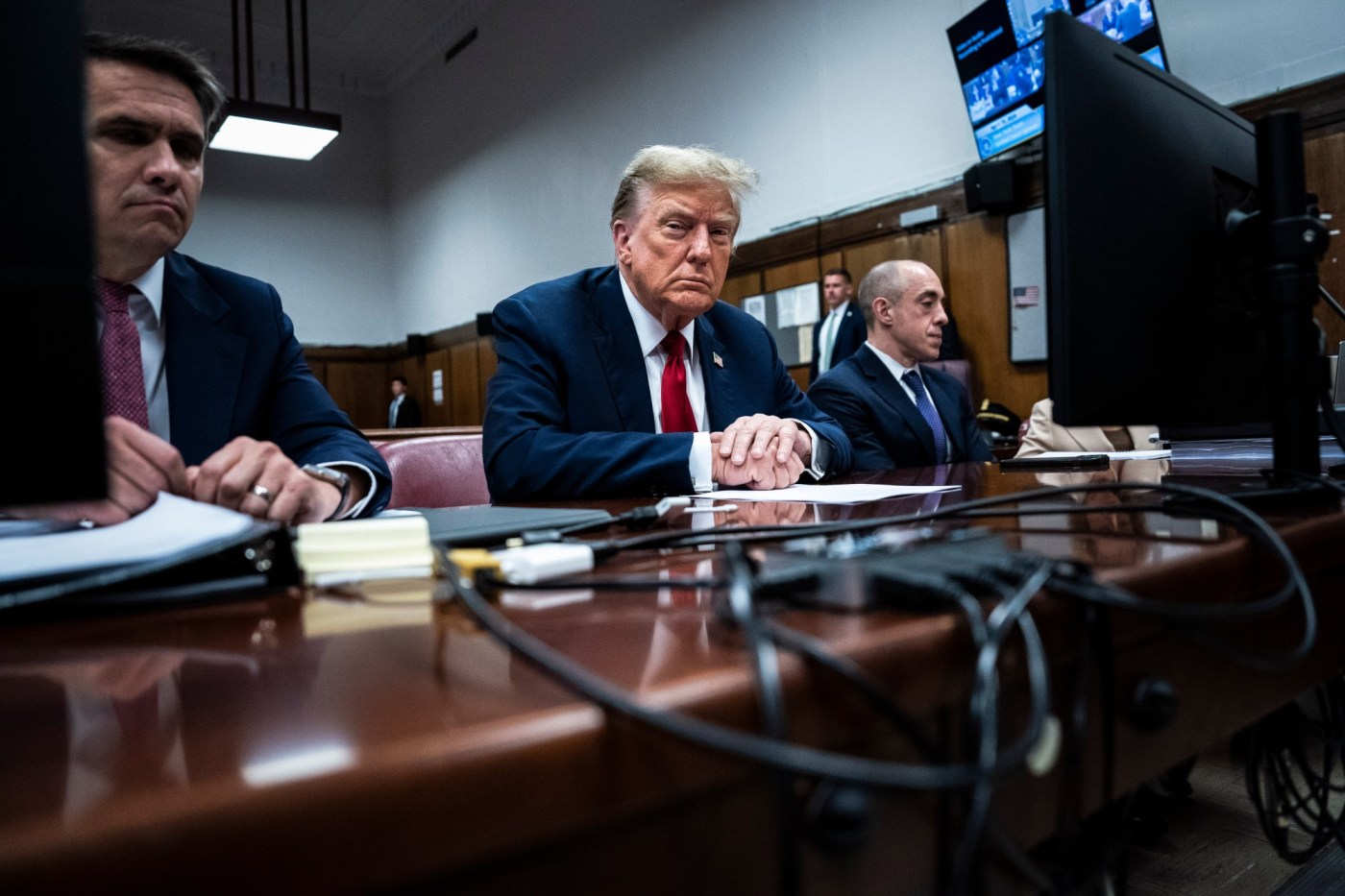
Former U.S. President Donald Trump appears with his legal team Todd Blanche (L) and Emil Bove (R) ahead of the start of jury selection at Manhattan criminal court on April 15, 2024 in New York City. Former President Donald Trump faces 34 felony counts of falsifying business records in the first of his criminal cases to go to trial. (Photo by Jabin Botsford-Pool/Getty Images)

Former US President Donald Trump attends the first day of his trial for allegedly covering up hush money payments linked to extramarital affairs, at Manhattan Criminal Court in New York City on April 15, 2024. Trump is in court Monday as the first US ex-president ever to be criminally prosecuted, a seismic moment for the United States as the presumptive Republican nominee campaigns to re-take the White House. The scandal-plagued 77-year-old is accused of falsifying business records in a scheme to cover up an alleged sexual encounter with adult film actress Stormy Daniels to shield his 2016 election campaign from adverse publicity. (Photo by Jefferson Siegel / POOL / AFP) (Photo by JEFFERSON SIEGEL/POOL/AFP via Getty Images)

Former President Donald Trump leaves Trump Tower on his way to Manhattan criminal court, Monday, April 15, 2024, in New York. The hush money trial of former President Donald Trump begins Monday with jury selection. It’s a singular moment for American history as the first criminal trial of a former U.S. commander in chief. (AP Photo/Yuki Iwamura)

of

Expand

Jury selection could take several more days — or even weeks — in the heavily Democratic city where Trump grew up and catapulted to celebrity status decades before winning the White House.

Only about a third of the 96 people in the first panel of potential jurors brought into the courtroom on Monday remained after the judge excused some members. More than half of the group was excused after telling the judge they could not be fair and impartial and several others were dismissed for other reasons that were not disclosed. Another group of more than 100 potential jurors sent to the courthouse Monday was not yet brought into the courtroom for questioning.

Richer reported from Washington.

Charges against Trump and Jan. 6 rioters at stake as Supreme Court hears debate over obstruction law

posted in: Society | 0

By MARK SHERMAN (Associated Press)

WASHINGTON (AP) — The Supreme Court on Tuesday is taking up the first of two cases that could affect the criminal prosecution of former President Donald Trump for his efforts to overturn his election loss in 2020. Hundreds of charges stemming from the Capitol riot also are at stake.

The justices are hearing arguments over the charge of obstruction of an official proceeding. That charge, stemming from a law passed in the aftermath of the Enron financial scandal more than two decades ago, has been brought against 330 people, according to the Justice Department. The court will consider whether it can be used against those who disrupted Congress’ certification of Joe Biden’s 2020 presidential election victory over Trump.

The former president and presumptive nominee for the 2024 Republican nomination is facing two charges in the case brought by special counsel Jack Smith in Washington that could be knocked out with a favorable ruling from the nation’s highest court. Next week, the justices will hear arguments over whether Trump has “absolute immunity” from prosecution in the case, a proposition that has so far been rejected by two lower courts.

The first former U.S. president under indictment, Trump is on trial on hush money charges in New York and also has been charged with election interference in Georgia and with mishandling classified documents in Florida.

In Tuesday’s case, the court is hearing an appeal from Joseph Fischer, a former Pennsylvania police officer who has been indicted on seven counts, including obstruction, for his actions on Jan. 6, 2021, when a mob of Trump supporters stormed the Capitol in a bid to keep Biden, a Democrat, from taking the White House. Lawyers for Fischer argue that the charge doesn’t cover his conduct.

The obstruction charge, which carries up to 20 years behind bars, is among the most widely used felony charges brought in the massive federal prosecution following the deadly insurrection.

Roughly 170 Jan. 6 defendants have been convicted of obstructing or conspiring to obstruct the Jan. 6 joint session of Congress, including the leaders of two far-right extremist groups, the Proud Boys and Oath Keepers. A number of defendants have had their sentencings delayed until after the justices rule on the matter.

Some rioters have even won early release from prison while the appeal is pending over concerns that they might end up serving longer than they should have if the Supreme Court rules against the Justice Department. That includes Kevin Seefried, a Delaware man who threatened a Black police officer with a pole attached to a Confederate battle flag as he stormed the Capitol. Seefried was sentenced last year to three years behind bars, but a judge recently ordered that he be released one year into his prison term while awaiting the Supreme Court’s ruling.

The high court case focuses on whether the anti-obstruction provision of a law that was enacted in 2002 in response to the financial scandal that brought down Enron Corp. can be used against Jan. 6 defendants.

Fischer’s lawyers argue that the provision was meant to close a loophole in criminal law and discourage the destruction of records in response to an investigation. Until the Capitol riot, they told the court, every criminal case using the provision had involved allegations of destroying or otherwise manipulating records.

But the administration says the other side is reading the law too narrowly, arguing it serves “as a catchall offense designed to ensure complete coverage of all forms of corrupt obstruction of an official proceeding,” including Fischer’s “alleged conduct in joining a violent riot to disrupt the joint session of Congress certifying the presidential election results.”

Smith has argued separately in the immunity case that the obstruction charges against Trump are valid, no matter the outcome of Fischer’s case.

Most lower court judges who have weighed in have allowed the charge to stand. Among them, U.S. District Judge Dabney Friedrich, a Trump appointee, wrote that “statutes often reach beyond the principal evil that animated them.”

But U.S. District Judge Carl Nichols, another Trump appointee, dismissed the charge against Fischer and two other defendants, writing that prosecutors went too far. A divided panel of the federal appeals court in Washington reinstated the charge before the Supreme Court agreed to take up the case.

While it’s not important to the Supreme Court case, the two sides present starkly differing accounts of Fischer’s actions on Jan. 6. Fischer’s lawyers say he “was not part of the mob” that forced lawmakers to flee the House and Senate chambers, noting that he entered the Capitol after Congress had recessed. The weight of the crowd pushed Fischer into a line of police inside, they said in a court filing.

Sen. Tom Cotton of Arkansas and Reps. Jim Jordan of Ohio, Lauren Boebert of Colorado, Matt Gaetz of Florida and Marjorie Taylor Greene of Georgia are among 23 Republican members of Congress who say the administration’s use of the obstruction charge “presents an intolerable risk of politicized prosecutions. Only a clear rebuke from this Court will stop the madness.”

The Justice Department says Fischer can be heard on a video yelling “Charge!” before he pushed through a crowd and “crashed into the police line.” Prosecutors also cite text messages Fischer sent before Jan. 6 saying things might turn violent and social media posts after the riot in which he wrote, “we pushed police back about 25 feet.”

More than 1,350 people have been charged with Capitol riot-related federal crimes. Approximately 1,000 of them have pleaded guilty or been convicted by a jury or judge after a trial.

___

Associated Press writers Alanna Durkin Richer in Washington and Michael Kunzelman in Silver Spring, Maryland, contributed to this report.

Related Articles

National News |


Trump trial: Why can’t Americans see or hear what is going on inside the courtroom?

National News |


Only 1 in 3 US adults think Trump acted illegally in New York hush money case, poll shows

National News |


Trump will return to court after first day of hush money criminal trial ends with no jurors picked

National News |


Trump returns to court after first day of his hush money criminal trial ended with no jurors picked

National News |


Trump’s historic hush-money trial gets underway; 1st day ends without any jurors being picked