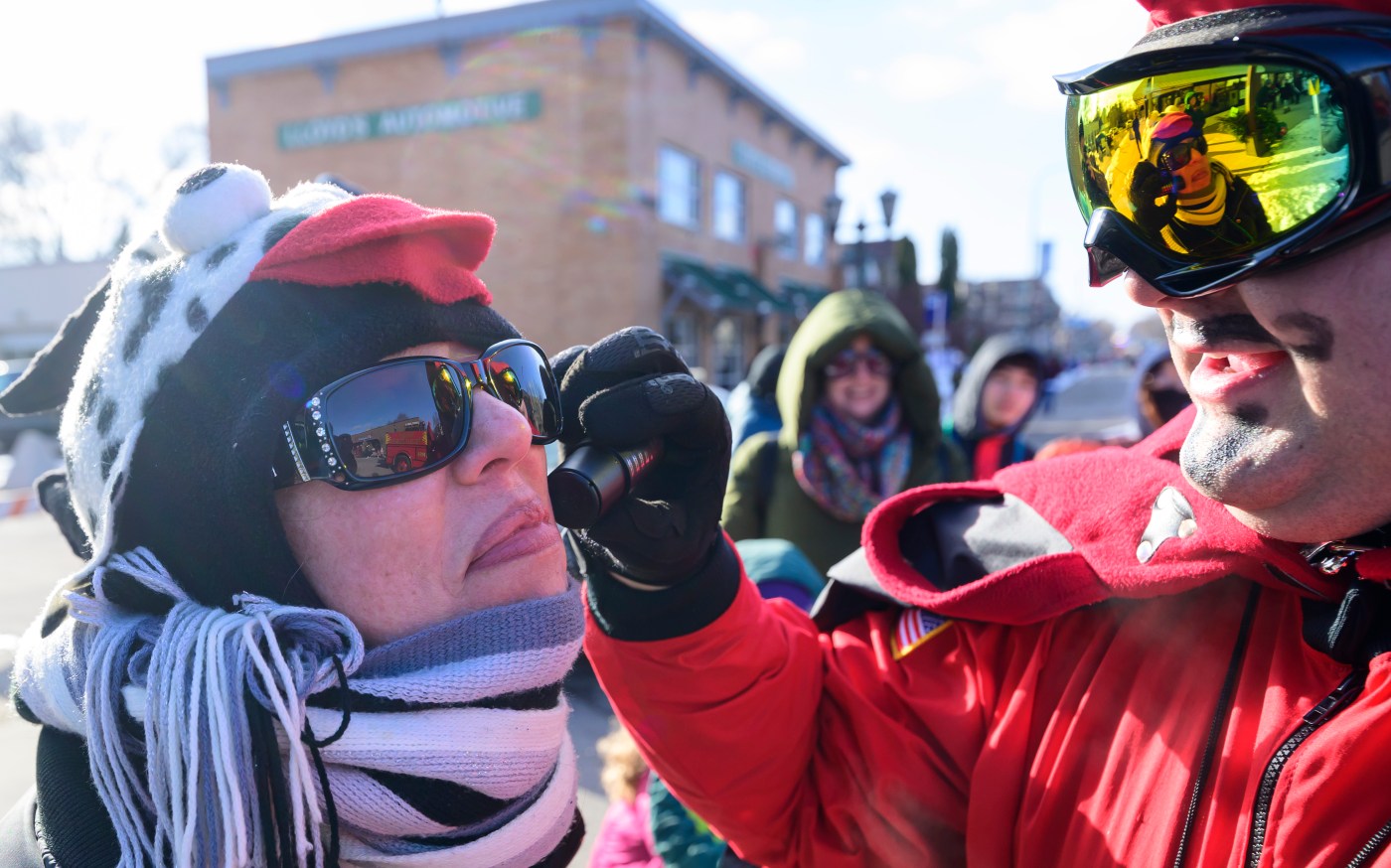
Icy King Boreas strikes again: Due to expected extreme cold windchills, the St. Paul Winter Carnival is postponing some of its opening events.
The Kick-off to Carnival, an outdoor laser light show, was scheduled for Thursday, Jan. 22, but will instead be modified to a celebration of the annual festival’s 140th anniversary next Friday, Jan. 30. An ice bar and food truck lineup around Rice Park will also not be open Thursday, Jan. 22, nor Friday, Jan. 23.
The carnival’s indoor Thursday events, including a Klondike Kate cabaret night and a Winter Carnival Night at the Minnesota Wild game, will proceed as normal.
“We’ve consulted with the National Weather Service and local meteorologists, and this decision is being made with everyone’s safety as the top priority,” Carnival executive director Lisa Jacobson said in a statement announcing the schedule change.
As of Thursday morning, carnival organizers still expect Friday and weekend events to take place as scheduled, including the King Boreas Grande Day Parade along Grand Avenue on Saturday, Jan. 24. The ice bar and food truck festival are also set to resume their previously announced hours of operation during the remainder of the carnival.
All of Minnesota, including the Twin Cities, and broad swaths of the upper Midwest are set to experience extreme cold temperatures starting Thursday afternoon. An extreme cold warning — meaning possible windchills in the -40 to -50-degree range — is in effect from 6 p.m. Thursday to noon Friday, and then a slightly less severe cold weather advisory lasts till midnight.
On Saturday, the parade begins at 2 p.m. Daytime temperatures are expected to hit a high of -2 but with sunny conditions and significantly calmer wind, according to the National Weather Service. Still, that forecast would make this year’s parade the coldest in recent memory: Since 2000, only two other Grande Day Parades, in 2009 and 2023, have seen single-digit high temps, according to data from the Minnesota Department of Natural Resources.
WASHINGTON (AP) — The Trump administration is expanding its ban on U.S. foreign aid for groups supporting abortion services to include assistance going to international and domestic organizations and agencies that promote gender identity as well as diversity, equity and inclusion programs.
Related Articles
Trump administration scraps multimillion-dollar solar projects in Puerto Rico as grid crumbles
Trump’s European threats could cause lasting damage to US standing in the world
Vance heads to Minneapolis and says ‘far left’ should stop resisting immigration enforcement
NATO chief Mark Rutte shows he’s a ‘Trump whisperer’ with Greenland diplomacy
US government warns it will take action if Haitian politicians destabilize country
An administration official said Thursday that the State Department would release final rules that expand the scope of the “Mexico City” policy that has already severely reduced assistance to international organizations that provide abortion-related care. The policy was first established under President Ronald Reagan but rescinded by subsequent Democratic administrations.
The new rules, first reported by Fox News, would halt foreign assistance from going toward not only groups that provide abortion as a method of family planning but also those that advocate “gender ideology” and DEI, according to the official, who spoke on condition of anonymity ahead of the rules’ publication in the Federal Register on Friday.
The official said the expanded policy would apply to more than $30 billion in foreign aid that the U.S. provides and would cover not only foreign and U.S.-based aid agencies but international organizations.
“The Trump administration’s expanded global gag rule puts politics between people and their care around the world,” Human Rights Campaign President Kelley Robinson said in a statement. “Simply put, the White House is putting medically necessary health care at risk for people around the world in service to a political agenda.”
The move is timed to coincide with the anniversary of the now-overturned Roe vs. Wade Supreme Court ruling and the annual March for Life demonstration by anti-abortion advocates.
“There’s likely to be tens of billions of dollars that will be affected by this policy change, many more billions than in any prior period,” said Jen Kates, senior vice president and director of the Global and Public Health Policy Program at the health care research nonprofit KFF.
The White House reposted a Fox News article on X seemingly confirming the plans, but did not immediately respond to an emailed request for comment.
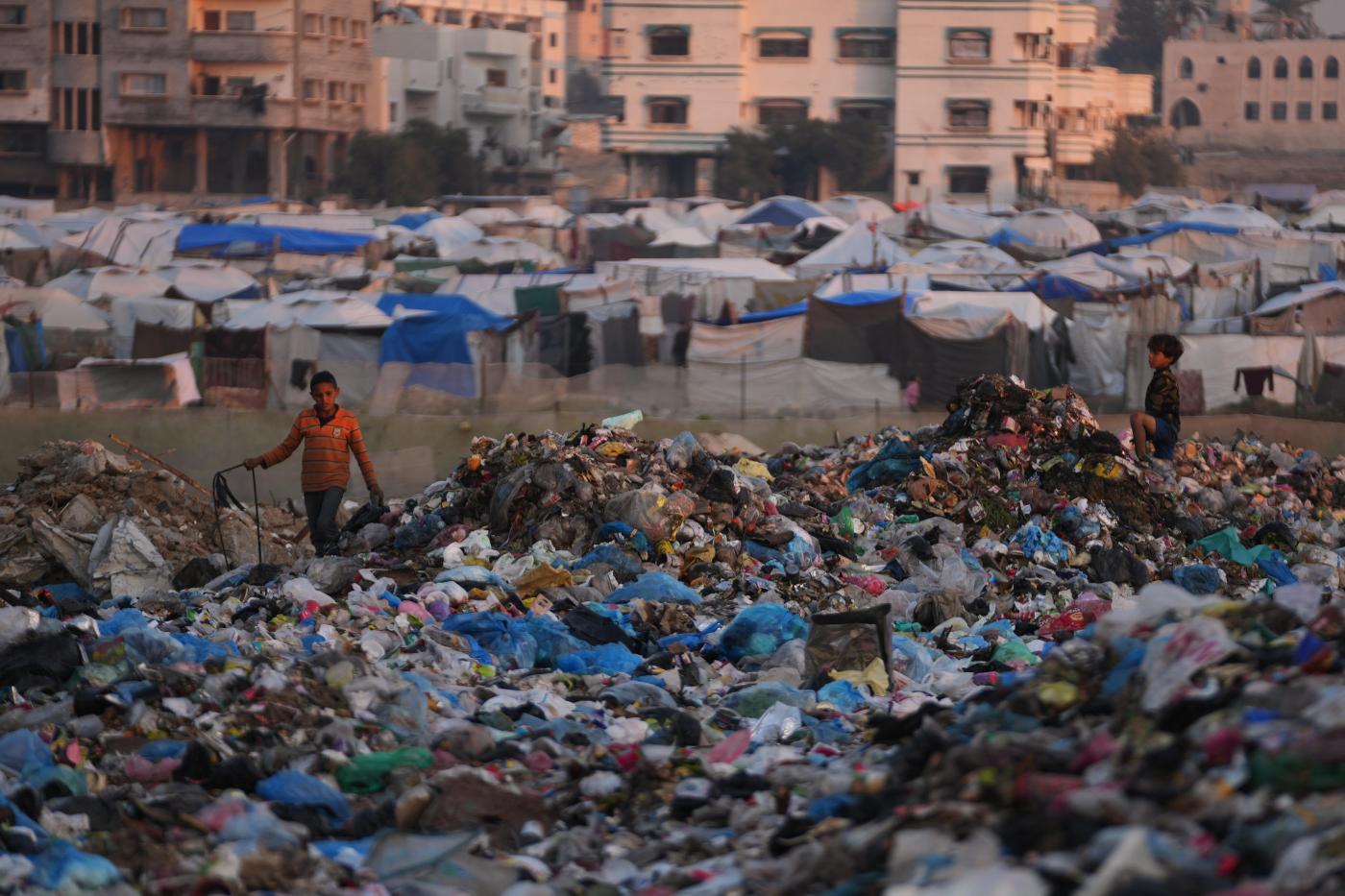
CAIRO (AP) — Desperate Palestinians at a garbage dump in a Gaza neighborhood dug with their bare hands for plastic items to burn to keep warm in the cold and damp winter in the enclave, battered by two years of the Israel-Hamas war.
The scene in the Muwasi area of the city of Khan Younis contrasted starkly with the vision of the territory projected by world leaders gathered in Davos, Switzerland, where they inaugurated U.S. President Donald Trump’s Board of Peace that will oversee Gaza.
At the World Economic Forum in Davos, Trump claimed that “record levels” of humanitarian aid had entered Gaza since the October start of a U.S.-brokered ceasefire deal. His son-in law, Jared Kushner, and envoy Steve Witkoff triumphantly touted the devastated territory’s development potential.
A Palestinian resident of Ras Ein al-Auja village, West Bank burns trash, Sunday, Jan. 11, 2026. (AP Photo/Mahmoud Illean)
A starkly different reality
In Gaza, months into the truce, hundreds of thousands of Palestinians still languish in displacement camps, sheltering in tents and war-ravaged buildings, unable to protect them from the temperatures dropping below 10 degrees Celsius (50 Fahrenheit) at night.
Despite the ceasefire, there are still recurring deadly strikes in Gaza. Israeli tank shelling on Thursday killed four Palestinians east of Gaza City, according to Mohamed Abu Selmiya, director of the Shifa Hospital, where the bodies were taken. The Israeli military did not immediately comment.
Some in Gaza expressed skepticism about Trump’s Board of Peace and whether it would change their grim lives.
Related Articles
Trump rolls out his Board of Peace at the Davos forum, but many top US allies aren’t participating
Israeli fire kills 11 Palestinians in Gaza, including 2 children, local hospital officials say
Trump’s Board of Peace is dividing countries in Europe and the Middle East
Israeli crews target UN facilities for Palestinian refugees in east Jerusalem
Baby dies from cold in Gaza as leaders meet to discuss Trump’s Board of Peace
“This committee includes Israelis. I don’t understand, as citizens, how can we understand this situation?” Rami Ghalban, who was displaced from Khan Younis, said Thursday. “The Israelis that inflicted suffering upon us.”
But grappling with what’s ahead seems futile for others.
“We are in a position where there are no alternatives,” said Fathi Abu Sultan. “Our situation is miserable.”
While aid flow into Gaza has significantly increased since the ceasefire, residents say fuel and firewood are in short supply. Prices are exorbitant and searching for firewood is dangerous. Two 13-year-old boys were shot and killed by Israeli forces on Wednesday as they tried to collect firewood, hospital officials said.
At the Nasser hospital in southern Gaza, dozens of Palestinians gathered Thursday to mourn three Palestinian journalists — including a frequent contributor to Agence France-Presse — killed the day before when an Israeli strike hit their vehicle, according to Gaza health officials.
The Israeli military said the strike came after it spotted suspects who were operating a drone that posed a threat to its troops.
When survival means digging through garbage
For Sanaa Salah, who lives in a tent with her husband and six kids, starting a fire is a critical daily chore so they can cook and keep warm. Her family has barely has enough clothes to keep them warm.
She said the family cannot afford to buy firewood or gas, and that they are aware of the dangers of burning plastic but have no other choice.
“Life is very hard,” she said as her family members threw plastic and paper into a fire to keep it burning. “We cannot even have a cup of tea.”
“This is our life,” she said. “We do not sleep at night from the cold.”
Firewood is just too expensive, said Aziz Akel. His family has no income and they can’t pay the 7 or 8 shekels (about $2.5) it would cost.
“My house is gone and my kids were wounded,” he said.
His daughter, Lina Akel, said he leaves the family’s tent early each morning to look for plastic in the garbage to burn — “the basics of life.”
Mourners carry the body of Anas Ghoneim, one of the three Palestinian journalists who were killed in an Israeli strike on an Egyptian committee’s vehicle, during his funeral in Khan Younis, southern Gaza Strip, Thursday, Jan. 22, 2026. (AP Photo/Abdel Kareem Hana)
Mourners pray over the bodies of the Palestinian journalists Abd Shaat and Anas Ghoneim who were killed in an Israeli strike on an Egyptian committee’s vehicle, during their funeral in Khan Younis, southern Gaza Strip, Thursday, Jan. 22, 2026. (AP Photo/Abdel Kareem Hana)
1 of 2
Mourners carry the body of Anas Ghoneim, one of the three Palestinian journalists who were killed in an Israeli strike on an Egyptian committee’s vehicle, during his funeral in Khan Younis, southern Gaza Strip, Thursday, Jan. 22, 2026. (AP Photo/Abdel Kareem Hana)
Mourners bid farewell to 3 Palestinian journalists killed in Israeli strike
The three journalists killed Wednesday were filming near a displacement camp in central Gaza, managed by an Egyptian government committee, said Mohammed Mansour, the committee’s spokesperson.
One of them, Abdul Raouf Shaat, a regular contributor to AFP, was not on assignment for the news agency at the time, it said. A statement from AFP demanded a full investigation.
Israel has barred international journalists from entering to cover the war, aside from rare guided tours. News organizations rely largely on Palestinian journalists and residents in Gaza to show what is happening on the ground.
Mourners on Thursday wept over the journalists’ bodies, which were covered in body bags and had press vests placed on their chests.
More than 470 people have been killed by Israeli fire in Gaza since the ceasefire began in October, according to Gaza’s health ministry. At least 77 have been killed by Israeli gunfire near a ceasefire line that splits the territory between Israeli-held areas and most of Gaza’s Palestinian population, the ministry says.
The ministry, which is part of the Hamas-led government, maintains detailed casualty records that are seen as generally reliable by U.N. agencies and independent experts.
What’s next in Gaza
While Trump tries to build support for his Board of Peace by mapping out a future for Gaza, more details about what’s ahead were emerging Thursday.
Ali Shaath, the head of a new, future technocratic government in Gaza, said the Rafah border crossing will open in both directions next week on the Gaza-Egypt border. Israel said in early December it would open the Gaza side of the crossing but has yet to do so.
Reopening the crossing would make it easier for Palestinians in Gaza to seek medical treatment or visit family in Egypt.
Russian President Vladimir Putin wants to send $1 billion to the Board of Peace for humanitarian purposes in Gaza if the U.S. unblocks the money. He met with Palestinian President Mahmoud Abbas in Moscow.
“We believe that only forming and proper functioning of the Palestinian state can lead to a final settlement of the Middle East conflict,” Putin said.
News of widespread fraud among a minority of Minnesota’s Somali community has fractured public trust and damaged the well-being of the entire community. It has left many asking, “Why has oversight failed so miserably?” and, “Why was this fraud not stopped long ago?” The Somali fraudsters were not that sophisticated. There were obvious red flags, and it appears that assistance with this fraud may have come from individuals who have not yet been identified.
Research in psychology shows that people are more likely to commit fraud when they rationalize their actions, when they believe “everyone is doing it,” and when responsibility is diffused. Legal enforcement alone cannot stop fraud; addressing the social and psychological conditions that enable it is also necessary.
Rationalization may be one of the strongest psychological forces that increases fraud. A number of Somalis involved in fraud do not think of themselves as criminals. “It’s a white-collar crime,” one stated, implying that it was not so bad. Some may even believe they are helping their community — or at least claim that “No one got hurt.” Rationalization is a classic defense mechanism, but it involves an avoidance of reality.
Another element at play has been the bandwagon effect, or the belief that “everybody is doing this.” Those engaged in fraud freely spent the money they had wrongfully acquired, showing off their luxury cars, expensive homes, or other high-end purchases and making their schemes look legitimate. Evidence of financial gain with apparently no negative consequences may have lured more Somalis into fraud. But widespread participation in something does not automatically mean it is good or right.
The bystander effect occurs when the presence of many people tends to hinder anyone from stepping in when they see a concerning behavior. Research has shown that a bystander is less likely to extend help in the (real or imagined) presence of others. The bystander effect can help explain why fraud within the Somali community was sometimes underreported, even when many people were aware it is happening. A diffusion of responsibility occurs. In tight networks, many people may know about fraud, but each assumes someone else will report it. Because “everyone knows,” no one acts. Responsibility has been spread so thin that it has no effect. The bystander effect can be especially strong because of how closely connected Somalis are. Families, clans, mosques and businesses overlap. Reporting wrongdoing could mean reporting to your cousin, your neighbor, or someone who prayed next to you on Friday. The social cost may seem enormous. Therefore, many people stay silent.
Finally, we must not overlook the role that one’s conscience needs to play. Perhaps cases of fraud like this serve as evidence of a collective breakdown of conscience, and until this spiritual problem is addressed, there may be no real resolution to the other issues.
Badeh Dualeh, St. Paul.
The writer is an assistant professor of psychology at North Central University
A swap
The U.S. might now best return Minnesota to its Scandinavian roots.
Swap Minnesota for Greenland. We can become an autonomous territory of the Kingdom of Denmark … also, no need to add another star to our iconic American flag.
Gene Delaune, Arden HIlls
Investigate
This newspaper reports that Ramsey County Attorney John Choi has committed to investigating any shooting or crime committed by federal officers, and that certainly is appropriate. The only way a society will have the rule of law is when it is applied to all in the jurisdiction.
The overwhelming and dominant crime today is the massive fraud that seems to expand with every news cycle. The amounts involved are staggering, and a shameful embarrassment for the State of Minnesota. It is unfathomable that a theft of this scope could occur only through neglect or incompetence.
Numerous media entities have reported there are dozens, if not hundreds, of state employees that allege the issue of fraud was repeatedly raised, and ignored or suppressed, and any who voiced that concern intimidated. All of the state offices where this allegedly occurred are in Ramsey County.
If these allegations are true, shouldn’t there be a grand jury convened to consider charges of conspiracy in furtherance of the fraud, or aiding and abetting after the fact?
The public image of state government and the DFL is at an all time low, by any measure, rock bottom. Both need a 12-step program.
The first would be complete transparency, and complete accountability.
The county attorney can initiate the process by doing his job.
Andy Lynn, Mendota Heights
The ice we need
Remember The Great Ice Cube art controversy of 2021 at Summit Avenue and Griggs Street in the shape of a heart?
That’s the only ice we need now more than ever in this town.
Alisa Lein, St. Paul
Some of us just don’t cooperate
As an American with four Swedish immigrant grandparents, I qualify as the “right kind of person” in Minnesota. Even though the Saint Paul Globe published disparaging comments on the Swedish squatters in Swede Hollow back in the mid-19th Century, we are now model citizens.
But some of us just don’t cooperate. Maybe it is my obsession with eating well. I shop and eat in exactly the neighborhoods where the ICE police gather to root out recent immigrants. ‘Nordeast,” named to mimic the speech of early European immigrants, is the most vibrant area of Minneapolis. I can enjoy a “Dago” sandwich and beer and conversation at Dusty’s bar. For something high-toned, I can stop at Diane’s Place, the Hmong bakery, or the Korean Pizza place, each rated by the New York Times as one of the best 15 bakeries or pizza places in the USA.
But my favorite place is the Holy Land on Central Avenue, where I buy Lebanese labneh and Palestinian olives and cheese. The Lebanese had horrible times in their home country and those who came here have contributed a lot. That they have been here for some time protects them from the treatment more recent immigrants have experienced.
Lake Street has the Swedish Deli, Ingebretsen’s. There I saw a commotion. Citizens surrounded an ICE SUV, blowing whistles and shouting at the officers to leave. The ICE patrol eventually left down a side street as one of the officers raised his middle finger to all onlookers.
I recall when I did a tour of Martin Luther King sites in Chicago, I learned that King could bear vicious shouts by keeping calm and silent. I suppose if the ICE police believed in their mission as King did in his, they might adopt this tactic rather than shout obscenities and “give the finger.”
Daniel Norstedt, Eau Claire
Related Articles
Real World Economics: How the Fed ends, with a whimper
Skywatch: There’s a giant on the rise
Your Money: Helping children build healthy money habits
Working Strategies: Leverage your college career services
Joe Soucheray: We’re in the national news every day but don’t want to be