By Mary Ann Anderson, Tribune News Service
MILLEDGEVILLE, Ga.— When the Savannah-born Flannery O’Connor, widely regarded as the queen of Southern Gothic literature, moved home to Georgia from Connecticut in 1951, she was diagnosed with lupus, an incurable, crippling autoimmune disease. Her mother brought the then 25-year-old to live with her at Andalusia, the family farm just north of Milledgeville, a town of some 17,000 in the heart of Georgia’s lake country.
Environment is everything to a writer, and the venerable yet charming two-story white house rising on a hill and overlooking a quietly serene pond where Regina Cline O’Connor and her daughter lived is set among the hardwoods and pines on more than 500 acres of bucolic pastures and woodlands. It is peaceful here, despite the hectic four-lane U.S. 441 a stone’s throw away, and was the ideal place for the young writer to spend the last dozen years of her life writing much of her two novels and 32 short stories before she died at age 39 from the illness that also claimed her father.
The fans and scholars who appreciate Flannery O’Connor, Andalusia is the holy grail to absorb and understand all that is and was the writer and from where her creativity sprang.
Andalusia Farm, just off U.S. Highway 441 north of Milledgeville, Georgia, was once the home of author Flannery O’Connor and her mother, Regina Cline O’Connor. Now a house museum, about 90% of its artifacts are original to the home. The town where O’Connor did much of her writing is getting attention due to Ethan Hawke’s new movie “Wildcat,” a 2023 biopic that brings O’Connor to life and rolls out nationally in May. (Mary Ann Anderson/TNS)
“We call them Flanatics,” says Suzy Parker, a lively student-docent at Andalusia from nearby Milledgeville’s Georgia College and State University (GCSU) and expert on all things Flannery.
Among that number of Flanatics are Ethan Hawke, who directed, produced and co-wrote “Wildcat,” a 2023 biopic that brings O’Connor to life and rolls out nationally in May, and his daughter, Maya, who portrays the radical if not groundbreaking O’Connor. Laura Linney, whose mother is from Georgia, plays the steel magnolia of Regina. “Wildcat” weaves together O’Connor’s life story with reenactments of her short stories, with Hollywood heavyweights Liam Neeson, Steven Zahn and Vincent D’Onofrio rounding out the stellar cast.
Southern Gothic literature captures the essence of the rural South that we sometimes really don’t want to admit is real. If you’ve read O’Connor, then you know her stories and characters are disturbing, strange and specialized.
Family photos, including one of Flannery O’Connor, center, are among the artifacts at Andalusia Farm. The farm, where O’Connor wrote most of her books and short stories, is set on more than 500 bucolic acres near Milledgeville, Georgia. (Explore Georgia/TNS)
Outside of these peaceful red-clay landscapes and small towns is a side of Georgia that O’Connor conjures in her mind, among them the sinister murderer called The Misfit in “A Good Man is Hard to Find,” the loquacious Tom T. Shiflet in “The Life You Save May Be Your Own” with Shiflet a name that O’Connor plucked from the Milledgeville phone book; and the ungrateful, selfish Julian in “Everything that Rises Must Converge.”
Equally impressive is that in a Bible Belt state where just about everyone is Baptist or Methodist, O’Connor, who was Catholic, managed to somehow incongruously weave threads of religion onto almost every page that she wrote.
Andalusia Interpretive Center at Andalusia Farm near Milledgeville, Georgia, houses a gift shop, conference room and artifacts relating to Flannery O’Connor. A timeline of O’Connor’s life adorns the walls of the interpretive center. (Mary Ann Anderson/TNS)
“People come from all over the world for Flannery,” Parker explains. “Spain, California, India, England. She is considered a saint by Europeans. They come here to understand who she is and where she came from and can relate more to her writing by coming here. It humanizes her.”
Andalusia Farm, dating to 1814 when it produced primarily cotton, isn’t the only Flanatic stop in Milledgeville. The first stop, even before the farmhouse tour, should be GCSU’s Andalusia Interpretive Center, perched on a hill as you drive through the gate of Andalusia and up a gravel road. Open for just over a year, the bright barn-like structure encompasses more than 5,000 square feet of exhibition and conference space, a gift shop and, most importantly, an extremely detailed timeline of O’Connor’s life and artifacts including a few of her dresses.
I visit Andalusia with family members, and as we begin the house tour after visiting the interpretive center, Parker tells us that about 90% of the furnishings in the house are original. We walk patiently through the kitchen, dining room and other rooms before we come to O’Connor’s bedroom.
“Flannery’s health didn’t allow her to climb the stairs,” explains Parker, so familiar with the writer that she calls her by her first name. “So her first-floor bedroom served double-duty as her office.”
About 90% of the artifacts are original at Andalusia Farm, once home to Flannery O’Connor, the purported queen of Southern Gothic. Shown here is the cookbook of Regina Cline O’Connor, Flannery O’Connor’s mother. (Mary Ann Anderson/TNS)
The room is much the way O’Connor left it, even her crutches that she used when she couldn’t walk on her own anymore lean silently against the armoire. Her bed with its plaid quilt is still there, as are the dark blue plaid matching curtains. A typewriter is on the desk beside the bed and looks at the back of the armoire. Parker said that O’Connor wrote religiously every morning for three to four hours, facing the bleak rearmost of the armoire so that she wouldn’t be distracted from the goings-on around the farm, including birds galore and her famous peacocks that roamed the yard. The room was simple, dark, maybe a little musty — the home was built in the early 19th century — but it also had the ambiance that great words and stories were created within these wooden walls.
Later, as we stand and talk on the long, screened-in front porch with its row of white rocking chairs, a fat black rat snake suns itself in the garden, oblivious and uncaring as it enjoys the warmth of the springtime sun. Andalusia is in the countryside, and snakes, coyotes and other varmints are not uncommon.
Moving past Andalusia
Several historic sites dotting Milledgeville also tell the literary legacy of O’Connor. GCSU’s Heritage Hall in the downtown houses a special collections library including the Flannery O’Connor Gallery of Southern Literary Works. Other memorabilia and papers include the works of Pulitzer Prize winner Alice Walker, author of “The Color Purple,” and former U.S. Sen. Paul Coverdell, as well as collections related to Milledgeville’s contributions to the music industry.
Student-docent Suzy Parker from Georgia College and State University points out many of the items remaining in the bedroom of Flannery O’Connor. The room doubled as a study, and O’Connor wrote much of her two novels and 32 short stories within its walls. (Mary Ann Anderson/TNS)
Other places represent O’Connor’s childhood and life, including the Gothic Revival-style Sacred Heart Catholic Church, built in 1874 and where the writer attended church. You can also drive by the Cline-O’Connor-Florencourt House, often referred to as simply the Cline Mansion, where O’Connor lived throughout high school and college. The 1820 federal-style home is adorned with Ionic columns and Victorian touches. The house remains in the family as a private residence. Also visit O’Connor’s plain grave at Memory Hill Cemetery where she’s buried next to her father and mother. Fans have left tokens such as peacock feathers, coins, pebbles, poems and journals.
Milledgeville more than Flannery
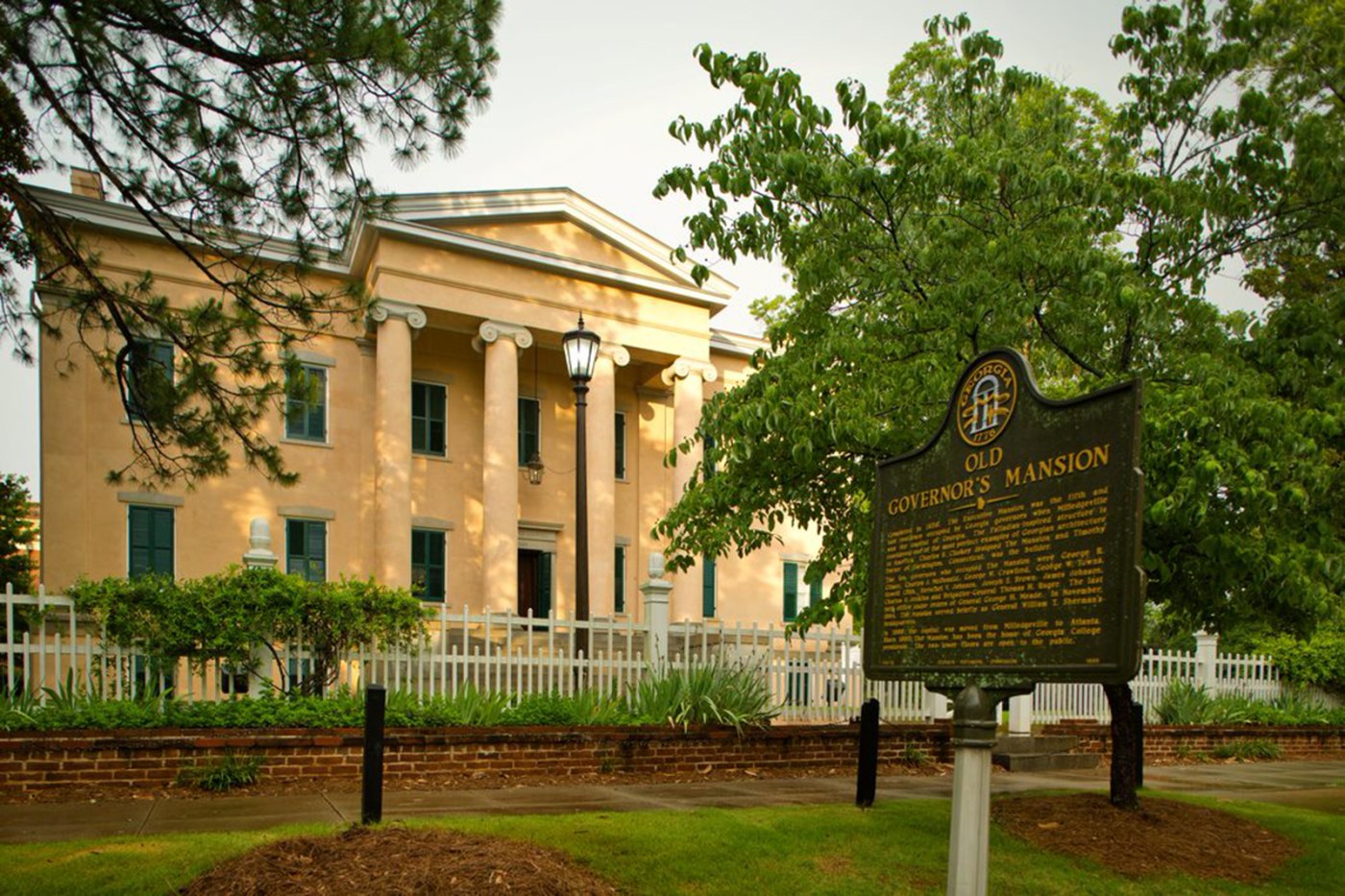
There is more to do in Milledgeville than chase the ghost of Flannery O’Connor. Long before the state capital moved to Atlanta, it rotated between Augusta and Savannah, then Augusta alone, and after that Louisville. In 1807 Milledgeville became the capital, and a new capital building reshaped the city’s low-set skyline. Partially because it was the capital, Milledgeville was built in gorgeous, flower-lined squares still in place today. It remained the capital until Atlanta was named in 1868, but the bonus is that you can still visit the Old Governor’s Mansion and state legislative chambers.
Popping into the Milledgeville-Baldwin County Convention and Visitors Bureau, I meet Rebekah Snider, its executive director.
“People come for the lake and for the history and culture,” she says, noting that nearby Lake Sinclair covers some 15,300 acres of coves, marinas and vast open stretches of water perfect for fishing, swimming and boating. She also says that two “high demand” trolley tours are offered on weekends by reservation only, including a one-hour history tour that will take you past some of the most beautiful antebellum architecture in Georgia.
The other is a two-hour tour to the 2,000-acre Central State Hospital, originally known as the Georgia State Lunatic, Idiot and Epileptic Asylum. Now almost completely abandoned – a few patients are still housed at the hospital – the site, dating to 1842, gained national if not notorious recognition as the U.S.’s largest mental institution with more than 12,000 patients and 6,000 employees scattered across the then massive 8,000-acre complex.
Eating and drinking, Milledgeville style
Milledgeville is a small town with big flavor. We stopped in at the Reel Grill of Milledgeville right in the heart of downtown. My sister-in-law raved about the crab bisque, as did her sister about the bourbon salmon. I chose blackened shrimp with cheese grits as a side, and since then have been trying to figure a way to get back to Milledgeville soonest to have them again. For the drinking Flanatics, try the Flannery O’Connor Love Letters, a unique bourbon cocktail.
Milledgeville may be a small town but it is big on restaurants. From Southern cuisine to world-class pizza to amazing seafood, including the blackened shrimp, cheese grits and mac-and-cheese at the Reel Grill in historic downtown, Milledgeville is known for its local restaurants. (Mary Ann Anderson/TNS)
Greene’s Fresh Farmhouse is a well-liked weekday lunch spot that offers traditional Southern fare. Think: pulled pork, mac-and-cheese and sweet potato souffle. And biscuits. Oh, those biscuits. For breakfast, brunch and lunch, you’ll love the Local Yolkal, known for its award-winning eggs benedict and indoor and outdoor dining.
Milledgeville, with GCSU and its global students, has gone international with Kai Thai for traditional Thai and sushi. Go for curry, stir-fry, noodles or hibachi or all of the above. If you’re hankering for Italian, then hop to The Brick, known for its pizza, calzones, pastas and sandwiches. But don’t miss its Stuffed Sticks, a bit of heaven with fresh pizza dough, stuffed with mozzarella and a choice of other fresh ingredients.
Sleeping, Milledgeville style
Milledgeville offers a variety of hotel and lodging options with standard hotels, RV sites and campgrounds. Vacation rentals offer a variety of accommodations from antebellum homes to cozy lakeside cottages. For a unique stay and to soak up the local ambience, try the Inn on North Jefferson, a well-appointed bed and breakfast in a 200-year-old home, or the Rockwell House, a stunning 1838 home and events center where you can rent the entire home or one of four individual suites.
The last word
As I make the two-hour drive back home to south Georgia from Milledgeville, I ponder a great deal about O’Connor and her impact, even some 50 years after she passed away, on how others view Georgia and the South in general. Expressing her view of the region’s identity, if you will, she wrote in an essay in 1963 for The Regional Writer, “Southern identity is not really connected with mocking-birds and beaten biscuits and white columns any more than it is with hookworm and bare feet and muddy clay roads.”
Andalusia Farm, just off U.S. Highway 441 north of Milledgeville, Georgia, was once the home of author Flannery O’Connor and her mother, Regina Cline O’Connor. Now a house museum, about 90% of its artifacts are original to the home. (Explore Georgia/TNS)
And snakes, I think, as I’m reminded of the rat snake at Andalusia. When you visit the farm, and watch “Wildcat,” you just might gain a better understanding of where she came from, too.
If you go
Milledgeville is about 100 miles from Atlanta and Hartsfield-Jackson International Airport. For more detailed information on what to do, where to eat and where to stay, including vacation rentals, visit Milledgeville-Baldwin County Convention and Visitors Bureau at www.visitmilledgeville.org or call 478-452-4687. For more information on Andalusia, visit www.gcsu.edu/andalusia. Milledgeville offers ghost walks throughout the year, Milledgeville Burger Week May 17-25, and the Deep Roots Festival in October. If you visit during the Christmas holidays, don’t miss the enviable décor at the Old Governor’s Mansion.
©2024 Tribune Content Agency, LLC.