‘In the name of security’
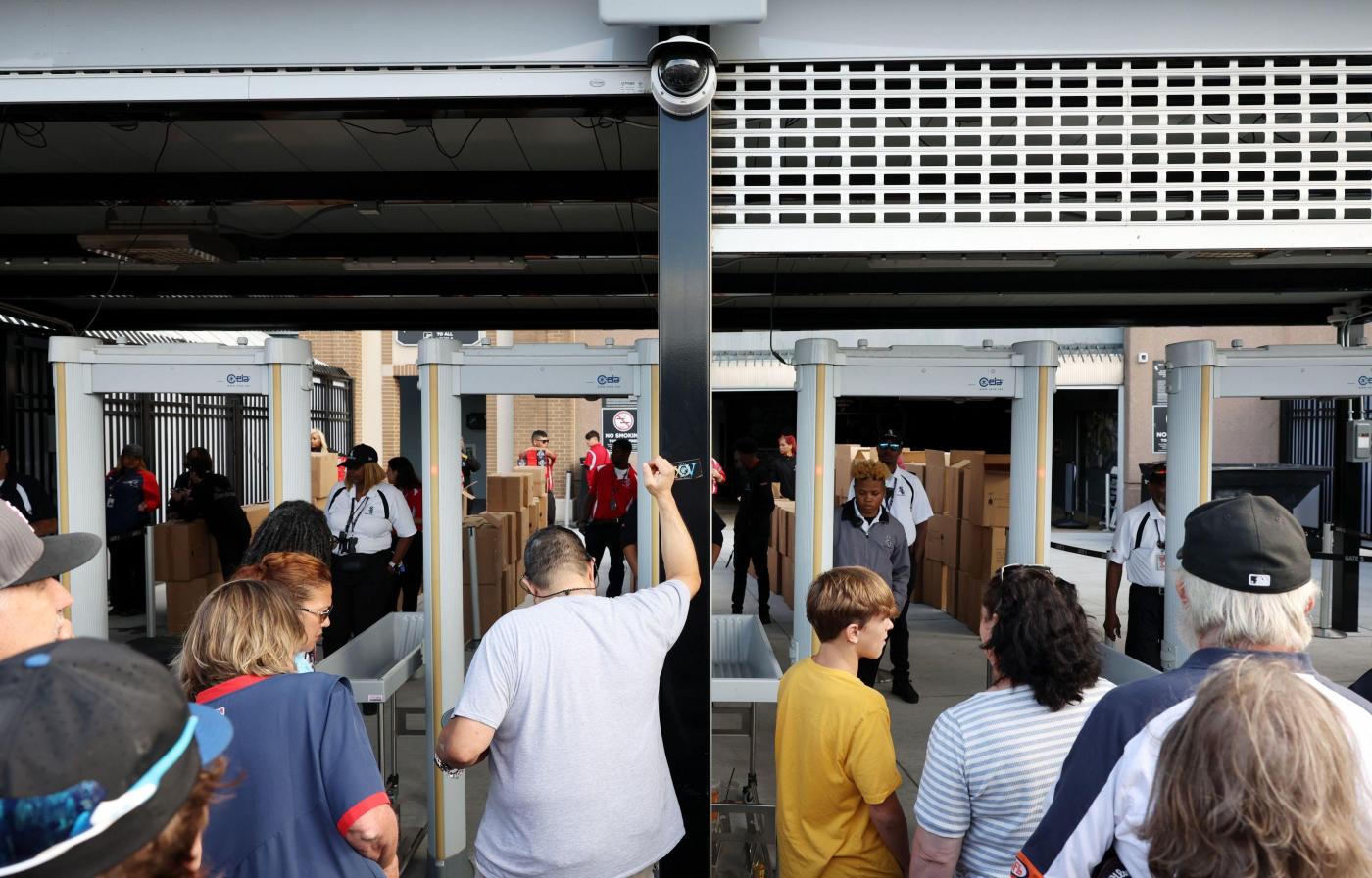
The pretext of “in the name of security” confounds me (“Minnesota officials recommend weapons screening at state Capitol”). Often employed in total irony, “security” has become the catchall for 21st Century distrust “of the people.” Have we ever been more scared of ourselves?
‘Welcome, welcome … please proceed through the metal detector.’ The discord of the latter against the former is to me like fingernails across a blackboard. Shall we place Minnesota town welcome signs under FLOCK cameras? A penny for your thoughts, but a pound of flesh for your data. Identify yourself here, identify yourself there – “Welcome, Welcome.” Papers, please.
In ICE we seem to have a Lt. Calley searching for his My Lai. The contempt for the other is palpable. The “other” of course is now us. We ought remember that anywhere “security” has been applied small it has ultimately ended up big; your neighbor is a dangerous person writ large. Who’s to blame? I have witnessed all the finger pointing. I’ve read all the accusations but what I never read is the dystopian genesis of modern “security,” nor its slippery slopes that have caused masked agents to march in our streets.
Distrust – the outright contempt — of practically everyone is this century’s massacre upon our own nation.
Julia Bell, St. Paul
I don’t understand how we tolerate this
Like many Minnesotans, I have been deeply shaken by the fatal shooting during a recent federal enforcement operation in Minneapolis, and by the subsequent expansion of ICE activity in our communities. I am writing not to argue policy, but to ask a human and moral question that I cannot stop asking:
How are we tolerating this?
How are we watching parents taken from their homes, children left behind in shock and confusion, neighbors disappearing overnight — and not being disturbed enough to demand something better?
I am trying, sincerely, to understand how people of good will — people who care about family, order and the rule of law — can witness scenes of armed agents taking someone away in front of their children, or read about a woman killed in the course of enforcement, and not feel compelled to say: This is not how a humane society should function.
Do supporters of our current system know anyone outside their own social or economic circles who is being affected? Do they know what it looks like when a child comes home from school and their parent is simply gone? Do they know what it does to a community when people are afraid not only of being taken, but even of leaving their own homes — afraid to go to work, to school, to the doctor, or to church — and when enforcement actions are disrupting staff and children in our schools?
This is not a theoretical debate. This is lived trauma.
I find myself thinking about Anne Frank’s words describing how people simply “disappeared,” how neighbors were taken away and ordinary life tried to go on around that absence. I am not equating our moment with hers — history is not that simple — but I am troubled by how familiar the pattern feels: people removed, families silenced by fear, the rest of society slowly learning not to look too closely. That is not a comparison meant to accuse, but a warning meant to awaken.
I understand that immigration is complex. I understand that law matters and borders matter. But the way we enforce the law also matters. The means we choose shape who we become. A system that relies on fear, force and family separation as routine tools cannot be called orderly or just — only cruel.
What troubles me most is not disagreement. It is indifference.
It is the sense that many people have become so accustomed to this machinery of enforcement that they no longer see the human cost, or no longer feel responsible for it because it is being done “legally,” “federally,” or “by someone else.”
But moral responsibility does not disappear just because harm is bureaucratized.
Minnesota cannot legally order ICE out. I understand that. But we can refuse to normalize what is happening. We can refuse to accept that this is the best we can do. We can demand accountability, transparency, restraint and, above all, humanity.
And I am deeply grateful to all who are standing up in protest — peacefully, courageously and publicly — to insist that our neighbors’ lives and families matter, and that we can do better than this.
I am not asking everyone to agree with me about immigration policy.
I am asking how anyone can watch families be torn apart, children traumatized, communities destabilized, and now people killed — and not feel called to say: This must change.
If we cannot feel that, then something far more dangerous than any immigration crisis is happening to us.
Jane White Schneeweis, St. Paul
What would Bishop Whipple do?
Henry Benjamin Whipple (1822–1901) came to Minnesota in 1860 as the first Episcopalian bishop for our state, a position he held until his death. He was a humanitarian and a man of conscience. As such he quickly became a strong advocate for the Dakota and Ojibwe people, protesting the way these Native Americans were being mistreated by the government and cheated by others. He quickly learned their language and was referred to as “straight tongue” by some Dakota.
The short-lived (Aug. 18 to Sept. 26) Dakota War of 1862, along the Minnesota River from New Ulm toward the western border, erupted primarily because the Dakota people were starving when arrogant Indian Agents would not advance credit after the annual annuity payments from the federal government were delayed. Certainly, Bishop Whipple acutely felt the terrible deaths of the more than 300 settler men, women and children cruelly killed by the Dakota in the uprising. He also certainly prayed for them and their loved ones.
Immediately upon the completion of the war, 392 Dakota men were tried in front of a military commission headed by Colonel Henry Sibley. With some “trials” lasting no more than five minutes, 303 of these men were sentenced to death by hanging.
Against vehement and almost universal public sentiment, Bishop Henry Whipple opposed this blatant miscarriage of justice and was instrumental in getting President Lincoln to review the trial transcripts. Although the Civil War was raging, Abraham Lincoln took the time and made the effort to conduct a review and ultimately reduced the list of condemned to 39. On Dec. 5, 1862, thirty-eight Dakota men (one additional man was reprieved) were hanged in Mankato. This was and is the largest one-day mass execution in our country’s history. The Dakota people were stripped of their land, and most were forcibly removed from the state. Bishop Whipple continued to befriend and advocate for the Dakota and Ojibwe people in Minnesota for the rest of his life.
If he were living today, I know that Bishop Whipple would befriend and advocate for those who are currently being so cruelly persecuted by federal agents in the Twin Cities. Bishop Henry Whipple would be appalled and saddened by the fact that citizens and non-citizens are being detained under dreadful conditions in the building that was named in his honor. He would also be disgusted by the “leaders” of our federal government who act and speak with such forked or crooked tongues.
Joseph C. Brotzler, South St. Paul
For decent and lawful enforcement, but not this
Earlier this month a neighbor of my friend in St. Paul was picked up and detained by ICE. The spouse of a teacher at the school where I volunteer was also picked up and detained by ICE. Both were born in America and have no criminal history. They are NOT illegal immigrants and NOT the “worst of the worst” of illegal immigrants purportedly being targeted by ICE agents at the direction of President Trump.
I don’t believe President Trump has ICE in Minnesota to enforce immigration law as their primary mission. I believe ICE is in Minnesota to terrorize and traumatize our citizens because President Trump hates Rep. Ilhan Omar and Gov. Tim Walz (based on the president’s many vicious public insults of Omar and Walz). Disagreeing with your political opponents is one thing, terrorizing their constituents is quite another.
I am not defending unlawful immigration, but President Trump’s blatant prejudicial violation of the 4th Amendment of the Constitution to punish political enemies and terrorize law-abiding American citizens is, very simply, wrong. I am an advocate for decent and lawful enforcement of immigration law and putting an end to President Trump’s targeted traumatization of our fellow Americans.
Eric Lillyblad, Forest Lake
The risk
My family has realized that no one, especially innocent people, is immune from the ongoing negative interactions and complications caused by the ICE presence in Minneapolis. I want to present the fear, daily-life routines needing to be changed and adjustments we are dealing with, realizing that many have it much worse. The major fear of course is what if ICE detains a family member who is only going about their daily routine and who is not able to provide a clear presentation of their actions.
We have been alerted to the risk that one of our family members faces based on a learning disability that makes it difficult for her to deal with complex issues requiring lengthy explanations. Several years ago my husband and I decided to complete our family with a fourth child, who would be a special needs child adopted from Korea. She was able to graduate from high school and works in food service at a vibrant parochial school on Randolph Avenue in St. Paul.
Her limitations make it difficult for her to comprehend and address complex issues and reply in a perceived timely manner. If her bus or Lyft transportation is detained by ICE because of other passengers or because many of the drivers appear to be Muslim or because she looks Asian or for any reason and she would be questioned, she would be at great risk to be taken to a facility for “further interrogation” because she would not have been able to explain that she is a U.S. citizen or answer rapid questioning. So for now we are driving her ourselves or keeping in close phone connections if she takes her usual method of getting to and from work.
Jane Greeman, Woodbury
Not on the basis of need
I have lived in St. Paul for 95 years and have never seen a situation that local and state authorities could not handle. Because they have not been invited, ICE needs to leave Minnesota.
ICE is assigned to various neighborhoods, not on the basis of need, but as intimidators and fear mongers. The fact that they have no badges with numbers displayed and have masks or face coverings should not be tolerated as both prevent accountability. The face coverings and the anonymity would not be necessary if they were doing honest work.
Donald Ausemus, St. Anthony
Send out the Fraud Stoppers
This bizarre Minnesota historical ‘fraud’ event, all blamed on Walz and the Democrats, has hit the international news, including my distant Norwegian relatives and friends. Equally amazing is how confidently the fraudsters thought this would be a ‘piece of cake’! The fraudsters ‘ASSUMED’ they could easily get away with it, AND they almost did!
There is too much public ignorance and distrust about where these Grant moneys go and why? This Grant money fraud has been going on in every state and for many decades! The fraudsters were quite aware of how easy this would be to pull off, and they almost got away with it!
Now is the time to consider organizing the ‘FS’, Fraud Stoppers citizen project of citizen volunteers who would be trained and then assigned by local governments to go out and monitor what those grants were for and “document” they were being accomplished as contracted! Also, this would educate the public about how their money was being spent AND that these Grants were good ideas, or perhaps not done well and needed to change?
Send out the Fraud Stoppers, ‘FS’, NOW!
Mark Nupen, Anoka