
TikTok has promised to sue over the potential US ban. What’s the legal outlook?

posted in: News | 0

By WYATTE GRANTHAM-PHILIPS (AP Business Writer)

NEW YORK (AP) — Legislation forcing TikTok’s parent company to sell the video-sharing platform or face a ban in the U.S. received President Joe Biden’s official signoff Wednesday. But the newly minted law could be in for an uphill battle in court.

Critics of the sell-or-be-banned ultimatum argue it violates TikTok users’ First Amendment rights. The app’s China-based owner, ByteDance, has already promised to sue, calling the measure unconstitutional.

But a court challenge’s success is not guaranteed. The law’s opponents, which include advocacy organizations like the American Civil Liberties Union, maintain that the government hasn’t come close to justifying banning TikTok, while others say national-security claims could still prevail.

For years, lawmakers on both sides of the aisle have expressed concerns that Chinese authorities could force ByteDance to hand over U.S. user data, or influence Americans by suppressing or promoting certain content on TikTok. The U.S. has yet to provide public evidence to support those claims, but political pressures have piled up regardless.

If upheld, legal experts also stress that the law could set a precedent carrying wider ramifications for digital media in the U.S.

Here’s what you need to know.

IS A TIKTOK BAN UNCONSTITUTIONAL?

That’s the central question. TikTok and opponents of the law have argued that a ban would violate First Amendment rights of the social media platform’s 170 million U.S. users.

Patrick Toomey, deputy director of the ACLU’s National Security Project, said a TikTok ban would “stifle free expression and restrict public access” to a platform that has become central source for information sharing.

Among key questions will be whether the legislation interferes with the overall content of speech on TikTok, notes Elettra Bietti, an assistant professor of law and computer science at Northeastern University, because content-based restrictions meet a higher level of scrutiny.

ByteDance has yet to officially file a lawsuit, but Bietti said she expects the company’s challenge to primarily focus on whether a ban infringes on these wider free-speech rights. Additional litigation involving TikTok’s “commercial actors,” such as businesses and influencers who make their living on the platform, may also arise, she added.

COULD TIKTOK SUCCESSFULLY PREVENT THE BAN IN COURT?

TikTok is expressing confidence about the prospects of its planned challenge.

“Rest assured, we aren’t going anywhere,” TikTok CEO Shou Chew said in a video response posted to X Wednesday. “The facts and the Constitution are on our side, and we expect to prevail again.”

Related Articles

Business |


US growth slowed sharply last quarter to 1.6% pace, reflecting an economy pressured by high rates

Business |


Survey: More than 1 in 3 American travelers plan to go into debt for their summer vacations this year

Business |


Ryan’s proposed redevelopment of Thomson Reuters site in Eagan moves forward

Business |


Is financial trauma holding you back from living your best life?

Business |


MPCA fines East Grand Forks sugar plant $350K for air quality violations

Toomey also said that he is optimistic about the possibility of TikTok being able to block the measure in court, noting that both users and the company “have extremely strong” First Amendment claims.

“Many of the calls to completely ban TikTok in the U.S. are about scoring political points and rooted in anti-China sentiment,” Toomey added. “And to date, these steps to ban TikTok had not been remotely supported by concrete public evidence.”

Still, the future of any litigation is hard to predict, especially for this kind of case. And from a legal perspective, it can be difficult to cite political motivations, even if they’re well-documented, as grounds to invalidate a law.

The battle could also string along for some time, with the potential for appeals that could go all the way to the Supreme Court, which would likely uphold the law due to its current composition, said Gus Hurwitz, a senior fellow at the University of Pennsylvania’s Carey Law School.

HOW MIGHT THE GOVERNMENT RESPOND TO THE CHALLENGE?

TikTok’s legal challenge won’t go on without a fight. The government will probably respond with national-security claims, which were already cited prominently as the legislation made its way through Congress.

Toomey maintains that the government hasn’t met the high bar required to prove imminent national-security risks, but some other legal experts note that it’s still a strong card to play.

“One of the unfortunate and really frustrating things about national-security legislation (is that) it tends to be a trump card,” Hurwitz said. “Once national-security issues come up, they’re going to carry the day either successfully or not.”

Hurwitz added that he thinks there are legitimate national-security arguments that could be brought up here. National security can be argued because it’s a federal measure, he noted. That sets this scenario apart from previously unsuccessful state-level legislation seeking to ban TikTok, such as in Montana.

But national-security arguments are also vulnerable to questioning as to why TikTok is getting specific scrutiny.

“Personally, I believe that what TikTok does isn’t that different from other companies that are U.S.-based,” Bietti said, pointing to tech giants ranging from Google to Amazon. “The question is, ‘Why ban TikTok and not the activities and the surveillance carried out by other companies in the United States?’”

IF THE LAW IS UPHELD, COULD THERE BE WIDER RAMIFICATIONS?

Still, legal experts note that there could be repercussions beyond TikTok in the future.

The measure was passed as part of a larger $95 billion package that provides aid to Ukraine and Israel. The package also includes a provision that makes it illegal for data brokers to sell or rent “personally identifiable sensitive data” to North Korea, China, Russia, Iran or entities in those countries.

That has encountered some pushback, including from the ACLU, which says the language is written too broadly and could sweep in journalists and others who publish personal information.

“There’s real reason to be concerned that the use of this law will not stop with TikTok,” Toomey said. “Looking at that point and the bigger picture, banning TikTok or forcing its sale would be a devastating blow to the U.S. government’s decades of work promoting an open and secure global internet.”

US growth slowed sharply last quarter to 1.6% pace, reflecting an economy pressured by high rates

posted in: News | 0

By PAUL WISEMAN (AP Economics Writer)

WASHINGTON (AP) — The nation’s economy slowed sharply last quarter to a 1.6% annual pace in the face of high interest rates, but consumers — the main driver of economic growth — kept spending at a solid pace.

Thursday’s report from the Commerce Department said the gross domestic product — the economy’s total output of goods and services — decelerated in the January-March quarter from its brisk 3.4% growth rate in the final three months of 2023.

A surge in imports, which are subtracted from GDP, reduced first-quarter growth by nearly 1 percentage point. Growth was also held back by businesses reducing their inventories. Both those categories tend to fluctuate sharply from quarter to quarter.

By contrast, the core components of the economy still appear sturdy. Along with households, businesses helped drive the economy last quarter with a strong pace of investment.

The import and inventory numbers can be volatile, so “there is still a lot of positive underlying momentum,” said Paul Ashworth, chief North America economist at Capital Economics.

The economy, though, is still creating price pressures, a continuing source of concern for the Federal Reserve. A measure of inflation in Friday’s report accelerated to a 3.4% annual rate from January through March, up from 1.8% in the last three months of 2023 and the biggest increase in a year. Excluding volatile food and energy prices, so-called core inflation rose at a 3.7% rate, up from 2% in fourth-quarter 2023.

From January through March, consumer spending rose at a 2.5% annual rate, a solid pace though down from a rate of more than 3% in each of the previous two quarters. Americans’ spending on services — everything from movie tickets and restaurant meals to airline fares and doctors’ visits — rose 4%, the fastest such pace since mid-2021.

But they cut back spending on goods such as appliances and furniture. Spending on that category fell 0.1%, the first such drop since the summer of 2022.

Gregory Daco, chief economist at the tax and consulting firm EY, noted that the underlying economy looks solid, though it’s slowing from last year’s unexpectedly fast pace. The rise in imports that accounted for much of the drop in first-quarter growth, he noted, is “a sign of solid demand” by American consumers for foreign goods.

Still, Daco said that the economy’s “momentum is cooling.”

“It’s unlikely to be a major retrenchment,” he said, “but we are likely to see cooler economic momentum as a result of consumers exercising more scrutiny with their outlays.’’

The state of the U.S. economy has seized Americans’ attention as the election season has intensified. Although inflation has slowed sharply from a peak of 9.1% in 2022, prices remain well above their pre-pandemic levels.

Republican critics of President Joe Biden have sought to pin responsibility for high prices on Biden and use it as a cudgel to derail his re-election bid. And polls show that despite the healthy job market, a near-record-high stock market and the sharp pullback in inflation, many Americans blame Biden for high prices.

Last quarter’s GDP snapped a streak of six straight quarters of at least 2% annual growth. The 1.6% rate of expansion was also the slowest since the economy actually shrank in the first and second quarters of 2022.

The economy’s gradual slowdown reflects, in large part, the much higher borrowing rates for home and auto loans, credit cards and many business loans that have resulted from the 11 interest rate hikes the Fed imposed in its drive to tame inflation.

Even so, the United States has continued to outpace the rest of the world’s advanced economies. The International Monetary Fund has projected that the world’s largest economy will grow 2.7% for all of 2024, up from 2.5% last year and more than double the growth the IMF expects this year for Germany, France, Italy, Japan, the United Kingdom and Canada.

Related Articles

Business |


Survey: More than 1 in 3 American travelers plan to go into debt for their summer vacations this year

Business |


Ryan’s proposed redevelopment of Thomson Reuters site in Eagan moves forward

Business |


Is financial trauma holding you back from living your best life?

Business |


MPCA fines East Grand Forks sugar plant $350K for air quality violations

Business |


Sudden closure of Isanti wedding venue leaves bride scrambling

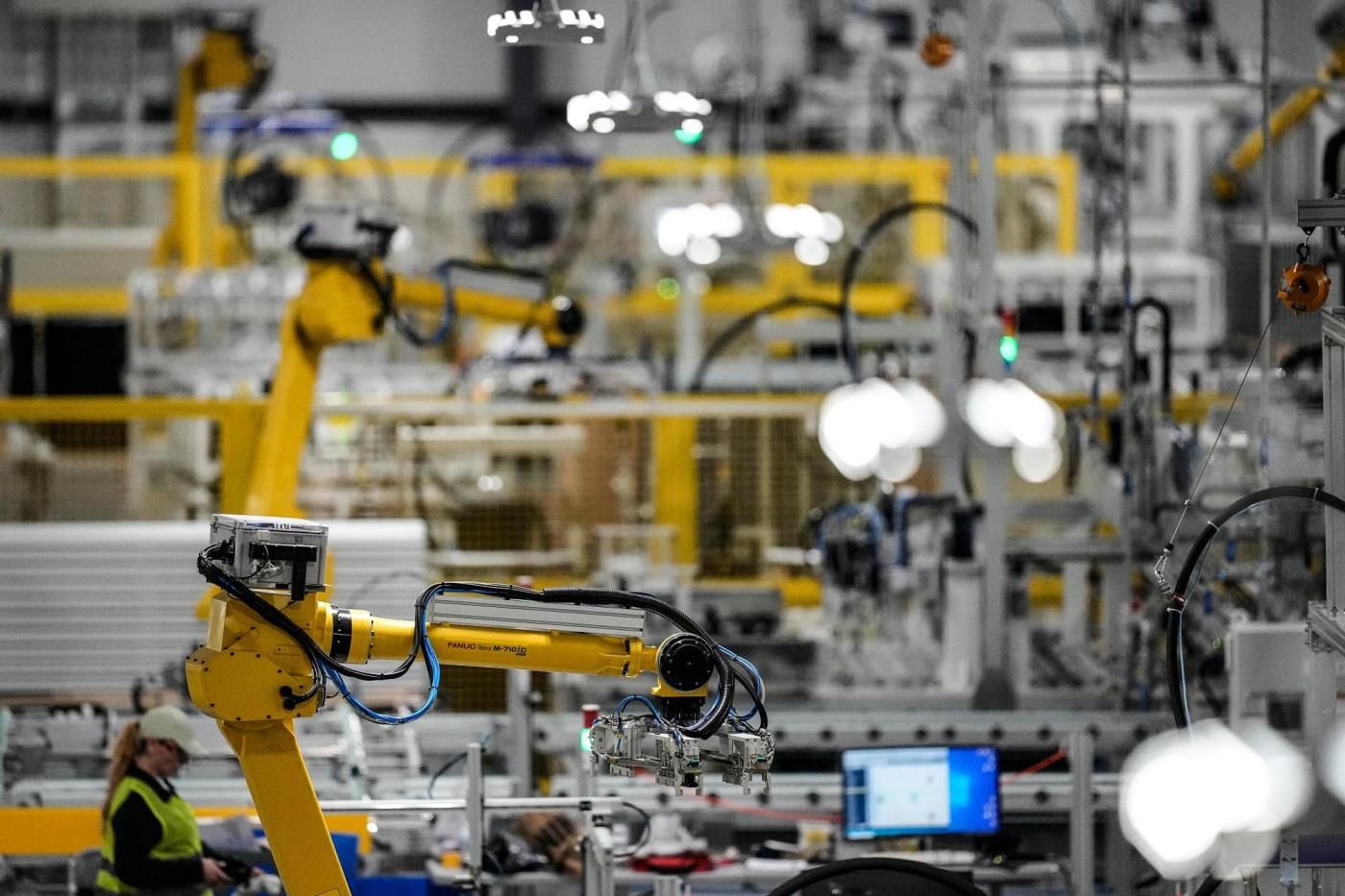
Businesses have been pouring money into factories, warehouses and other buildings, encouraged by federal incentives to manufacture computer chips and green technology in the United States. On the other hand, their spending on equipment has been weak. And as imports outpace exports, international trade is also thought to have been a drag on the economy’s first-quarter growth.

Kristalina Georgieva, the IMF’s managing director, cautioned last week that the “flipside″ of strong U.S. economic growth was that it was ”taking longer than expected” for inflation to reach the Fed’s 2% target, although price pressures have sharply slowed from their mid-2022 peak.

Inflation flared up in the spring of 2021 as the economy rebounded with unexpected speed from the COVID-19 recession, causing severe supply shortages. Russia’s invasion of Ukraine in February 2022 made things significantly worse by inflating prices for the energy and grains the world depends on.

The Fed responded by aggressively raising its benchmark rate between March 2022 and July 2023. Despite widespread predictions of a recession, the economy has proved unexpectedly durable. Hiring so far this year is even stronger than it was in 2023. And unemployment has remained below 4% for 26 straight months, the longest such streak since the 1960s.

Inflation, the main source of Americans’ discontent about the economy, has slowed from 9.1% in June 2022 to 3.5%. But progress has stalled lately.

Though the Fed’s policymakers signaled last month that they expect to cut rates three times this year, they have lately signaled that they’re in no hurry to reduce rates in the face of continued inflationary pressure. Now, a majority of Wall Street traders don’t expect them to start until the Fed’s September meeting, according to the CME FedWatch tool.

Woman robbed of dog as she’s pushed down during walk in St. Paul

posted in: News | 0

A woman was robbed of her dog in St. Paul during a walk and police asked for the public’s help Thursday to find the pet.

Two young men approached the 37-year-old woman in the Payne-Phalen area just before 4 p.m. Wednesday and asked her about her dog, said Alyssa Arcand, a St. Paul police spokeswoman. They then pushed the woman down and took the dog, whose name is Clementine. It happened in the area of Westminster Street and York Avenue.

Clementine, who is also known as “Tiny,” is a French bulldog-Boston terrier mix who is mostly black in color and has a white underbelly. She weighs about 25 pounds and is microchipped.

“Right now we want to make sure Clementine is found and is back home safe,” Arcand said.

Police are asking anyone with information to call robbery/homicide unit at 651-266-5650.

A detailed description of the suspects wasn’t available as of Thursday morning.

Related Articles

Crime & Public Safety |


New York appeals court overturns Harvey Weinstein’s 2020 rape conviction from landmark #MeToo trial

Crime & Public Safety |


Blaine man gets 8 months for high-speed St. Anthony crash that injured two

Crime & Public Safety |


Yia Xiong’s daughter sues St. Paul police over fatal shooting, says officers ‘deliberately ignored’ policy reforms

Crime & Public Safety |


St. Paul murder charges: 17-year-old tried to rob marijuana dealer and fatally shot his friend

Crime & Public Safety |


Minnesota sues Fridley used car dealership for misrepresenting vehicles, other fraudulent practices

Ariel Henry resigns as prime minister of Haiti, paving the way for a new government to take power

posted in: News | 0

By DANICA COTO (Associated Press)

PORT-AU-PRINCE, Haiti (AP) — Ariel Henry resigned Thursday as prime minister of Haiti, leaving the way clear for a new government to be formed in the Caribbean country, which has been wracked by gang violence that killed or injured more than 2,500 people from January to March.

Henry presented his resignation in a letter signed in Los Angeles, dated April 24, and released on Thursday by his office on the same day that a council tasked with choosing a new prime minister and Cabinet for Haiti was sworn in.

Henry’s remaining Cabinet meanwhile chose Economy and Finance Minister Michel Patrick Boisvert as the interim prime minister. It was not immediately clear when the transitional council would select its own interim prime minister.

The council was installed more than a month after Caribbean leaders announced its creation following an emergency meeting to tackle Haiti’s spiraling crisis. Henry had pledged to resign once the council is installed.

The nine-member council, of which seven have voting powers, is also expected to help set the agenda of a new Cabinet. It will also appoint a provisional electoral commission, a requirement before elections can take place, and establish a national security council.

The council’s non-renewable mandate expires Feb. 7, 2026, at which date a new president is scheduled to be sworn in.

Gangs launched coordinated attacks that began on Feb. 29 in the capital, Port-au-Prince, and surrounding areas. They burned police stations and hospitals, opened fire on the main international airport that has remained closed since early March and stormed Haiti’s two biggest prisons, releasing more than 4,000 inmates. Gangs also have severed access to Haiti’s biggest port.

The onslaught began while Prime Minister Henry was on an official visit to Kenya to push for a U.N.-backed deployment of a police force from the East African country. He remains locked out of Haiti.

“Port-au-Prince is now almost completely sealed off because of air, sea and land blockades,” Catherine Russell, UNICEF’s director, said earlier this week.

The international community has urged the council to prioritize Haiti’s widespread insecurity. Even before the attacks began, gangs already controlled 80% of Port-au-Prince. The number of people killed in early 2024 was up by more than 50% compared with the same period last year, according to a recent U.N. report.

“It is impossible to overstate the increase in gang activity across Port-au-Prince and beyond, the deterioration of the human rights situation and the deepening of the humanitarian crisis,” María Isabel Salvador, the U.N. special envoy for Haiti, said at a U.N. Security Council meeting on Monday.

Nearly 100,000 people have fled the capital in search of safer cities and towns since the attacks began. Tens of thousands of others left homeless after gangs torched their homes are now living in crowded, makeshift shelters across Port-au-Prince that only have one or two toilets for hundreds of residents.

“Although I’m physically here, it feels like I’m dead,” said Rachel Pierre, a 39-year-old mother of four children.

“There is no food or water. Sometimes I have nothing to give the kids,” she said as her 14-month-old suckled on her deflated breast.

Many Haitians are angry and exhausted at what their lives have become and blame gangs for their situation.

“They’re the ones who sent us here,” said Chesnel Joseph, a 46-year-old math teacher whose school closed because of the violence and who has become the shelter’s informal director. “They mistreat us. They kill us. They burn our homes.”

___