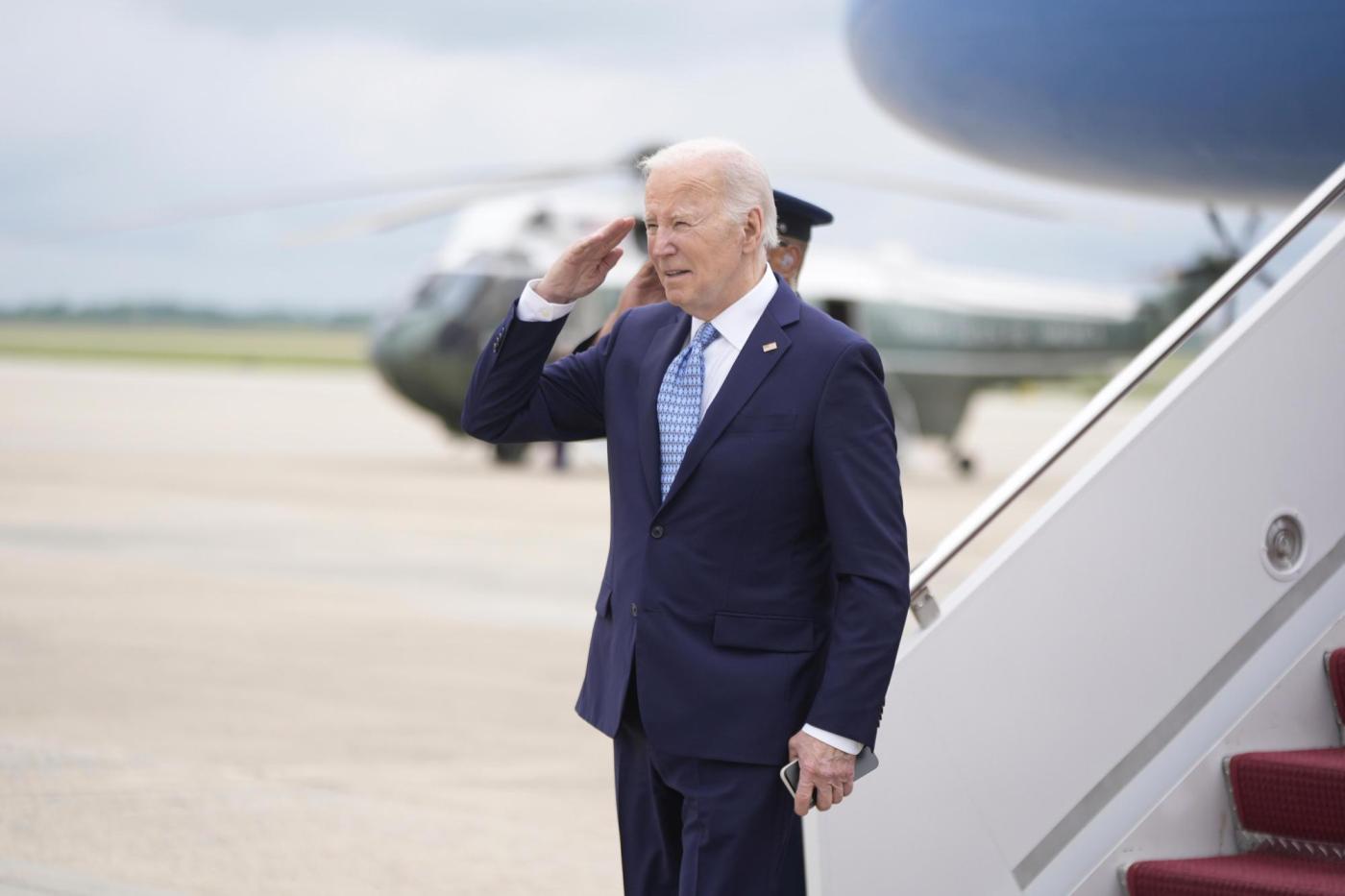
Biden condemns current antisemitism in Holocaust remembrance during college protests and Gaza war

posted in: Politics | 0

By ZEKE MILLER (AP White House Correspondent)

WASHINGTON (AP) — President Joe Biden condemned the “ferocious surge of antisemitism in America and around the world” during a Tuesday ceremony to remember victims of the Holocaust at a time when the Hamas attack on Israel and controversy over the war in Gaza have sparked new waves of violence and hateful rhetoric toward Jews.

“We’re at risk of people not knowing the truth,” Biden said of the horrors of the Holocaust, when 6 million Jews were systematically killed by Nazi Germany and its collaborators. “This hatred continues to lie deep in the hearts of too many people in the world.”

Biden’s remarks at the Capitol played out as pro-Palestinian protests — some of which have involved antisemitic chants and threats toward Jewish students and supporters of Israel — rock college campuses across the country. It comes as the Democratic president has struggled to balance his support for Israel after the Oct. 7 Hamas attack — the deadliest day for Jews worldwide since the Holocaust — with his efforts to protect civilian life in Gaza. Hamas has been designated as a terrorist organization by the United States, Canada and the European Union.

Biden said that on Oct. 7, Hamas “brought to life” that hatred with the killing of more than 1,200 Israelis, mostly civilians.

“Not 75 years later, but just seven and a half months later, and people are already forgetting, they’re already forgetting, that Hamas unleashed this terror that it was Hamas that brutalized Israelis, that it was Hamas that took and continues to hold hostages,” Biden said. “I have not forgotten, nor have you. And we will not forget.”

Biden, whose relationship with Israeli Prime Minister Benjamin Netanyahu has grown strained over his government’s push to invade the southern Gaza city of Rafah, said American support for Israel is “iron clad…even when we disagree.”

Biden steered clear of the upcoming presidential election in his speech. But his address comes as former President Donald Trump has criticized the incumbent for not doing more to combat antisemitism — while ignoring his own long history of rhetoric that invokes the language of Nazi Germany and plays on stereotypes of Jews in politics.

The Capitol event, hosted by the U.S. Holocaust Memorial Museum, also featured remarks from House Speaker Mike Johnson and House Democratic Leader Hakeem Jeffries. Holocaust survivors, local youth and elected officials took part in the remembrance ceremony, which included a recitation of the Jewish prayers for the dead.

The campus protests have posed a political challenge for Biden, whose coalition has historically relied on younger voters, many of whom are critical of his public support for Israel.

Biden said “There’s no place on any campus in America” or any place in America for antisemitism or threats of violence. He added, “We’re not a lawless country — we are a civil society”

In conjunction with Biden’s speech, his administration was announcing new steps to combat antisemitism on colleges campuses and beyond. The Department of Education’s Office of Civil Rights was sending every school district and college in the nation a letter outlining examples of antisemitism and other hate that could lead to federal civil rights investigations.

The Department of Homeland Security was moving to educate schools and community groups about resources and funding available to promote campus safety and address threats. And the State Department’s special envoy to monitor and combat antisemitism was meeting with technology companies on how to combat the rise in hateful conflict online.

On Monday, Doug Emhoff, the husband of Vice President Kamala Harris and the first Jewish spouse of a nationally elected American leader, met with Jewish college students at the White House about the administration’s efforts to combat antisemitism. He heard students describe their own experiences with hatred, including threats of violence and hate speech, his office said.

Trump’s campaign on Monday released a video on Yom Hashoah, Israel’s Holocaust remembrance day, that aimed to contrast the 2024 presidential candidates’ responses on antisemitism.

The video shows images of Trump visiting Israel and speeches he has given pledging to stand with Jewish people and confront antisemitism, while showing footage of the protests on campuses and clips of Biden responding to protesters upset with his administration’s support for Israel in its war against Hamas.

One of the clips shows Biden saying, “They have a point,” but does not include the next sentence in which Biden said, “We need to get a lot more care into Gaza.”

Biden campaign spokesman James Singer said in response that “President Biden stands against antisemitism and is committed to the safety of the Jewish community, and security of Israel — Donald Trump does not.”

Associated Press writer Michelle L. Price in New York and Seung Min Kim in Washington contributed to this report.

Woman charged in deaths of 2 children on Red Lake reservation

posted in: Society | 0

RED LAKE, Minn. — A northern Minnesota woman has been charged with murder, arson and child neglect following the death of two children on the Red Lake Indian Reservation in March.

According to the U.S. attorney’s office in Minneapolis, on March 15, 35-year-old Jennifer Marie Stately of Red Lake attacked two children, slashing them with “a knife or other sharp object,” and then setting a house on fire. One of the children was fatally stabbed in the chest, and the other one suffered non-fatal stab wounds but ultimately died of smoke inhalation.

Authorities did not name the victims, but the Minneapolis Star Tribune reported that they were Stately’s children, ages 5 and 6.

After setting the house on fire, Stately fled the scene in her vehicle with a third child. That night, an Amber Alert was issued for the child. Soon after the alert was issued, a motorist spotted Stately’s vehicle and contacted law enforcement, authorities said.

Todd County law enforcement found the vehicle with Stately and a 3-year-old boy inside. The Star Tribune reported that he was her son.

“Upon seeing him in the vehicle, law enforcement immediately observed that (the child) had scabs covering his face and entire body,” the complaint read. “Open sores covered roughly 95% of his face … His cheeks were red and the sores appeared to be bleeding.”

The child was taken to the Long Prairie Hospital where a full-body examination revealed that he had several open sores and lesions. He also had “rotten” teeth and was unable to eat, the complaint read. Stately was arrested on suspicion of child neglect and endangerment, malicious punishment, torture and assault.

On Monday, Stately appeared in U.S. District Court, where she was ordered to remain in custody pending further proceedings.

Her attorney, Paul Engh, said in an email to the Associated Press that there is a “firm basis” for a not guilty plea, but did not elaborate.

Related Articles

Crime & Public Safety |


Final defendant in deadly St. Paul funeral home gunfight sentenced to six months

Crime & Public Safety |


Hudson teacher charged with sexually assaulting 11-year-old student

Crime & Public Safety |


Man who served as firefighter in Eagan, Eden Prairie lost his life in Minneapolis shooting

Crime & Public Safety |


Off-duty Eagan firefighter dies Sunday morning

Crime & Public Safety |


Felony charges filed against man shot by police during standoff in Woodbury Target lot

Boy Scouts of America changing name to more inclusive Scouting America after years of woes

posted in: News | 0

By JAMIE STENGLE (Associated Press)

IRVING, Texas (AP) — The Boy Scouts of America is changing its name for the first time in its 114-year history and will become Scouting America. It’s a significant shift as the organization emerges from bankruptcy following a flood of sexual abuse claims and seeks to focus on inclusion.

The organization steeped in tradition has made seismic changes after decades of turmoil, from finally allowing gay youth to welcoming girls throughout its ranks. With an eye on increasing flagging membership numbers, the Irving, Texas-based organization announced the name change Tuesday at its annual meeting in Florida.

“In the next 100 years we want any youth in America to feel very, very welcome to come into our programs,” Roger Krone, who took over last fall as president and chief executive officer, said in an interview before the announcement.

The organization began allowing gay youth in 2013 and ended a blanket ban on gay adult leaders in 2015. In 2017, it made the historic announcement that girls would be accepted as Cub Scouts as of 2018 and into the flagship Boy Scout program — renamed Scouts BSA — in 2019.

There were nearly 1,000 young women in the inaugural class of female Eagle Scouts in 2021, including Selby Chipman. The all-girls troop she was a founding member of in her hometown of Oak Ridge, North Carolina, has grown from five girls to nearly 50, and she thinks the name change will encourage even more girls to realize they can join.

“Girls were like: ‘You can join Boy Scouts of America?’” said Chipman, now a 20-year-old college student and assistant scoutmaster of her troop.

Within days of the announcement that girls would be allowed, Bob Brady went to work. A father of two girls and a proud Eagle Scout himself, the New Jersey attorney eagerly formed an all-girls troop. At their first weekend gathering with other troops, the boys were happy to have the girls involved but some adult leaders seemed concerned, he recalled. Their worries seemed to melt away as soon as the girls led a traditional cheer around the campfire.

“You could see a change in the attitude of some of the doubters who weren’t sure and they realized, wait, these kids are exactly the same, they just happen to have ponytails,” said Brady. His daughters are among the 13 girls in his troop and 6,000 girls nationwide who have achieved the vaunted Eagle Scout rank.

Like other organizations, the scouts lost members during the pandemic, when participation was difficult. After a highpoint over the last decade of over 2 million members in 2018, the organization currently services just over 1 million youths, including more than 176,000 girls and young women. Membership peaked in 1972 at almost 5 million.

The move by the Boy Scouts to accept girls throughout their ranks strained a bond with the Girl Scouts of the USA, which sued, saying it created marketplace confusion and damaged their recruitment efforts. They reached a settlement agreement after a judge rejected those claims, saying both groups are free to use words like “scouts” and “scouting.”

While camping remains an integral activity for the Boy Scouts, the organization offers something for everyone today, from high adventures to merit badges for robotics and digital technology, Krone said: “About anything kids want to do today, they can do in a structured way within the scouting program.”

The Boy Scouts’ $2.4 billion bankruptcy reorganization plan took effect last year, allowing the organization to keep operating while compensating the more than 80,000 men who say they were sexually abused as children while scouting.

Angelique Minett, the first woman chairperson of Scouts BSA, gets excited about the future of scouting when she sees the about 20-person youth council from across the United States help guide the program by raising issues important to them, like sustainability, and things that they’d like to see changed, like the fit on some of the uniforms.

“When we think scouts we think knots and camping, but those are a means to an end,” Minett said. “We are actually teaching kids a much bigger thing. We are teaching them how to have grit, and we’re teaching them life skills and we’re teaching them how to be good leaders.”

The organization won’t officially become Scouting America until Feb. 8, 2025, the organization’s 115th birthday. But Krone said he expects people will start immediately using the name.

“It sends this really strong message to everyone in America that they can come to this program, they can bring their authentic self, they can be who they are and they will be welcomed here,” Krone said.

Israeli forces seize Rafah crossing in Gaza, threatening aid and putting cease-fire talks on edge

posted in: Society | 0

By SAMY MAGDY, MELANIE LIDMAN and LEE KEATH (Associated Press)

CAIRO (AP) — An Israeli tank brigade seized control of Gaza’s vital Rafah border crossing Tuesday as Israel brushed off urgent warnings from close allies and launched an incursion into the southern city even as cease-fire negotiations with Hamas remained on a knife’s edge.

The U.N. warned of a potential collapse of the flow of aid to Palestinians from the closure of Rafah and the other main crossing into Gaza, Kerem Shalom, at a time when officials say northern Gaza is experiencing “full-blown famine.”

The Israeli foray overnight came after hours of whiplash in the now 7-month-old Israel-Hamas war, with Hamas saying Monday it accepted an Egyptian-Qatari mediated cease-fire proposal. Israel, however, insisted the deal did not meet its core demands. Hamas has been designated as a terrorist organization by the United States, Canada and the European Union.

The high-stakes diplomatic moves and military brinkmanship left a glimmer of hope alive — if only barely — for a deal to bring at least a pause in the war, which has killed more than 34,700 Palestinians, according to local health officials, and has devastated the Gaza Strip.

By capturing Rafah, Israel gained full control over the entry and exit of people and goods for the first time since it withdrew soldiers and settlers from Gaza in 2005, though it has long maintained a blockade of the coastal enclave in cooperation with Egypt.

The incursion appeared to be short of the full-fledged offensive into Rafah that Israel has planned and might have been a pressure tactic in the cease-fire talks.

But Israeli Prime Minister Benjamin Netanyahu called the capture of the crossing an “important step” toward dismantling Hamas’ military and governing capabilities, and Defense Minister Yoav Gallant said Israel would “deepen” the Rafah operation if the talks on the hostage deal failed.

Fighting forced the evacuation of the Abu Youssef al-Najjar Hospital, one of the main medical centers that has been receiving people wounded in airstrikes on Rafah in recent weeks. It was not immediately clear how many patients had been moved to other facilities.

The looming operation threatens to widen a rift between Israel and its main backer, the United States, which says it is concerned over the fate of around 1.3 million Palestinians crammed into Rafah, most of whom have fled fighting elsewhere.

U.S. President Joe Biden warned Netanyahu again Monday against launching an invasion of the city after Israel ordered 100,000 Palestinians to evacuate from parts of Rafah. But Netanyahu’s far-right coalition partners have threatened to bring down his government if he calls off the offensive or makes too many concessions in cease-fire talks.

Palestinians’ cheers of joy over Hamas’ acceptance of the cease-fire turned to fear Tuesday. Families fled Rafah’s eastern neighborhoods on foot or in vehicles and donkey carts piled with mattresses and supplies. Children watched as parents disassembled tents in the sprawling camps that have filled Rafah for months to move to their next destination — which for many remained uncertain.

“Netanyahu only cares about coming out on top. He doesn’t care about children. I don’t think he’ll agree” to a deal, said Najwa al-Saksuk as her family packed up while Israeli strikes rang out amid plumes of black smoke.

Families of the hostages also saw their hope turn to despair. Rotem Cooper, whose 85-year-old father, Amiram, was among scores abducted during Hamas’ Oct. 7 attack, slammed what he said was the government’s inaction on a deal.

“We see all sorts of explanations — this isn’t the deal that we gave them, Hamas changed it without saying something,” Cooper said at a parliamentary hearing Tuesday. He questioned whether military pressure was an effective bargaining tactic.

Israel’s 401st Brigade took “operational control” of the Gaza side of the Rafah crossing early Tuesday, the military said. Military footage showed Israeli flags flying from tanks in the area. It also said troops and airstrikes targeted suspected Hamas positions in Rafah.

The military claimed it had intelligence the crossing was “being used for terrorist purposes,” though it did not immediately provide evidence. It said Hamas fighters near the crossing launched a mortar attack that killed four Israeli troops near Kerem Shalom on Sunday and that more mortars and rockets were fired from the area on Tuesday.

Hamas said its fighters clashed with Israeli troops barricaded in a building in Rafah and that it fired rockets on a military facility close to Kerem Shalom.

The Rafah crossing with Egypt and the Kerem Shalom crossing with Israel are critical points of entry for food, medicine and other supplies keeping Gaza’s population of 2.3 million alive. They have been closed for at least the past two days, though the smaller Erez crossing between Israel and northern Gaza continues to operate.

Israeli authorities denied the U.N. humanitarian affairs office access to the Rafah crossing Tuesday, said its spokesman, Jens Laerke, warning the disruption could break the fragile aid operation. All fuel for aid trucks and generators comes through Rafah, and Laerke said there was a “very, very short buffer of about one day of fuel.”

Israeli strikes and bombardment across Rafah overnight killed at least 23 Palestinians, including at least six women and five children, according to hospital records.

Mohamed Abu Amra said his wife, two brothers, sister and niece were killed when a strike flattened their home as they slept. “We did nothing. … We don’t have Hamas,” he said.

Egypt’s Foreign Ministry condemned the seizure of the crossing, calling it “a dangerous escalation.”

Egypt has previously warned that any seizure of Rafah — which is supposed to be part of a demilitarized border zone — or an attack that forces Palestinians to flee over the border into Egypt would threaten the 1979 peace treaty with Israel that’s been a linchpin for regional security.

Netanyahu has said an offensive to take Rafah — which Israel says is Hamas’ last major stronghold in Gaza — is crucial to the goal of destroying Hamas after its Oct. 7 attack on southern Israel that triggered the war. In that unprecedented raid, Hamas and other terrorists killed some 1,200 people, mostly civilians, and took around 250 hostages back to Gaza.

The United States, Egypt and Qatar have spent months trying to broker an agreement on a cease-fire and the release of the estimated 100 hostages and the remains of 30 others still held by Hamas, which insists it will not release them unless Israel ends the war and withdraws from Gaza.

Netanyahu and other top officials have publicly rejected those demands, saying they plan to resume the offensive after any hostage release and continue it until Hamas is destroyed. For now, the hostages serve as Hamas’ strongest bargaining chip and potential human shields for its leaders.

Israel said the cease-fire proposal that Hamas agreed to did not meet its “core demands.” But it said it would send a delegation to Egypt to continue negotiations. An Egyptian official said delegations from Hamas and Qatar arrived in Cairo on Tuesday.

An Egyptian official and a Western diplomat said the draft Hamas accepted had only minor changes in wording from a version the U.S. had earlier pushed for with Israeli approval. The changes were made in consultation with CIA chief William Burns, who embraced the draft before sending it to Hamas, they said, speaking on condition of anonymity to discuss the deliberations.

The White House said Burns was discussing the Hamas response with the Israelis and other regional officials.

According to a copy released by Hamas, the proposal outlines a phased release of the hostages alongside the gradual withdrawal of Israeli troops from the entire enclave and ending with a “sustainable calm,” defined as a “permanent cessation of military and hostile operations.”

Lidman reported from Jerusalem. Associated Press journalists Ashraf Sweilam in el-Arish, Egypt, and Abby Sewell in Beirut contributed to this report.