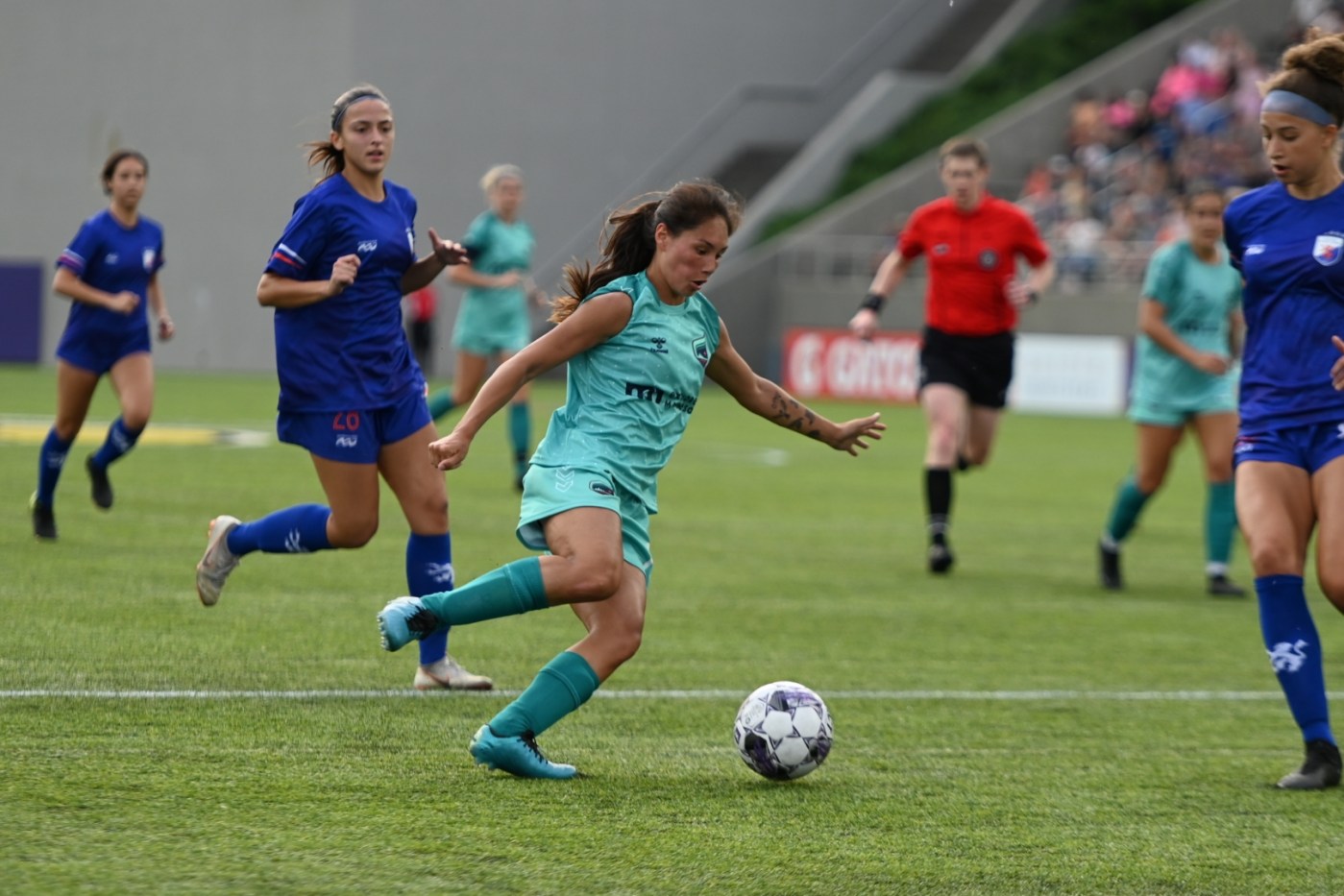
Minnesota Aurora blows out Chicago Dutch Lions 8-0 to start 2024 season

posted in: News | 0

Minnesota Aurora picked up right where it left off in the USL W League regular season on Thursday.

The amateur women’s soccer club blitzed the Chicago Dutch Lions in a 8-0 road win in Aurora, Ill. Aurora was undefeated in 2022 and ’23 regular seasons and remained unblemished to begin this year.

Aurora led 2-0 at halftime and then scored four goals in 15 minutes to open up the second half.

“They did what we asked them to do at halftime, which was to bring creativity, a way to unblock a road block, and find different ways to challenge the players,” head coach Colette Montgomery said in a news release. “Tess (Werts) did a phenomenal job, along with the entire squad tonight.”

Aurora will play River Light FC on Saturday before ether home opener against RKC Third Coast at TCO Stadium in Eagan on May 30.

Related Articles

Minnesota United FC |


Minnesota Aurora putting together another NWSL expansion bid

Minnesota United FC |


Minnesota Aurora begins era with new coach but same high standards

Minnesota redistricting process will count inmates at home addresses, instead of prison locations

posted in: Politics | 0

Minnesota has joined a growing list of states that plan to count prisoners at their home addresses instead of at the prisons they’re located when drawing new political districts.

Minnesota Gov. Tim Walz last week signed legislation that says last known addresses will be used for counting inmates, not the federal or state correctional facilities where they are housed. Prisoners whose last address is out of state or whose address is unknown would be excluded from the redistricting process, though they would be counted as part of Minnesota’s population total, according to the new law signed by the Democratic governor.

Eighteen states already have made similar changes to how prisoners are counted during the once-a-decade census. Most, but not all of the states, are controlled by Democrats and have large urban centers.

Although the U.S. Census Bureau has counted inmates as prison residents since 1850, states control redistricting and can move those populations to their home counties for that purpose or not include inmates at all when maps are drawn.

Advocates for the changes have argued that counting prisoners at their institutions shifts resources from traditionally liberal urban centers — home to many inmates who are disproportionately black and Hispanic — to rural, white, Republican-leaning areas where prisons are usually located.

Opponents, however, argue that towns with prisons need federal money for the additional costs they bring, such as medical care, law enforcement and road maintenance.

Population data collected from the census are used to carve out new political districts at the federal, state and local levels during the redistricting process every 10 years.

Related Articles

Politics |


MN Legislature: Measure to speed up cannabis dispensaries passed, but GOP lawmaker has questions

Politics |


Hastings seeks PFAS funding after Legislature sinks bonding bill. But why isn’t 3M paying?

Politics |


Medical aid in dying bill didn’t cross finish line this MN Legislature session

Politics |


Jennifer Huddleston: AI and privacy rules meant for Big Tech could hurt small businesses most

Politics |


Bruce Corrie: We have a distinct opportunity in downtown St. Paul

Saints walk their way to a win in Game 1 in Buffalo before loss in second game

posted in: News | 0

After weather cut Wednesday’s game short in the third inning, the St. Paul Saints and Buffalo Bisons returned to the field on Thursday for 16 innings, starting with a resumption of Wednesday’s game.

Buffalo pitchers might have rather not resumed the game at all.

The Bisons walked 15 St. Paul batters for the game — a Saints’ franchise record — in an 18-3 win in Thursday’s first game. Buffalo had a better time of it in the second game, winning 5-1 in the regularly scheduled game.

The score was 3-1 when the rain halted play in the top of the third inning on Wednesday, the Saints playing from in front on a three-run homer by Tony Kemp. Buffalo scored once before the rain and then added another run in the third a day later. It was all St. Paul from there.

The Saints scored four times in the fourth. DaShawn Keirsey Jr. had an RBI single, Austin Martin and Chris Williams both walked with the bases loaded and Will Holland plated another run when he was hit by a pitch with the bases loaded.

In the seventh, Matt Wallner scored a run with a sacrifice fly and Yunior Severino had an RBI single. Keirsey added an two-run double in the eighth before St. Paul poured it on with seven runs in the ninth. Diego A. Castillo had an RBI double, Keirsey and Wallner had RBI singles and Severino finished it off with a grand slam, his seventh homer of the season.

The offensive outburst, and walks, made a winner of reliever Scott Blewett (2-2), who pitched three scoreless innings on Thursday. Keirsey had four hits, four RBIs, three runs scored and a stolen base. Severino had four hits and five RBIs, while Martin walked five times.

St. Paul might have used up its offense for the day.

In the second game, the Saints only scored on Patrick Winkel’s solo homer in the second and totaled five hits, two from Michael Helman.

Adam Plutko (0-1) started the game for St. Paul, giving up three runs on three hits and a walk in 2 1/3 innings. Martin walked two more times in the second game.

Related Articles

Minnesota Twins |


Holland, Martin homer as Saints start road trip with 3-1 win in Buffalo

Minnesota Twins |


Saints split a pair of 4-2 games with Omaha after Friday postponement

Minnesota Twins |


Saints fall to Storm Chasers in 11 after late collapse

Minnesota Twins |


St. Paul Saints strike out 12 times in 6-0 loss to Omaha Storm Chasers

Minnesota Twins |


Saints’ offense rolls over Omaha

Opinion: Free NYC’s Block Parties from Suffocating Red Tape

posted in: News | 0

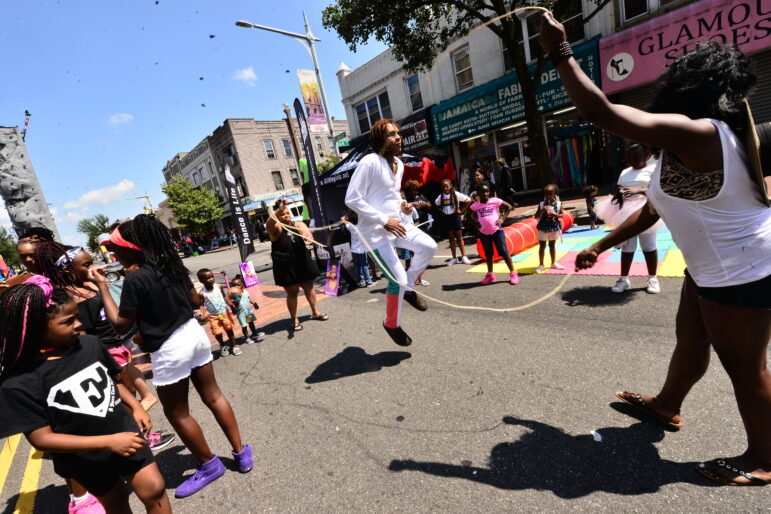
“As warm weather returns and the summer approaches, we are reminded that the streets, sidewalks, parks, and plazas of New York City are our civic commons. New Yorkers should be able to dance in the streets, sidewalks, and curbs if they want to.”

Courtesy of the authors

CityViews are readers’ opinions, not those of City Limits. Add your voice today!

Block parties are an iconic New York City experience. They bring communities together, give kids space to run and play—they even birthed hip hop! Yet, New York City has made it so difficult to get a permit that it is now nearly impossible to plan one. You need to apply at least two months in advance with no option for a rain date, all just to close one block for half a day. This is just one of the many types of simple public space activations where bureaucratic red tape makes it unbearably challenging for community groups when they want to utilize a street or a public plaza.

As warm weather returns and the summer approaches, we are reminded that the streets, sidewalks, parks, and plazas of New York City are our civic commons. New Yorkers should be able to dance in the streets, sidewalks, and curbs if they want to. Yet for most New Yorkers, these communal spaces outside our doors remain frustratingly unavailable and inaccessible, hidden deep inside a maze of paperwork. New York City needs to reform its permitting process so that it works for, not against, community members who want to organize activities in public spaces.  

Many of the permitting rules for public spaces have not been updated in decades and no longer reflect how New Yorkers want to use them today. The same time-antiquated, onerous process also applies to the liability requirements for public events. A simple meetup to play the board game Jenga requires 34th Avenue Open Street in Queens to have the same million-dollar insurance coverage as a large one-off dance performance with a stage and speakers. Even if the Jenga meetup is happening regularly, organizers must submit individual applications for each event, making planning routine events like that astoundingly time-consuming. Sometimes, Open Street organizers don’t even know if their events are approved by the city until the day before.

There are reforms that would improve this street permitting process. The city should create a single portal that provides access to all street activity permit types. There should be a permit type that covers a series of regularly scheduled events to reflect the new reality of Open Streets, and integrated activations that are popping up in neighborhoods all over the city. The city should work to develop a sliding scale of liability based on the intensity of activation.

Reforming street permits is not just a simple matter of access, but also of social equity. In neighborhoods where there are no Business Improvement Districts (BIDs), seasoned legacy organizations, or parks conservancies, the burden of applying for these permits falls on volunteer community members. These are the people who are already providing the critical work of raising funds, arranging activities, and providing maintenance services necessary for a successful event. Many communities simply do not have the time or resources necessary to also cut through the bureaucratic jungle laid in front of them.

Mayor Eric Adams campaigned on public realm improvements and his administration often champion major capital projects, like the Kimlau Plaza redesign, aimed at transforming commercial and tourism hubs, and the new people-centered amenities in the Flatiron District as part of the Broadway Vision Plan. These marquee projects have shown, on a grand scale, what’s possible for our public realm, and New Yorkers love them.

It is time to give New Yorkers, in all boroughs and all neighborhoods, more control over their public spaces. Permit reform is the next step in creating more equitable, accessible, and activated public spaces. It’s time to cut the red tape and let the block parties flourish.

Burdensome permitting policies are just one aspect of the public realm status quo that has many New Yorkers burnt out. Let’s make this year one of excitement for both the participants and stewards of our precious public realm by making it easier to make fun events happen!  

Jackson Chabot is director of advocacy and organizing at Open Plans. Elana Ehrenberg is director of strategic partnerships at Design Trust for Public Space. Rebecca Macklis is senior manager of strategic initiatives at the Municipal Art Society of New York. They are members of The Alliance for Public Space Leadership, a partnership committed to improving the state of the public realm for all New Yorkers.