Last August, Dallas business consultant Lance Wallnau addressed the “Awaken the Sleeper” conference at Vida Church in Mesa, Arizona. Dressed business casual and speaking off-the-cuff in a lively style that mixed humor with right-wing, anti-media vitriol, he spoke for nearly an hour about a coming “global economic meltdown,” the evils of the left, and how Christians should respond.
“I can’t help prophetically wanting to tell you the future,” he said. Because U.S. Christians have been too politically disengaged, he warned, “The entire system will be taken over by a horned entity that will put its arms around the church and the economy and squeeze it into compliance,” including “locking up the preachers.”
Wallnau’s Youtube show (which aired an excerpt from the Mesa talk) has about 64,000 subscribers. His fellow North Texan and self-described prophet Cindy Jacobs once attributed the 2011 tsunami that devastated the Fukushima nuclear plant in Japan, along with an earlier mass death of birds in Arkansas, to the Obama administration’s repeal of Don’t Ask, Don’t Tell.
Some readers—Christian and non-Christian—may be tempted to write off such comments as mere fundamentalist nonsense. That would be a mistake. Texans like Wallnau and Jacobs, who take the titles “apostle” and “prophet,” are quite serious. And their version of Christianity, which an early leader named the New Apostolic Reformation (NAR) in the 1990s, is growing in nationwide religious and political influence—becoming, as two experts have deemed it, “one of the most important Christian religious and political movements of our time.”
Despite its name, the NAR isn’t all that new: A 2011 Texas Observer story revealed its ties to then-Governor Rick Perry. But it’s recently drawn attention, nationally and in Texas, reflecting its growth in the Christian landscape and the close ties of some NAR leaders to ex-President Donald Trump and other GOP luminaries. It’s also drawn criticism, even in evangelical circles.
The NAR has deep roots in the Lone Star State, which is home to three of its leading “prophets”: Wallnau, Jacobs, and Corinth minister Chuck Pierce. (Specifically, all three hang their hats in Dallas-Fort Worth, the sprawling metro area that has spawned more than its fair share of extremists.) They “are among the most influential and politically important” of the “hundreds of apostles and prophets in the U.S.,” said Frederick Clarkson, senior research analyst at Political Research Associates, a progressive think tank in Massachusetts. Their prophecies and teachings illuminate the NAR worldview and its politics—and indicate why we should be concerned about the “reformation” this movement seeks.
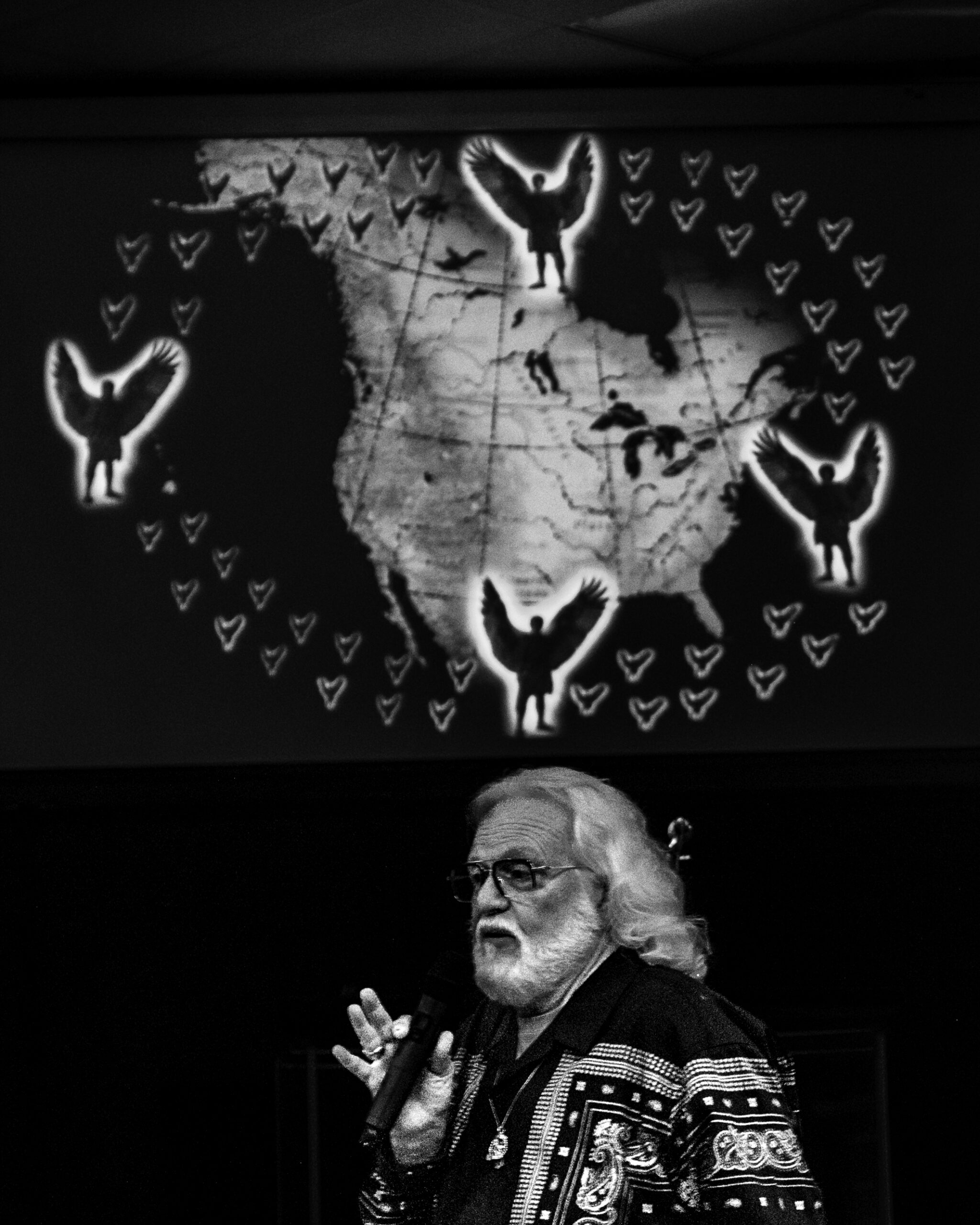
The word “prophet” might bring to mind a Gandalf-like figure: long white beard, eyes that see into the spirit realm, etc. These Texas prophets don’t much resemble that image. Wallnau looks like the business consultant he is. Jacobs presents the image of a suburban grandmother: pantsuits, hair in a pixie cut. With his long white hair and beard, Pierce might come closest to that Gandalf image, but given that he favors jeans and flowered shirts, he looks more like the Grateful Dead’s Jerry Garcia (latter-era) than an ancient Hebrew oracle.
Pierce speaks at the Worship at the Border event.
All three are prominent members of what The Atlantic has described as “a sprawling ecosystem of leaders who call themselves apostles and prophets and claim to receive direct revelations from God.” This “ecosystem” includes “global prayer networks, streaming broadcasts, books, podcasts, apps, social-media influencers, and revival tours.”
According to historian Brian C. Sears, the number of NAR adherents in the United States might be as high as 33 million—or it may be “only a fraction of that figure.” Regardless, Sears writes, the NAR in recent decades “grew faster than any group within or on the periphery of American Christianity, laying claim to significant religious and political power.”
The social media following of our three North Texas prophets suggests their reach: Jacobs has 358 thousand Facebook followers; Pierce, over 367 thousand; and Wallnau, around 1 million.
The NAR grew out of the Pentecostal and charismatic strains in evangelical Christianity, movements which call for a “baptism in the Holy Spirit” that is followed by supernatural gifts, including speaking in tongues and faith healing.
The NAR, however, isn’t your parents’ Pentecostalism. Most Pentecostal congregations, like Protestants generally, are led by pastors or evangelists, often affiliated with denominations and accountable to denominational standards. The NAR, on the other hand, is led by mutually recognized apostles and prophets, roles mentioned in some New Testament texts but largely absent (at least as formal offices) in most of Christianity. In NAR culture, apostles exercise authority over individual leaders and churches; prophets, as Concordia University professor André Gagné writes in his book American Evangelicals for Trump, are “recipients of a particular inspiration of the Holy Spirit.” As NAR critics Holly Pivec and Doug Geivett put it: NAR apostles and prophets “claim to bring new revelation the church needs to advance God’s kingdom.”
“Prophecy,” Pierce has written in a book titled The Passover Prophecies, “is speaking the mind and heart of God as revealed by the Holy Spirit. … It is what Jesus is saying to His Church.”
What Jesus is (allegedly) saying through Pierce, however, is sometimes—at least to a mainline Protestant outsider like myself—head-scratchingly inscrutable. For instance, in 2022, Pierce prophesied: “In the season ahead, our prayer lives will become more authoritative. What will happen once you pray is that [the] Holy Spirit will bring down certain judgments and start dealing with injustices. … Do not be over-merciful and back down.”
Often, far clearer than our three Texans’ theology is their political message—which is emphatically right-wing.
Essentially, the NAR is Christian nationalism on steroids. As I’ve written elsewhere, Christian nationalists contend (on very sketchy grounds) that the Founding Fathers intended America to be a Christian nation governed by Bible-based laws. Liberals and secularists, they argue, have diverted the nation from that intent, and Christianity—typically, evangelical Christianity—should “once again” determine our laws. Like Christian nationalists, NAR leaders seek to establish evangelical Christian dominance over government.
The difference is that many NAR figures depict political opponents as tools of demonic forces working to stop the spread of God’s Kingdom. For the NAR, the battle is not just over the Founders’ intent; it’s a cosmic battle between Good and Evil—a battle that plays out at the levels of the individual, the nation, and the globe.
Pierce is probably the least overtly political of our three Texas prophets. “I am not politically motivated in the prophetic realm,” Pierce told the Observer by email. “A true prophetic voice doesn’t prophesy based on political leanings. … I pray for all of those who serve in authority.
“I have only encouraged people to vote and support their community by voting how their conscience leads them,” he added. (Jacobs and Wallnau did not respond to Observer requests for comment for this article.)
Participants at the Worship at the Border event
Yet Pierce’s spiritual diagnosis of America’s problems echoes familiar right-wing complaints. He writes that a lack of “godly leaders,” an active church, and “biblically based governmental and economic principles” have allowed “the enemy”—Satan, presumably—“to wreak havoc. … The entire territory then falls under the darkness of his presences, and demonic hosts redirect those in that territory away from God’s plan of fullness, peace, joy, and abundance.”
How has “the enemy” achieved this domination? In a 2016 book, Pierce and co-author Rebecca Wagner Sytsema cite longtime conservative Christian bugbears ranging from lack of prayer in schools to legal abortion. “We’ve allowed a small minority to determine what is acceptable in society, such as same-sex marriages and allowing those couples to adopt children,” they write. “Now God wants back what is His, and He is looking to us to go get it. … It is time for a breakout.”
For NAR leaders, the “breakout” entails like-minded Christians taking dominion over the so-called seven “mountains” that mold a nation’s culture, a teaching that Wallnau popularized. The so-called Seven Mountains Mandate, Clarkson and Gagné have written, “divides the world of cultural power and influence that Christians are to conquer into seven categories: religion, family, government, education, business, media, and arts & entertainment.”
The aim is not just to control U.S. government and culture. It’s to trigger the second coming of Christ and the millennial kingdom of God (about which Christians have disagreed vigorously for centuries). For the NAR, Sears writes: “Key to the inauguration of Christ’s thousand-year reign on earth is the belief that apostles will have risen in power to control or influence the leaders of the seven spheres of society.”
In 2016, NAR leaders found an unlikely instrument of evangelical dominion in Donald Trump.
“NAR support for candidate Trump coalesced more quickly than did support from wider evangelicalism,” Sears notes. Wallnau and Jacobs were early backers of Trump during both his 2016 campaign and his presidency.
Wallnau issued prophecies in 2016 that gave evangelicals a way to look past Trump’s sketchy religious convictions and quite public moral failings. After first hearing Trump speak in 2015, Wallnau said he “heard the Lord say: ‘Donald Trump is a wrecking ball to the spirit of political correctness,’” leading him to wonder “whether Trump could be ‘the unpredictable instrument of God.’” After meeting Trump later that year, Wallnau received another “unexpected download” from God, directing him to Isaiah 45, which discusses how the Persian king Cyrus, though not a believer in the Jewish God, was anointed by that God to deliver the Jews from exile and restore their temple. For Wallnau, this “download” indicated that God was giving Trump “a Cyrus anointing.” The upshot: Trump didn’t need to be personally evangelical, or even morally upstanding, to be God’s agent.
Jacobs was also an early Trump supporter. In a 2017 interview, she said she organized 10,000 people in a prayer walk for Trump in swing states. “There’s no way [Trump] could have been elected if it wasn’t supernatural,” she insisted.
After Trump’s inauguration, Jacobs suggested that Trump’s rhetoric and agenda were divinely blessed. In an appearance on televangelist Jim Bakker’s program, she implied that God approved Trump’s “drain the swamp” rhetoric, saying God gave her a vision of a “swamp” being drained replete with “alligators and … snakes and everything … all fighting each other.” The Holy Spirit also revealed that there were “many moles in … the FBI, many of the agencies,” and told her “to pray that every mole is exposed.”
Jacobs’ comments illustrate Gagné’s observation that NAR references to “demonic networks” are not purely spiritual but are “also ways of referring to … Trump’s enemies: the mainstream media, the ‘Deep State,’ and the Democrats.”
A perennial problem with prophesying the future is that the future sometimes fails to cooperate. In 2020, the NAR movement suffered a crisis when several high-profile figures prophesied Trump’s reelection and were proved wrong. While a few prophets apologized, some doubled down, insisting that Trump had been reelected and God would vindicate him. Our three prophets avoided this scandal: All said they had not received clear indications from the Holy Spirit concerning Trump’s reelection.
“Spiritual warfare theology lead[s] to the demonization of peoples, cultures, and political communities.”
So far, none of our three Texas prophets seems to have promised a Trump win this November. But Wallnau has certainly used his Youtube show to push anti-Biden talking points, calling the administration’s border policies “evidence that America has lost its capacity for self-government” and claiming that the spirit of the biblical monster Leviathan is working “through media and the Democratic Party … to divide America into categories that will go to war with each other.”
As Gagné told the Observer: “Wallnau is the best example of what the NAR is all about. … [And he’s] visiting swing states and targeting specific counties that he believes will make the difference for Trump’s re-election in November.”
Despite its astounding growth and political reach, the NAR remains controversial even within evangelical and Pentecostal circles.
Especially pointed criticism has come from the world’s largest Pentecostal denomination, the Assemblies of God (AG), which claims more than 3 million adherents in the United States. A 2010 AG position paper on “The Kingdom of God” effectively rejects NAR dominionism: “The kingdom of God is not the blueprint for a radical cultural change based on some carnal theocratic or revolutionary agenda. Instead, it radically changes human personalities and lives.” In a 2000 position paper, AG leaders warned that NAR apostles and prophets can “become dictatorial, presumptuous, and carnal while claiming to be more biblical” than traditionally structured denominations like the AG.
Even some major NAR figures have distanced themselves from positions taken by their fellow apostles and prophets. A 2022 statement, signed by more than 60 leading NAR-linked Pentecostal figures, rejected “the belief that ‘new revelation’ is essential for the life and growth of the Church or that contemporary apostles or prophets are the only ones privy to such ‘new revelation.’” The statement also rejected any calls for a “potential Christian uprising against the government or hints at the use of force to advance God’s kingdom.” The statement warned against “marry[ing] the cause of Christ to the cause of a political party (or leader),” instead advocating “Christ-like engagement in every sphere of society.”
Jacobs, Pierce, and Wallnau have not signed on to the statement.
So, what should we make of our three Texas prophets?
As a religion scholar, I regularly encounter reports of mystical experience, divine revelation, spirit journeys, miraculous healings, and the like. Some are, from my perspective, difficult to believe. Yet that’s insufficient reason to write them off. Such phenomena form the bedrock of the world’s great religions; to dismiss them out of hand is to dismiss the worldviews of billions of people.
“God wants back what is His, and He is looking to us to go get it.”
I have no reason to doubt that Jacobs, Pierce, and Wallnau believe they have received divine “downloads”—even if those alleged revelations make little sense to me or contradict what I understand it means to be a faithful Christian. Needless to say, they have as much right to their political convictions as you or I.
But the danger lies in their claims that their side has divine authority while their opponents are the tools of literal demons. As Gagné writes, the NAR’s “spiritual warfare theology … lead[s] to the demonization of peoples, cultures, and political communities.”
Many of us who are not NAR adherents—Christian and non-Christian alike—may find in today’s politics something “demonic,” if only in a metaphorical sense. But we find it in very different places than do these prophets: in some politicians’ vigorous embrace of autocracy; in the vilification of migrants; in the relentless efforts to take away hard-won rights from women, the LGBTQ+ community, and people of color; in the shameless use of public office for self-enrichment; and in the exploitation of religion for political gain.
Of course, there is nothing supernatural about those evils. They’re just the latest examples in a long, sad history of human iniquity. However sincere they may be, I worry that NAR prophets and followers are wrapping the perpetrators of such evils in a cloak of divine legitimacy. This, too, has happened repeatedly in human history (think of the Crusades or Manifest Destiny).
At this juncture in the American experiment, with our democracy strained to the breaking point, the perils are greater than ever. I, for one, can’t claim to see the future—or to draw my views from much other than my own faith and fallible instincts—but, as we move into yet another fateful election season, I’d say that the NAR and its myriad prophets bear close watching.