You’ve got to love a country drive called the “Fruit Loop.”
This popular weekend road trip in Oregon’s orchard and vineyard-packed Hood River Valley, about 60 miles east of Portland, explores the broad base of Mount Hood just south of the mighty Columbia River Gorge. It’s a wonderfully scenic spot with views of two snowcapped volcanoes, Oregon’s Mount Hood and Washington’s Mount Adams. The fertile soils found at the base of Mount Hood and rarefied, glacier-fed water sources create a lush growing environment, and the valley abounds with grapevines and apple, pear and cherry trees — a landscape that’s as pretty as the signage on a vintage fruit crate.
Anchoring the Hood River Valley is the charming former timber town of Hood River, regarded as one of the top windsurfing and kiteboarding hot spots in the world. It’s also a burgeoning foodie destination for Pacific Northwest travelers, who come here to savor meals crafted from fresh locally-produced ingredients.
I explored the Hood River region with my family last summer, with a scenic riverside lodge as home base. For four days, we enjoyed nearly nonstop recreation, eating, drinking, sightseeing and fruit-picking fun.
The “Fruit Loop” trail in Oregon’s Hood River Valley includes Mountain View Orchards, which is known for its lush stonefruit. (Ben Davidson Photography)
Getting to Hood River from Portland was half the adventure. Landing at Portland International airport after an easy flight from SFO, we picked up a rental car and headed east into the scenic Columbia River Gorge on Interstate 84.
Our first stop was lunch at the charming Sugarpine Drive-In, a casual eatery in a renovated 1920s gas station set along the banks of the Sandy River in Troutdale, just outside Portland. The walk-up or drive-up patiocafé offers salads, cans of Buoy pilsner and Underwood wine, frosé (frozen rosé slushies) and a lineup of sandwiches that included a waffle grilled cheese. The star attraction is the soft serve ice cream — milk- or plant-based — in cones or their signature sundaes.
Continuing east up the gorge, we took in lush forest and river views, passed double-tiered Multnomah Falls — one of 70 waterfalls in the area — and exited the interstate four miles west of the town of Cascade Locks to visit the Bradford Island visitor center of the Bonneville Dam.
From the visitor center’s outdoor platform, visitors can watch the spectacle of salmon and other fish swimming up a fish ladder — steelhead and sockeye salmon in early summer and chinook and coho salmon in September. Up to 250,000 fish pass through the ladders each day during high season, which runs from August to November. You’ll also learn about how the Columbia River produces more hydropower than any North American river — five billion kilowatts of electricity each year, providing power for 80 percent of the Pacific Northwest.
Run by members of the Confederated Tribes of the Umatilla Indian Reservation in Oregon’s Cascade Locks, Brigham Fish Market specializes in smoked salmon and other wild, native-caught fish from the Columbia River. (Ben Davidson Photography)
We indulged in plenty of sockeye spectating before heading for Cascade Locks to buy packets of smoked salmon at the Brigham Fish Market. Run by members of the Confederated Tribes of the Umatilla Indian Reservation, the market specializes in wild, native-caught fish from the Columbia River: spring salmon and sturgeon in spring; summer chinook, sockeye and steelhead in summer; and fall chinook, coho and steelhead in autumn.
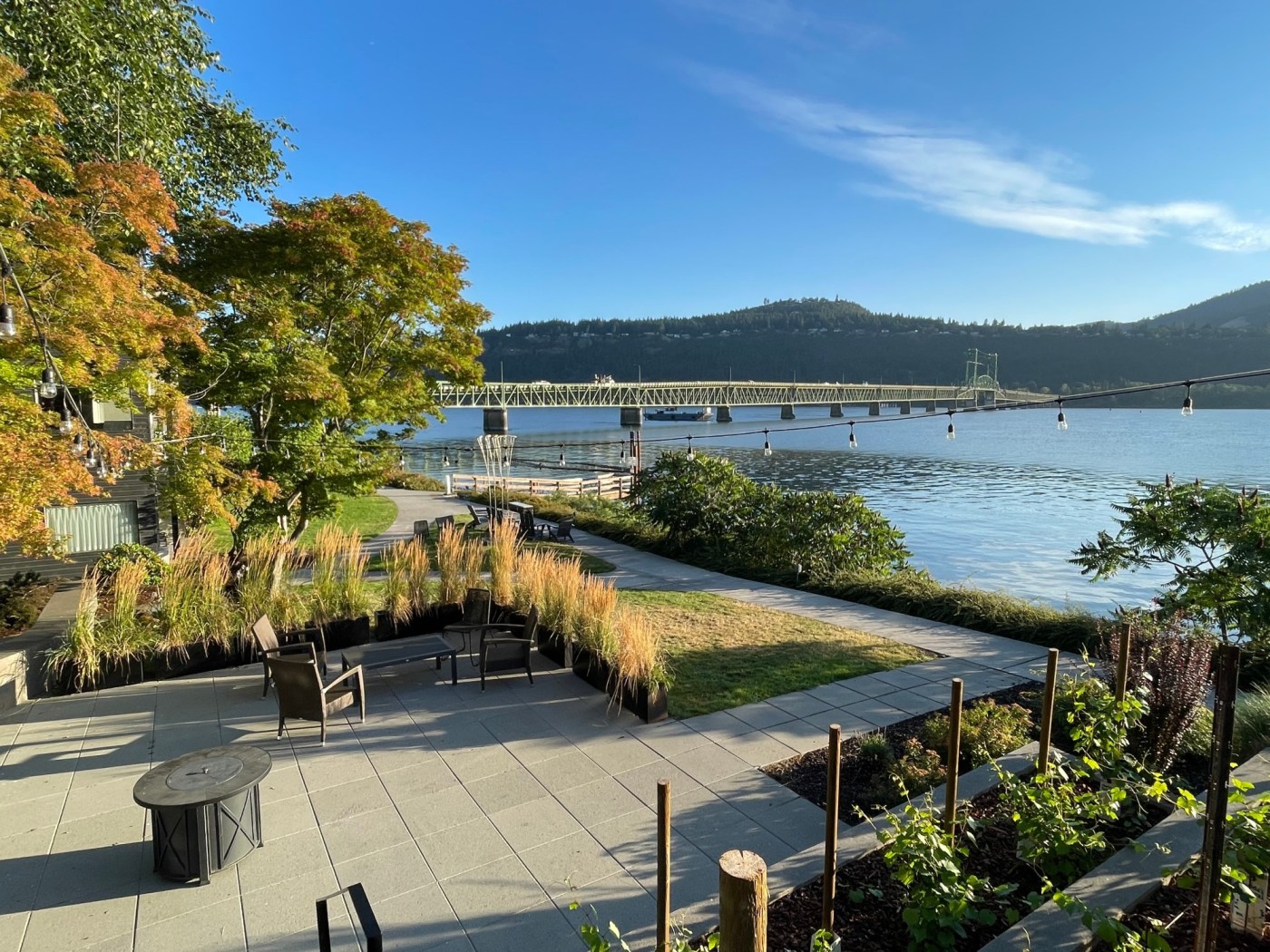
It was late afternoon when we arrived in the charming town of Hood River. With its historic buildings and a downtown lined with galleries, restaurants and pubs, it’s a perfect hub for full immersion in Pacific Northwest living. Our lodge, the Hood River Inn, provided a comfy river view room perched right above the water’s edge, with excellent breakfasts served on a broad deck overlooking the Columbia River Gorge.
Oregon’s Hood River Inn offers waterfront lodging in the town of Hood River in the Columbia River Gorge. (Ben Davidson Photography)
The Fruit Loop
There are some 35 miles of scenic country roads to explore in the Hood River Valley, whose rich agricultural heritage goes back to 1855, when the first fruit trees were planted. Today, there are 14,500 acres of pear, apple and cherry orchards covering the valley floor. The valley grows more d’Anjou pears than anywhere in the world.
You’ll find several dozen farmstands selling freshly picked fruit, produce, jams, syrups and honey. U-pick orchards offer apples, pears, strawberries, cherries, blueberries, peaches and pluots — and even lavender at one farm. Wineries, breweries and cideries round out the options.
A must-do first stop is Pearl’s Place Fruit Stand, just three miles south of Hood River on Highway 35. The stand carries local apples, pears and cherries — including coveted Rainier cherries — plus peaches, berries nectarines,plums and more. Pearl’s also carries handcrafted baskets, local wild honey, Oregon-grown hazelnuts, dried fruit snacks. U-pick strawberries are available from July through September and apples from August through October.
Housed in a historic 1940s-era factory, the Fruit Company has fascinating exhibits on the valley’s agricultural history. You can certainly drive here, but it’s far more fun to take the historic Hood River Railway or a railbike excursion. Be sure to check out the Fruit Company’s orchard tours in an open-air shuttle.
Traipse along the Hood River Valley’s “Fruit Loop” trail via car or take a ride aboard the historic Hood River Railway or one of its railbikes. (Ben Davidson Photography)
July is the peak of cherry season, and local favorite u-pick orchards include Kiyokawa Family Orchards, Packer Orchards and Draper Girls Country Farm. The largest u-pick orchard in the Hood River Valley, Kiyokawa Family Orchards dates back to 1911. The orchards offer breathtaking views of Mount Hood and plenty of picnicking possibilities as well as, of course, apples, cherries, pears and Asian pears. Kids love the play area, and the fruit stand offers award-winning pies, turnovers, local honey, jams and fresh cider.
Sips and shops
There’s no shortage of vineyards producing top notch wines here. The tasting room at the Grateful Vineyard offers pours from its boutique winery, craft cidery and microbrewery. The southernmost vineyard in theColumbia Gorge AVA, their specialty is high-elevation sparkling wine.
Marchesi is one of Hood River’s premier wineries, with exceptional Italian varietals, including barbera, dolcetto, pinot nero and pinot grigio. Vintner Franco Marchesi produces award-winning wines reminiscent of those produced in his birthplace in Northern Italy’s Piemonte.
The Gorge White House is situated in a beautiful 1908 Dutch Colonial home in the heart of the Hood River Valley. A part of Hood River’s booming hard cider scene, the beer and cider tasting room offers the family farm’s award-winning apple-pear, blueberry and perry — made with pears — hard ciders. The Gorge White House also offers u-pick flowers, fruit and a food truck serving delicious farm-to-table pizzas and sandwiches.
And Apple Valley Country Store has freshly baked desserts and more than 50 housemade jams, jellies and syrups. The shop also offers a wide variety of local foods and handmade products — we picked up a lovely quilted trivet by Hood River-based artist Rhonda Harris.
Hood River bites
Sixth Street Bistro’s farm-to-table pub menu focuses on local producers and ingredients, many of them grown organically in the Columbia Gorge or greater Pacific Northwest. The wine list includes many Columbia Gorge wine producers, and the bar’s 12 taps offer some of the best Oregon and Washington beer and cider.
Hood River’s original brewery, Full Sail Brewing is perched on a bluff overlooking an epic wind and kitesurfing scene. Enjoy their handcrafted brews, which kicked off Hood River’s huge brewery scene, and pub food on the outdoor patio. It’s elevated pub fare — burgers with Tillamook cheddar and housemade bacon jam, salmon fish and chips, and mac and cheese made with Gouda, roasted garlic and artichoke hearts. And free, guided brewery tours are offered daily at 1, 2, 3 and 4 p.m.
Ferment Brewing is the newest kid on the local beer scene. This taproom enjoys a scenic second story space on the Hood River waterfront. They pair their handcrafted beers and kombuchas with food that features local ingredients and housemade fermented condiments including kraut, pickles and kimchi ranch.
The fun, waterfront Solstice Wood Fire Cafe delivers river views alongside its creative wood-fired pizzas. The Siragusa Pear pizza, for example, is topped with local pears, blue cheese and caramelized onions, while the popular Country Girl boasts local cherries and housemade chorizo, and the Yakima pairs Northwest asparagus with prosciutto and goat cheese.
Oregon’s pFriem Family Brewers is known for its award-winning beer and pub fare inspired by its Hood River Valley setting. (Ben Davidson Photography)
PFriem Family Brewers — pronounced freem — is a Northwest- and Belgian-inspired 15-barrel brewery, restaurant and tasting room. Founded in 2012, the brewery has racked up medals at the World Beer Cup and Great American Beer Festival. And the pub fare ranges from PNW mussels with a kimchi vinaigrette to a pulled pork sandwich made with lager-braised pork shoulder, gochujang barbecue sauce and Blue Bus Kraut-chi.
And Riverside, at the Hood River Inn hotel, is known by locals as a small farm business incubator whose cultivated relationships with local farmers, creameries, vintners, brewers, fermenters and fishers creates dynamic dishes.
Getting outdoors
One of the top sports towns in the nation, Hood River attracts wind and watersport enthusiasts, road and mountain bikers, fishers, campers, hikers and whitewater kayakers — and there’s plenty of choices for active, outdoor fun.
My daughter and I settled on a three-hour Twin Tunnels e-bike ride with Hood River-based Sol Rides. The highlight of this guided tour through the Columbia River Gorge and Hood River Valley was the gorgeous view along a car-free section of the Historic Columbia River Highway State Trail between the towns of Hood River and Mosier.
The Hood River Inn patio and waterfront walkway offer expansive views. (Ben Davidson Photography)
Prefer waterfalls? The Columbia River Gorge is famous for its dramatic, lofty waterfalls. A great way to see these cascades without the hassle of driving is to join the Sasquatch Shuttle. The two-hour narrated van tour includes stops at six attractions, including Latourell Falls, Horsetail Falls and Multnomah Falls, where you can hike up to a viewing platform midway up. (Chances of Sasquatch sightings, though, are slim.)
If You Go
PLAY
Bonneville Dam: Entry to the dam is free. Open from 9 a.m. to 5 p.m. daily on Bradford Island; www.nwp.usace.army.mil/bonneville/.
Hood River Fruit Loop: A convenient website — hoodriverfruitloop.com — and print-your-own guide outline many of the farmstand locations and valley events.
Traipse along the Hood River Valley’s “Fruit Loop” trail via car or take a ride aboard the historic Hood River Railway or one of its railbikes. (Ben Davidson Photography)
Apple Valley Country Store: Hours vary by season and staffing, but the store is typically open from 9 a.m. to 6 p.m. daily from June through October at 2363 Tucker Road in Hood River; applevalleystore.com.
The Fruit Company: Reserve your tickets ahead, then hop aboard the Mount Hood Railroad ($27-$67) or a railbike ($199 for two people) at 110 Railroad Ave.; www.mthoodrr.com. The Fruit Company Museum is at 2850 Van Horn in Hood River;www.thefruitcompany.com.
Kiyokawa Family Orchards: The orchards are open from 9 a.m. to 5 p.m. on weekends from July 6 through Aug. 18; 10 a.m. to 4 p.m. weekdays and 9 a.m. to 5 p.m. weekends from Aug. 23 through Nov. 3; and 10 a.m. to 4 p.m. daily from Nov. 4 to 24. 5625 Hutson Road, Parkdale; https://kiyokawafamilyorchards.com
Pearl’s Place Fruit Stand: Open for the season from 9 a.m. to 6 p.m. on weekends at 1860 Highway 35, Hood River; https://pearlsplacefruit.com/.
Sasquatch Shuttle: The waterfall loop ($25-$35) runs twice a day; sasquatchshuttle.com.
Sol Rides: This tour company offers a Twin Tunnels & Beyond ($89) tour that departs at 9:30 a.m. daily from Sol Rides headquarters at 13A Oak St. in Hood River. Find details on its bike rentals and cycling and winery tours at solrides.com.
SLEEP
Hood River Inn: Rooms at this Best Western Plus property at 1108 East Marina Way in Hood River, start at $223; https://hoodriverinn.com. The hotel’s Riverside restaurant is open for breakfast, lunch and dinner daily; riversidehoodriver.com.
EAT & DRINK
Brigham Fish Market: Open from 11 a.m. to 5:30 p.m. Monday-Thursday and 10 a.m. to 6 p.m. Friday-Sunday at 681 WaNaPa St. in Cascade Locks; http://brighamfish.com/.
Ferment Brewing: Open from 11 a.m. to 9 p.m. weekdays and 10 a.m. to 9 p.m. weekends at 403 Portway Ave. in Hood River; fermentbrewing.com.
Full Sail Brewing: Open daily from 11 a.m. to 9 p.m. at 506 Columbia St. in Hood River; fullsailbrewing.com.
Gorge White House: The tasting room is open seasonally — from 10 a.m. to 7 p.m. Thursday-Monday during the summer, for example, with limited hours in the fall. Closed December-February. 2265 Highway 35 in Hood River; thegorgewhitehouse.com
Grateful Vineyards: Open daily from noon to 6 p.m. at 6670 Trout Creek Ridge Road in Mt. Hood. Make reservations at gratefulvineyards.com.
Marchesi Vineyards: Open daily from 11 a.m. to 6 p.m. at 3955 Belmont Drive in Hood River; marchesivineyards.com.
pFriem Family Brewers: Open daily from 11 a.m. to 9 p.m. at 707 Portway Ave., Suite 101, in Hood River; pfriembeer.com.
Sixth Street Bistro: Open from noon to 8 p.m. Friday-Monday at 509 Cascade Ave. in Hood River; sixthstreetbistro.com.
Solstice: Open for lunch and dinner daily, except Tuesdays, at 501 Portway Ave., Hood River; solsticehoodriver.com.
Sugar Pine Drive-In: Open from 11 a.m. to 5 p.m. Thursday-Monday at 1208 E. Historical Columbia River Highway in Troutdale, Oregon; sugarpinedrivein.com.