Readers and writers: Minnesotan’s new collection of stories tackles climate change in imaginative ways

posted in: News | 0

I also underwent counseling during which I was told about this lunacy specific to the Iqaluit run, which manifested itself as hallucinations — even mass hysteria — featuring one common theme: the bears speak. Not in husky-like complaints but in English, with clear diction and a slight but very strange accent. I was shown film of exit interviews given by the crew of the infamous Marigold immediately after they landed at Ushuaia, conducted in a secure facility. The crew maintained that not only did the bears communicate in English, several bears had acted as Able Seamen, capable of performing routine duties, such as taking on lookout shifts and anchor watch. –– from “Honeymoons in Temporary Locations”

Ashley Shelby’s cat Greta approves of the cover of Shelby’s new story collection, “Honeymoons in Temporary Locations,” which she will launch June 25, 2024, at Moon Palace Books in Minneapolis. (Courtesy of Ashley Shelby)

“Experts See Eco-Disaster for These Polar Bears” shouted a headline in the New York Times recently. The story says polar bears in the Southern Hudson Bay, an “indicator species,” could go extinct as early as the 2030s because the sea ice that helps them hunt for food is thinning.

Ashley Shelby (Courtesy of Ashley Shelby)

This doesn’t surprise Minnesotan Ashley Shelby. Her new book, “Honeymoons in Temporary Locations,” begins with polar bears in the story “Muri.” It’s narrated by the captain of an icebreaker bringing the last pod of Baffin Bay polar bears to the coast of Antarctica in an attempt to keep them alive. The bears, who can talk, take over the ship under the leadership of the bear Muri, and turn it back north. They know they will die of starvation but they want to do so in their ancestral home.

“That’s one of the challenges of writing something speculative,” Shelby said of this intersection of fiction and reality. “It takes years to write a book and the speculative becomes documentary. These are strange times, strange and uncanny and hard to make sense of.”

“Honeymoons in Temporary Locations,” a story collection Shelby will launch this week in Minneapolis, is one in the growing category of climate change fiction dubbed Cli-fi. There’s debate in the literary world about whether Cli-fi is a genre or a spin-off of science fiction. Shelby, who worked in New York publishing, feels it’s a “problematic term” that creates barriers for readers to find the work.

“My argument at this point is that Cli-fi is realistic fiction,” she said. “It’s not a term of art; it’s a term of convenience used in publishing, like ‘chick lit.’ I would say to the reader that I acknowledge climate change is not part of your regular thinking and these stories might be weird to you. These are not your traditional stories for the most part, taking you to places you might not have expected or even wanted to go. I want the reader to walk away thinking ‘Wow, that really resonated with me,’ or ‘I hated this book.’ I ask them to think about it.”

Shelby acknowledges she never thought she’d write anything like “Muri,” inspired by Herman Melville’s 1855 novella “Benito Cereno,” about an 18th-century slave revolt on a Spanish slave ship.

Besides talking bears, her book is made up of humorous, horrific, satirical stories told not in the usual narrative style but in imaginative ways — a travel brochure for “impact cruises” of endangered cities, menus (including Saddle of Squirrel in Merlot Sauce), medical patient impact studies, a Support Group for Recently Displaced Millionaires, a podcast titled Climate Crime Files. The only thing that hasn’t changed is bureaucracy, as shown by the story “Federal Eligibility Questionnaire from the Temporary Aid to Climate-Impacted Deserving Poor Benefits Program.”

One unsettling thread is emails from staff of a marketing campaign for Climafeel, a drug in development that treats the disease Solastalgia, a term you will be hearing with increasing frequency as our world literally heats up. Environmental philosopher Glenn Albrecht coined the term in 2005 to describe the specific kind of grief human beings experience as the natural world changes around them, a grief that anticipates a separation while you are still in the place you know you will leave. Or lose.

“Albrecht’s brilliant neologism haunts and disturbs me,” Shelby writes in her acknowledgments. “In these pages I’ve processed his concept by imagining solastalgia into an illness the world tries to cure, a disease to be eliminated, a mental illness to be treated. But grief is not pathological. It’s the inevitable endpoint of love.”

Shelby isn’t surprised therapists are reporting increased anxiety in their clients.

“When I got finished copies of my book I saw this was about solastalgia, written by someone who has it,” she said. “Biophilia (the urge to affiliate with other forms of life) is also a real thing. We have something bone-deep in us that reaches out to the natural world and creatures in it. As we see the connection starting to fray because of what’s happening in the world it impacts our mental health and experience of living in the world. That’s what I am feeling. I am not alone. This is not free-floating depression. Something is happening.”

The last generation

Shelby, 46, lives in an old farmhouse in Shorewood near Lake Minnetonka with her husband, Emmanuel (Manny) Benites, son Hudson, 17, and Josephine, 14, who prefers to be called Joey

Ashley Shelby with her husband, Emmanuel Benites, and her daughter, Josephine. (Courtesy of Ashley Shelby)

On their acre of property Shelby has a garden “with so many little winged things.” Her favorite books growing up were “Watership Down” and “The Incredible Journey,” which gave her access to thoughts and emotions of animals. Now one of the things that bothers her most is “how the blameless fellow creatures are trying to make sense of what climate change is doing to them.”

Ashley’s family lives not far from the Excelsior home of her parents, Don and Barbara Shelby.

“I was born in Texas but I am a Minnesotan through and through,” she says. “My sisters (Lacy and Delta) and I were raised in Minneapolis’ Linden Hills area when it was mixed-income, before it became a wealthy enclave. It’s the place I go to in my mind sometimes and think of the good times. My generation is the last to have free rein, turned out of the house on our bikes, back at dinnertime.”

After graduating from Hopkins High School, Shelby earned a degree in journalism from Indiana University-Bloomington, and an MFA from Columbia University School of the Arts. Her first book, “Red River Rising: The Anatomy of a Flood and the Survival of an American City” (Minnesota Historical Society Press/Borealis Books, 2003), was nonfiction about the historic 1997 flood in Grand Forks, N.D. It is dedicated to Don Shelby, Emmy Award-winning retired WCCO reporter/anchor, who taught Ashley the importance of research and accuracy.

“My dad was a big figure in my life growing up,” she recalls.

Don Shelby, 77, is also an author. His book “The Season Never Ends: Wins, Losses and the Wisdom of the Game” was inspired by his life-long love of basketball. He admitted in a phone chat that he is still feeling “a little grief” after culling about a third of his formerly 10,000-book library. One he definitely kept is “Honeymoons in Temporary Locations.”

“It’s an incredible book. Important stuff, literature that changes minds.” he said. “It’s not dystopian in the sci-fi sense. What would be considered talk of the future ends up being true. Ashley has this Nostradamus piece of her that interests me.”

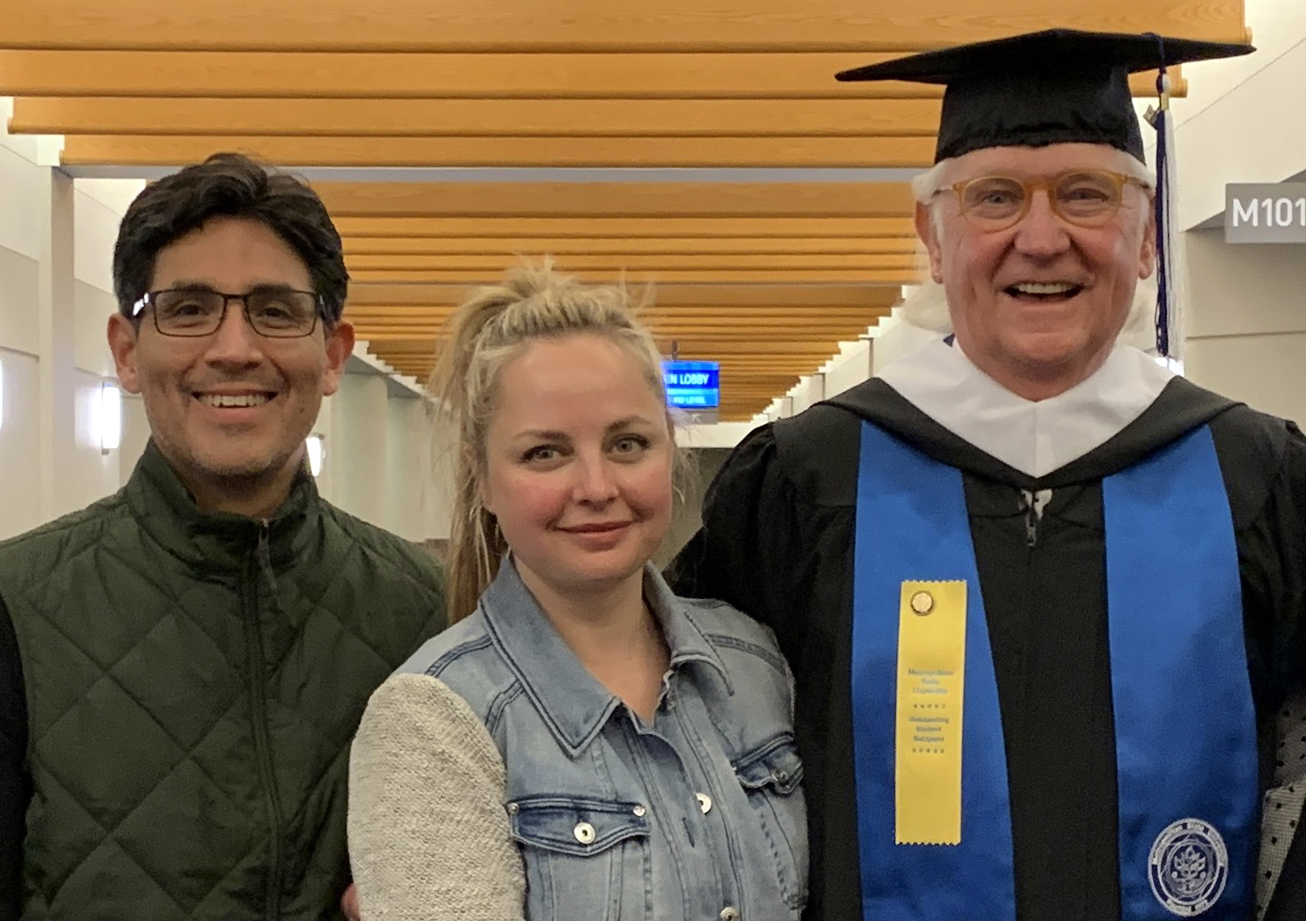
Ashley Shelby, center, with her husband, Emmanuel Benites, right, and her father, Don Shelby, at Don’s commencement ceremony at Metropolitan State University. (Courtesy of Ashley Shelby)

Shelby takes no credit for Ashley’s writing (“she got her mother’s brains”) but he does credit her growing up in a household watching news and being around her dad’s colleagues including Dave Nimmer, godfather to Ashley and her sisters. The Shelby daughters also saw their dad, who loves the outdoors, introduce environmental/climate change reporting years before anyone took it seriously, with some 800 stories aired on WCCO.

Don Shelby has worked hard at his commitment to the Earth as a volunteer helping mitigate the damage already done by rising temperatures. He participated in a project to reforest the 52-mile Mississippi River National Park that replaced dying or dead ash trees with species more accustomed to the climate farther south because trees are moving north. He has attended a climate change meeting in Oslo presented by the Nobel Peace Prize Committee as well as belonging to Climate Science Rapid Response Team, a match-making service to connect scientists with lawmakers and the media. He also serves on the board of Minnesota-based Climate Generation, which believes in the power of youth to have an impact on the systems perpetuating the climate crisis.

Writing for Beno

After Ashley wrote “Red River Rising,” she turned to fiction with her 2017 comic novel “South Pole Station” (University of Minnesota Press paperback), about a person who joins the National Science Foundation’s Artist & Writers program in Antarctica that becomes the center of global controversy when a fringe scientist claims climate change is a hoax.

“I am not a scientist,” Shelby says. “I wanted to be one but my mind didn’t trend that way. It takes me a lot more reads of scientific material to suck out meaning. Sometimes I wish I were better at science, but I’m glad I am not. I can utilize abstraction and imagination and creativity in a way that scientists cannot do day-to-day.”

After “South Pole Station” was published, Shelby started another book set in the climate-affected world, but it didn’t go well:

“I had difficulty using the tools I’d used for ‘South Pole Station.’ They weren’t up to the task of narrative, framework, characters and dialogue. Now I know it was (because of) my grief at what had happened and what will happen. I started having strange thoughts after reading ‘Benito Cereno,’ Melville’s masterpiece. For some reason, I thought, ‘What if it was bears?’ They are the most salient image used about climate change, a trope we look away from because it’s so upsetting. But I dismissed the idea as too big an ask of the reader, too ridiculous. No one would accept this premise.”

That changed when she started telling a story about talking bears to Beno, her son’s friend.

“He was only 11 years old, but he looked at me seriously, nodding, and said, ‘This is going to be bestseller,’ ” Shelby recalled. “That conversation made me go back to my desk and write ‘Muri.’ I didn’t think I would ever show it to anyone, but I would write it for Beno who saw something in it.”

To Shelby’s surprise, when “Muri” was published as a limited-run chapbook in Radix Media’s Futures: A Science Fiction Series, people not only read it, but it was adopted in university courses teaching climate fiction.

“I am so grateful for the generous readers of speculative fiction who wanted to know more about these bears,” she said. “This filled me with happiness and joy. It allowed me to have the courage to process grief about climate change in a way my brain was telling me I could do it, not with traditional forms but telling the story in your head as you are experiencing it without worrying about narrative form.”

The kids will understand

“This book is written in a way that will appeal to younger people,” Shelby says. “A story about a podcast resonates with them. Marketing documents for a drug resonates with a generation that has come to be suspicious of the pharma industry.”

Shelby’s concern for the confusion in some young people also runs through her stories. She’s writing about the in-between generation, youngsters who never knew the world in which their parents lived. As one character says, “How do you explain to a child who has never experienced the normal contours of spring why many adults preferred death than a world without it?”

“This generation knows things are changing,” Shelby says. She sees the toll climate change takes in her own family.

“My daughter has asthma and has difficulty breathing,” she says. “During soccer season in the summer she has to bring an inhaler and separate medication. Asthma rates are skyrocketing. For my daughter it’s always been like this. My and my dad’s generations don’t see it, but my kids see it clearly and they will understand how to address it in maybe uncomfortable ways. These climate change activists who deface artwork and block traffic are telling us in all different ways ‘this is the future.’ They are relying on us, but the people in power, the ruling class, are foisting this on us, making us feel guilty for using fuel or plastic straws. We are beholden to CEOs who create rocket ships and pay no attention to what they caused. It gets to me. That’s the emotion distilled in these stories..”

In the end, Shelby returns to our longings: “Solastalgia exists because we love Nature, and as long as we still love Nature, there is hope.”

Honeymoons in Temporary Locations

What: Ashley Shelby launches “Honeymoons in Temporary Locations” in conversation with Eric Holthaus, a St. Paul-based leading journalist on all things weather and climate change who has written for the Wall Street Journal, Slate, Grist and The Correspondent, where he currently covers our interconnected relationship with the climate.

When: 6 p.m. Tuesday, June 25

Where: Moon Palace Books, 3032 Minnehaha Ave., Mpls.

Admission: Free (masks required in the store)

Publisher/price: University of Minnesota Press ($22.95)

Information: Moonpalacebooks.com/events

For readers who want to dive into more climate fiction, here are titles that most often appear on reading lists.

“American War,” Omar El Akkad
“Barkskins,” Annie Proulx
“Blackfish City,” Sam J. Miller
“The Drowned World,” J.G. Ballard
“Flight Behavior,” Barbara Kingsolver
“How Beautiful We Were,” Imbolo Mbue
“The Ministry for the Future,” Kim Stanley Robinson
“Parable of the Sower,” Octavia E. Butler
“The Overstory,” Richard Powers
“The Water Knife,” Paolo Bacigalupi
“War Girls,” Tochi Onyebuchi
“The Swan Book,” Alexis Wright
“Tentacle,” Rita Indiana
“Oryx and Crake,” “The Year of the Flood,” “MaddAddam” trilogy, Margaret Atwood

Related Articles

Books |


Literary picks for week of June 23: Native American words and music are on display this week

Books |


Literary calendar for week of June 23

Books |


Literary calendar for week of June 16

Books |


Readers and writers: Young adult novels that will hook adults, too

Books |


Why Maisie Dobbs author Jacqueline Winspear says it’s time to end the series
Skywatch: Long days, long moon shadows, and a promising comet?

posted in: Society | 0

I hope you’re enjoying the first official weekend of summer 2024.

This past Thursday evening, on summer solstice day, the sun reached its most northern position in our celestial dome in its very slow annual eastward migration among the stars. With the sun so far north in the sky now, it’s taking the longest, highest arc across our sky, providing us with the maximum amount of daylight, well over 15 hours. The sun has achieved a midday altitude of over 68 degrees above the southern horizon. Because of that, you’ll cast your shortest midday shadow of the year. The bad news I hate to share with you is that from now until the winter solstice in late December, daylight hours gradually decline…. Boo hiss!

Unfortunately for us diehard, determined stargazers, the longest days of the year translate to the shortest nights, making it really tough. It’s a late-night affair compounded with extended evening and morning twilights in our northern latitude. So summer stargazing requires an afternoon nap, at least for old star-geezers like me. This first week of summer is challenging because we have a full moon whitewashing the summer sky. It’s an official full moon this weekend, and it’ll stay nearly full into the first part of the coming week.

Many of us diehards keep telescopes in the barn during full moons. Don’t get me wrong. This time of year, the full moon rising in the southeastern sky is a thing to behold. One of my greatest pleasures during full summer moons is getting a campfire in my backyard and watching the moon climb above the horizon. I love to look for the face of the man on the moon, although my favorite is the poodle on the moon on the upper right half of the rising moon. Once you’ve spotted the lunar pooch, you’ll never forget it!

The poodle on the moon (Mike Lynch)

Full moons don’t rise very high in the sky this time of year. They take the same low arc across the southern sky as the sun does as winter begins. This makes sense because the sun and any full moon are on opposite sides of the sky. Around the summer solstice, the maximum height of the full moon in the midnight hour is the lowest of the year. Around here, it’s less than 30 degrees above the southern horizon. That makes your shadow from the midnight light of the full moon the longest of the year.

Switching gears, there’s a chance we could see a bright comet this October, but first, if you allow me, I need to get something off my chest. Over the years, and especially lately with the explosion of media sources and social media, I’ve seen so many examples of overhyped and exaggerated stargazing and astronomy news in my travels, some so bad I would go as far as calling it a hoax. A few weeks ago I even saw an article about how you could see a planet parade, including the planet Krypton. Another example would be exaggerating the “brilliance” of minor meteor showers. Folks see these stories and get all excited, bring the kids out in the middle of the night, and see absolutely nothing. This hurts the credibility of science and the hobby of stargazing.

There are also way overblown predictions of comets that “could be brighter than the brightest stars” and turn out to be nothing or near nothing! That’s why I want to be so careful telling you about Comet Tsuchinshan–ATLAS, discovered by the Asteroid Terrestrial-impact Last Alert System in South Africa last year. Comets are basically globs of ice embedded with dust and rock. They fly in from the cold outer edges of the solar system toward the inner planets along highly elongated orbits. As they get closer and closer to the sun, they at least partially melt, producing a tail of gas and another one made up of mostly dust and pebbles.

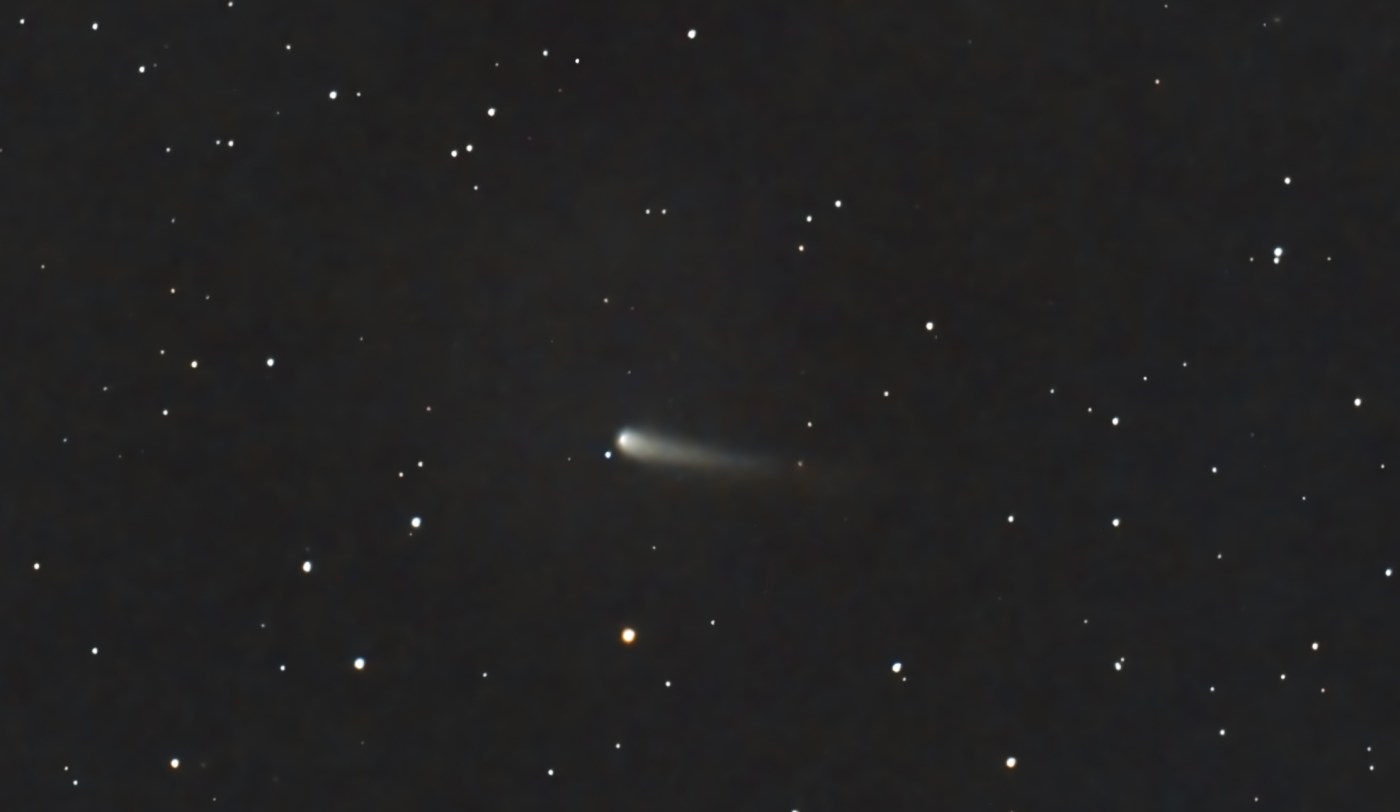
Comet Tsuchinshan-ATLAS (Mike Lynch)

Right now, Comet Tsuchinshan–ATLAS is just about 180 million miles from Earth. It’s crossing the orbit of Venus and heading toward the sun’s direction at over 2,200 mph. There’s no way you can see unless you have a really powerful telescope. Earlier this month I took a picture of it with astrophotography gear.

It’ll pass within 37 million miles of the sun in late September when the melting really gets going. From there, it’ll head back out toward the outer solar system, passing within 44 million miles of Earth on Oct. 12. That’s when it could be easily seen in the early evening sky with the naked eye, but that’s very far from guaranteed. Early forecasts from respected astronomers indicate it could be a really nice show (fingers crossed)…. Or it could be a dud. Stay tuned!

Mike Lynch is an amateur astronomer and retired broadcast meteorologist for WCCO Radio in Minneapolis/St. Paul. He is the author of “Stars: a Month by Month Tour of the Constellations,” published by Adventure Publications and available at bookstores and adventurepublications.net. Mike is available for private star parties. You can contact him at mikewlynch@comcast.net.

Related Articles

Outdoors |


Skywatch: Happy summer solstice

Outdoors |


Skywatch: Summer is coming — it’s in the stars

Outdoors |


Skywatch: Late night with the stars in June

Outdoors |


Skywatch: Little crown of night sky may pop a new star this summer

Outdoors |


Skywatch: Arcturus is the great star of summer and on the rise … for now

Commentary: As AI is embraced, what happens to the artists whose work was stolen to build it?

posted in: News | 0

Amid the hype surrounding Apple’s new deal with OpenAI, one issue has been largely papered over: The AI company’s foundational models are, and have always been, built atop the theft of creative professionals’ work.

The arrangement with Apple isn’t the only news from OpenAI. Among recent updates and controversies including high-level defections, last month the company quietly announced Media Manager, scheduled for release in 2025.

A tool purportedly designed to allow creators and content owners to control how their work is used, Media Manager is really a shameless attempt to evade responsibility for the theft of artists’ intellectual property that OpenAI is already profiting from.

OpenAI says this tool would allow creators to identify their work and choose whether to exclude it from AI training processes. But this does nothing to address the fact that the company built its foundational models using authors’ and other creators’ works without consent, compensation or control over how OpenAI users will be able to imitate the artists’ styles to create new works.

As it’s described, Media Manager puts the burden on creators to protect their work and fails to address the company’s past legal and ethical transgressions. This overture is like having your valuables stolen from your home and then hearing the thief say, “Don’t worry, I’ll give you a chance to opt out of future burglaries … next year.”

Writers, artists, journalists and other creative workers have consistently asked that OpenAI and other generative AI companies obtain creators’ consent before using their work to train artificial intelligence products, and that the organizations refrain from using works without express permission.

Last July, more than 16,000 authors signed a letter to leading AI companies demanding that the businesses obtain permission and pay for works they use to train their AI. Yet OpenAI continues to trample on artists’ rights and rebuff their appeals, as we saw recently when it launched a ChatGPT audio assistant with a voice similar to Scarlett Johansson’s despite the actor’s clear and repeated refusals.

Although Johansson won her battle — OpenAI “paused” the offending voice from its offerings after the actor threatened legal action — the best chance for the wider community of artists is to band together. AI companies’ cavalier attitude toward creators’ rights and consent extends to people at all levels of fame.

Last year the Authors Guild, along with 17 other plaintiffs, sued OpenAI and Microsoft, demanding that authors receive what they are due. That suit is ongoing and other creative professionals and copyright owners have also taken legal action. Among these are a class action filed by visual artists against Stability AI, Runway AI, Midjourney and Deviant Art, a lawsuit by music publishers against Anthropic for infringement of song lyrics, and suits in the U.S. and U.K. brought by Getty Images against Stability AI for copyright infringement of photographs.

AI companies often argue that it would be impossible for them to license all the content that they need and that doing so would bring progress to a grinding halt. This is simply untrue.

OpenAI has signed a succession of licensing agreements with publishers large and small. While the exact terms of these agreements are rarely released to the public, the compensation estimates pale in comparison with the vast outlays for computing power and energy that the company readily spends. Payments to authors would have minimal effects on AI companies’ war chests, but receiving royalties for AI training use would be a meaningful new revenue stream for a profession that’s already suffering.

Authors’ earnings have been in precipitous decline for more than a decade. In 2022, the median annual writing-related income for full-time writers was just over $20,000, down nearly 50% from 2009. And the data for 2023 look even more dire.

AI-generated books, sometimes listed as written by real authors without the writer’s permission, flood Amazon, where anyone searching might buy them instead of the creative work the human author spent months or years writing.

Meanwhile, OpenAI is valued at $80 billion, Anthropic at $18.4 billion and French AI startup Mistral at $6.2 billion. These companies claim they need our work to succeed but can’t afford to pay for it. Any human author can tell you that this narrative has blatant inconsistencies.

We cannot trust tech companies that swear their innovations are so important that they do not need to pay for one of the main ingredients — other people’s creative works. The “better future” we are being sold by OpenAI and others is, in fact, a dystopia. It’s time for creative professionals to stand together, demand what we are owed and determine our own futures.

Mary Rasenberger is the CEO of the Authors Guild. She wrote this column for the Los Angeles Times.

Related Articles

Opinion |


Joe Grogan: Access to new Alzheimer’s treatments bogged down by Medicare policy

Opinion |


Andreas Kluth: U.S. exceptionalism is dead no matter who wins the election

Opinion |


Clive Crook: You don’t have to love Trump to fear a partisan U.S. justice system

Opinion |


Bret Stephens: How capitalism went off the rails

Opinion |


Nolan Finley: Treat all gun violators the same as Hunter Biden

Literary picks for week of June 23: Native American words and music are on display this week

posted in: All news | 0

Native American words and music are on display this week, with two programs presented by Indigenous Nations Poets (IN-NA-PO) in partnership with Minnesota Humanities Center, as well as the launch of Minnesotan Teresa Peterson’s book “Perennial Ceremony,” and a program on writing about climate change.

Wednesday, June 26, 5:30 p.m., Minnesota Humanities Center, 987 E. Ivy Ave., St. Paul:

“An Evening of Haiku and Anishinaabe Song” with Kimberly Blaeser, Gordon Henry Jr. and Gerald Vizenor sharing haiku, Anishinaabe dream songs and music as well as conversing with one another and the audience on their work and inspirations. Blaeser is a former Wisconsin poet laureate and founding director of Indigenous Nations Poets, author of six poetry collections. An Anishinaabe activist and environmentalist, she is an enrolled member of White Earth Nation. She is a professor emerita at the University of Wisconsin-Milwaukee and MFA faculty member for Institute of American Indian Arts. Gordon Henry is an Anishinaabe poet and novelist, and an enrolled member of the White Earth Nation of Minnesota. A past professor in the English department at Michigan State University, he also served for many years as senior editor of the American Indian Studies series at Michigan State University Press. Vizenor is professor emeritus of American Studies at the University of California, Berkeley. A citizen of the White Earth Nation in Minnesota, he has published more than 40 books including novels, literary and cultural studies, and poetry and is one of this country’s leading Native scholars and writers. This program includes a complimentary community meal preceding the program. Free, registration required at mnhum.org.

(IN-NA-PO is a national Indigenous poetry community committed to mentoring emerging writers, nurturing the growth of Indigenous poetic practices, and raising the visibility of all Native writers. It recognizes the role of poetry in sustaining tribal sovereignty and Native languages.)

Friday, June 28, 5:30 p.m., Minnesota Humanities Center:

Gwen Westerman (Courtesy of Melanie Zacek)

Nations Poets reading with this year’s IN-NA-PO fellows sharing some of their original work. Hosts will be former Wisconsin poet laureate Kimberly Blaeser, Minneapolis poet laureate Heid Erdrich and Minnesota poet laureate Gwen Nell Westerman. A  community meal included. Free, reservations required. Go to mnhum.org.

Wednesday, June 26, 7 p.m., Birchbark Books event space, 1629 Hennepin Ave., Minneapolis:

Teresa Peterson celebrates publication of her book “Perennial Ceremony” in conversation with Diane Wilson, hosted by Birchbark Books. In this collection of prose, poetry and recipes from University of Minnesota Press, Peterson shares how she found refuge from the struggle to reconcile her Christianity and Dakota spirituality, discovering solace and ceremony in community with the Earth by observing and embracing the cycles of her garden. In this seasonal cycle, we learn how the garden becomes a healing balm, reclaiming and honoring our relationship with Mother Earth. Peterson is Sisseton Wahpeton Dakota and citizen of the Upper Sioux Community. Free.

Tuesday, June 25, 5 p.m., Open Book, 1011 Washington Ave. S., Mpls.:

Diane Wilson (Courtesy photo)

Milkweed Editions reading series presents “Beyond Guilt: Writers Reflect on Climate Change,” hosted by Diane Wilson, author of “The Seed Keeper,” She is executive director of Native American Food Sovereignty Alliance, a Mdewakanton descendant enrolled on the Rosebud reservation. She will be joined by Erin Sharkey and Halee Kirkwood. Sharkey is a writer, arts and abolition cultural worker, and film producer who was awarded the Black Seed Fellowship from Black Visions and the Headwaters Foundation. Kirkwood is a member of Indigenous Nations Poets and direct descendant of Fond du Lac Band of Lake Superior Ojibwe. Free.

Related Articles

Books |


Literary calendar for week of June 23

Books |


Literary calendar for week of June 16

Books |


Readers and writers: Young adult novels that will hook adults, too

Books |


Why Maisie Dobbs author Jacqueline Winspear says it’s time to end the series

Books |


How Stuart Woods’ character Stone Barrington lives on in Brett Battles’ ‘Smolder’