NEW YORK (AP) — Pinterest plans to lay off under 15% of its workforce, as part of broader restructuring that arrives as the image-sharing platform pivots more of its money to artificial intelligence.
In a Tuesday securities filing, San Francisco-based Pinterest said it was making these cuts to support “transformation initiatives” — which include reallocating the company’s resources to AI-focused roles and prioritizing AI-powered products. It said it was also working to reshape its “sales and go-to-market approach.”
Beyond the coming layoffs, Pinterest said it will reduce office space. The company expects to complete its restructuring plan by the end of September, incurring pretax charges of $35 million to $45 million.
Pinterest’s job cuts are expected to impact hundreds of workers. As of the end of last year, Pinterest had a total headcount of about 5,200 employees, the company confirmed to The Associated Press.
Like other tech and social media companies, Pinterest has accelerated its integration of AI recently, particularly in consumer-facing offerings. In October, the company introduced AI-powered updates to users’ in-platform “boards” and unveiled Pinterest Assistant, which is also powered by AI and gives users shopping recommendations.
Pinterest isn’t the first company to turn to job cuts while pivoting spending to AI. Last fall, Amazon, for example, said it would cut about 14,000 corporate jobs (close to 4% of its workforce) as it ramped up AI investments while trimming costs elsewhere.
Shares of Pinterest fell more than 9% as of midday trading Tuesday.
Related Articles
EU steps in to make sure Google gives rivals access to AI services and data
Watch: Investigator describes intense air traffic at time of deadly midair collision near DC
Meta, TikTok and YouTube face landmark trial over youth addiction claims
Fed expected to keep rates unchanged as Chair Powell pivots back to economics
Americans’ confidence in the U.S. economy falls sharply in January to lowest level since 2014
UPS is planning to cut up to 30,000 operational jobs this year as the package delivery company continues with its turnaround efforts and reducing the number of Amazon shipments that it handles.
Related Articles
EU steps in to make sure Google gives rivals access to AI services and data
Watch: Investigator describes intense air traffic at time of deadly midair collision near DC
Meta, TikTok and YouTube face landmark trial over youth addiction claims
Fed expected to keep rates unchanged as Chair Powell pivots back to economics
Americans’ confidence in the U.S. economy falls sharply in January to lowest level since 2014
Chief Financial Officer Brian Dykes said during the company’s conference call on Tuesday that the job cuts will be made through a voluntary buyout offer for full-time drivers and through attrition.
UPS is also looking to close 24 buildings in the first half of the year and is evaluating additional buildings to close later in the year, he added.
UPS said in a regulatory filing in October that it had cut about 34,000 operational positions and closed daily operations at 93 leased and owned buildings during the first nine months of last year. The company also announced approximately 14,000 job cuts, mostly within management.
According to FactSet UPS employs about 490,000 workers.
In April UPS announced that it was looking to slash about 20,000 jobs and close more than 70 facilities as it drastically reduces the number of Amazon shipments it handles. The company said in January 2025 that it had reached a deal with Amazon, its biggest customer, to lower its volume by more than 50% by the second half of 2026.
CEO Carol Tome said during the conference call that by the end of 2025 UPS had reduced Amazon’s volume in its network by approximately 1 million pieces per day.
“We’re in the final six months of our Amazon accelerated glide down plan, and for the full year, 2026, we intend to glide down another million pieces per day, while continuing to reconfigure our network,” Tome said.
Shares of United Parcel Service Inc. rose 3.4% in afternoon trading.
DUBAI, United Arab Emirates (AP) — Two Iranian-backed militias in the Mideast are signaling their willingness to launch new attacks, likely trying to back Iran, as officials acknowledged the arrival of a U.S. aircraft carrier to the region Monday. President Donald Trump ordered the carriers to move to the Middle East as he threatened military action over its crackdown on nationwide protests.
Related Articles
EU steps in to make sure Google gives rivals access to AI services and data
‘Doomsday Clock’ moves closer to midnight over threats from nuclear weapons, climate change and AI
ICE agents to have security role at Milan Cortina Olympics
Today in History: January 27, Michael Jackson burned in filming accident
Mexico investigates soccer field attack that killed at least 11 people
Yemen’s Iranian-backed Houthi rebels on Monday hinted they were ready to resume attacks on shipping in the Red Sea. That came just after Iraq’s Kataib Hezbollah paramilitary group, long supported by Iran’s paramilitary Revolutionary Guard, issued a direct threat late Sunday toward any attack targeting Iran, warning a “total war” in the region would be a result.
The statements came as the entire region is mired in a tense waiting game to see if Trump will strike. Kataib Hezbollah sat out from Israel’s 12-day war on Iran in June that saw the United States bomb Iranian nuclear sites, while the Houthis fired missiles at Israel during that period.
The hesitancy to get fully involved shows the disarray still affecting Iran’s self-described “Axis of Resistance” after facing attacks from Israel during its war on Hamas in the Gaza Strip.
US carrier arrives in region
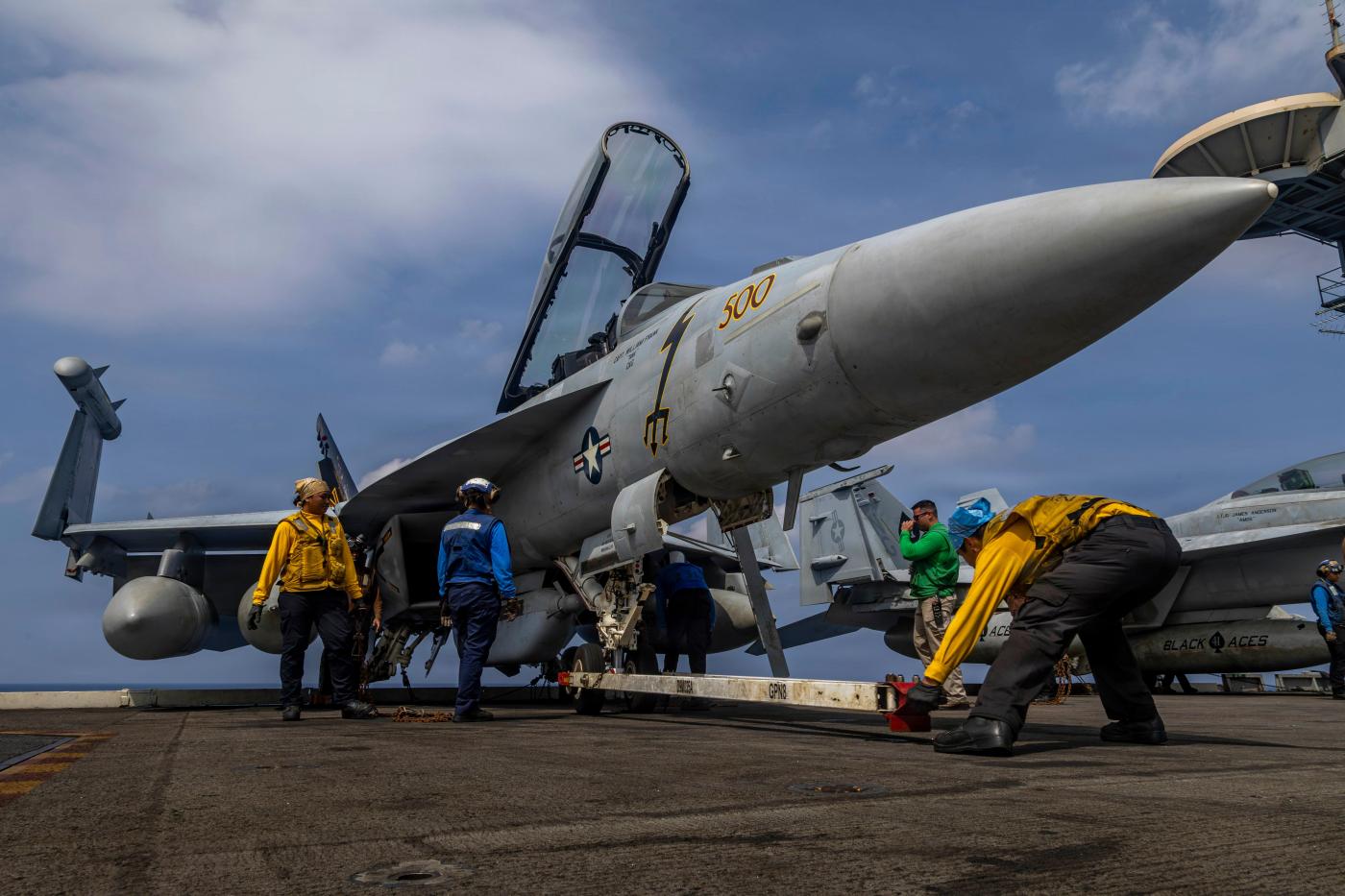
The threats came as the aircraft carrier USS Abraham Lincoln and other guided missile destroyers in its strike group arrived in the region to “promote regional security and stability,” U.S. Central Command said Monday on social media.
Trump has said the ships are being moved “just in case” he decides to take action against Iran. He has already laid out two red lines for attack — the killing of peaceful protesters and Tehran conducting mass executions of those it has arrested in a massive crackdown over the demonstrations.
This photo provided by the U.S. Navy shows a Boeing F/A-18E Super Hornet landing on the Nimitz-class aircraft carrier USS Abraham Lincoln in the Indian Ocean on Jan. 22, 2026. (Mass Communication Specialist Seaman Daniel Kimmelman/U.S. Navy via AP)
This photo provided by the U.S. Navy shows Aviation Ordnanceman 3rd Class Dianna Hernandez directs an MH-60R Sea Hawk helicopter on the flight deck of the Nimitz-class aircraft carrier USS Abraham Lincoln in the Indian Ocean on Jan. 21, 2026. (Mass Communication Specialist Seaman Daniel Kimmelman/U.S. Navy via AP)
This photo provided by the U.S. Navy shows Seaman Rafael Brito standing watch aboard the Nimitz-class aircraft carrier USS Abraham Lincoln in the Indian Ocean on Jan. 22, 2026. (Mass Communication Specialist Seaman Angel Campbell/U.S. Navy via AP)
1 of 3
This photo provided by the U.S. Navy shows a Boeing F/A-18E Super Hornet landing on the Nimitz-class aircraft carrier USS Abraham Lincoln in the Indian Ocean on Jan. 22, 2026. (Mass Communication Specialist Seaman Daniel Kimmelman/U.S. Navy via AP)
A senior Iranian military official who spoke anonymously on Iran’s state TV dismissed the American threat as “an exaggeration” and noted that Iran had increased its military presence in response. The official added that the Lincoln’s presence was not a deterrent but an accessible target.
Threats from Iraq, Yemen, while Hezbollah stays mum
Iran projected its power across the Mideast through the “Axis of Resistance,” a network of proxy militant groups in Gaza, Lebanon, Yemen, Syria, and Iraq, and other places. It was also seen as a defensive buffer, intended to keep conflict away from Iranian borders. But it has collapsed after Israel targeted Hamas, Hezbollah in Lebanon and others during the Gaza war. Meanwhile, rebels in 2024 overthrew Syria’s Bashar Assad after a yearslong, bloody war in which Iran backed his rule.
The Lebanese militant group Hezbollah, one of Iran’s staunchest allies, refused to say how it planned to react in the case of a possible attack.
“During the past two months, several parties have asked me a clear and frank question: If Israel and America go to war against Iran, will Hezbollah intervene or not?” Hezbollah leader Sheikh Naim Kassem said via a video address to thousands of supporters gathered in Beirut’s southern suburbs for a rally backing Iran.
He said the group is preparing for “possible aggression and is determined to defend” against it. But as to how it would act, he said, “these details will be determined by the battle and we will determine them according to the interests that are present.”
Iraqi and Yemeni militant groups were much more forthright in their threats, which were interpreted as support for Iran. A short video by the Houthis included images of a ship on fire, with the caption: “Soon.” It later aired footage Monday from its January 2024 attack in the Gulf of Aden on the Marshall Islands-flagged tanker Marlin Luanda, one of over 100 ships attacked as part of a campaign the Houthis said pressured Israel over its war against Hamas in the Gaza Strip.
The Houthis halted their fire after a ceasefire in Gaza, though they’ve repeatedly warned they could resume fire if needed.
Meanwhile, Ahmad “Abu Hussein” al-Hamidawi of Kataib Hezbollah issued his own threat in a statement.
“We affirm to the enemies that the war on the (Islamic) Republic will not be a picnic; rather, you will taste the bitterest forms of death, and nothing will remain of you in our region,” he said.
The United Arab Emirates announced on Monday that it would not allow its airspace, territory or territorial waters to be used for military action against Iran. The UAE said it would stress dialogue and diplomatic resolutions.
Iran warns America not to attack
Iranian Defense Ministry spokesperson Gen. Reza Talaei-Nik renewed warnings Monday to both Israel and the U.S., saying any attack would “be met with a response that is more painful and more decisive than in the past.” Iranian state TV quoted Talaei-Nik as saying that threats required Iran “to maintain full and comprehensive preparedness.”
Foreign Ministry spokesman Esmail Baghaei separately told journalists: “Regional countries fully know that any security breach in the region will not affect Iran only. The lack of security is contagious.”
Iran over the weekend unveiled a new banner in Tehran’s Enghelab Square threatening the Lincoln, showing an aircraft carrier strewn with bodies and streaked with blood with the warning: “If you sow the wind, you will reap the whirlwind.” However, Iran is still reeling from the 12-day war in June in which its air defense systems were broadly destroyed, top military leaders killed, and its nuclear enrichment sites bombed by the U.S.
Two girls, not wearing the legally required headscarves, walk past a billboard depicting a damaged U.S. aircraft carrier with disabled fighter jets on its deck and a sign reading in Farsi and English, “If you sow the wind, you’ll reap the whirlwind,” at Enqelab-e-Eslami (Islamic Revolution) Square in Tehran, Iran, Sunday, Jan. 25, 2026. (AP Photo/Vahid Salemi)
As a sign of concern over its airspace, Iran issued a notice to pilots Sunday that banned small private aircraft from flying in the country, with carve-outs for the oil industry and emergency medical flights.
Many Western airlines have started to avoid Iranian airspace entirely due to the tensions, though Gulf Arab carriers flying to Moscow still rely on the route. Iranian air defense troops in 2020 shot down a Ukrainian commercial airliner, killing 176 people on board.
Death toll rises from protest crackdown
The protests in Iran began on Dec. 28, sparked by the fall of the Iranian currency, the rial, and quickly spread across the country. They were met by a violent crackdown by Iran’s theocracy, the scale of which is only starting to become clear as the country has faced more than two-week internet blackout — the most comprehensive in its history.
The U.S.-based Human Rights Activists News Agency on Monday put the death toll at 5,973, with the number expected to increase. It says more than 41,813 people have been arrested.
The group’s figures have been accurate in previous unrest and rely on a network of activists in Iran to verify deaths. That death toll exceeds that of any other round of protest or unrest there in decades, and recalls the chaos surrounding Iran’s 1979 Islamic Revolution. The Associated Press has not been able to independently verify the toll.
Iran’s government has put the death toll at a far lower 3,117, saying 2,427 were civilians and security forces, and labeled the rest “terrorists.” In the past, Iran’s theocracy has undercounted or not reported fatalities from unrest.
Associated Press writer Abby Sewell in Beirut contributed to this report.
This story has been corrected to note that the Houthis fired missiles on Israel during the 12-day war last June.
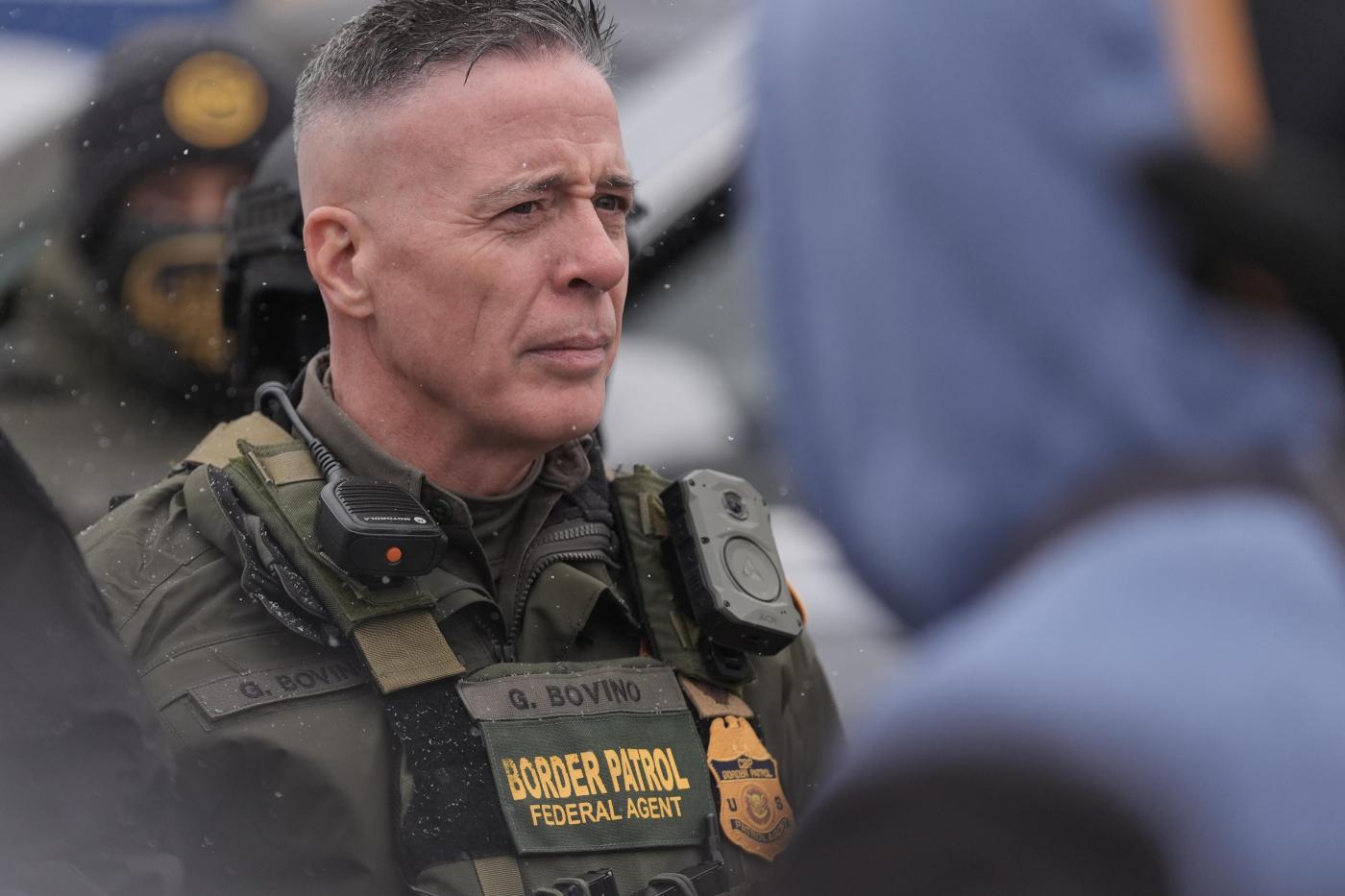
Gregory Bovino had been the go-to architect for the large-scale immigration crackdowns ordered by Trump and the public face of his administration’s city-by-city sweeps. The Border Patrol chief led agents in Los Angeles, Chicago and New Orleans before he headed to Minnesota in December for what the Department of Homeland Security called its largest-ever immigration enforcement operation.
He’s also been heavily criticized for his norm-breaking tactics.
U.S. Border Patrol Cmdr. Gregory Bovino stands during a news conference Tuesday, Jan. 20, 2026, in Minneapolis. (AP Photo/Angelina Katsanis)
U.S. Border Patrol Cmdr. Gregory Bovino arrives as protesters gather outside the Bishop Henry Whipple Federal Building, Thursday, Jan. 8, 2026, in Minneapolis, Minn. (AP Photo/Tom Baker)
U.S. Border Patrol Cmdr. Gregory Bovino shouts at protesters, Sunday, Jan. 11, 2026, in Minneapolis. (AP Photo/Jen Golbeck)
U.S. Border Patrol Cmdr. Gregory Bovino stands with Federal agents outside a convenience store on Wednesday, Jan. 21, 2026, in Minneapolis. (AP Photo/Angelina Katsanis)
1 of 4
U.S. Border Patrol Cmdr. Gregory Bovino stands during a news conference Tuesday, Jan. 20, 2026, in Minneapolis. (AP Photo/Angelina Katsanis)
Smashing windows when a driver refuses to open and is subject to arrest is “a safer tactic than letting someone drive away and then getting in a high-speed pursuit,” he said.
Blasting the door off a home in Huntington Park, California, to search for a man accused of ramming a Border Patrol vehicle days earlier was a “very, very prudent, thoughtful application of tactics,” said Bovino, who joined that early-morning raid. “I don’t want to surround a house for hours and hours and hours and then create another riot.”
Bovino often appears in tactical gear, as he did outside California Gov. Gavin Newsom’s news conference on congressional redistricting in August.
Agents rappel from helicopter in Chicago
In Chicago, agents stormed an apartment complex by helicopter, deploying chemical agents near a public school and handcuffed a Chicago City Council member at a hospital.
Agents rappelled down to the apartment building from a Black Hawk helicopter. Authorities said they were targeting the Venezuelan gang Tren de Aragua, but only two of the 37 immigrants arrested were gang members. The others were in the country illegally, they said, including some with criminal histories. One U.S. citizen was arrested on an outstanding narcotics warrant.
Activists, residents and leaders said the combative tactics sparked violence and fueled neighborhood tensions in the nation’s third-largest city.
Bovino also drew a rare public rebuke from a federal judge who said he misled the court about the threats posed by protesters and deployed tear gas and pepper balls without justification during a chaotic confrontation downtown.
Vowing a ‘turn and burn’ approach
U.S. Immigration and Customs Enforcement, the agency primarily responsible for interior immigration enforcement since its was created in 2003, has historically made arrests in the streets after lengthy investigations of individual targets, including surveillance that an official once likened to watching paint dry. Officials rarely have judicial warrants to enter a home, causing them to wait outside.
Related Articles
Trump administration’s trust and credibility tested in wake of Pretti’s death in Minneapolis
Watch: NTSB hearing underway to highlight what led to a deadly midair collision near Washington, DC
Trump’s about-face in Minnesota after Pretti’s death is latest in pattern of sudden shifts
Trump visits Iowa trying to focus on affordability during fallout over nurse’s Minneapolis shooting
Feds seek action against Minnesota Department of Education, Minnesota State High School League over Title IX
It is not a pace that will lead to the mass deportations Trump has promised.
“We’re going to turn and burn to that next target and the next and the next and the next, and we’re not going to stop,” he said in an interview in a seventh-floor conference room of the federal building in West Los Angeles, where an unused office wing served as a sparsely furnished temporary base.
Bovino was one of 20 regional Border Patrol chiefs around the country when he was relieved of his command leading leading the agency’s sector in El Centro, California.
He blamed an online profile picture of him posing with an M4 assault rifle; social media posts that were considered inappropriate; and sworn congressional testimony that he and other sector chiefs gave on the state of the border during a record surge of migrants.
Thirty minutes after his second congressional hearing, Bovino said, he was removed from his position and asked, “Are you going to retire now?”
He didn’t retire. The change in administration from President Joe Biden to Trump in 2025 turned Bovino into a MAGA-world hero. The profile photo with the assault rifle was back online and by the summer, he was leading immigration enforcement in Los Angeles, where the Trump administration launched its first sustained blitz of a U.S. city.
Deporting people who ‘skip the line’
Bovino joined the Border Patrol in 1996 and is nearing the agency’s mandatory retirement age of 57. He eventually plans to return home to North Carolina to harvest apples.
He served as Border Patrol chief in El Centro, California, long a relatively quiet part of the southern border that has become even quieter as illegal crossings have plummeted to their lowest levels in six decades.
His media savvy is on display each summer when Border Patrol sector chiefs hold news conferences to warn against illegal crossings. In 2021, Bovino led journalists in swimming across the All-American Canal, whose deceptively swift current and smooth concrete lining result in migrant deaths every year. In 2023, he locked reporters in a vehicle trunk, saying he wanted them to appreciate the dangers firsthand.
While administration officials like to say they are deporting the “worst of the worst,” Bovino embraces arrests of hard-working people with deep roots in the country. He said they “skip the line” ahead of people waiting to enter the country legally.
“The folks undercutting American businesses, is that right?” he said. “Absolutely not. That’s why we have immigration laws in the first place, and that’s why I’m here.”
‘Not afraid to push the envelope’
ICE has led interior immigration enforcement since it was created in 2003, but the Border Patrol has been around much longer. Bovino’s sense of mission never strayed from the Border Patrol’s roots. When assigned to lead a station in Blythe, California, he pitched his boss, Paul Beeson, on raiding the airport and bus stations in Las Vegas.
The 2010 operation was supposed to last three days but got called off after the first hour yielded dozens of arrests and unleashed a furious reaction from then-Senate Majority Leader Harry Reid, a Nevada Democrat.
“He’s not afraid to push the envelope, very articulate, leads from the front,” said Beeson, who, as a sector chief, selected Bovino to lead stations in Blythe and in Imperial Beach, California.