Tony Leys | (TNS) KFF Health News
If you or someone you know may be experiencing a mental health crisis, contact the 988 Suicide & Crisis Lifeline by dialing “988,” or the Crisis Text Line by texting “HOME” to 741741.
____
GRINNELL, Iowa — The farmers’ co-op here is a center of hope every spring. It’s where farmers buy seed and fertilizer for the summer’s crops, and where they seek tips to maximize their harvest of corn and soybeans.
But on a recent morning, a dozen mental health professionals gathered at the Key Cooperative Agronomy Center to discuss why so many farmers quietly struggle with untreated anxiety and depression.
Studies have concluded that suicide is unusually common among farmers. Researchers believe it’s not just because many farmers have other risk factors, such as rural addresses and access to guns.
The tragic trend has caught the attention of the U.S. Department of Agriculture, which sponsors training sessions like the one in Grinnell to help health care professionals learn how to talk to farmers about the pressures they face in wringing a living out of the land.
“A lot of them are born to it. They don’t have any choice,” family therapist David Brown explained to the session’s participants. He noted many farms have been passed down for generations. Current owners feel that if they fail, they would be letting down their grandparents, parents, children, and grandchildren.
Brown, who works for Iowa State University Extension and Outreach, led the training in Grinnell. He said farmers’ fate hinges on factors out of their control. Will the weather be favorable? Will world events cause prices to soar or crash? Will political conflicts spark changes in federal agricultural support programs? Will a farmer suffer an injury or illness that makes them unable to perform critical chores?
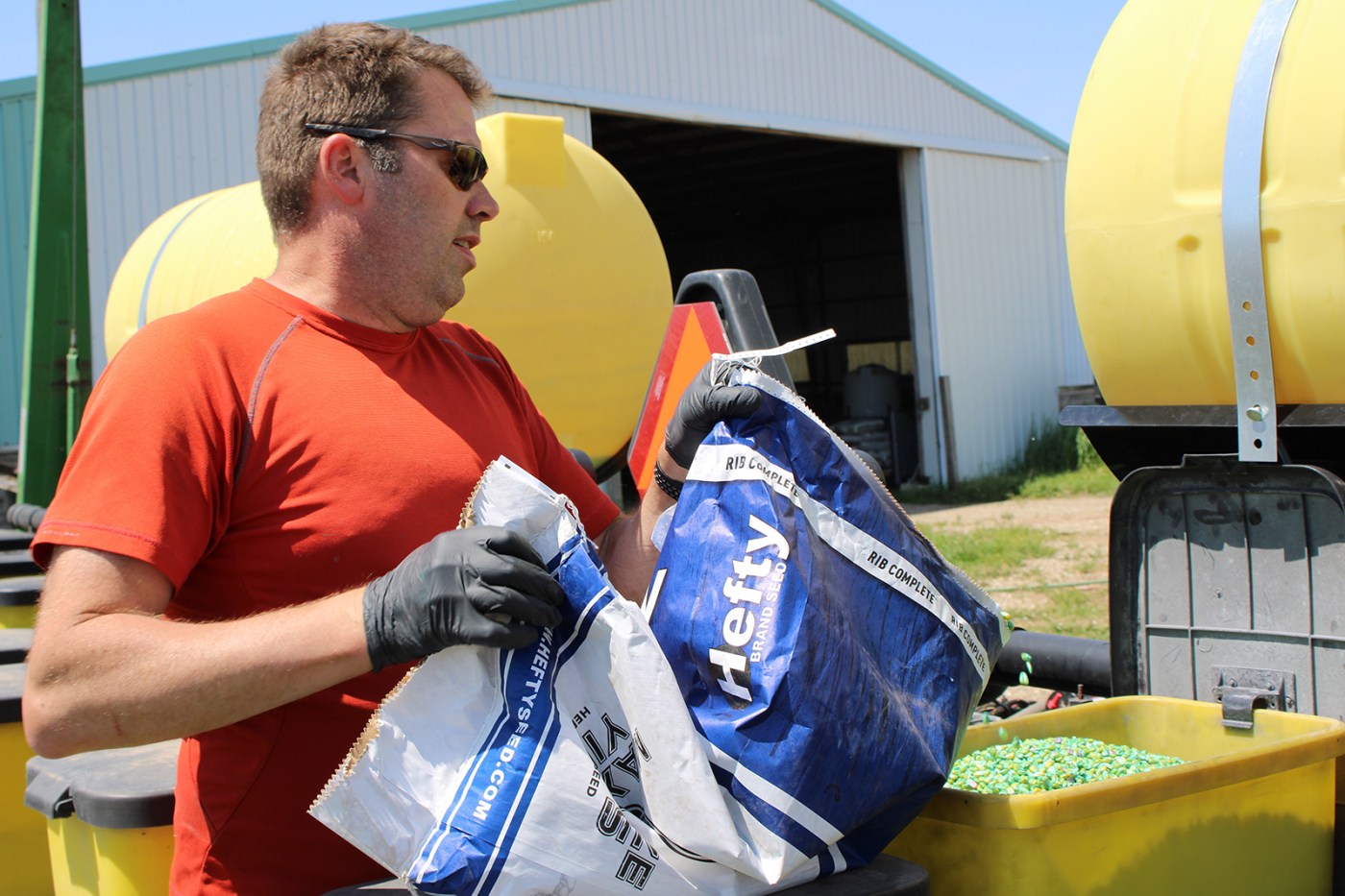
Josh Kruse plants corn near Boone, Iowa, on May 17, 2024. Kruse runs the 500-acre farm with brother-in-law Jason Haglund, who grew up there and is a mental health advocate. (Tony Leys/KFF Health News/TNS)
Brown said surveys show many farmers are reluctant to seek mental health care, partly because they think therapists or doctors couldn’t understand their lives.
Tina Recker, a mental health therapist in northeastern Iowa, attended the training session. She has lived on farms, and she has seen how the profession can become a person’s entire identity. “It’s just farm, farm, farm, farm,” she told the group. “If something goes wrong with it, that’s your whole world.”
It’s difficult to estimate how much of farmers’ increased risk of suicide is due to their profession.
Part of the reason for the elevated rate could be that many farmers are middle-aged or older men, who tend to be more at risk in general. “But it’s broader than that for sure,” said Edwin Lewis, a USDA administrator who helps oversee efforts to address the situation.
The Grinnell training session was part of a federal program called the Farm and Ranch Stress Assistance Network. Lewis said the program, which also funds counseling hotlines and support groups, spends $10 million a year.
Jason Haglund sees the issue from multiple angles. He’s a mental health advocate who farms part-time near the central Iowa town of Boone. He and his brother-in-law raise corn and soybeans on the 500-acre farm where Haglund grew up. His family has farmed in the area since the 1880s. His parents hung on despite going into bankruptcy during the 1980s farm crisis, and he embraces his role as caretaker of their legacy.
Haglund is trained as an alcohol and drug addiction counselor, and he co-hosts an Iowa podcast about the need to improve mental health care.
He said it can be stressful to run any kind of family business. But farmers have a particularly strong emotional tie to their heritage, which keeps many in the profession.
“Let’s be honest: Farming at all these days isn’t necessarily a good financial decision,” he said.
Farmers traditionally have valued self-sufficiency, he said. They try to solve their own problems, whether it’s a busted tractor or a debilitating bout of anxiety.
Mental health advocate Jason Haglund stands outside a machine shed on his family’s farm near Boone, Iowa, on May 17, 2024. He has seen how farmers’ traditional self-sufficiency can make them hesitate to seek help for mental stress. (Tony Leys/KFF Health News/TNS)
“With the older generation, it’s still, ‘Suck it up and get over it,’” Haglund said. Many younger people seem more willing to talk about mental health, he said. But in rural areas, many lack access to mental health care.
Farmers’ suicide risk is also heightened by many of them owning guns, which provide an immediate means to act on deadly impulses, Haglund said.
Guns are an accepted part of rural life, in which they are seen as a useful tool to control pests, he said. “You can’t go into a rural community and say, ‘We’re going to take your guns away,’” he said. But a trusted therapist or friend might suggest that a depressed person temporarily hand over their guns to someone else who can safely store them.
Haglund said health care professionals shouldn’t be the only ones learning how to address mental stresses. He encourages the public to look into “mental health first aid,” a national effort to spread knowledge about symptoms of struggle and how they can be countered.
A 2023 review of studies on farmer suicides in multiple countries, including the U.S., cited cultural and economic stresses.
“Farmers who died by suicide, particularly men, were described as hard-working, strong, private people who took great pride in being the stoic breadwinners of their families. They were often remembered as members of a unique and fading culture who were poorly understood by outsiders,” wrote the authors, from the University of Alberta in Canada.
Rebecca Purc-Stephenson, a psychology professor who helped write the paper, said health professionals face two challenges: persuading farmers to seek help for mental stress, then encouraging them to keep coming back for therapy.
Back at the training in Iowa, instructors urged mental health professionals to have flexible schedules, and to be understanding when farmers postpone appointments at the last minute.
Maybe one of their animals is sick and needs attention. Maybe a machine broke and needs to be fixed immediately. Maybe the weather is perfect for planting or harvesting.
“Time is money,” said Brown, the therapist leading the training.
The session’s lessons included what to ask and not ask when meeting farmers. A big no-no is inquiring right away about how much land they are working. “If you ask them how many acres they’re farming, that’s like asking to see their bank account,” warned Rich Gassman, director of Iowa’s Center for Agricultural Safety and Health, who assisted with the lesson.
It would be better to start by asking what they enjoy about farming, the instructors said.
Many farmers also need to talk through emotional issues surrounding when, how, or even if the next generation will take over the family operation.
Tim Christensen, a farm management specialist for Iowa State University Extension and Outreach, said some standard advice on how to deal with stress could backfire with farmers.
For example, he said, a health care professional should never advise a farmer to relax by taking a couple of weeks off. Most of them can’t get away from their responsibilities for that long, he said.
“There’s a common saying on the farm: No good vacation goes unpunished.”
Warning Signs of Mental Struggle
The American Foundation for Suicide Prevention lists these signs that a person might be considering suicide:
The person talks about killing themselves, feeling hopeless, having no reason to live, being a burden to others, feeling trapped, or having unbearable pain.
The person increases their use of alcohol or drugs, sleeps too much or too little, displays fatigue or aggression, withdraws from activities and family and friends, visits or calls people to say goodbye, gives away possessions, or searches online for a way to end their life.
People considering suicide often seem depressed, anxious, irritable, angry, ashamed, or uninterested in activities. In some cases, they may appear to feel sudden relief or improvement in their mood.
People in crisis can reach the national 988 Suicide & Crisis Lifeline by calling or texting “988.”
___
(KFF Health News is a national newsroom that produces in-depth journalism about health issues and is one of the core operating programs of KFF — the independent source for health policy research, polling and journalism.)
©2024 KFF Health News. Distributed by Tribune Content Agency, LLC.